
🔥 Admissions Open for 2026! Apply Now

UPSC CSE 2026 Complete Guide: The Strategic 3-Year Preparation Roadmap


If you are currently in college or high school and aiming for the UPSC Civil Services Examination (CSE) in 2026, you hold a tremendous advantage: Time. While most aspirants start preparing intensely one year out, your three-year runway is the perfect "Goldilocks Zone"—enough time for deep understanding without the frantic pressure.


This authoritative guide is specifically designed for long-term aspirants (2023-2026). We will move beyond the basic syllabus and give you a structured, phase-wise strategic roadmap to maximize every month leading up to your dream attempt.


Understanding the UPSC CSE: Debunking the Myths


UPSC aspirant studying with a large calendar and clock, symbolizing long-term preparation

What Exactly is the Civil Services Examination (CSE)?

The CSE is not just another government exam; it is a gateway to the most prestigious administrative services in India, including the Indian Administrative Service (IAS), Indian Police Service (IPS), and Indian Foreign Service (IFS). It tests not only your knowledge but your analytical ability, ethical judgment, and composure under pressure.


The Three Pillars: Prelims, Mains, and Personality Test

Preparation must be integrated because these three stages are intrinsically linked:

  • Prelims (CSAT & GS I): The screening stage. Objective (MCQ) format. Focuses heavily on broad knowledge and factual recall.
  • Mains (GS I-IV, Essay, Optional): The core evaluation stage. Subjective (answer writing) format. Determines your rank. Focuses on depth, analysis, and articulate expression.
  • Personality Test (Interview): The final stage. Tests your suitability for a civil service career, confidence, and current affairs awareness.

  • Key Eligibility Requirements for 2026 Aspirants

    Since you are planning ahead, verify these criteria. The 2026 aspirant must meet the minimum age and educational qualification by August 1, 2026.


    Minimum Eligibility Criteria Snapshot (As per current rules)
    CategoryRequirement
    Minimum Age Limit (2026)Must be 21 years old (Born before August 1, 2005)
    Educational QualificationA Bachelor’s Degree from any recognized university. Final year students are eligible to appear.
    Number of Attempts (General)6 attempts (3 attempts for PwBD, 9 for OBC)

    Your 2026 Timeline: When to Start the Clock


    Estimated Exam Dates and Notification Cycles (2026)

    While dates are provisional, the UPSC generally maintains a predictable annual cycle:

    • Notification: February 2026
    • Prelims Exam: May/June 2026
    • Mains Exam: September/October 2026
    • This means your preparation must peak by March 2026.


      Why 3 Years is the "Goldilocks Zone" for Preparation

      Starting three years early is ideal because it allows for:

      1. Depth over Speed: You can read foundational texts (like NCERTs) multiple times and develop a deep understanding, rather than just memorizing facts.
      2. Skill Development: You have time to build necessary skills like analytical writing, speed reading, and effective note-taking, which takes months to master.
      3. Trial and Error: If your initial study strategy or optional subject choice doesn't work out, you have time to course-correct without panic.

      4. The Graduation Question: Aligning Degree Choices with CSE

        Contrary to popular belief, your college major does not matter for eligibility. However, choosing a subject that aligns with a potential Optional Subject (e.g., Political Science, History, Economics) can save significant time in Year 2.

        Recommendation: Focus on scoring well in your degree while systematically covering the foundational CSE syllabus on the side. Balance is key during this phase.


        Phase I: The Foundational 3-Year Strategic Roadmap

        This roadmap assumes you begin in the second half of 2023 or early 2024. Your preparation is divided into three distinct phases, each with specific deliverables.


        Year 1 (2023-2024): Conceptual Clarity and NCERT Mastery

        • Focus: Building base, developing reading habits, and understanding core concepts across all disciplines.
        • Key Activities:
          • NCERTs: Complete Class 6th to 12th books across History, Geography, Polity, Economics, and Science. Treat them as your Bible.
          • Newspaper Routine: Start reading one national newspaper (The Hindu/Indian Express) daily. Focus on editorial comprehension, not memorizing facts.
          • Starting a Core Subject: Dedicate 3-4 months to completing one major static subject, such as Indian Polity (Laxmikanth).
          • Goal: Completion of all foundational NCERTs and development of a consistent study routine (2-3 hours daily).

          • Year 2 (2024-2025): Mains Focus and Optional Subject Deep Dive

            • Focus: Shifting from reading to retention, integration, and articulation. Mains preparation dominates this year.
            • Key Activities:
              • Optional Subject: Select your Optional Subject carefully (based on interest and resource availability) and aim for 70% completion. This is 500 crucial marks.
              • Standard Books: Complete the remaining standard reference books (History, Economics, Environment, Art & Culture).
              • Answer Writing Practice: Start basic Mains answer writing. Begin with structured responses to previous years' questions (PYQs).
              • Ethics (GS IV): Complete the theoretical portion of the Ethics paper, including case studies.
              • Goal: Comprehensive coverage of the Mains General Studies syllabus (GS 1-4) and near-completion of the Optional Subject.

              • Year 3 (2025-2026): The Revision and Mock Marathon

                This is the crunch time—the final 12 months, which will be divided into two main parts: Mains Revision (up to Dec 2025) and dedicated Prelims focus (Jan 2026 onwards).

                • Focus: Dedicated Prelims preparation, comprehensive revision, and mastering time management through mocks.
                • Key Activities:
                  • Prelims Lock-down (Jan-May 2026): Halt Mains writing. Focus 80% effort on Prelims material, current affairs revision (last 18 months), and mock tests.
                  • CSAT Mastery: Do not ignore CSAT! Dedicate 1-2 hours weekly to practice comprehension and reasoning.
                  • Mock Tests: Start taking full-length Prelims mocks monthly, increasing frequency to weekly closer to the exam.
                  • Essay Practice: Write 5-6 full essays, focusing on structure and philosophical themes.
                  • Goal: Peak performance readiness three months before Prelims; ability to score 120+ consistently in GS Prelims mocks.

                  • The 3-Year Prep Milestone Checklist (2023-2026)
                    Year/PhasePrimary FocusKey Deliverable (Goal)Time Allocation %
                    Year 1 (Foundation)NCERTs, Reading Habit, One Core Static SubjectComplete all 6-12th NCERTs; establish daily 2-hour routine.70% Static, 30% Current Affairs
                    Year 2 (Mains Deep Dive)GS Syllabus Completion, Optional Subject Selection & 70% coverageFull GS 1-4 notes ready; start regular answer writing.50% Static, 30% Optional, 20% Current Affairs
                    Year 3 (Revision & Testing)Integrated Revision, Prelims Lock-down, Mock Tests100+ full-length mock tests attempted (Prelims & Mains); all subjects revised 3 times.50% Prelims Mock/Revision, 30% Mains Revision, 20% CSAT/Essay

                    Core Resources: What Every 2026 Aspirant Needs


                    Stack of standard UPSC reference books and current affairs newspaper

                    The Absolute Must-Have Booklist

                    Do not hoard books. Stick to a few, reliable sources and revise them thoroughly:

                    • Polity: M. Laxmikanth (The only book you need).
                    • History (Modern): Spectrum (Rajiv Ahir) / Bipin Chandra.
                    • Geography: GC Leong (Physical Geography) + 11th & 12th NCERTs.
                    • Economics: Sriram’s Notes / Vivek Singh Class Notes + 11th NCERT.
                    • Environment: Shankar IAS Book / relevant current affairs compilations.

                    • Mastering Current Affairs: The Digital Strategy

                      Current Affairs is not an isolated subject; it is the link between the static syllabus and reality. Since you have three years, focus on building context, not just facts.

                      1. Daily Habit: Read one standard national newspaper (1.5 hours max).
                      2. Monthly Compilations: Utilize one reliable coaching institute's monthly magazine for structured revision.
                      3. Note-Taking: Adopt a simple digital note-taking method (e.g., OneNote, Evernote) categorized by GS Paper (GS-I, GS-II, etc.).

                      4. The Role of Coaching vs. Self-Study

                        For a three-year plan, intense full-time coaching is usually not required initially. Your time is best spent on self-study and deep comprehension.

                        • Recommended Approach (Year 1 & 2): Focus on high-quality online resources (video lectures for conceptual clarity) and joining targeted test series (especially for Mains answer writing in Year 2 and Prelims in Year 3).
                        • Coaching Advantage: If you struggle with the Optional subject or need structure in Year 3, consider a specific module for that area only.

                        • Developing the Civil Services Mindset

                          The biggest challenge in long-term preparation is maintaining motivation and consistency.


                          Skill Building: Reading Speed and Analytical Writing

                          Use your first year to train your brain. Practice speed reading (essential for large syllabus coverage) and learn how to structure an argument quickly, rather than merely summarizing facts. Good analytical writing is the difference between clearing Mains and getting a top rank.


                          The Habit of Consistency: Scheduling and Time Management (3-Year View)

                          Consistency trumps intensity. Aim for:

                          • Year 1: 2-3 hours daily (or 15-20 hours weekly).
                          • Year 2: 4-5 hours daily (or 30-35 hours weekly).
                          • Year 3 (Full-time after graduation): 8-10 hours daily.
                          • Never let the preparation stop completely, even during college exams or family events. A little consistency prevents huge gaps later.


                            Maintaining Mental Health and Avoiding Burnout
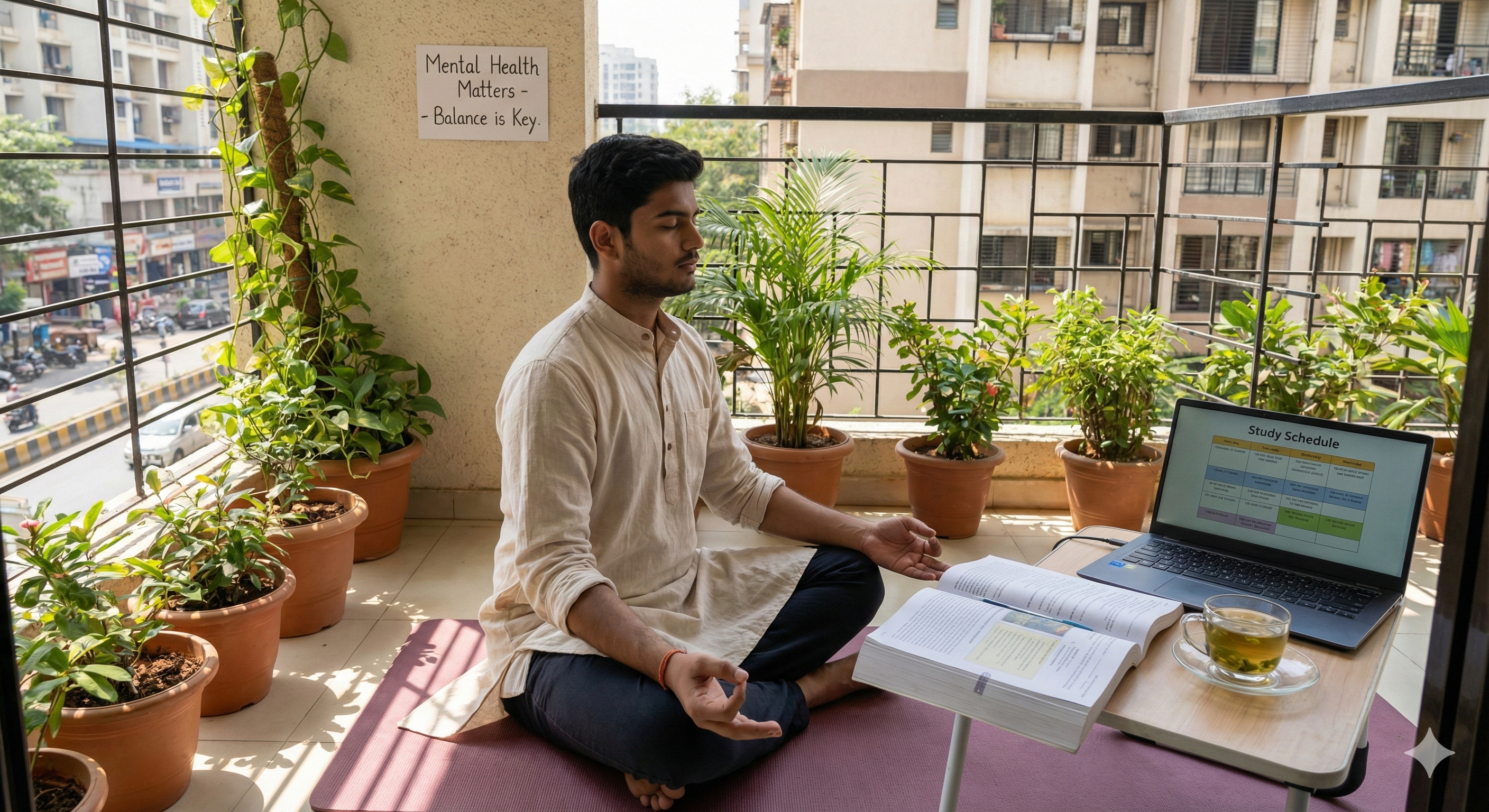

                            Student meditating peacefully while studying, promoting mental health

                            Burnout is a major risk in a three-year marathon. Ensure you incorporate:

                            • A Hobby: Keep one non-academic hobby active throughout your preparation (sports, music, etc.).
                            • Socializing: Do not isolate yourself. Maintain a small, supportive circle.
                            • Sleep: Never compromise sleep for studying. Efficiency drops sharply.

                            • 💡 Key Takeaways for 2026 Aspirants

                              Your strategic advantage is time. Use it wisely:

                              1. Year 1 = NCERTs & Newspaper: Master the basics and build context.
                              2. Year 2 = Mains & Optional: Complete 70% of the Optional subject and all GS papers.
                              3. Year 3 = Revision & Mock Tests: Dedicate the last 6 months entirely to Prelims practice.
                              4. Consistency is King: Small daily efforts are better than massive, sporadic efforts.

                              5. Conclusion: Your First Step Towards 2026 Success


                                Starting now gives you an incredible head start. Your goal over the next few weeks isn't to clear the exam, but to build the foundational structure that will support all future learning.


                                A Quick Checklist to Get Started Today

                                1. Download the official UPSC syllabus (Prelims and Mains).
                                2. Purchase the 6th-grade History and Geography NCERTs.
                                3. Subscribe to a reliable national newspaper.
                                4. Choose a dedicated, distraction-free time slot (e.g., 9 PM - 11 PM) for UPSC study and commit to it.

                                5. Staying Updated: Following Official UPSC Announcements

                                  Always bookmark the official UPSC website (upsc.gov.in). While this roadmap gives you a solid plan, the official notification published in February 2026 will contain the definitive schedule and rules. Good luck!


                                  CallWhatsApp