
BSc Nursing 2026: 4-Year Degree, Eligibility & Career Scope
Enroll in the BSc Nursing 2026 program. Develop clinical competence, EBP skills, and leadership for a successful RN career. 10+2 PCB eligibility required.
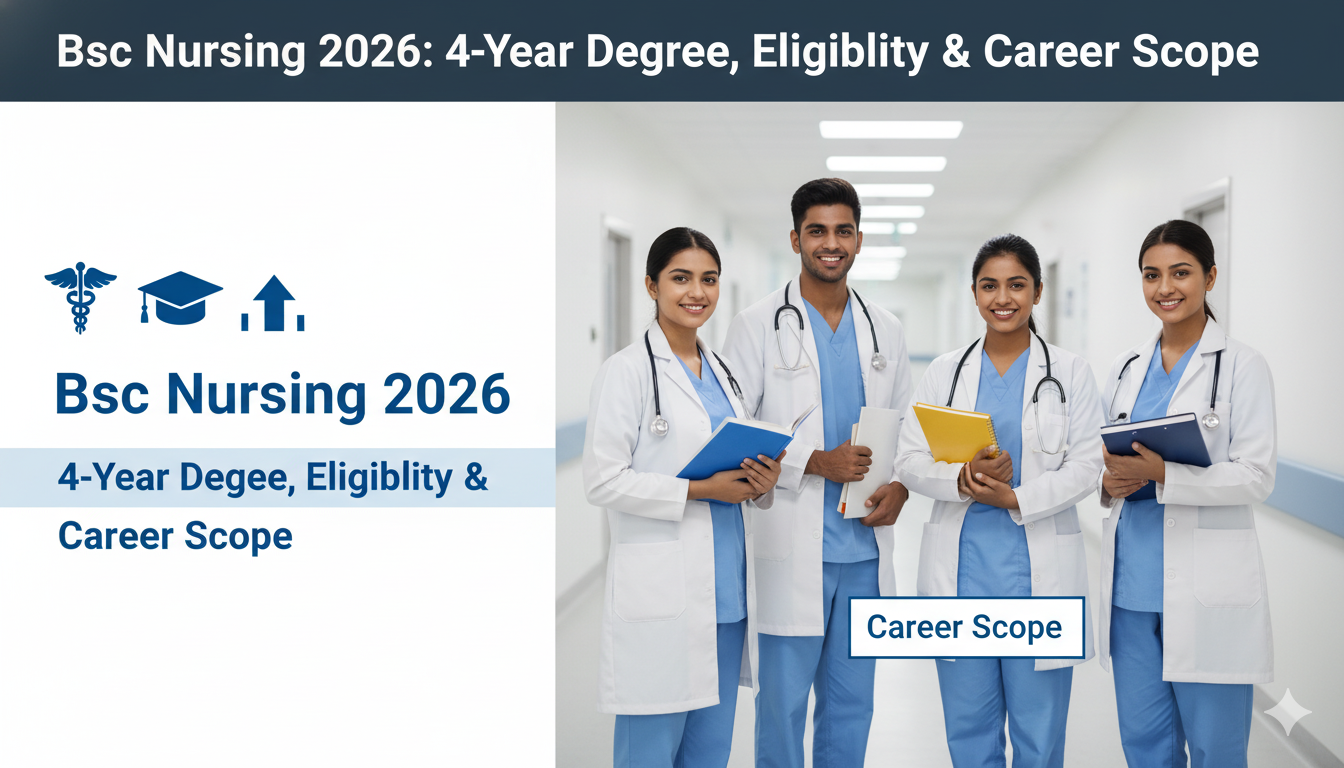
Bachelor of Science in Nursing (BSc Nursing) 2026 Program
A Comprehensive Undergraduate Program for Future Registered Nurses Focused on Evidence-Based Practice and Advanced Clinical Care.
1. Course Overview & Key Highlights
The BSc Nursing 2026 program is a rigorous, 4-year undergraduate professional degree designed to cultivate highly competent, compassionate, and ethically grounded registered nurses. This curriculum emphasizes Evidence-Based Practice (EBP), holistic patient care, and proficiency in modern healthcare technology, preparing graduates to excel in dynamic and complex global healthcare environments.
| BSc Nursing 2026: Program Snapshot | |
|---|---|
| Course Name | Bachelor of Science in Nursing (BSc Nursing) |
| Course Level | Undergraduate (UG) |
| Duration | 4 Years (8 Semesters) Full-Time, including mandatory clinical internships. |
| Eligibility Criteria | 10+2 (High School) completion with mandatory Physics, Chemistry, and Biology (PCB) subjects. Minimum 50% aggregate score. |
| Entrance Exams | Mandatory National or Institutional Entrance Test qualification (e.g., NEET, specific university entrance exam). |
| Course Fees (Estimate) | ₹10,000 - ₹50,000/year. |
| Admission Process | Entrance-based, followed by counseling and medical fitness screening. |
| Key Subjects | Anatomy & Physiology, Medical-Surgical Nursing, Pharmacology, Pediatric Nursing, Nursing Research, and Clinical Practicum. |
| Examination Type | Semester-wise (Theory and Practical/Clinical Competency Assessments). |
| Average Starting Salary (Estimate) | ₹2.5 to ₹4 Lakhs per annum |
2. Course Identity & Logistics
- Official Title: Bachelor of Science in Nursing (BSc Nursing)
- Program Code: BSN-2026
- Accreditation: Recognized by the relevant National Nursing Council/Board.
- Total Credits: 180-200 ECTS equivalent.
- Delivery Mode: Full-time, Campus-based with compulsory integrated clinical placements and high-fidelity simulation lab work.
- Intake Cycle: Annual (Fall/Autumn).
- Department: School of Nursing and Allied Health Sciences.
3. Course Description & Rationale
The BSc Nursing program is a transformative professional pathway that prepares students for the challenges and rewards of modern healthcare. The curriculum is structured around the principles of patient safety, ethical practice, and interprofessional collaboration, ensuring graduates are not just care providers, but critical thinkers and patient advocates.
Curriculum Context & Industry Relevance (2025 Trends)
The 2026 curriculum is specifically designed to address the increasing complexity of patient populations and the rapid adoption of digital health technologies. We integrate modules on telehealth, genomics in patient care, and digital health records (EHR) management from Year 1. This focus ensures that our graduates possess the advanced technological literacy and critical decision-making skills required to lead care teams in future healthcare systems.
Target Audience
This program is ideal for highly motivated 10+2 Science stream students who possess a strong aptitude for scientific reasoning, empathy, resilience, and a deep commitment to public service and patient well-being. Candidates must be prepared for rigorous academic study combined with intensive, hands-on clinical training.
4. Prerequisites & Eligibility
Academic Prerequisites
- Educational Qualification: Successful completion of the 10+2 (High School) examination or equivalent.
- Subject Mandates: Physics, Chemistry, and Biology (PCB) are compulsory subjects of study at the 10+2 level.
- Minimum Score: A minimum aggregate score of 50-60% (as specified by the institution) in the qualifying examination.
Mandatory Requirements
- Entrance Examination: Mandatory qualification in a centralized national or institutional entrance test.
- Age Requirement: Minimum age of 17 years completed by December 31st of the admission year.
- Health Screening: Successful completion of a mandatory medical fitness examination to ensure suitability for clinical practice.
5. Learning Objectives
By the end of the four-year BSc Nursing course, students will be able to demonstrate comprehensive competence across professional, clinical, and leadership domains:
- Define: Key ethical, legal, and professional responsibilities governing nursing practice and patient advocacy on a global scale.
- Apply: Principles of Evidence-Based Practice (EBP) to plan, implement, and evaluate complex nursing interventions across diverse patient populations.
- Analyze: Patient responses to treatment, critical data from digital health records (EHR), and dynamic clinical environments to prioritize care needs effectively.
- Evaluate: The effectiveness of coordinated care plans and quality improvement initiatives, adjusting strategies based on patient outcomes and research findings.
- Implement: Leadership and management principles to coordinate interprofessional care teams, delegate tasks safely, and manage resources within healthcare organizations.
6. Course Materials
Required Textbooks (Examples)
- Kozier & Erb's Fundamentals of Nursing: Concepts, Process, and Practice (Latest Edition).
- Brunner & Suddarth's Textbook of Medical-Surgical Nursing (Latest Edition).
- Guyton and Hall Textbook of Medical Physiology (Latest Edition).
- Pharmacology for Nurses: A Pathophysiologic Approach.
Reference Materials & Digital Resources
- Subscription access to essential nursing and medical e-journals (e.g., CINAHL, PubMed, Cochrane Library).
- Dedicated access to the Learning Management System (LMS) for lecture notes, assignments, and collaborative forums.
- Clinical Skills Manuals, Drug Handbooks, and standardized procedure guidelines.
Software & Tools
- Access to high-fidelity simulation technology platforms (e.g., SimMan, virtual reality simulators).
- Training and access to institutional Electronic Health Record (EHR) systems for documentation practice.
7. Detailed Syllabus & Module Breakdown
The program is structured into three progressive phases, combining foundational science, core clinical application, and advanced leadership development.
Phase I: Foundations (Year 1 - Weeks 1-4)
Objective: Establish core scientific vocabulary, communication skills, and the foundational principles of nursing practice and patient safety.
| Week | Topics Covered (Foundations) |
|---|---|
| Week 1: | History, Scope, and Ethics of Nursing; Introduction to Holistic Care. |
| Week 2: | Anatomy & Physiology I (Cellular structure, Musculoskeletal, Cardiovascular systems). |
| Week 3: | Microbiology and Applied Pathology; Basic Infection Control Principles. |
| Week 4: | Nursing Foundations & Procedures (Bedside care, Communication Skills, Safety Measures). |
Phase II: Application & Core Concepts (Years 2-3 - Weeks 5-9)
Objective: Practical application of theories into core clinical areas, integrating pathophysiology with pharmacological management and specialized care.
| Week | Topics Covered (Application) |
|---|---|
| Week 5: | Medical-Surgical Nursing I (Respiratory, Renal, and Gastrointestinal Disorders). |
| Week 6: | Pharmacology (Drug classifications, Administration routes, Dosage calculations). |
| Week 7: | Pediatric Nursing (Growth and Development, Common Childhood Illnesses). |
| Week 8: | Midterm Evaluation & Clinical Skills Checkpoint (OSCE). |
| Week 9: | Obstetrics & Gynecological Nursing (Maternal health, Reproductive health, Neonatal care). |
Phase III: Advanced Topics (Year 4 - Weeks 10-14)
Objective: Advanced complexity, synthesis of knowledge, leadership training, and professional preparation for licensure.
| Week | Topics Covered (Advanced) |
|---|---|
| Week 10: | Nursing Research & Statistics (Critically appraising EBP literature). |
| Week 11: | Nursing Management & Administration (Healthcare quality, Budgeting, Resource allocation). |
| Week 12: | Professional Trends & Issues (Telehealth, Genomics, Legal aspects of practice). |
| Week 13: | Advanced Clinical Practicum (Capstone Project/Comprehensive Internship Review). |
| Week 14: | Final Review and Preparation for RN Licensure Examination. |
8. Assessment & Grading Scheme
Assessment is continuous and comprehensive, focusing on both theoretical knowledge and demonstrable clinical competency.
Assessment Distribution
| Assessment Type | Weighting | Description |
|---|---|---|
| Internal Assessment (Formative) | 40% | Mid-term exams, practical assignments, case studies, seminars, and clinical logbooks. |
| External Assessment (Summative) | 60% | End-of-semester theory examinations conducted by the university/board. |
| Clinical Competency | Mandatory Pass | Assessed via Objective Structured Clinical Examinations (OSCE/OSPE) and Clinical Performance Checklists (CPC). |
Passing Criteria
Students must achieve a minimum of 50% in both the internal (theory and practical combined) and external examinations to be eligible for promotion to the next academic year and ultimately, graduation.
9. Course Policies
Attendance Requirements
- Theory Classes: Mandatory minimum of 80% attendance is required in all theory and laboratory sessions.
- Clinical Placements: Mandatory 100% attendance in all assigned clinical rotations and mandatory hours is strictly enforced due to regulatory requirements.
Academic Integrity
The institution enforces a strict zero-tolerance policy regarding academic misconduct, including plagiarism, cheating, and unauthorized collaboration. Violations will result in disciplinary action, up to and including expulsion.
Professional Conduct and Fitness to Practice
Students are required to adhere strictly to the institutional Code of Conduct, the Nursing Professional Ethics standards, and mandatory uniform policies at all times, especially during clinical hours. Continuous evaluation of professional suitability is maintained throughout the program.
10. Career Scope & Certification
Graduates of the BSc Nursing 2026 program are immediately eligible for licensure and possess a versatile skill set that allows for rapid career advancement in specialized and leadership roles.
Certification Details
Upon successful completion of the program, graduates are eligible to sit for the national Registered Nurse (RN) Licensure Examination (or equivalent examination, such as NCLEX) required to practice professionally.
Skills Acquired
- Technical Skills: Advanced life support, critical care monitoring, wound management, digital charting (EHR), and pharmacological administration.
- Soft Skills: Critical thinking, interprofessional communication, ethical decision-making, resilience, and patient advocacy.
Immediate Job Roles
| Job Role | Description | Further Studies/Specialization |
|---|---|---|
| Staff Nurse (Hospital) | Providing direct, comprehensive patient care in specialized wards (e.g., Medical, Surgical, Pediatrics). | Critical Care Nursing, Perioperative Nursing. |
| Community Health Nurse | Delivering preventative care, health education, and immunization programs in public health settings. | Master of Public Health (MPH). |
| Clinical Instructor/Educator | Assisting in the training and supervision of junior nursing students in clinical settings. | MSc Nursing (Nursing Education). |
| Home Health Care Nurse | Providing specialized, high-acuity care to patients in their private residences. | Geriatric Nursing, Palliative Care. |
Advanced Study Recommendations
Graduates are highly encouraged to pursue advanced degrees such as the Master of Science in Nursing (MSc Nursing), Nurse Practitioner (NP) programs, or specialized degrees in public health or healthcare administration.
11. Frequently Asked Questions (FAQs)
What are the primary eligibility requirements for BSc Nursing 2026 admission?
You must have successfully completed the 10+2 examination (or equivalent) with Physics, Chemistry, and Biology (PCB) as mandatory subjects. Additionally, candidates must meet the minimum age requirement of 17 years and qualify a mandatory national or institutional entrance examination.
Is the clinical internship paid, and how long does it last?
The clinical internship duration is integrated throughout the 4 years, culminating in a comprehensive final practicum in Year 4. Whether the internship is paid (stipend provided) varies significantly by institution and regulatory body; applicants should confirm specific financial aid details with their chosen university.
What kind of clinical training and hospital affiliations are provided?
Training is intensive, utilizing high-fidelity simulation labs and mandatory integrated clinical rotations starting in Year 1. The program partners with several affiliated teaching hospitals and specialty centers, ensuring exposure to diverse clinical settings, including critical care, community health, and specialty surgical units.
What is the typical student-to-faculty ratio in the program?
We maintain a favorable student-to-faculty ratio, particularly in clinical and laboratory settings (often 1:10 or less for practical skills), to ensure personalized attention, effective supervision, and high-quality mentorship during complex skill acquisition.
After graduation, what is the next step for professional practice?
Upon graduation, the immediate next step is to register for and successfully pass the mandatory national Registered Nurse (RN) Licensure Examination. Passing this exam grants the legal authority to practice as a Registered Nurse in the relevant jurisdiction.