
B.Sc. Anesthesia & OT Technology Course 2026 | Admission, Scope
Master surgical environment management and anesthesia assistance with our 4-year B.Sc. in Anesthesia & OT Technology program. Essential training for critical healthcare roles.
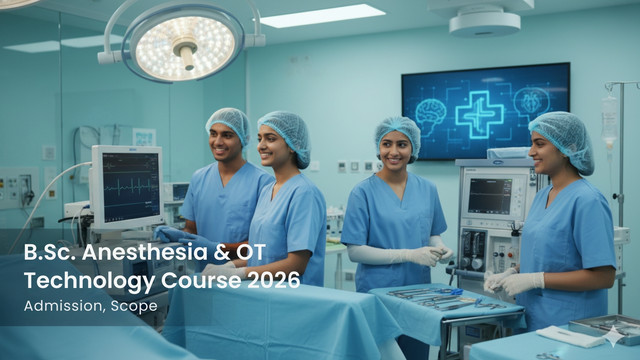
B.Sc. in Anesthesia & Operation Theatre Technology (AOTT) 2026
Transforming Healthcare Technicians into Essential Surgical Professionals.
1. Course Overview & Key Highlights
The B.Sc. in Anesthesia & Operation Theatre Technology (AOTT) is a rigorous four-year undergraduate program designed to produce highly competent allied health professionals. This course provides comprehensive training in managing the sophisticated Operation Theatre (OT) environment, sterilizing equipment, assisting surgeons, and crucially, supporting the Anesthesiologist through all phases of patient sedation and monitoring. Graduates are immediately ready to step into dynamic roles in modern critical care and surgical units.
| Key Course Highlights: B.Sc. AOTT | |
|---|---|
| Course Name | B.Sc. in Anesthesia & Operation Theatre Technology |
| Course Level | Undergraduate (UG) |
| Duration | 4 Years (3 Years Academic + 1 Year Mandatory Internship) |
| Eligibility Criteria | 10+2 (High School) with Physics, Chemistry, and Biology (PCB) or PCM, minimum 50% aggregate. |
| Entrance Exams | Varies; Institutional or National Allied Health Entrance Examinations may be required. |
| Course Fees (Estimate) | ₹80,000 to ₹2,50,000 per annum (Varies by institution) |
| Admission Process | Merit-based selection followed by counseling or Entrance Exam-based. |
| Key Subjects | Anatomy & Physiology, Applied Pharmacology, Anesthesia Equipment, Sterilization Techniques, Critical Care Management. |
| Examination Type | Semester-wise Theory and Practical Assessments, OSCEs, and Clinical Evaluations. |
| Average Starting Salary | ₹3.0 LPA – ₹6.0 LPA (Highly dependent on location and facility type) |
2. Course Identity & Logistics
- Course Title: B.Sc. in Anesthesia & Operation Theatre Technology
- Course Code: AOTT-UG-2026
- Credit Value/ECTS: Total 180 Credits (approx. 45 credits per academic year)
- Format: Hybrid Learning Model (Integrated Theory Lectures, High-Fidelity Simulation Labs, and Extensive Clinical Rotations/Workshops)
- Instructor/Department: Taught by specialized faculty from the Allied Health Sciences Department, Anesthesiology Department, and Surgical Specialists.
3. Course Description & Rationale
This comprehensive degree program is specifically designed to bridge the gap between surgical necessity and technical expertise. Students gain profound theoretical knowledge in human biology, pharmacology, and disease processes, coupled with unparalleled practical skills in managing the complex logistical and technical demands of the operating room. The program emphasizes patient safety, infection control, and rapid emergency response.
Curriculum Context & Industry Relevance (2025 Trends)
The modern healthcare landscape demands professionals with dual competencies. This course offers a unique selling proposition by covering both pre-operative anesthesia support (calibration, monitoring, drug preparation) and intra-operative surgical assistance (instrument handling, maintaining aseptic fields). This integrated approach ensures graduates meet the stringent requirements of multispecialty hospitals and advanced surgical centers, where efficiency and technical reliability are paramount.
Target Audience
The ideal candidate is a highly disciplined, detail-oriented science student (preferably PCB background) who possesses strong critical thinking skills, excellent communication abilities, and a commitment to working under pressure in high-stakes clinical environments.
4. Prerequisites & Eligibility
Academic Prerequisites
- Successful completion of the 10+2 (High School) examination or equivalent from a recognized board.
- Mandatory subjects include Physics, Chemistry, and Biology (PCB). Students with PCM may be considered, but PCB is strongly preferred.
- A minimum aggregate score of 50% in the qualifying examination is typically required.
Skill Requirements
- High level of attention to detail and manual dexterity.
- Ability to remain calm and focused during emergencies (e.g., cardiac arrest).
- Strong verbal communication skills for effective team coordination.
Technical Requirements
Students must be prepared for intensive lab work, simulation training, and the use of sophisticated digital patient management systems (LMS, EMR access).
5. Learning Objectives
By the end of this course, students will be able to:
- Define: The foundational anatomical and physiological principles governing patient response to anesthesia and surgical trauma.
- Apply: Aseptic techniques, sterilization protocols, and infection control measures to prepare and maintain a sterile surgical environment.
- Analyze: Complex patient monitoring data (ECG, pulse oximetry, capnography) to identify potential complications during surgical procedures.
- Evaluate: The function and performance of anesthesia delivery systems (e.g., anesthesia machine, ventilator) and troubleshoot technical failures critically and rapidly.
- Create: Comprehensive pre-operative and post-operative technical reports, ensuring effective documentation and inventory management within the OT suite.
6. Course Materials
Required Textbooks
- Textbook 1:Anatomy and Physiology for Nurses and Allied Health Sciences by S. R. Joshi.
- Textbook 2:Pharmacology for Anaesthesia and Intensive Care by T. N. Calvey and N. E. Williams.
- Textbook 3:Textbook of Operation Theatre Techniques and Management by V. K. Singh.
- Textbook 4:Basic Sciences for Anesthesia by T. D. V. Swaminathan.
Reference Materials
- Access to institutional Learning Management System (LMS) for lecture notes and video databases.
- Clinical protocol manuals (e.g., WHO Surgical Safety Checklist, institutional infection control guidelines).
- Interactive 3D Anatomy Software licenses.
Software & Tools
- Surgical Simulation Software (for high-fidelity training).
- Electronic Health Record (EHR) training modules.
- Required personal clinical tools (stethoscope, diagnostic kit, standardized uniform).
7. Detailed Syllabus & Module Breakdown (Academic Years 1-3)
The academic portion is structured across three years, culminating in a mandatory 12-month clinical internship.
Phase I: Foundations (Year 1 - Semesters 1 & 2)
Objective: Establish core vocabulary, principles of human biology, and professional ethics necessary for clinical practice.
- Module 1: Basic Sciences: Human Anatomy & Physiology, Biochemistry, Microbiology.
- Module 2: Professional Fundamentals: Communication Skills, Professional Ethics, Basic Computer Applications in Healthcare.
- Key Certification: Basic Life Support (BLS) Certification.
Topics Covered:
- Week 1-4: Cell Biology, Tissue Types, Introduction to Organ Systems (Anatomy).
- Week 5-8: Homeostasis, Respiration, Circulation (Physiology).
- Week 9-12: Sterilization Principles, Types of Microorganisms, Infection Pathways.
- Week 13-16: Professional Conduct and Patient Safety Protocols.
Phase II: Application & Core Concepts (Year 2 - Semesters 3 & 4)
Objective: Practical application of theories, focusing on core technology, pharmacology, and standard OT procedures.
- Module 3: Core Technology: Operation Theatre Techniques, Sterilization & Disinfection Systems, Surgical Instruments Identification.
- Module 4: Applied Pharmacology: Classification and Administration of Anesthetic Agents, Muscle Relaxants, and Reversal Drugs.
- Module 5: Patient Monitoring: Understanding and operating basic and advanced patient monitoring systems.
Topics Covered:
- Week 1-4: Pre-operative patient preparation and risk assessment.
- Week 5-8: Detailed study of the Anesthesia Machine, circuits, and ventilation mechanisms.
- Week 9-12: Types of Anesthesia (General, Regional, Local), Drug calculations and preparation.
- Week 13-16: Handling of infectious waste and specialized OT furniture/lighting systems.
Phase III: Advanced & Clinical Synthesis (Year 3 - Semesters 5 & 6)
Objective: Advanced complexity, specialized surgical assistance, critical care management, and synthesis of knowledge.
- Module 6: Advanced Anesthesia: Regional Anesthesia Techniques, Advanced Ventilator Management, Pain Management.
- Module 7: Specialized OT: Protocols for Cardio-Thoracic, Neuro, Pediatric, and Orthopedic surgeries.
- Module 8: Management & Quality: Healthcare Quality Management, OT Scheduling, Inventory Control, and Medico-Legal Aspects.
Topics Covered:
- Week 1-4: Advanced airway management and difficult intubation scenarios.
- Week 5-8: Principles of Critical Care (ICU setup, hemodynamic monitoring).
- Week 9-12: Assisting in high-trauma and emergency surgical procedures.
- Week 13-16: Final practical skill assessment (OSCE) and preparation for mandatory clinical internship.
Mandatory Internship (Year 4 - 12 Months)
Full-time, supervised clinical rotations providing hands-on experience across multiple departments (ICU, Emergency, Recovery, General and Specialized OT units).
8. Assessment & Grading Scheme
Evaluation is continuous, ensuring mastery of both theoretical knowledge and critical technical skills.
| Assessment Component | Weightage | Description |
|---|---|---|
| Assignments/Quizzes | 15% | Regular module quizzes, case study analyses, and technical reports. |
| Midterm Exam (Theory) | 25% | Comprehensive written examination covering Phase I and II core concepts. |
| Practical/Clinical Performance (OSCEs) | 35% | Objective Structured Clinical Examinations, simulation performance, and logbook maintenance. |
| Final Exam (Theory) | 25% | End-of-semester written examination covering advanced topics and synthesis. |
| Total | 100% |
Grading Scale & Passing Criteria
The grading scale typically follows institutional standards (A: Excellent, B: Good, C: Average, D: Pass, F: Fail). A minimum overall score of 50% is required in both the theoretical and practical components separately to pass the semester and qualify for clinical rotations.
9. Course Policies
Academic Integrity
The institution maintains a zero-tolerance policy regarding academic dishonesty, including plagiarism, cheating on examinations, and falsification of clinical data. Violations will result in disciplinary action up to and including expulsion.
Attendance Requirements
Mandatory minimum attendance of 75% for theoretical classes and 85% for practical labs and clinical rotations is strictly enforced. Failure to meet clinical attendance requirements will disqualify the student from sitting for final examinations.
Late Submissions Policy
Assignments submitted after the deadline will incur a daily penalty (e.g., 5% reduction per day). Clinical logbooks must be maintained and signed off weekly without fail.
Accommodations for Students with Disabilities
Students requiring academic accommodations should register with the Student Services Office at the start of the semester. Clinical placements are managed on a case-by-case basis to ensure full compliance with accessibility standards while maintaining patient safety protocols.
10. Career Scope & Certification
Skills Acquired
- Technical Skills: Anesthesia machine calibration, ventilator management, advanced patient monitoring, instrument sterilization, surgical assistance.
- Soft Skills: Team leadership, crisis management, precise documentation, effective communication in high-pressure environments, professional ethics.
Job Roles and Salary Expectations
| Career Role | Description | Avg. Starting Salary (INR/Year) |
|---|---|---|
| Operation Theatre Technician | Managing the sterile field, instrument preparation, and logistical control of the OT during surgery. | ₹3,00,000 – ₹5,50,000 |
| Anesthesia Technician/Assistant | Directly assisting the Anesthesiologist with drug preparation, machine setup, patient induction, and recovery room monitoring. | ₹3,50,000 – ₹6,00,000 |
| Critical Care Technician | Working in Intensive Care Units (ICU) managing specialized equipment like ventilators, dialysis machines, and hemodynamic monitors. | ₹4,00,000 – ₹6,50,000 |
| Medical Equipment Specialist | Sales, demonstration, or maintenance of high-end surgical and anesthesia equipment for device manufacturers. | ₹4,50,000 – ₹8,00,000+ |
Further Studies and Certification
Graduates are well-positioned for specialization through:
- M.Sc. in Allied Health Sciences (Specializing in Critical Care or OT Management).
- Post-Graduate Diplomas in Cardiac Perfusion Technology or Respiratory Therapy.
- Encouraged to obtain professional certifications such as Advanced Cardiovascular Life Support (ACLS) and Certified Anesthesia Technologist (Cert. AT).
11. Frequently Asked Questions (FAQs)
Is the B.Sc. AOTT equivalent to a medical degree like MBBS?
No. The B.Sc. in Anesthesia & OT Technology is a specialized Allied Health Science degree. It trains technical experts who work alongside doctors (surgeons and anesthesiologists) to ensure the technical success and safety of surgical procedures. It does not qualify you to practice medicine or perform surgery.
What is the eligibility requirement for admission to this course?
Candidates must have successfully completed 10+2 (High School) with Physics, Chemistry, and Biology (PCB) or sometimes Physics, Chemistry, and Mathematics (PCM). A minimum aggregate score of 50% in the qualifying examination is generally mandatory.
What is the structure of the 4-year program?
The program consists of three years of rigorous academic training (theory and simulation labs) followed by one full year (12 months) of mandatory, paid or unpaid, full-time clinical internship in affiliated hospitals. The internship is crucial for degree completion.
What are the career prospects immediately after graduation?
Graduates are in high demand both nationally and internationally. You can work as an Anesthesia Technician, OT Technician, or Critical Care Assistant in multispecialty hospitals, trauma centers, and specialized surgical units. Starting salaries are competitive and increase significantly with specialization and experience.
Are placements guaranteed after the mandatory internship?
While placements are not strictly guaranteed, institutions typically maintain strong ties with major hospital networks. Successful completion of the mandatory internship often leads to preferential hiring opportunities within the training hospital or partner facilities, given the acute shortage of trained professionals.