
BUMS 2026: Bachelor of Unani Medicine & Surgery Course Details
Explore BUMS (Bachelor of Unani Medicine & Surgery) 2026 admissions. Learn about eligibility (NEET-UG, PCB), 5.5-year duration, syllabus, and career scope in Unani medicine.
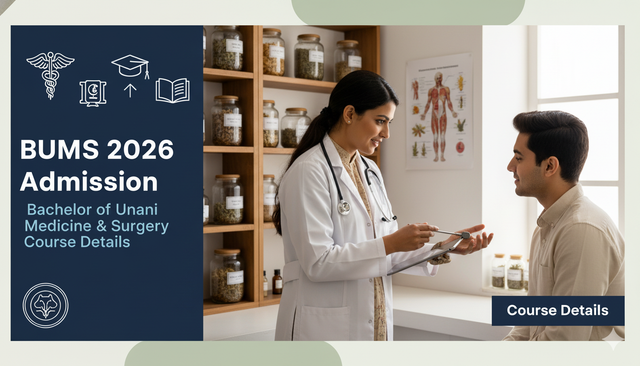
Bachelor of Unani Medicine and Surgery (BUMS) 2026
Comprehensive Guide to the BUMS Undergraduate Professional Degree Program
1. Course Overview & Key Highlights
The Bachelor of Unani Medicine and Surgery (BUMS) is a prestigious undergraduate medical program designed to train proficient physicians in the Unani System of Medicine (USM). Integrating ancient Greco-Arabic principles—such as the theory of Humors (Akhlat) and Temperament (Mizaj)—with contemporary scientific methodologies, BUMS prepares graduates for holistic clinical practice, research, and public health service. This 5.5-year rigorous course is recognized globally for its focus on lifestyle regulation (Ilaj bit Tadbeer) and natural therapeutics.
Key Highlights Table
| Attribute | Details |
|---|---|
| Course Name | Bachelor of Unani Medicine and Surgery (BUMS) |
| Course Level | Undergraduate Professional Degree |
| Duration | 5.5 Years (4.5 Years Academic Study + 1 Year Compulsory Internship) |
| Eligibility Criteria | 10+2 (PCB) with minimum 50% aggregate marks |
| Entrance Exams | Mandatory qualification in NEET-UG (National Eligibility cum Entrance Test) or equivalent state/institutional exam. |
| Course Fees (Avg. Range) | ₹80,000 to ₹3,50,000 per annum (Highly institution-dependent) |
| Admission Process | Entrance-based, followed by centralized counseling (All India and State Quota). |
| Key Subjects | Tashreeh-ul-Badan (Anatomy), Ilm-ul-Advia (Pharmacology), Moalijat (Medicine), Ilaj bit Tadbeer (Regimental Therapy). |
| Examination Type | Annual/Professional Examinations (University based) combined with continuous Internal Assessments. |
| Average Starting Salary | ₹3,00,000 – ₹7,00,000 per annum (Varies by sector and location) |
2. Course Identity & Logistics
The BUMS program is structured under the guidelines of the Central Council of Indian Medicine (CCIM) to ensure standardization and high quality across affiliated universities.
- Course Title: Bachelor of Unani Medicine and Surgery (BUMS)
- Course Level: UG Professional Medical Degree
- Medium of Instruction: Primarily English, with extensive use of Urdu/Hindi for traditional texts (as required by the curriculum).
- Affiliation: CCIM Recognized; Affiliated with recognized State/Central Universities.
- Format: Hybrid (Lectures, Seminars, Laboratory Practicals, Compulsory Clinical Rotations, Hospital Postings).
- Instructor/Department: Faculty of Unani Medicine and Surgery (AYUSH Department).
3. Course Description & Rationale
BUMS is a rigorous medical training program aimed at developing holistic healthcare professionals. The curriculum emphasizes the four pillars of Unani treatment: Dietotherapy (Ilaj bil Ghiza), Regimental Therapy (Ilaj bit Tadbeer), Pharmacotherapy (Ilaj bid Dawa), and Surgery (Jarahat). Students gain deep expertise in traditional diagnostic techniques, particularly pulse examination (Nabz), alongside modern diagnostic tools.
Curriculum Context and Rationale
The program’s rationale is rooted in preserving and advancing the rich legacy of Unani medicine while meeting the escalating global demand for integrated, natural, and patient-centered healthcare solutions. The 2025 healthcare landscape increasingly values traditional systems for chronic disease management and preventive care, positioning BUMS graduates as key contributors to public health.
Target Audience
This course is ideal for highly motivated 10+2 Science stream students who possess strong academic foundations in Biology, Chemistry, and Physics, and who are passionate about traditional, holistic healing systems and medical ethics.
4. Prerequisites & Eligibility
Admission to the BUMS program for the 2026 academic session is highly competitive and regulated by national standards.
Academic Prerequisites
- Successful completion of 10+2 (Higher Secondary Examination) or equivalent.
- Mandatory subjects: Physics, Chemistry, and Biology (PCB) with English as a core subject.
- Minimum Marks: Generally, a minimum of 50% aggregate marks in PCB (40% for candidates belonging to SC/ST/OBC categories).
Entrance Examination & Age Limit
- Entrance Exam: Qualification in the NEET-UG exam is mandatory for admission to most BUMS institutions across India.
- Age Limit: The candidate must be 17 years of age or older on or before December 31st of the admission year.
5. Learning Objectives
Upon successful completion of the BUMS program, students will be able to demonstrate competence in the following areas:
- Philosophical Mastery (Define): Define and articulate the core philosophical concepts of Unani Medicine, including the elements (Arkan), humors (Akhlat), temperaments (Mizaj), and vital forces (Quwa).
- Clinical Competence (Apply): Apply traditional Unani diagnostic methodologies (e.g., Nabz, Bawl, Baraz examination) and integrate them with modern clinical examination techniques for accurate disease identification.
- Therapeutic Planning (Analyze): Analyze complex disease states based on the patient's Mizaj and devise comprehensive, personalized treatment plans utilizing Dietotherapy, Regimental Therapy (Ilaj bit Tadbeer), and Pharmacotherapy.
- Ethical Practice (Evaluate): Evaluate legal and ethical dilemmas in clinical settings and adhere strictly to the professional code of conduct and patient confidentiality laws.
- Research Acumen (Create): Synthesize clinical observations and critically evaluate research literature to contribute to the advancement of Unani medicine through clinical studies and formulation development.
6. Course Materials
The BUMS curriculum relies on a blend of classical Unani texts and modern medical science literature.
Required Textbooks (Core Texts)
- Qanoon-fil-Tibb (The Canon of Medicine) - Ibn Sina (Avicenna) (Translated/Commented Editions)
- Tashreeh-ul-Badan (Human Anatomy) - Standardized CCIM Textbooks
- Ilm-ul-Advia (Unani Pharmacology) - Reference to National Formulary of Unani Medicine
- Munafe-ul-Aza (Human Physiology) - Standardized Modern/Integrated Texts
- Hifzan-e-Sehat (Preventive and Social Medicine) - Relevant Public Health Publications
Reference Materials
- Unani Pharmacopoeia of India (UPI)
- Peer-reviewed journals focusing on AYUSH, Traditional Medicine, and Complementary Health.
- Clinical Case History Logs and Mandatory Practical Observation Journals.
Software & Tools
- Institutional Learning Management System (LMS) for accessing digital notes and assignments.
- Access to clinical databases and basic statistical software for research projects.
7. Detailed Syllabus & Module Breakdown
The 4.5 years of academic study are divided into three professional phases, each culminating in university examinations.
Phase I: Foundations (Approx. 1.5 Years)
Objective: Establish core vocabulary, fundamental principles of Unani Medicine (Umoor-e-Tabiya), and the basic structure and function of the human body.
Key Subjects Covered:
- Tashreeh-ul-Badan: Gross Human Anatomy, Histology, and Embryology.
- Munafe-ul-Aza: Human Physiology, including functions of Arkan, Akhlat, and Mizaj.
- Umoor-e-Tabiya: Fundamentals of Unani Medicine, defining health and disease based on Humoral Theory.
- Tarikh-e-Tibb: History of Medicine, focusing on Greco-Arabic contributions.
Phase II: Application & Core Concepts (Approx. 2 Years)
Objective: Practical application of theories, understanding disease mechanisms (Pathology), and mastering Unani materia medica and therapeutics.
Key Subjects Covered:
- Ilm-ul-Advia: Detailed Unani Pharmacology, identification, preparation, and uses of single and compound drugs.
- Ilm-ul-Amraz: General and Systemic Pathology, principles of diagnosis (including Nabz, Bawl, Baraz).
- Hifzan-e-Sehat: Preventive and Social Medicine, Hygiene, and Public Health programs.
- Ilaj bit Tadbeer: Regimental Therapy, including Hijamat (Cupping), Dalak (Massage), and Fasd (Venesection).
- Tibb-e-Qanooni wa Samoomiyat: Forensic Medicine and Toxicology.
Phase III: Advanced Clinical Practice (Approx. 1 Year)
Objective: Advanced complexity, specialized clinical subjects, synthesis of knowledge, and preparation for the compulsory internship.
Key Subjects Covered:
- Moalijat (Internal Medicine): Clinical practice, diagnosis, and management of systemic diseases.
- Jarahiyat: Principles of Surgery, including Minor Surgery, ENT, and Ophthalmology.
- Ilm-ul-Qabalat wa Amraz-e-Niswan: Obstetrics, Gynaecology, and diseases specific to women.
- Amraz-e-Atfal: Paediatrics and child health.
- Community Medicine: Clinical postings and practical application in hospital settings.
8. Assessment & Grading Scheme
Assessment is rigorous, utilizing both continuous internal evaluation and comprehensive professional university examinations.
Assessment Distribution
| Component | Weightage (%) | Description |
|---|---|---|
| Internal Assessment (Assignments, Quizzes, Attendance) | 20% | Continuous evaluation of professional conduct and academic engagement. |
| Theory Examination (External University Exam) | 50% | Written papers covering the entire syllabus for the professional phase. |
| Practical/Clinical Examination | 20% | Hands-on skills assessment in labs and clinical settings (e.g., patient examination, drug preparation). |
| Viva Voce (Oral Examination) | 10% | Testing comprehensive understanding and communication skills. |
Passing Criteria
Students must secure a minimum of 50% marks in both the theory component and the combined practical/viva voce component in each subject to be declared successful in the professional examination.
9. Course Policies
- Academic Integrity: Strict adherence to institutional policies regarding plagiarism and academic misconduct. Any violation results in disciplinary action.
- Attendance Requirements: Mandatory minimum of 75% attendance in theory classes and 80% in practical/clinical sessions. Failure to meet this requirement disqualifies the student from sitting for the university examination.
- Late Submissions Policy: Assignments and clinical logs must be submitted by the deadlines. Late submissions are generally penalized or rejected, impacting internal assessment scores.
- Accommodations for Students with Disabilities: Institutions provide reasonable academic accommodations in compliance with national guidelines. Students must register with the relevant administrative office.
- Internship Policy: The 1-year compulsory rotatory internship must be completed successfully in designated departments before the degree is awarded and licensure is granted.
10. Career Scope & Certification
BUMS graduates are certified medical professionals recognized under the AYUSH framework, opening diverse career pathways in clinical practice, public health, research, and pharmacology.
Certification Details
Successful completion leads to the award of the Bachelor of Unani Medicine and Surgery (BUMS) degree. Graduates are eligible to register with the Central Council of Indian Medicine (CCIM) or respective State Medical Councils to obtain a license to practice Unani Medicine.
Key Skills Acquired
- Technical Skills: Traditional diagnosis (Nabz), Regimental Therapy techniques (Cupping, Leeching), Unani drug formulation, and basic surgical procedures.
- Soft Skills: Holistic patient counseling, ethical decision-making, compassionate care, and interdisciplinary teamwork.
Job Roles and Average Salary
| Job Role | Description | Avg. Starting Salary (INR) |
|---|---|---|
| Unani Physician/Medical Officer | Clinical practice in government AYUSH hospitals, private clinics, or health centers. | ₹4,00,000 – ₹7,00,000 |
| Research Associate | Working in research institutions (e.g., CCRUM) on drug standardization, clinical trials, or validation of Unani formulations. | ₹3,50,000 – ₹6,50,000 |
| Unani Consultant/Specialist | Private consulting or specialization in areas like Regimental Therapy or specific chronic diseases. | Varies widely; generally higher in private practice. |
| Academician/Lecturer | Teaching in BUMS colleges after obtaining a postgraduate qualification (MD/MS Unani). | ₹5,00,000 – ₹8,00,000+ |
Further Studies Recommendations
Graduates can pursue higher education by undertaking:
- MD/MS Unani: Specialization in clinical areas (Moalijat, Ilaj bit Tadbeer) or non-clinical subjects (Ilm-ul-Advia).
- MPH/MHA: Master’s in Public Health or Hospital Administration for management roles.
11. Frequently Asked Questions (FAQs) about BUMS
Is NEET mandatory for BUMS admission in 2026?
Yes. Qualification in the NEET-UG (National Eligibility cum Entrance Test) is mandatory for admission to the BUMS course in recognized government and private institutions across India, as per regulatory guidelines.
What is the primary difference between BUMS and BAMS (Ayurveda)?
Both are traditional medical systems, but BUMS is based on the Greco-Arabic Humoral Theory (Akhlat, Mizaj), focusing on balancing body temperaments. BAMS (Ayurveda) is based on the Tridosha theory (Vata, Pitta, Kapha). Their philosophical bases, diagnostic techniques, and pharmacological approaches are distinct.
Can BUMS graduates practice modern (Allopathic) medicine?
BUMS graduates are licensed to practice the Unani System of Medicine. While the curriculum includes modern basic sciences (Anatomy, Physiology) and emergency training, the legal scope of integrating modern medicine varies by state and is subject to local regulatory frameworks and specific cross-practice training programs.
What is the structure of the 5.5-year BUMS course?
The course is structured into 4.5 years of academic study divided into three professional phases (Foundations, Application, Advanced Clinicals), followed by 1 year of Compulsory Rotatory Internship (hospital postings in various departments like Medicine, Surgery, and Gynaecology).
Is the compulsory 1-year internship paid?
Yes, the one-year compulsory rotatory internship is typically a paid position. Students receive a monthly stipend, the amount of which is determined by the respective state government or the institution.