
Diploma in Medical Lab Technology (DMLT) 2026 Course Details
Launch your career in clinical diagnostics with the DMLT 2026 program. Get hands-on training in Hematology, Microbiology, and LIS/NABL standards. Apply now!
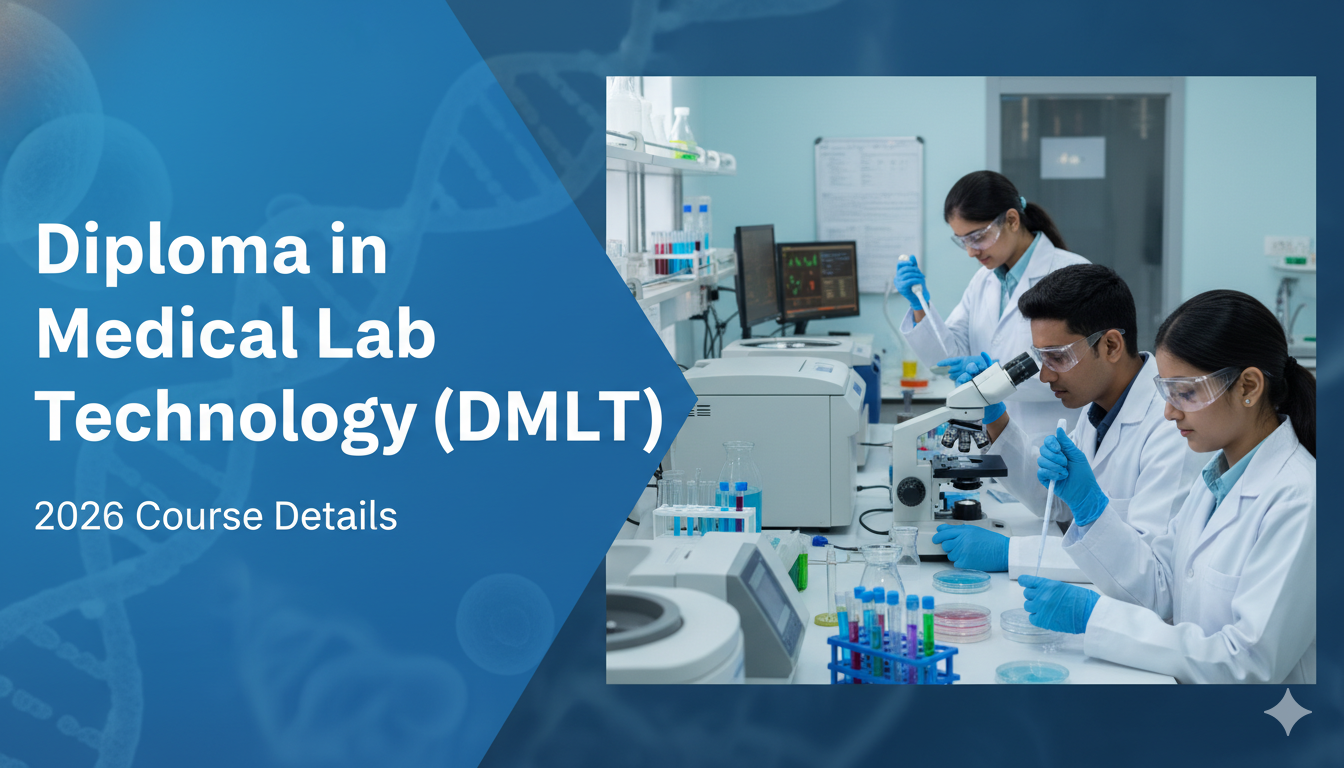
Diploma in Medical Laboratory Technology (DMLT) 2026
The Diploma in Medical Laboratory Technology (DMLT) 2026 is a rigorous, vocational paramedical program designed to train highly competent laboratory professionals. This 2-year diploma focuses intensively on hands-on clinical diagnostics, specimen management, quality assurance, and the operation of modern laboratory instrumentation, ensuring graduates are immediately employable and compliant with global standards like NABL.
1. Course Overview & Key Highlights
The DMLT program is the essential first step for students aiming for a career in the dynamic field of clinical diagnostics. It provides the core scientific knowledge and technical skills necessary to perform routine and specialized tests across major departments, including Hematology, Biochemistry, and Microbiology, bridging the critical gap between patient care and diagnostic results.
Component Detail Course Name Diploma in Medical Laboratory Technology (DMLT) 2026 Course Level Diploma (Vocational/Paramedical) Duration 2 Years (4 Semesters) + Mandatory 6-Month Internship Eligibility Criteria 10+2 Science Stream (Physics, Chemistry, Biology compulsory) with minimum 50% aggregate. Entrance Exams Varies by institution; typically Merit-based or institutional screening test. Course Fees (Annual Estimate) ₹5,000 - ₹30,000 in government colleges to ₹30,000 - ₹2 Lakh+ in private colleges, with averages often falling between ₹50,000 - ₹1.5 Lakh per year Admission Process Merit-based on 10+2 scores, followed by interview/counseling. Key Subjects Clinical Pathology, Hematology, Biochemistry, Microbiology, Blood Banking, Quality Management Systems (QMS). Examination Type Semester-wise (Theory + Practical/Viva) Average Starting Salary ₹15,000 to ₹25,000 per month, or ₹2 Lakhs to ₹4 Lakhs per year 2. Course Identity & Logistics
- Official Title: Diploma in Medical Laboratory Technology (DMLT) 2026
- Course Code: DMLT-2026
- Credit Value/Units: Approximately 80 Credits (Varies by affiliated board)
- Format: Hybrid (Lectures, Highly Simulated Labs, Mandatory Clinical Rotations)
- Language of Instruction: English
- Instructor/Department Info: Taught by certified Pathologists, Senior Technicians, and specialized faculty from the Paramedical Sciences Department.
3. Course Description & Rationale
Summary
DMLT 2026 is a comprehensive diploma focusing on technical proficiency in clinical laboratory procedures. Students are trained to become the backbone of the diagnostic healthcare team, mastering techniques from phlebotomy and specimen handling to complex chemical and microscopic analysis. The curriculum is meticulously structured to ensure graduates possess the accuracy, speed, and ethical judgment required in high-stakes diagnostic environments.
Curriculum Context & Industry Relevance
The 2026 curriculum is highly relevant, integrating mandatory training in modern Laboratory Information Systems (LIS) and strict adherence to NABL (National Accreditation Board for Testing and Calibration Laboratories) standards. This focus ensures graduates understand automation, data management, and international quality management protocols, making them preferred candidates in organized hospital and diagnostic chains.
Target Audience
This program is ideal for recent 10+2 Science graduates who possess a strong interest in biological and chemical sciences, exhibit high attention to detail, and seek a fast-track, secure career path in the essential healthcare sector.
4. Prerequisites & Eligibility
Academic Prerequisites
- Educational Qualification: Successful completion of the 10+2 examination (or equivalent).
- Mandatory Subjects: Physics, Chemistry, and Biology (PCB).
- Minimum Marks: Minimum 50% aggregate marks in the qualifying examination (may be relaxed for reserved categories).
Skill Requirements
- Aptitude: High level of concentration, manual dexterity (for handling fine instruments), and strong organizational skills.
- Scientific Foundation: Basic understanding of cellular biology, chemical reactions, and human anatomy.
Technical Requirements
Students must have reliable access to a computer and internet connection for accessing the Learning Management System (LMS) and simulated LIS software during non-clinical hours.
Corequisites
Enrollment requires the submission of a mandatory medical fitness certificate and current immunization records (including Hepatitis B and Tetanus).
5. Learning Objectives
By the end of this course, successful students will be able to:
- Define: Key terminology, fundamental concepts of human pathology, and strict biohazard safety protocols (BSL-2).
- Apply: Standard Operating Procedures (SOPs) for phlebotomy, specimen transportation, processing, and storage across all laboratory sections.
- Analyze: Clinical samples (blood, urine, body fluids) using both manual techniques and automated analyzers to generate accurate diagnostic data in Hematology and Biochemistry.
- Evaluate: Quality control (QC) results, identify systematic and random errors, and troubleshoot basic technical malfunctions in laboratory instrumentation.
- Create: Comprehensive and ethically sound laboratory reports, maintain accurate records using LIS, and adhere to NABL-compliant documentation standards.
6. Course Materials
Required Textbooks
- Textbook of Medical Laboratory Technology: P.B. Godkar & D.P. Godkar
- District Laboratory Practice in Tropical Countries (Part 1 & 2): Monica Cheesbrough
- Essentials of Clinical Pathology: Shirish M. Kawthalkar
- Basic Clinical Laboratory Techniques: Barbara H. Estridge, Anna P. Reynolds, & Norman F. Walters
Reference Materials
- Digital access to peer-reviewed journals on clinical pathology and laboratory medicine.
- Institutional Lab Manuals for specific SOPs and practical training guides.
- WHO and CDC guidelines on infectious disease handling and safety.
Software & Tools
- Access to institutional Learning Management System (LMS).
- Simulated Laboratory Information System (LIS) software for data entry and reporting practice.
- Mandatory Personal Protective Equipment (PPE) kit, including specialized lab coats, gloves, and eye protection.
7. Detailed Syllabus & Module Breakdown
The curriculum is structured across 4 semesters, integrating theoretical lectures with extensive practical training and clinical rotation.
Phase I: Foundations (Semester 1)
Objective: Establish core vocabulary, scientific principles, and foundational lab safety.
- Week 1: Introduction to Laboratory Medicine, Safety & Ethics (Biohazard Levels, Waste Management).
- Week 2: Basic Human Anatomy & Physiology (Focus on circulatory, excretory, and lymphatic systems).
- Week 3: General Biochemistry & Instrumentation (pH, buffers, colorimetry, microscopy).
- Week 4: Basic Phlebotomy Techniques and Specimen Processing SOPs.
Phase II: Application & Core Concepts (Semesters 2 & 3)
Objective: Practical application of core diagnostic theories across major disciplines.
- Week 5: Clinical Pathology: Urine and Stool Analysis (Physical, Chemical, and Microscopic examination).
- Week 6: Hematology I: Basic Blood Cell Morphology, Hemoglobin Estimation, and Blood Film Preparation.
- Week 7: Clinical Microbiology I: Basic Bacteriology, Sterilization Techniques, and Culture Media Preparation.
- Week 8: Midterm Evaluation (Theory and Practical Competency Check in Phlebotomy/Safety).
- Week 9: Blood Banking & Transfusion Medicine: Blood Grouping, Cross-Matching, and Donor Screening.
Phase III: Advanced & Integration (Semester 4)
Objective: Advanced complexity, quality management, automation, and clinical synthesis.
- Week 10: Advanced Instrumentation & Automation (Automated Analyzers in Biochemistry and Hematology).
- Week 11: Immunology & Serology: Principles of Antigen-Antibody reactions and diagnostic test interpretation (e.g., ELISA, Agglutination tests).
- Week 12: Quality Management Systems (QMS) and NABL Standards: Internal & External Quality Control (IQC/EQC) procedures.
- Week 13: Molecular Diagnostics Introduction: Basic PCR techniques and application in disease detection.
- Week 14: Final Review and Mandatory Clinical Internship Project Preparation/Submission.
8. Assessment & Grading Scheme
Assessment in the DMLT program is competency-based, requiring students to demonstrate both theoretical knowledge and practical skills mastery.
Distribution Table
| Assessment Component | Weighting | Description |
|---|---|---|
| Theory Examinations (Semester End) | 40% | Comprehensive written exams covering all theoretical modules. |
| Practical/Viva Examinations | 40% | Hands-on demonstration of technical skills (e.g., staining, instrumentation operation) and oral defense. |
| Internal Assessment | 20% | Quizzes, assignments, lab notebook maintenance, and professional conduct evaluation. |
Grading Scale
Grades are awarded based on a standardized 10-point scale, requiring minimum proficiency in all areas.
- A: Excellent (75% and above)
- B: Good (65% - 74%)
- C: Satisfactory (50% - 64%)
- F: Fail (Below 50%)
Passing Criteria
Students must achieve a minimum passing threshold of 50% in both the theoretical component and the practical/viva component separately to pass a subject and be eligible for the next semester.
9. Course Policies
Academic Integrity
The institution enforces a strict zero-tolerance policy regarding academic dishonesty, including plagiarism, unauthorized collaboration, and cheating on examinations. Violations will result in immediate disciplinary action, including failure in the course or expulsion from the program.
Attendance Requirements
Mandatory attendance is required: 80% minimum for theoretical lectures and 90% minimum for all practical and clinical training sessions. Failure to meet these thresholds will render the student ineligible to sit for the final semester examinations.
Late Submissions Policy
Assignments submitted after the specified deadline may incur a daily penalty (e.g., 5% reduction per day). Submissions more than seven days late will not be accepted unless prior accommodation has been approved by the course coordinator.
Lab Safety and Professional Conduct
Adherence to all biohazard, chemical, and institutional safety protocols is mandatory. Students must wear the designated professional uniform and PPE (lab coat) at all times during practical sessions and clinical rotations.
10. Career Scope & Certification
Certification Details
Upon successful completion of all four academic semesters and the mandatory 6-month clinical internship, the student will be awarded the Diploma in Medical Laboratory Technology (DMLT) by the affiliated University or Board.
Skills Acquired
- Technical Skills: Proficient phlebotomy, complex staining techniques, operation of automated analyzers, microbiological culture methods, and basic histopathology processing.
- Soft Skills: Critical thinking, data accuracy, professional communication, teamwork (essential for hospital settings), and rigorous adherence to ethical guidelines.
Job Roles and Salary Outlook
Graduates are prepared for immediate entry-level roles in diverse sectors of the healthcare industry.
| Job Role | Description | Average Starting Salary (Annual Estimate) |
|---|---|---|
| Medical Lab Technician (MLT) | Performing routine tests in Hematology, Biochemistry, and Clinical Pathology under supervision. | ₹2-3 Lakhs Per Annum (LPA) for freshers |
| Phlebotomist Specialist | Expert in blood sample collection, handling, and logistics management. | ₹2.0 to ₹4.5 Lakhs per year |
| Quality Control Technician | Monitoring lab equipment calibration and performing daily QC checks in NABL-accredited labs. | ₹12,000–₹20,000/month (₹1.4L-₹2.4L/year) for freshers, increasing to ₹25,000–₹40,000+/month (₹3L-₹5L+/year) |
| Research Lab Assistant | Assisting scientists in academic or pharmaceutical research settings with sample processing and documentation. | ₹1.8 to ₹3 Lakhs per annum (LPA) |
Further Studies
DMLT graduates often qualify for lateral entry into the second year of a B.Sc. in Medical Laboratory Technology (B.Sc. MLT) program, enabling them to pursue advanced specialization and higher management roles.
11. Frequently Asked Questions (FAQs)
1. What are the strict eligibility criteria for DMLT 2026 admission?
Applicants must have successfully completed the 10+2 level (or equivalent) with the Science stream, ensuring Physics, Chemistry, and Biology (PCB) were compulsory subjects. A minimum aggregate score, typically 50%, is also required.
2. How is the DMLT course structured, and how much practical exposure is provided?
The DMLT 2026 program spans 2 years (4 semesters) focused on theory and simulated lab work, followed by a mandatory 6-month full-time clinical internship. Practical exposure is prioritized, with 90% compulsory attendance in lab sessions and access to modern LIS software and automated equipment.
3. Is the 6-month clinical internship paid, and does the institution assist with placements?
The internship is mandatory and typically includes a stipend, though the exact amount varies depending on the affiliated hospital or diagnostic center. Yes, the institution maintains a dedicated placement cell that provides job search support, interview preparation, and connects graduates with leading diagnostic chains and hospitals.
4. What distinguishes DMLT 2026 from older MLT programs?
The DMLT 2026 curriculum emphasizes modern requirements, specifically mandatory training in Laboratory Information Systems (LIS) for data management and rigorous adherence to international quality standards (NABL), making our graduates highly competitive in automated lab environments.
5. What is the expected total cost of the DMLT program, including fees and mandatory materials?
The estimated annual tuition fee ranges from₹30,000 to ₹2,00,000+. Students should also budget for mandatory costs, including the specialized PPE kit, textbooks, and examination fees. Detailed fee structures are available upon request from the admissions office.