
B.Sc. in Cardiac Technology 2026
Launch your career as a Cardiac Technologist. This 4-year B.Sc. program covers Cath Lab procedures, Echocardiography, and critical care monitoring. High demand, global scope.
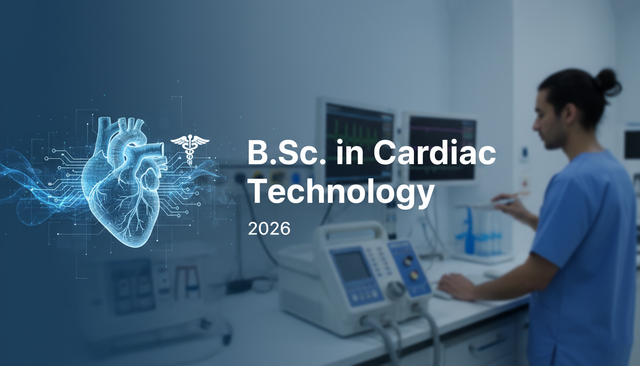
B.Sc. in Cardiac Technology (2026 Intake)
Advance Your Career in Cardiovascular Diagnostics and Interventional Support
1. Course Overview & Key Highlights
The B.Sc. in Cardiac Technology is a specialized, rigorous undergraduate program designed to train highly skilled professionals capable of operating sophisticated cardiovascular equipment and assisting cardiologists during complex diagnostic and interventional procedures. Focused heavily on practical clinical exposure, this course addresses the critical need for proficient allied health staff in managing the rising global incidence of cardiovascular diseases (CVDs).
Key Highlights of the B.Sc. Cardiac Technology Program
| Attribute | Detail |
|---|---|
| Course Name | Bachelor of Science in Cardiac Technology |
| Course Level | Undergraduate (B.Sc.) |
| Duration | 4 Years (3 Years Academic + 1 Year Mandatory Clinical Internship) |
| Eligibility Criteria | 10+2 (PCB/PCMB Stream) with minimum 50% aggregate. |
| Entrance Exams | Institutional or National Level Entrance Examination Required. |
| Course Fees (Estimate) | INR 80,000 – INR 2,00,000 per annum (Varies by institution) |
| Admission Process | Entrance-based followed by Personal Interview/Counseling. |
| Key Subjects | Cath Lab Procedures, Echocardiography, Cardiovascular Pharmacology, Hemodynamic Monitoring, Radiation Safety. |
| Examination Type | Semester-wise theory and practical exams (including OSCEs and CCTs). |
| Average Starting Salary | INR 3.5 Lakhs – 7 Lakhs per annum (Highly dependent on location and facility type). |
2. Course Identity & Logistics
This program is structured around an Interprofessional Education (IPE) model, ensuring technologists train alongside future doctors and nurses, fostering collaborative patient care.
- Course Title & Code: B.Sc. Cardiac Technology (CT-UG-401)
- Credit Value/ECTS: Approximately 160 Total Credits (as per University/Council norms).
- Format: Hybrid (Lectures, Seminars, Mandatory Skills Lab sessions, High-Fidelity Simulation, Extensive Clinical Rotations).
- Instructor/Department Info: Taught by experienced Cardiac Technologists, Consulting Cardiologists, and Allied Health Faculty from the Department of Cardiovascular Sciences.
- Affiliation/Accreditation: Affiliated with a recognized University and relevant Allied Health Council (e.g., UGC/AICTE recognized).
3. Course Description & Rationale
Summary: The B.Sc. in Cardiac Technology is a comprehensive 4-year program providing deep knowledge in cardiovascular anatomy, physiology, and pathology, coupled with intensive training in diagnostic and interventional procedures. Graduates emerge as competent Cardiac Technologists, proficient in handling equipment like ECG machines, TMT systems, Holter monitors, and highly sophisticated Cath Lab machinery.
Curriculum Context: The curriculum integrates modern technological advancements, including the application of Artificial Intelligence (AI) in cardiac imaging and the principles of Telecardiology, preparing students for the future landscape of healthcare delivery.
Industry Relevance (2025 Trends): Cardiovascular Diseases (CVDs) remain the leading cause of mortality globally. The program’s rationale is to directly address the critical shortage of highly skilled, internationally benchmarked paramedical staff needed to operate complex surgical and diagnostic units. Training focuses heavily on patient safety, radiation protection, and ethical practice required in high-stakes environments like the Cardiac Catheterization Lab.
Target Audience: Students who have successfully completed their Higher Secondary Education (10+2) with a strong foundation in science, possess excellent fine motor skills, and are dedicated to a career involving direct patient care and technical precision.
4. Prerequisites & Eligibility
Meeting the following criteria is mandatory for admission to the B.Sc. Cardiac Technology program:
Academic Prerequisites
- Educational Qualification: Successful completion of 10+2 or equivalent examination.
- Required Stream: Mandatory study of Physics, Chemistry, and Biology (PCB) or Physics, Chemistry, Mathematics, and Biology (PCMB) in 10+2.
- Minimum Aggregate: Typically 50% - 60% aggregate marks in the core science subjects (P, C, B) is required, varying by institution.
Selection and Health Requirements
- Selection Process: Must qualify in the mandatory institutional or national entrance examination.
- Interview: Performance in a Personal Interview (PI) may be factored into the final merit list.
- Health Requirement: Submission of a mandatory medical fitness certificate confirming physical capability for rigorous clinical duties.
5. Learning Objectives (LOs)
By the end of this course, students will be able to demonstrate proficiency across technical, clinical, and ethical domains:
- Define: Key terminology related to cardiovascular pathology, pharmacology, and biomedical instrumentation principles.
- Apply: Tools and frameworks for performing and troubleshooting non-invasive procedures, including 12-lead ECG, TMT, and Holter monitoring setup.
- Analyze: Complex hemodynamic data and basic cardiac rhythms accurately to assist in preliminary diagnosis and patient monitoring during critical care.
- Evaluate: Solutions critically regarding patient safety, sterile field maintenance, and radiation dosimetry during Cath Lab procedures (Angiography, Angioplasty).
- Create: Novel clinical case study reports or a Capstone Project based on observed practices or minor research, contributing to evidence-based practice in cardiac technology.
6. Course Materials & Resources
Required Textbooks (Illustrative Examples)
- Cardiovascular Anatomy & Physiology by J. Smith (Focus on clinical relevance).
- Principles of Cardiac Technology: Non-Invasive Procedures by K. Sharma.
- The Cath Lab Handbook: Interventional Procedures and Safety by L. Chen.
- Basic Biomedical Instrumentation and Monitoring by R. Singh.
Reference Materials & Facilities
- Digital Resources: Access to institutional Learning Management System (LMS), subscribed e-journals (e.g., JACC), and video lecture repositories.
- Practical Facilities: Dedicated Skills Lab equipped with diagnostic simulation equipment, high-fidelity cardiac simulation mannequins, and guaranteed rotational exposure to a functional, high-volume Cardiac Catheterization Lab.
- Clinical Rotations: Mandatory postings across CCU (Coronary Care Unit), ICU (Intensive Care Unit), and Non-Invasive Diagnostic Labs affiliated with the teaching hospital.
7. Detailed Syllabus & Module Breakdown
The 4-year program is systematically divided into foundational, application, and advanced clinical integration phases, culminating in a mandatory 1-year internship.
Phase I: Foundations (Year 1 Focus)
Objective: Establish core vocabulary and principles of human biology and basic medical technology.
- Week 1: Human Anatomy (Cardiovascular Focus) and Medical Terminology.
- Week 2: Medical Physiology (Cardiac Cycle, Hemodynamics).
- Week 3: Fundamentals of Medical Physics, Basic Electronics, and Biomedical Instrumentation.
- Week 4: Basic Life Support (BLS) Certification and Introduction to Hospital Ethics and Management.
Phase II: Application & Core Concepts (Year 2 Focus)
Objective: Practical application of theories; mastering non-invasive diagnostic techniques and procedural theory.
- Week 5: Detailed Electrocardiography (ECG) – Recording, Standardization, and Interpretation of Basic Rhythms.
- Week 6: Treadmill Testing (TMT) and Holter Monitoring – Protocols, Patient Preparation, and Report Generation.
- Week 7: Principles of Echocardiography (2D, M-Mode, Doppler Physics) and Ultrasound Safety.
- Week 8: Midterm Evaluation and Practical Skill Assessment in Non-Invasive Labs.
- Week 9: Introduction to Cardiovascular Pharmacology, Drug Classes, and Administration Routes.
Phase III: Advanced & Clinical Integration (Year 3 Focus)
Objective: Advanced complexity, synthesis, and preparation for interventional roles and critical care.
- Week 10: Advanced Cath Lab Technology: Angiography, Patient Prep, Scrubbing, and maintaining Sterile Technique.
- Week 11: Interventional Support: Balloon Pump Operation, Stenting Principles, and Hemodynamic Monitoring during procedures.
- Week 12: Specialized Areas: Pacemaker and ICD (Implantable Cardioverter-Defibrillator) Technology and Electrophysiology (EP) basics.
- Week 13: Advanced Cardiac Life Support (ACLS) Certification and Critical Care Monitoring Techniques.
- Week 14: Radiation Protection, Dosimetry, Bioethics, and Mandatory Capstone Project Proposal Submission.
8. Assessment & Grading Scheme
Assessment ensures a balanced evaluation of theoretical understanding, technical precision, and professional conduct.
Evaluation Distribution Table
| Evaluation Component | Weightage | Description |
|---|---|---|
| Assignments/Quizzes & Seminars | 15% | Continuous internal assessment, case presentations, and mandatory logbook maintenance. |
| Midterm Exam (Theory & Practical) | 25% | Tests knowledge application halfway through the semester. |
| Final Project/Capstone | 10% | Mandatory research paper or detailed clinical case study submitted in Year 3/4. |
| End-of-Semester/Year University Exam (Theory) | 30% | External, comprehensive examination of theoretical knowledge. |
| Practical Assessment (OSCEs/CCTs/Viva Voce) | 20% | Objective Structured Clinical Examinations and Clinical Competency Checklists during rotations. |
| TOTAL | 100% |
Passing Criteria
Students must achieve a minimum of 50% marks in both the theoretical component and the practical/clinical component separately to pass the semester/year and advance to the next phase.
9. Course Policies
Academic Integrity
The institution enforces a strict zero-tolerance policy against plagiarism, cheating, or any form of academic misconduct. Students are expected to adhere to the highest standards of integrity in all written and practical work.
Attendance Requirements
- Theory Classes: Minimum 75% attendance is required to be eligible to sit for the end-of-semester examinations.
- Practical/Clinical Rotations: Minimum 90% attendance is mandatory due to the critical nature of hands-on training and patient exposure.
Late Submissions Policy
Assignments submitted after the deadline will incur penalties, typically a deduction of 10% per day, unless accompanied by documented extenuating circumstances approved by the course coordinator.
Clinical Rotation Policy
Strict adherence to patient confidentiality (HIPAA/GDPR equivalents), radiation safety protocols, and hospital infection control guidelines is non-negotiable. Any breach of patient safety will result in immediate disciplinary action.
10. Career Scope & Certification
Graduates of the B.Sc. in Cardiac Technology are highly sought after globally, given the specialized and essential nature of their skills in modern cardiovascular healthcare.
Certification Details
Upon successful completion of the 4-year program (including the mandatory internship), students are awarded the Bachelor of Science degree. Graduates also typically receive certifications in Basic Life Support (BLS) and Advanced Cardiac Life Support (ACLS).
Skills Acquired
- Technical Skills: Expertise in Echocardiography operation, Cath Lab scrubbing, hemodynamic monitoring, defibrillation, and TMT operation.
- Soft Skills: Critical thinking, rapid decision-making in emergencies, effective communication with surgical teams, and high-level professionalism and empathy.
Primary Job Roles and Salary Estimates
| Job Role | Description | Avg. Starting Salary (INR p.a.) |
|---|---|---|
| Cardiac Catheterization Lab Technologist | Assists interventional cardiologists during procedures (angiography, angioplasty, stenting), manages inventory, and ensures radiation safety. | 4.5 L – 7.0 L |
| Cardiac Sonographer / Echocardiography Technician | Performs non-invasive ultrasound imaging of the heart (Echo, TEE) and generates preliminary reports. | 4.0 L – 6.5 L |
| Cardiovascular Invasive Specialist | Specializes in Electrophysiology (EP) studies or complex device implantations (Pacemakers, ICDs). | 5.0 L – 8.0 L |
| ECG/TMT Technician | Manages non-invasive diagnostic tests in OPD or specialized diagnostic centers. | 3.5 L – 5.0 L |
Further Studies Recommendations
Graduates are eligible to pursue higher education, including M.Sc. in Cardiac Technology, M.Sc. in Medical Technology, or specialized international certifications such as Registered Cardiovascular Invasive Specialist (RCIS).
11. Frequently Asked Questions (FAQs)
What is the typical admission process for the B.Sc. in Cardiac Technology?
Admission is primarily merit-based but requires qualification through a competitive entrance examination (either institutional or national level). Successful candidates often proceed to a personal interview round and mandatory counseling before final selection.
Is the B.Sc. Cardiac Technology course equivalent to an MBBS degree?
No, the B.Sc. in Cardiac Technology is an Allied Health Science professional course. It focuses entirely on technical assistance, diagnostics, equipment operation, and procedural support. Graduates do not diagnose diseases, prescribe medication, or perform surgical interventions independently; they work under the direct supervision of qualified medical doctors (Cardiologists).
What core subjects should I focus on in 10+2 to be eligible?
To meet the academic eligibility criteria, you must have successfully studied Physics, Chemistry, and Biology (PCB) in your 10+2. While Mathematics is often optional, having a strong foundation in all four (PCMB) is beneficial due to the course's emphasis on medical physics and biomedical instrumentation.
How is the 4-year course structured, and what is the role of the internship?
The program is structured as 3 years of intensive academic and laboratory training, followed by 1 year of mandatory, full-time clinical internship/rotational training. The internship is crucial for developing clinical competency, ensuring hands-on mastery of procedures, and meeting professional licensing requirements.
Is the job placement rate high for Cardiac Technologists?
Yes. Due to the high global burden of cardiovascular diseases and the specialized skill set required for Cath Lab and non-invasive procedures, the demand for qualified Cardiac Technologists significantly exceeds supply, leading to high placement rates in specialty hospitals and diagnostic centers worldwide.