pharmacyCOURSE
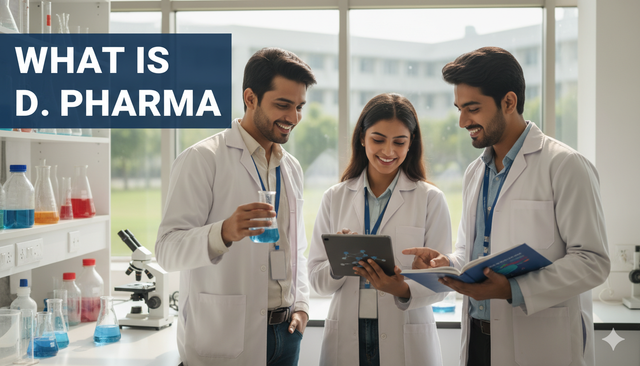
What is D Pharma
what is d pharma ?
Master Course Outline: D. Pharma Master Course Outline: Diploma in Pharmacy (D. Pharma)
[Image of assortment of pharmaceutical drugs and pills]Table of Contents (Click to Jump)
- 1. Course Identity
- 2. Course Overview
- 3. Eligibility & Prerequisites
- 4. Learning Outcomes
- 5. Course Syllabus
- 6. Practical Training
- 7. Assessment & Grading
- 8. Tools & Resources
- 9. Career Scope
- 10. Fee Structure & Duration
1. Course Identity (The Basics)
This section provides the administrative details to identify the course.
| Course Name | Diploma in Pharmacy |
|---|---|
| Course Code | D. Pharm (Varies by Institute) |
| Level | Undergraduate Diploma |
| Duration | 2 Years (Academic) + 500 Hours (Internship) |
| Mode of Delivery | On-Campus (Regular) - Distance learning is invalid for Pharmacy in many regions. |
| Certifying Body | Pharmacy Council of India (PCI) & State Technical Education Boards |
2. Course Overview (The "Hook")
- Description: This course covers the fundamentals of pharmaceutical science, including the chemistry of drugs, human anatomy, and the proper dispensing of medication.
- Purpose: Designed to train students to become Registered Pharmacists who bridge the gap between medical doctors and patients by ensuring safe drug usage.
- Target Audience: 12th-grade science students who want a quick entry into the healthcare sector or wish to open their own pharmacy business.
3. Eligibility & Prerequisites (The Requirements)
- Academic Qualification: Passed 10+2 (Higher Secondary) from a recognized board.
- Subject Requirement: Physics, Chemistry, and either Biology or Mathematics (PCB or PCM).
- Required Skills: Basic scientific aptitude, attention to detail, and communication skills.
- Entrance Exams: Varies by state (e.g., JEECUP in UP, MHT-CET in Maharashtra) or Direct Merit-based admission.
- Age Limit: Minimum 17 years at the time of admission.
4. Learning Outcomes (The "Promise")
At the end of this course, students will be able to:
- Understand: The chemical structure of drugs, human physiology, and the laws governing the sale of medicines.
- Apply: Techniques to compound and dispense medicines accurately according to a doctor's prescription.
- Analyze: A prescription for potential drug interactions or dosage errors.
- Create: Patient counseling plans to explain how and when to take medicines.
5. Course Syllabus (The Roadmap)
The curriculum is strictly regulated by the Pharmacy Council. It is divided into two academic years.
Year 1: Foundations & Basics
- Pharmaceutics I: Introduction to dosage forms (tablets, syrups).
- Pharmaceutical Chemistry I: Inorganic chemistry, acids, bases, and buffers.
- Pharmacognosy: Study of herbal and natural drugs (plants).
- Biochemistry & Clinical Pathology: Blood tests, urine analysis, and metabolism.
- Human Anatomy & Physiology: Study of body systems (skeletal, digestive, etc.).
- Practical: Preparation of lotions, powders, and basic chemical analysis.
Year 2: Core Technical Knowledge & Ethics
- Pharmaceutics II: Advanced dispensing, injections, and prescriptions.
- Pharmaceutical Chemistry II: Organic chemistry and drug structures.
- Pharmacology & Toxicology: How drugs affect the body and side effects.
- Pharmaceutical Jurisprudence: Pharmacy Acts, Narcotic Laws, and Ethics.
- Drug Store & Business Management: Accounting, inventory, and running a shop.
- Hospital & Clinical Pharmacy: Managing hospital drug stores and patient records.
6. Practical Training & Internship
D. Pharma is a skill-heavy course requiring extensive hands-on experience.
- Lab Work: Daily practical sessions in Chemistry, Pharmaceutics, and Anatomy labs (approx. 10-12 hours/week).
- Internship (Mandatory): After completing the final exams, a student must undergo 500 hours (minimum 3 months) of practical training.
- Internship Venue: Must be done at a Govt. Hospital or a recognized Dispensary under a Registered Pharmacist.
7. Assessment & Grading (The Score)
| Assessment Type | Weightage / Description |
|---|---|
| Theory Exams | Annual Board Exams (80 marks per subject). |
| Practical Exams | Lab performance, synopsis, and Spotting (80 marks). |
| Sessional (Internal) | Mid-term tests and day-to-day performance (20 marks). |
| Passing Criteria | Minimum 40% required separately in Theory and Practical. |
8. Tools & Resources (The Kit)
- Textbooks: Standard books by authors like R.M. Mehta (Pharmaceutics) or Dr. Ali (Pharmacognosy).
- Gear: White Lab Coat (Apron) is mandatory.
- Kits: Dissection box (for anatomy practicals) and Titration kit.
- Online Resources: Pharmacy Council of India website, online drug indices (CIMS/MIMS).
9. Career Scope & Job Opportunities (The Future)
Upon registration with the State Pharmacy Council:
- Job Roles: Hospital Pharmacist, Retail Chemist, Medical Representative (MR), Production Technician.
- Industries: Government Health Depts, Private Hospitals, Pharmaceutical Manufacturing, Retail Chains (Apollo, Frank Ross).
- Higher Education: Direct admission to 2nd Year of B. Pharma (Lateral Entry).
- Salary Expectations:
- Entry Level: ₹12,000 - ₹20,000 per month.
- Business (Own Shop): Varies based on location and sales.
10. Fee Structure & Duration
- Government Colleges: ₹10,000 - ₹40,000 per year (Highly subsidized).
- Private Colleges: ₹60,000 - ₹1,20,000 per year.
- Additional Costs: Exam fees (approx ₹2k-3k), Lab Manuals, Uniform.
- Scholarship Options: State-level post-matric scholarships for reserved categories (SC/ST/OBC).