SSC CGL 2026 Ultimate Guide: Start Your 18-Month Preparation Strategy Now
If you are aiming for a highly respected government job in ministries like External Affairs, Railways, or the CBDT, the Staff Selection Commission Combined Graduate Level (SSC CGL) examination is your gateway. Competition is fierce, with millions of applicants vying for limited spots.
Success in CGL 2026 won't come from a last-minute scramble. It requires a strategic, marathon approach. This guide is specifically designed for serious aspirants—college students and recent graduates—who are ready to dedicate the next 18 months to securing a top rank. Starting now is not just a choice; it's the competitive edge you need.
Understanding the SSC CGL 2026 Exam Landscape
Before diving into studies, you must clearly define your goal. What exactly is SSC CGL, and what jobs does it offer?
What is SSC CGL? (Roles and Career Scope)
The CGL exam selects candidates for Group ‘B’ and Group ‘C’ posts across various Central Government Ministries and Departments. These roles often offer excellent salary packages, job security, and significant social standing. Examples include Assistant Section Officer (ASO), Income Tax Inspector, and Assistant Enforcement Officer.
Expected Eligibility Criteria (Age Limit and Educational Qualifications)
While the official criteria for 2026 will be released with the notification, they are unlikely to change drastically from previous years. Plan based on these requirements:
Tentative CGL 2026 Notification and Exam Timeline
Based on past cycles, the timeline provides a generous preparation window:
This timeline confirms you have a full 18 months or more to prepare systematically.
Decoding the SSC CGL 2026 Exam Pattern and Syllabus
The SSC CGL 2026 exam consists of two main tiers: Tier-I (Screening) and Tier-II (The Merit Decider, combining subject modules and skills tests).
Tier-I Structure: Screening and Foundation Building
Tier-I is mandatory for all candidates. It is an objective, Computer Based Examination (CBE) that tests your basic analytical and comprehensive skills. Your score here determines if you move to Tier-II.
SSC CGL 2026 Tier-I Exam Pattern (Expected)
Structure and Scoring of Tier-I| Section Name | Number of Questions | Marks per Question | Total Marks |
|---|
| General Intelligence & Reasoning | 25 | 2 | 50 |
| Quantitative Aptitude | 25 | 2 | 50 |
| English Comprehension | 25 | 2 | 50 |
| Total | 100 Questions | | 200 Marks |
| Time Allotted: 60 Minutes (Composite). Negative Marking: 0.50 marks deducted for every wrong answer. |
Tier-II Structure: The Merit Decider
Tier-II is where the competition intensifies. It includes compulsory modules that significantly influence your final selection:
Key Insight: Tier-II tests not just knowledge, but your ability to handle pressurized timed tests and mandatory computer skills.
Detailed Section-Wise Syllabus Breakdown
Focus on the overlap between Tier-I and Tier-II syllabus. Topics are largely the same, but the depth required for Tier-II is significantly higher.
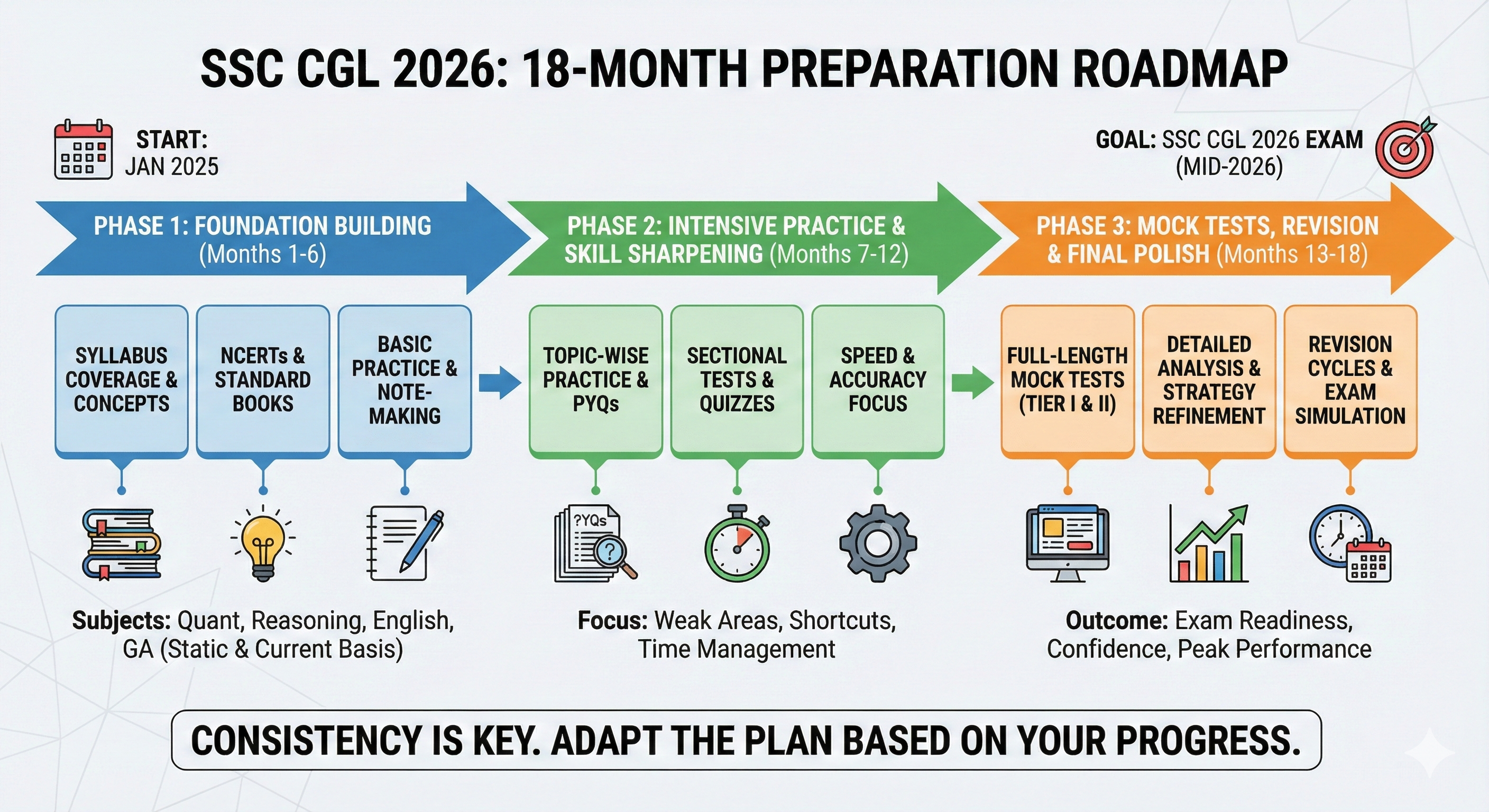
The 18-Month Master Preparation Plan (Starting Early Advantage)
An 18-month plan allows you to study without stress, revisit weak areas multiple times, and build true mastery.
Phase 1 (Months 1-6): Foundation Building and Concept Clarity
The goal of the first six months is to cover 100% of the syllabus basics and identify your inherent strengths and weaknesses.
Phase 2 (Months 7-12): Deep Dive, Practice, and Speed Development
Having covered the basics, this phase is about deepening your understanding and translating knowledge into quick solutions.
Phase 3 (Months 13-18): Mock Tests, Revision, and Exam Simulation
This is the crucial refinement stage, occurring just before the notification and exam date.
Section-Wise Strategy for Maximum Scores
Quantitative Aptitude: Balancing Speed and Accuracy
Quant is often the deciding factor. Since the time limit is tight (60 minutes for 100 questions), you must be fast.
English Language and Comprehension: Grammar vs. Vocabulary
Split your effort equally between rule-based learning (Grammar) and memory-based learning (Vocabulary).
General Awareness: Smart Study (Static GK and Current Affairs Fusion)
This section offers the lowest return on investment if studied randomly. Study smart:
Reasoning Ability: Techniques for Efficiency
Reasoning is generally high-scoring, but time-consuming.
Essential Resources and Common Pitfalls to Avoid
Recommended Books and Online Learning Platforms
Quantitative Aptitude: R.S. Aggarwal or Quantitative Aptitude by Arun Sharma (for concept clarity).English: Word Power Made Easy (for vocabulary) and standard coaching notes for grammar rules.General Awareness: NCERTs (6th-10th) and Lucent’s GK/General Studies manual.Must-Have: A consolidated book of Previous Year Question Papers (PYQs) from 2018 onwards.
The Importance of Mock Tests and Analysis (The 3R Technique)
Mocks are the lifeblood of competitive exam preparation. Use the 3R technique:
Top 5 Mistakes 2026 Aspirants Must Avoid
Ignoring Tier-II Computer Knowledge: This module is mandatory to qualify. Treat it seriously; many high scorers fail here.Relying Solely on Shortcuts: Shortcuts fail when questions are twisted. Master the fundamental method first.Avoiding General Awareness: While vast, skipping it guarantees a low score in Tier-I and Tier-II. Smart study is key.Studying Many Books at Once: Stick to 1-2 standard resources per subject and revise them multiple times.Skipping Mock Analysis: Taking mocks without analyzing them is equivalent to just wasting time.
Key Takeaways for Your 18-Month Plan
Timeline: Dedicate Months 1-6 strictly to foundation (NCERTs and basics).Focus Shift: Shift 70% of your time to Tier-II preparation (Advanced Quant, High-level English) after Month 6.Mandatory Practice: Include 30 minutes of typing practice weekly for the DEST component of Tier-II.Strategy: Use Previous Year Papers (PYQs) not just for practice, but for identifying high-yield topics.
Final Call to Action: Your SSC CGL 2026 Success Starts Now
The SSC CGL 2026 exam is a test of consistency, endurance, and strategic thinking. By committing to an 18-month preparation plan today, you are giving yourself the time needed to turn weaknesses into strengths, manage high volumes of information, and perfect your exam temperament.
Stop waiting for the official notification. The competition has already begun. Download the latest syllabus, choose your first foundational resource, and take the first step toward securing your dream government job.