
🔥 Admissions Open for 2026! Apply Now

NEET 2026 Mega Guide: Official Syllabus, Exam Dates, & The Ultimate 18-Month Power Prep Strategy


Starting early for the National Eligibility cum Entrance Test (NEET) is not just an advantage—it is a necessity. If you are aiming for a top medical college in 2026, your preparation timeline begins now. With competition soaring past 2 million candidates annually, a casual approach simply won't cut it.


This comprehensive guide provides serious NEET 2026 aspirants with the official roadmap, critical syllabus deep dives, competition statistics, and, most importantly, a structured, high-yield 18-month strategy designed to maximize your score and secure that coveted MBBS seat.


NEET 2026: The Official Roadmap (Dates & Exam Pattern)


The National Testing Agency (NTA) is the official body responsible for conducting NEET. While official notifications are typically released only a few months before the exam, the NEET calendar is highly predictable.


Tentative NEET 2026 Exam Date

Historically, the NEET UG exam has been scheduled for the first Sunday of May. Based on this pattern, the NEET 2026 examination is tentatively expected to be held on:

  • Sunday, May 3, 2026 or Sunday, May 7, 2026.
  • Treat this date as your firm deadline and build your 18-month strategy backward from it.


    Key Dates: Registration, Admit Card, & Result Timeline

    Prospective candidates should mark these anticipated windows:

    • Registration Window: February to March 2026.
    • Admit Card Release: Last week of April 2026.
    • Answer Key Release: Late May 2026.
    • Result Declaration: Mid-June 2026.

    • Understanding the NEET Exam Pattern & Marking Scheme

      NEET remains a single, paper-and-pen (OMR-based) test conducted in offline mode.

      • Total Questions: 200 questions presented (180 questions must be attempted).
      • Total Marks: 720.
      • Duration: 3 hours 20 minutes (200 minutes).

      • Student using a calendar and timetable to plan medical school entrance exam preparation
        Effective planning is non-negotiable for the 18-month preparation timeline.

        The Critical Marking Scheme:

        Mastering the marking scheme is vital for test-taking strategy, especially the negative marking:

        ActionMarks Awarded
        Correct Answer+4 Marks
        Incorrect Answer-1 Mark (Negative Marking)
        Unanswered/Unattempted0 Marks

        Deep Dive into the NEET 2026 Syllabus: What Has Changed?


        The Core Blueprint: NCERT is Non-Negotiable

        The NEET 2026 syllabus is expected to align closely with the revised and rationalized NCERT syllabi for Classes 11 and 12. If any units or chapters were removed from the core NCERT textbooks in the last two years, those topics are highly unlikely to feature heavily in the 2026 examination.

        Pro Tip: Stick strictly to the current NCERT editions. For Biology, 95% of questions are drawn directly from the text and diagrams.


        Key Subject Weightage & Recent Trends

        Understanding which subject commands the most attention is key to efficient time management:

        • Biology (Botany & Zoology): Accounts for 50% of the total paper (360 marks). This is the highest-yield subject.
        • Physics and Chemistry: Each accounts for 25% of the total paper (180 marks each).
        • Trending Fact: Recent examinations have shown an increased emphasis and weightage on the Class 12 syllabus across all subjects, making thorough coverage of the second year critical.


          Subject-Wise Syllabus Breakdown (High-Yield Topics)


          Physics:

          Physics often acts as the primary differentiator for securing a top rank. Focus less on theory and more on formula application.

          • High-Yield Units: Mechanics (especially Rotational Motion and Gravitation) and Electrodynamics (Current Electricity, Electrostatics).
          • Strategy: Practice numerical problems consistently. Stick to core concepts—don’t get lost in overly complex or out-of-syllabus derivations.

          • Chemistry:

            Chemistry is frequently cited as the most scoring section, provided you have strong foundational knowledge.

            • Physical Chemistry: Heavily numerical. Focus on Equilibrium, Thermodynamics, and Chemical Kinetics.
            • Inorganic Chemistry: Memory-based. Direct questions from NCERT on chemical bonding, P, D, and F-block elements.
            • Organic Chemistry: Reaction-based. Master General Organic Chemistry (GOC) and reaction mechanisms.

            • Biology (Botany & Zoology):

              To score 360/360, precision is required. Questions are generally direct but highly specific.

              • Class 11 Focus: Diversity, Plant Physiology, and Human Physiology are massive units.
              • Class 12 Focus: Genetics and Biotechnology are extremely high-yield and often feature challenging conceptual and interdisciplinary questions.

              • The Competition Crunch: Vital Statistics for 2026 Aspirants


                The Applicant vs. Seat Ratio: Why Competition is Fierce

                The sheer volume of competition demands a structured, long-term strategy. The numbers speak for themselves:
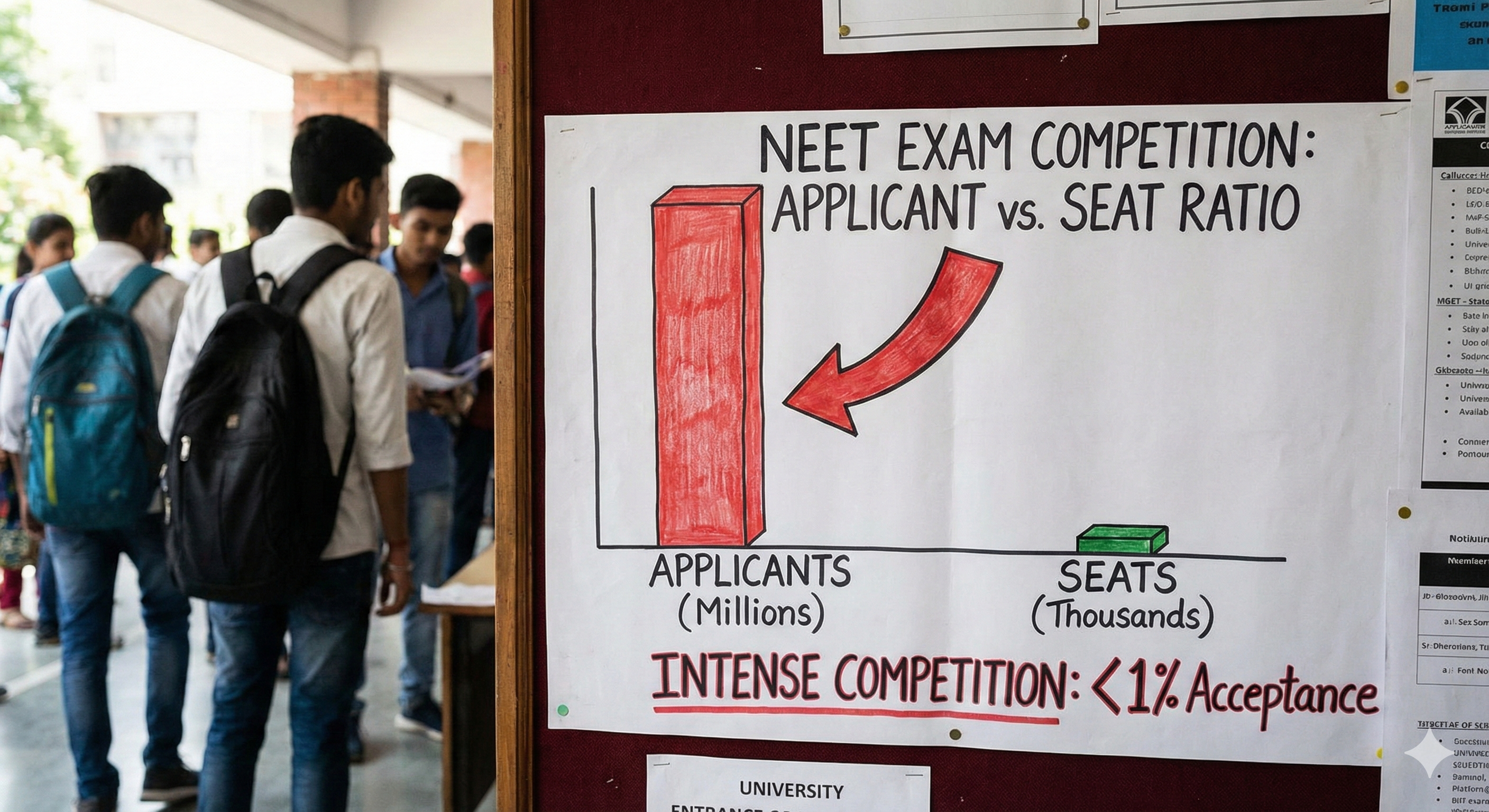

                Many students competing for limited medical college seats
                The Applicant vs. Seat ratio shows the intense competition in the NEET exam.

                NEET 2026 Competition Projection

                Based on recent trends, these are the critical statistics you are competing against:

                • Annual Applicants: Over 2 million aspirants.
                • Total Projected MBBS Seats: Approximately 1,26,600 (including government and private).
                • Government MBBS Seats: Only around 55,000.
                • This means only about 2.7% of test-takers will secure an MBBS seat, and less than 1.5% will get a seat in a government college.


                  Analyzing the Difficulty Trend (Easy to Very Tough?)

                  While NEET has historically hovered between easy to moderate difficulty, recent trends indicate an upward shift, particularly in the analytical sections of Physics and Chemistry.

                  • NEET 2025 Analysis: Many experts analyzed the paper as significantly tougher than previous years, focusing on complex, multi-concept questions.
                  • The 2026 Projection: Expect the difficulty level to remain high or increase slightly, rewarding students who master conceptual clarity over rote memorization.

                  • Safe Score and Cut-off Projections for Top Colleges

                    Given the increasing difficulty and competition, the minimum "safe score" needed for admission into a top-tier government medical college (like AIIMS or Maulana Azad Medical College) remains incredibly high.

                    Aspirants should aim for a target score of 650+ out of 720 to feel secure about receiving a government seat in their home state and 680+ for the top central institutes.


                    Your Ultimate 18-Month NEET 2026 Power Prep Strategy


                    The 18-month preparation window provides a golden opportunity to master Class 11 concepts without rushing, complete Class 12 seamlessly, and dedicate extensive time to revision and mock tests. This strategy is divided into three critical phases:


                    Phase 1 (Months 1-6): Foundation Building & Class 11 Mastery

                    The goal of this phase is depth, not speed. Focus entirely on Class 11 syllabus and foundational concepts.

                    • NCERT Line-by-Line: Read NCERT texts and make concise, short notes for every chapter.
                    • Concept Clarity: Do not move on until complex Physics and Physical Chemistry concepts (e.g., laws of motion, thermodynamics) are completely clear.
                    • Daily Practice: Solve at least 50-70 conceptual questions daily relevant to the topic covered.
                    • Weekly Review: Allocate every Sunday morning purely for reviewing the week’s tough topics.

                    • Phase 2 (Months 7-12): Class 12 Coverage & Interlinking Topics

                      This phase demands efficiency. You must cover the Class 12 syllabus while simultaneously keeping Class 11 fresh.

                      • Synchronized Study: Link relevant Class 11 and Class 12 topics (e.g., covering Molecular Basis of Inheritance (12) immediately after covering Cell Biology (11)).
                      • Active Recall: Use your Class 11 short notes daily for 30 minutes before starting the Class 12 material.
                      • Question Banks: Begin using structured question banks and previous year papers (PYQs) for Class 11 topics to assess retention.

                      • Phase 3 (Months 13-18): Revision, Mock Tests, & High-Yield Practice

                        This is the acceleration phase, governed by the 3-R Formula: Revision, Re-attempt, Rank.

                        • Month 13-15 (First Full Revision): Dedicate this time to a rapid review of the entire syllabus (Class 11 + 12).
                        • Mock Tests (Months 16-18): Start taking full-length, timed mock tests every 1-2 weeks.
                        • Analysis is Key: Dedicate an equal amount of time to analyzing your mock test mistakes as you did to taking the test. Use a dedicated mistake tracker.
                        • The Final Weeks: Focus solely on your weak areas and memorizing factual data, chemical structures, and formulas.

                        • Flowchart detailing an 18-month preparation strategy leading to exam success
                          The 18-month strategy involves three distinct phases: Foundation, Coverage, and Intensive Revision.

                          Strategic Subject-Specific Tips for Maximum Score


                          Physics: Mastering Problem-Solving Techniques and Formulas

                          Physics scores determine rank. Shift focus from solving 100 simple problems to solving 20 complex, multi-conceptual problems correctly.

                          • Formula Sheets: Maintain a dedicated, handwritten formula sheet for quick daily review.
                          • Dimensional Analysis: Use dimensional analysis to quickly eliminate incorrect options in MCQs.
                          • Mock Test Priority: Always attempt Physics last in your mock tests, allocating at least 50 minutes purely for this section.

                          • Chemistry: Leveraging the Most Scoring Subject

                            Chemistry is often the quickest section to attempt and offers the maximum return on time invested.

                            • Inorganic: Treat Inorganic Chemistry like Biology; memorize facts, trends, and exceptions directly from NCERT.
                            • Organic: Focus on naming reactions and reaction mechanisms. Understand *why* a reaction occurs, not just *what* the product is.

                            • Biology: Achieving the 360/360 Goal

                              Biology is the bedrock of your NEET score. Aiming for perfection here provides the buffer needed for harder sections.

                              • Source: NCERT, NCERT, NCERT. Do not rely on external material for basic facts.
                              • Diagrams: Memorize all NCERT diagrams, labels, and associated functions. Questions on plant morphology and anatomy often hinge on diagrammatic recall.
                              • Fast Revision: Biology notes should be highly condensed, allowing you to revise an entire unit in 30 minutes during the final phase.

                              • Final Takeaway: Mindset and Maintaining Momentum


                                The Importance of Mental Health & Periodic Breaks

                                The 18-month journey is a marathon, not a sprint. Burnout is a genuine threat to long-term success.

                                • Schedule Breaks: Mandate one evening off per week and ensure 7-8 hours of quality sleep nightly.
                                • Nutrition and Fitness: Studies show a direct correlation between physical health and memory retention. Don't neglect exercise and a balanced diet.

                                • When to Switch from Self-Study to Coaching/Online Resources

                                  The choice between self-study and coaching depends entirely on your learning style and discipline.

                                  • If you struggle with consistency, need structured tests, or find advanced topics (like Mechanics or Genetics) difficult to grasp from books alone, enrolling in a high-quality coaching program (online or offline) during Phase 1 or Phase 2 is highly recommended.
                                  • Use resources that specialize in conceptual clarity rather than just providing vast amounts of material.

                                  • A focused, confident student studying hard with books and notes
                                    Success in NEET 2026 relies on consistency, conceptual mastery, and a structured plan.

                                    Key Takeaways for NEET 2026 Aspirants

                                    • Start Now: The 18-month plan is your competitive edge; don't delay Phase 1 (Class 11 Mastery).
                                    • NCERT Dominance: Treat NCERT as the only textbook for Biology and the primary guide for Chemistry.
                                    • Target 650+: Assume high competition and aim for a score above 650 to secure a comfortable government MBBS seat.
                                    • Mock Test Analysis: From Month 16 onward, your rank is determined by how well you analyze your mistakes, not just how many tests you take.

                                    • The path to becoming a doctor is challenging, but with this focused, 18-month strategy, you are already steps ahead of the competition. Dedication today ensures success tomorrow.

                                      CallWhatsApp