
MHTCET 2026 Blueprint: Syllabus, Strategy, and 2-Year Roadmap for 99+ Percentile Score
Are you in Class 11 or just starting Class 12? If securing a seat in elite Maharashtra colleges like COEP, VJTI, or PICT is your dream, the time to plan for MHTCET 2026 is right now. This comprehensive guide breaks down the official exam structure, syllabus weightage, and provides a detailed 24-month strategy tailored for future 99+ percentile scorers.
Table of Contents
Introduction: Why MHTCET 2026 Demands Early Planning
Many students wait until their Class 12 final exams are over before focusing on competitive tests. This is a critical mistake for the MHTCET. Because the CET syllabus draws heavily from both Class 11 and Class 12 topics, starting early ensures that you don't struggle later under the combined pressure of Boards and CET prep.
Understanding the Importance of the State Common Entrance Test (CET)
The MHTCET is the gateway to nearly 80% of all engineering (B.Tech) and pharmacy (B.Pharma/D.Pharma) seats in the state of Maharashtra. While JEE Mains offers admission through the All India Quota, MHTCET provides the primary admission route for students with Maharashtra domicile, offering a higher chance of securing seats in state-run and autonomous institutions.
MHTCET vs. JEE Mains: Key Differences to Note
While both exams test the same core PCM/PCB syllabus, their approach and difficulty levels differ significantly. Understanding these differences allows you to tailor your preparation efficiently.
| Parameter | MHTCET | JEE Mains |
|---|---|---|
| Difficulty Level | Moderate to Easy (More direct questions) | High (Conceptual, multi-step problems) |
| Syllabus Focus | 20% Class 11 + 80% Class 12 | Balanced 50% Class 11 + 50% Class 12 |
| Negative Marking | None! (A huge advantage) | Yes, 1 mark deduction per wrong answer. |
| Exam Frequency | Once per year (in multiple shifts) | Twice per year (January and April sessions) |
Official Snapshot: Eligibility and Tentative MHTCET 2026 Dates
Academic and Domicile Eligibility Criteria
Defining the PCM and PCB Groups (Engineering vs. Pharmacy/Agriculture)
When registering, you must select the group corresponding to your desired career path:
Expected Timeline: Registration, Exam Window, and Results (Based on Historical Trends)
While official dates for 2026 will be released later, the historical timeline is crucial for planning:
Deconstructing the MHTCET 2026 Exam Pattern
The MHTCET is conducted online (Computer Based Test or CBT). The exam is divided into two or three papers depending on the group you choose. Each paper is 90 minutes long.
Subject-wise Breakdown (Questions, Marks, and Time Allotment)
| Subject Group | Subject | Questions (Class 11 & 12) | Marks per Question | Total Marks | Time Allotted |
|---|---|---|---|---|---|
| Paper 1 (Compulsory) | Physics | 50 | 1 Mark | 50 | 90 Minutes |
| Chemistry | 50 | 1 Mark | 50 | ||
| Paper 2 (Engineering) | Mathematics | 50 | 2 Marks | 100 | 90 Minutes |
| Paper 3 (Pharmacy/Agri) | Biology (Botany + Zoology) | 100 | 1 Mark | 100 | 90 Minutes |
The Scoring System: Marks Per Question and Crucial No Negative Marking Advantage
Notice the key difference: Physics and Chemistry questions carry 1 mark each, while Mathematics questions carry 2 marks each. This makes Mathematics the highest weightage single subject (100 marks) in the PCM group.
Crucial Tip: Since there is absolutely NO negative marking, you must attempt all 150 questions (for PCM) or all 200 questions (for PCB) without fail!
The Online Format (CBT) and Mock Test Importance
Practicing in the Computer-Based Test (CBT) format is non-negotiable. Familiarity with the interface, question navigation, and time constraints is essential to maximize your score.
Syllabus Mastery: Understanding the Class 11 and 12 Weightage
The Official Ratio: 20% Focus on Class 11 Topics (Mandatory Study)
The State CET Cell officially allocates approximately 20% of the questions to the Class 11 syllabus and 80% to the Class 12 syllabus. While the Class 12 portion is larger, the 20% from Class 11 serves as the absolute foundation. If your Class 11 concepts are weak, the Class 12 topics will be difficult to master.
| Subject | Questions from Class 11 (Approx 20%) | Questions from Class 12 (Approx 80%) | Total Questions |
|---|---|---|---|
| Physics | 10 | 40 | 50 |
| Chemistry | 10 | 40 | 50 |
| Mathematics | 10 | 40 | 50 |
| Biology (PCB) | 20 | 80 | 100 |
High-Yield Topics for PCM (Physics, Chemistry, Math)
Focus your initial revision on these topics, as they frequently appear and often carry conceptual connections to advanced Class 12 subjects:
High-Yield Topics for PCB (Physics, Chemistry, Biology)
The 24-Month Strategic Preparation Roadmap for 2026 Aspirants
Success in MHTCET 2026 is a marathon, not a sprint. Follow this phased approach to ensure consistent progress and peak performance.
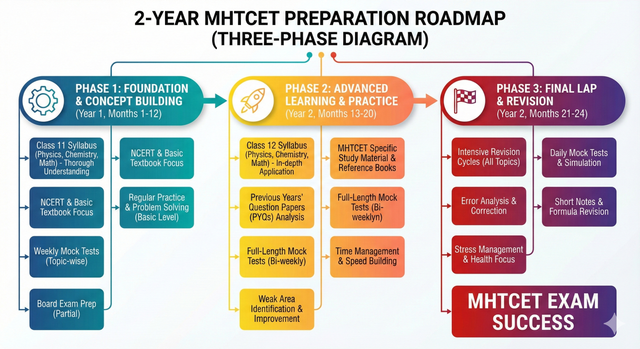
Phase 1 (Class 11 Fundamentals): Conceptual Clarity and Foundation Building (Months 1-12)
Your primary goal here is flawless integration of your Class 11 Board syllabus with MHTCET requirements.
Phase 2 (Class 12 & Integration): Simultaneous Completion and Backlog Clearing (Months 13-18)
This phase is the most challenging, requiring you to cover 80% of the syllabus while managing Class 12 Boards.
Phase 3 (Final 6 Months): Intensive Revision and Mock Test Domination (Months 19-24)
The final push is purely about speed, accuracy, and endurance.
Essential Resources and Practice Strategy
Must-Have Textbooks (HSC Boards, Reference Guides, Specific CET Books)
Your preparation should rely on a mix of foundational texts and dedicated question banks:
The Art of Mock Test Analysis: Converting Weaknesses into Strengths
Taking a mock test is only 50% of the job; analyzing it is the other 50%.
Time Management Techniques for the 90-Minute Subject Sections
In Physics and Chemistry, you have 90 minutes for 100 questions (less than a minute per question). In Math, you have 90 minutes for 50 questions (1.8 minutes per question). The strategy must adapt:
P & C Strategy: Aim to finish the 50 Chemistry questions in 35-40 minutes, leaving maximum time for the usually calculation-heavy 50 Physics questions.
Maths Strategy: Attempt all theory-based and formula-based questions first. Mark calculation-intensive problems for the second round. Remember, every question is worth 2 marks!
Post-Exam Planning: The Centralized Admission Process (CAP)
Your journey doesn't end with the exam; securing your dream college requires strategic participation in the CAP rounds.
How MHTCET Scores are Converted into Percentiles
Since the exam is conducted in multiple shifts with different difficulty levels, raw scores are normalized into percentiles. The percentile indicates the percentage of candidates who scored equal to or less than you. A 99 percentile means 99% of candidates scored less than you.
Aspirational Targets: Percentile Required for Top Engineering Colleges (COEP, VJTI, etc.)
To be competitive for CSE, IT, or E&TC branches in the state's most sought-after colleges, you must aim for the 99th percentile and above.

| College Name | Course (Example) | Required Percentile (Approx.) |
|---|---|---|
| VJTI Mumbai | Computer Engineering / E&TC | 99.50+ |
| COEP Pune | Computer Science / Mechanical | 99.20+ |
| PICT Pune | Information Technology (IT) | 99.00+ |
| SPCE Mumbai | Civil / Mechanical | 98.50+ |
Understanding the CAP Rounds and Document Verification
The Centralized Admission Process (CAP) involves multiple rounds where seats are allocated based on merit and preference. Be meticulous in filling out your option form and ensure all domicile, academic, and category documents are ready before the CAP window opens.
FAQs (Frequently Asked Questions)
Is MHTCET easier than JEE Mains?
Yes, generally MHTCET is considered easier than JEE Mains in terms of question difficulty. MHTCET focuses more on direct application of formulas and facts, whereas JEE Mains emphasizes complex multi-conceptual problem-solving. However, MHTCET is more time-constrained due to the high volume of questions.
Can I choose both PCM and PCB groups?
Yes. If you have studied all four subjects (Physics, Chemistry, Mathematics, and Biology) in Class 12, you can register and appear for both PCM and PCB groups. This allows you to apply for both Engineering and Pharmacy/Agriculture courses.
How much percentile is required for CSE/IT in a top college?
For Computer Science Engineering (CSE) or Information Technology (IT) in the top 5 colleges (like VJTI, COEP), a student in the General category must aim for a percentile of 99.50 or higher. For reserved categories, this typically ranges between 97.5 to 99.0+.
Key Takeaways for MHTCET 2026 Aspirants
Ready to start your journey? Begin with a quick revision of your Class 11 high-yield topics today!