
🔥 Admissions Open for 2026! Apply Now

IBPS PO & Clerk 2026: The Ultimate 18-Month Strategy Guide to Cracking the Exam

You’re not just planning ahead; you’re building an insurmountable advantage. If you are targeting the IBPS Probationary Officer (PO) or Clerk exams in 2026, the best time to start is right now. This comprehensive guide breaks down the next 18 months into manageable, strategic phases designed to turn an aspiring candidate into a successful banker.


Why Start Now? Understanding the 2026 Advantage

Most aspirants wait until the official notification drops—typically 2 to 3 months before the exam. This forces them to rush through the syllabus. By starting 18 months out, you eliminate stress, ensure depth of knowledge, and build the speed needed to compete.


The Competitive Landscape: Why Long-Term Planning is Essential

The IBPS exams see millions of applicants annually. The difference between those who qualify and those who don't often comes down to conceptual clarity and consistency. Long-term planning allows you to:

  • Build a Strong Foundation: Spend time truly understanding complex quantitative concepts rather than just memorizing formulas.
  • Master Puzzles: Reasoning puzzles, especially for the PO exam, require months of dedicated, high-level practice.
  • Balance GA: General Awareness (GA) cannot be crammed. An 18-month strategy ensures you read and revise daily current affairs consistently.

  • The 3-Phase Preparation Model

    Our 18-month plan is divided into three distinct phases, each with specific goals:
    1. Phase 1 (Foundation): Conceptual clarity and basic skill acquisition.
    2. Phase 2 (Practice): Improving speed, solving sectional tests, and handling medium-to-hard difficulty questions.
    3. Phase 3 (Mock Tests): Simulating exam conditions, focusing entirely on speed, strategy, and analysis.

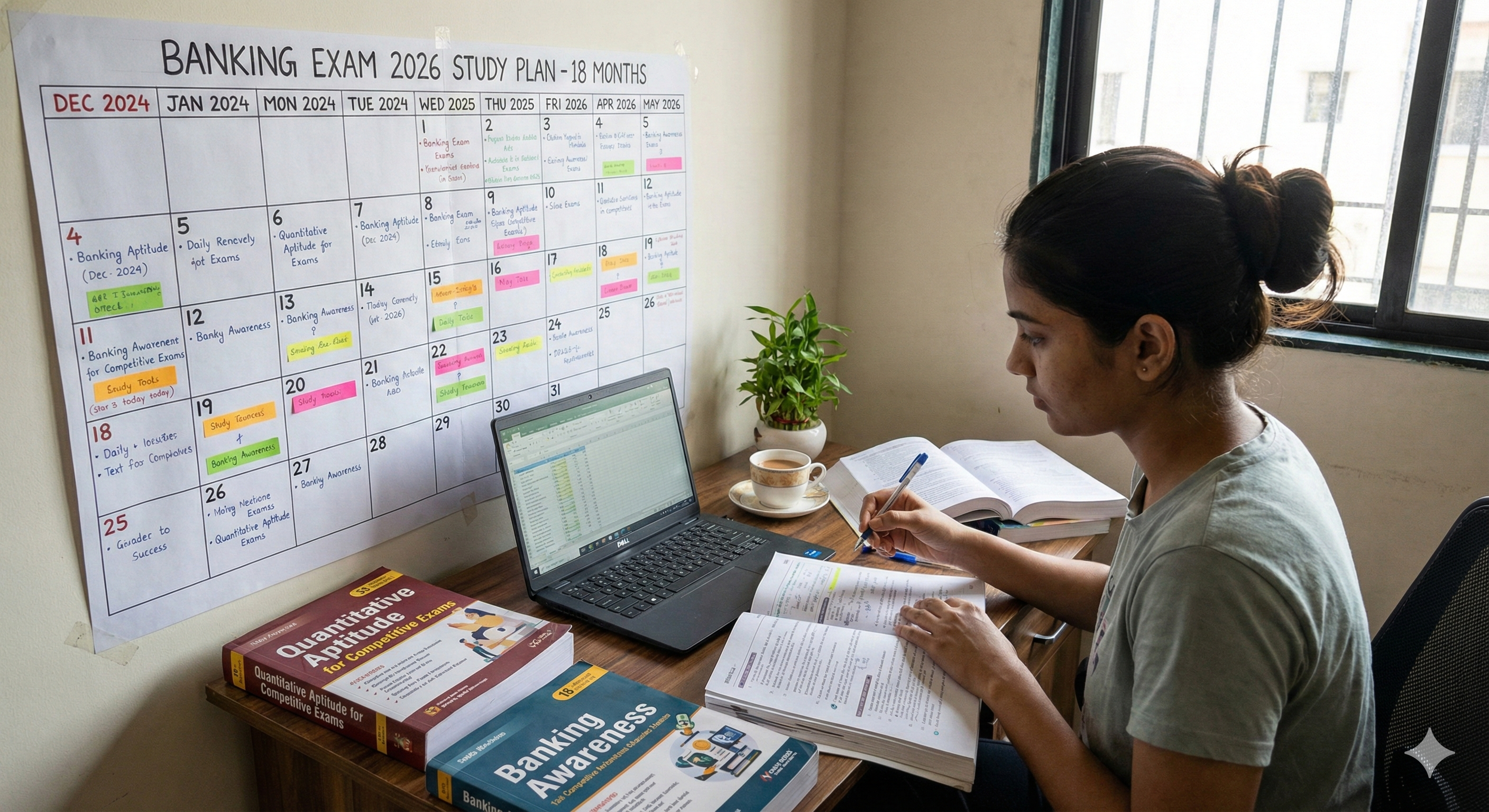
    4. A focused student planning their study schedule 18 months in advance for a banking exam

      IBPS PO vs. IBPS Clerk 2026: Knowing the Difference

      While the initial syllabus overlap is significant, the roles and the required depth of preparation differ greatly. Choose your target early so you can tailor your strategy accordingly.


      Job Profile and Career Progression Comparison

      • IBPS PO (Probationary Officer): A managerial cadre role. High responsibility, involving decision-making, loan processing, public relations, and internal administration. Offers faster career growth.
      • IBPS Clerk: A clerical cadre role. Focuses on customer service, cash handling, document verification, and administrative support. It is generally a less stressful job with fixed working hours.

      • Exam Pattern Variations (Difficulty and Interview Stage)

        The PO exam is significantly harder than the Clerk exam, particularly in Reasoning and Quantitative Aptitude Mains sections. PO is designed to test critical thinking and deep analysis, while Clerk tests speed and foundational knowledge.


        IBPS PO vs. IBPS Clerk: Quick Comparison (Projected 2026)

        Data Point CategoryIBPS PO (2026 Target)IBPS Clerk (2026 Target)
        Exam StagesPrelims, Mains, InterviewPrelims, Mains
        Total Marks (Mains)225 Marks (Objective + Descriptive)200 Marks (Objective Only)
        Exam Duration (Mains)3.5 Hours (including Descriptive)160 Minutes
        Eligibility Age Range20 - 30 Years20 - 28 Years
        Projected Vacancies (Estimate)3,000 – 4,000+6,000 – 7,500+

        Eligibility Criteria Snapshot (Age, Education)

        For both exams, the primary educational requirement is a bachelor’s degree in any discipline from a recognized university. Age relaxations apply for reserved categories. Make sure your degree will be completed before the notification date (expected mid-2026).


        Projected IBPS 2026 Timeline and Key Dates

        Based on previous years’ trends, here is a tentative look at the IBPS 2026 examination schedule. Use this timeline to structure your 18-month plan.


        Tentative Notification and Application Window

        Historically, IBPS releases its annual calendar in January and the official PO/Clerk notifications in the late summer/early autumn.

        • Tentative Notification Release: August 2026
        • Application Window: August – September 2026

        • Expected Preliminary and Main Exam Dates

          • IBPS PO Prelims: October 2026
          • IBPS Clerk Prelims: November 2026
          • IBPS PO Mains: November/December 2026
          • IBPS Clerk Mains: December 2026/January 2027

          • The Importance of Monitoring Official Sources

            While this timeline is a strong projection, always refer to the official IBPS website for definitive dates. Treat these projections as deadlines for your study phases.


            Comprehensive 18-Month Preparation Strategy (Phase-Wise Breakdown)


            Phase 1: Foundation Building (Months 1-6)

            This phase is about conceptual clarity. Do not worry about speed yet. Focus only on accuracy and understanding the 'why' behind the rules.

            • Focus: Mastering Quant Basics (Arithmetic, Simplification), Grammar Rules, and Core Reasoning Concepts (Syllogism, Inequalities).
            • Actionable: Dedicate 70% of your study time to Quant and Reasoning. Use textbooks (e.g., RS Aggarwal for Quant basics) to cover fundamentals. Write down all formulas and grammar rules in a dedicated notebook.
            • Goal: Achieve 90% accuracy on foundational topics before moving to the next phase.

            • Phase 2: Intensive Practice (Months 7-12)

              Now that you know the concepts, it is time to build speed and tackle intermediate difficulty questions.

              • Focus: Time management, sectional tests, advanced Data Interpretation (DI) sets, and high-level puzzles.
              • Actionable: Start taking timed sectional tests (30 minutes for a single subject). Solve 5-7 Reading Comprehension passages daily. Start integrating General Awareness by reading daily news and making short notes.
              • Recommended study schedule template: 2 hours Conceptual Revision, 3 hours Practice (timed), 1 hour GA/Reading.

              • Phase 3: High-Intensity Mock Tests (Months 13-18)

                This is the examination phase. Your primary tool now is the full-length mock test.
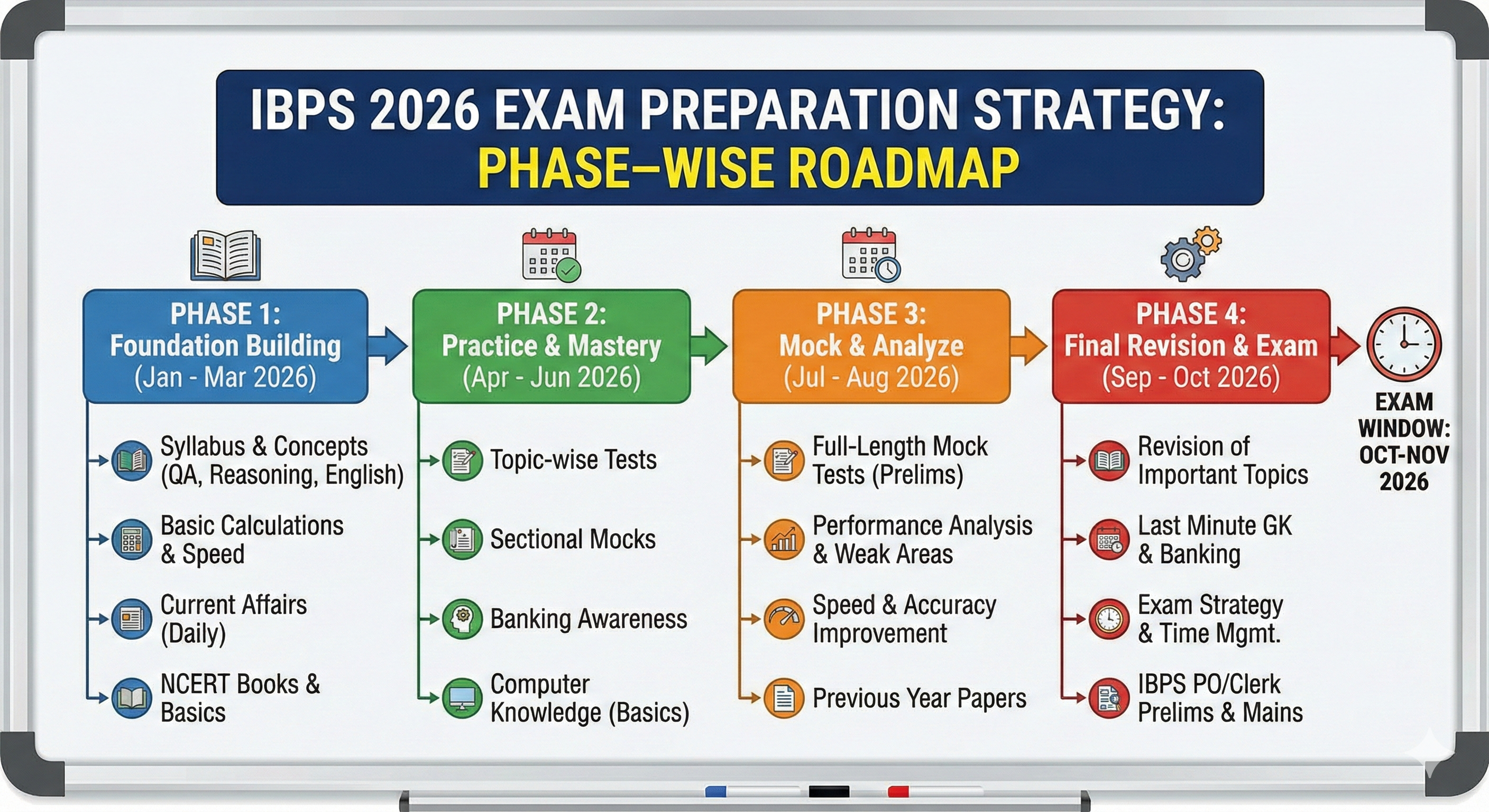
                • Focus: Full-length mocks (Prelims and Mains), analysis, and strategy refinement (which questions to skip, which order to attempt).
                • Actionable: Take 3 Prelims mocks per week until the notification, then increase to 5. Once the Mains syllabus is complete, start 1-2 Mains mocks per week.
                • Strategy for analyzing weak areas: Spend more time analyzing the mock than taking it. Note down missed questions, repeat mistakes in a "Mistake Log," and revise the core concept immediately.

                • A detailed chart showing phase-wise preparation for the IBPS 2026 exam

                  Mastering the Sections: Syllabus Deep Dive


                  Quantitative Aptitude: Essential Topics for Speed and Accuracy

                  Quant is split between foundational arithmetic and speed math. For 2026, focus heavily on modern DI patterns (Caselet DI, Missing DI).

                  • Must-Master Topics: Simplification/Approximation, Quadratic Equations, Number Series (essential for Prelims speed), and all Arithmetic chapters (Time & Work, Profit & Loss, Ratio, Average).
                  • PO Focus: Advanced DI, Data Sufficiency, and Quantity Comparison problems.

                  • Reasoning Ability: Focus Areas for PO (Puzzles and Seating Arrangements)

                    Reasoning is the primary selection criteria, especially for Mains. Puzzles can consume all your time if you lack a systematic approach.

                    • Clerk Focus: Coded Inequalities, Syllogisms, Blood Relations, and simple Linear/Circular Seating Arrangements.
                    • PO Focus: Box-based Puzzles, Scheduling Puzzles (Month/Day/Year), Input-Output (Advanced), and Critical Reasoning (Mains only).

                    • English Language: Grammar, Vocabulary, and Comprehension Tactics

                      Do not ignore English. It often serves as a tie-breaker.

                      • Vocabulary: Daily reading of high-quality articles (e.g., The Hindu editorial) is mandatory. Maintain a vocabulary journal.
                      • Grammar: Master Sentence Correction, Error Detection, and Phrase Replacement rules.
                      • Comprehension: Practice inference-based questions and Parajumbles specific to the banking exam style.

                      • General Awareness & Financial Banking Awareness (Strategy for Daily Prep)

                        Start 12 months out. Focus on the last 6 months intensely, but maintain daily reading from the start of your preparation.

                        • Daily Prep: Dedicate 1 hour to news reading. Focus on financial news, RBI regulations, government schemes, and international banking mergers.
                        • Notes: Create weekly or monthly digests of current affairs. Revision is key.

                        • Resources and Tools for the 2026 Aspirant


                          Top Recommended Books and Study Materials

                          • Quant Basics: NCERT Class 9/10 Math textbooks, M Tyra's Quicker Maths.
                          • Reasoning: R S Aggarwal Verbal and Non-Verbal Reasoning (for fundamentals), specialized books for high-level puzzles.
                          • English: SP Bakshi or Wren & Martin (for grammar foundation), and any daily national newspaper.

                          • Essential Online Platforms and Mock Test Series

                            The competitive nature of banking exams means practicing online is non-negotiable. Invest in a reputable mock test series during Phase 2 and 3.

                            Utilize free online resources for daily quizzes and sectional tests, especially for complex topics like DI and Seating Arrangement.


                            Integrating Daily News Reading and Financial Publications

                            Shift your news consumption habits. Instead of relying solely on generic news, subscribe to or follow economic news feeds, focusing specifically on Banking, Finance, and the economy of India.
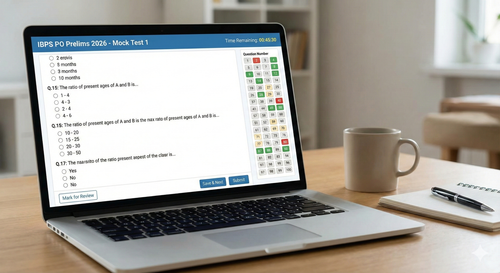

                            Online mock test interface on a laptop for banking aspirants

                            Beyond the Written Exam: Interview Preparation (PO Only)

                            If you are targeting the PO post, the Interview phase carries significant weight. Preparation for the interview should ideally begin during Phase 2.


                            Developing Communication Skills

                            Panelists evaluate confidence, clarity of thought, and professional demeanor. Practice speaking about current affairs and banking concepts clearly and concisely.


                            Common Banking Interview Questions and Answers

                            Prepare detailed answers for standard questions like:

                            • “Why banking?”
                            • “What is the difference between PO and Clerk?”
                            • “What are NPA (Non-Performing Assets)?”
                            • “Tell us about your strengths/weaknesses.”

                            • Final Checklist: Maintaining Motivation and Consistency

                              The 18-month journey is a marathon, not a sprint. Consistency is your greatest asset.


                              Setting Realistic Milestones

                              Break the 18 months into smaller, achievable targets (e.g., “Master Simplification by the end of Month 2,” or “Complete all Arithmetic topics by Month 6”). Celebrate small victories to keep motivation high.


                              The Role of Health and Stress Management

                              Burnout is common in long-term preparation. Incorporate short breaks, exercise, and proper sleep into your routine. A fresh, focused mind is more effective than an exhausted one.


                              A person taking a mindful break from studying to manage stress

                              Key Takeaways for the IBPS 2026 Aspirant

                              • Start Strong: Dedicate the first 6 months (Phase 1) solely to building conceptual foundations in Quant and Reasoning.
                              • Know Your Target: Understand the difficulty gap between PO and Clerk and structure your puzzle/DI practice accordingly.
                              • Analyze Mocks Religiously: In Phase 3, the analysis of your mistakes is more crucial than the mock test score itself. Maintain a detailed error log.
                              • Consistency Wins: General Awareness and Vocabulary require daily attention, not last-minute cramming.
                              • Your 2026 success story begins today. Good luck!


                                CallWhatsApp