Diploma in Pharmacy (D. Pharma) Course 2026 | Eligibility & Scope
Enroll in the PCI-approved D. Pharma Course 2026. A 2-year diploma covering pharmaceutics, pharmacology, and patient counseling. Start your career as a Registered Pharmacist.
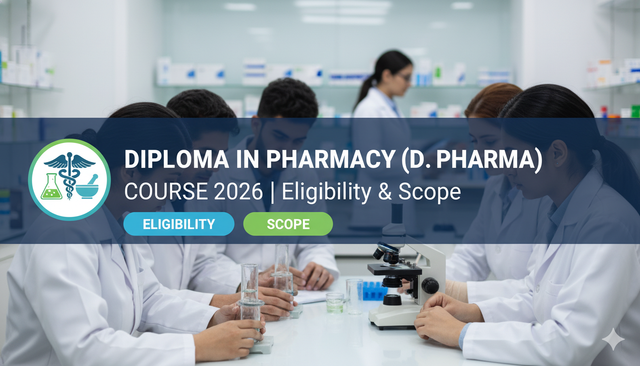
D. Pharma Course 2026: Diploma in Pharmacy (PCI Approved Curriculum)
The Diploma in Pharmacy (D. Pharma) is a two-year, full-time vocational program designed to train competent, entry-level pharmaceutical professionals. Recognized by the Pharmacy Council of India (PCI), this course provides essential knowledge in drug compounding, dispensing, patient counseling, and pharmaceutical law, serving as the direct pathway to registration as a Registered Pharmacist (R.Ph.) in India.
1. Course Overview & Key Highlights
The D. Pharma course focuses heavily on practical skills and foundational pharmaceutical sciences, preparing students immediately for roles in hospital and community settings. Successful completion mandates 500 hours of practical training, ensuring industry readiness.
Attribute Details Course Name Diploma in Pharmacy (D. Pharma) Course Level Diploma (Professional/Vocational) Duration 2 Academic Years + 500 Hours Practical Training Eligibility Criteria 10+2 (Science Stream) with PCB or PCM Entrance Exams Varies by State (e.g., State-level CETs) or Merit-based Course Fees (Estimate) ₹40,000 – ₹1,20,000 per annum (Varies by institution type) Admission Process Merit-based on 10+2 scores or Entrance Test Ranks Key Subjects Pharmaceutics, Pharmacology, Pharmacognosy, Pharmaceutical Jurisprudence, Community Pharmacy Examination Type Annual/End-of-Year University/Board Examinations Average Starting Salary ₹2,50,000 – ₹4,50,000 per annum (Highly dependent on sector and location) 2. Course Identity & Logistics
This program is structured to provide intensive, hands-on training compliant with national standards set by the PCI.
- Course Title: Diploma in Pharmacy
- Course Code: DP2026 (Institution Specific Placeholder)
- Credit Value/ECTS: Approximately 120 Credits (across two years)
- Format: Full-time, On-campus (Compulsory Lectures, Seminars, and Practical Laboratory Sessions)
- Intake Capacity: [Specify Institution Intake Capacity]
- Accreditation: Curriculum approved and regulated by the Pharmacy Council of India (PCI).
3. Course Description & Rationale
Summary
The D. Pharma curriculum is meticulously designed to create highly skilled paraprofessionals essential for the functioning of the modern healthcare ecosystem. Students are trained not only in the technical aspects of drug preparation and quality control but also in critical areas like drug management, inventory control, and ethical patient counseling.
Curriculum Context & Rationale
The course serves a fundamental societal need by ensuring the safe and accurate distribution of medicines. It is a vocational course that directly addresses the critical national demand for qualified paramedical staff, particularly Registered Pharmacists, who are legally authorized to dispense medications under the Drugs and Cosmetics Act. The structure is heavily regulated, ensuring uniformity and high standards across all approved institutions.
Industry Relevance (2025 Trends)
In 2025, the role of the community pharmacist is expanding, driven by increased public health awareness and the digitalization of healthcare records. D. Pharma graduates are increasingly required to handle complex inventory management systems, operate basic diagnostic tools, and actively participate in public health campaigns (e.g., immunization awareness), making their skills highly relevant across hospital, retail chain, and pharmaceutical manufacturing sectors.
4. Prerequisites & Eligibility
Academic Prerequisites
- Qualifying Examination: Successful completion of the 10+2 Senior Secondary Examination or equivalent recognized qualification.
- Mandatory Subjects: The candidate must have studied Physics, Chemistry, and Mathematics (PCM) OR Physics, Chemistry, and Biology (PCB) in the qualifying examination.
- Minimum Marks: Typically, a minimum aggregate of 50% in the science subjects is required, though this threshold may vary based on the state or specific institution's admission policy.
Skill Requirements
- Strong foundation in basic science (Chemistry and Biology).
- Attention to detail and precision (crucial for dispensing).
- Good communication skills for patient counseling.
- Ethical and responsible demeanor.
5. Learning Objectives
By the end of this course, students will be able to:
- Define: Key terminologies related to drug action, dosage forms, pharmaceutical calculations, and legal standards governing drug sales (Pharmaceutical Jurisprudence).
- Apply: Foundational principles of Pharmaceutics to accurately compound, dispense, and label medications according to valid prescriptions and legal guidelines.
- Analyze: Clinical scenarios to identify potential drug interactions, adverse effects, and contraindications, ensuring patient safety during dispensing.
- Evaluate: The quality and stability of pharmaceutical formulations using standard pharmacopoeial methods and basic quality control tests.
- Create: Comprehensive patient counseling strategies regarding drug usage, storage, lifestyle modifications, and adherence to therapy.
6. Course Materials
Required Textbooks
Students are required to utilize PCI-approved texts, including:
- C. K. Kokate, A. P. Purohit, and S. B. Gokhale – Textbook of Pharmacognosy
- L. M. Tripathi – Pharmaceutical Chemistry (Inorganic and Organic)
- D. M. Purohit – Hospital and Clinical Pharmacy
- S. B. Gokhale – Pharmaceutical Jurisprudence
Reference Materials
- The Indian Pharmacopoeia (IP) and relevant volumes.
- Access to institutional digital libraries, including databases like PubMed and ScienceDirect (institutional subscription required).
- Comprehensive laboratory manuals for Dispensing Pharmacy and Pharmaceutical Analysis.
Software & Tools
Training involves the use of:
- Pharmacy Management Software (for inventory and billing simulation).
- Standard laboratory equipment (e.g., balances, dissolution apparatus, titration kits).
7. Detailed Syllabus & Module Breakdown
The D. Pharma curriculum is divided into two academic years, structured around foundational, core, and advanced practice modules.
Phase I: Foundations (Year 1, Semester 1 Equivalent)
- Objective: Establish core vocabulary and principles related to the human body and basic chemical components of drugs.
- Topics Covered:
- Week 1-3: Human Anatomy & Physiology (Structure and functions of major organ systems).
- Week 4-6: Pharmaceutical Inorganic Chemistry (Purity standards, identification tests, and medicinal gases).
- Week 7-9: Basic Pharmaceutics I (History of pharmacy, dosage forms, and routes of drug administration).
- Week 10: Initial Assessment & Review.
Phase II: Application & Core Concepts (Year 1, Semester 2 & Year 2, Semester 3 Equivalent)
- Objective: Practical application of theories, focusing on drug action, natural sources, and community health.
- Topics Covered:
- Week 1-4: Pharmacology & Toxicology (Mechanisms of drug action, adverse drug reactions, and classifications).
- Week 5-7: Pharmacognosy (Study of drugs derived from natural sources, cultivation, and collection).
- Week 8-10: Pharmaceutical Organic Chemistry (Nomenclature, structure, and reactions of key organic compounds used in pharmacy).
- Week 11-14: Health Education & Community Pharmacy (Preventive medicine, family planning, and the role of the pharmacist in public health).
Phase III: Advanced Practice, Law & Management (Year 2, Semester 4 Equivalent)
- Objective: Advanced complexity, synthesis of knowledge, and preparation for professional practice and management.
- Topics Covered:
- Week 1-4: Hospital & Clinical Pharmacy (Drug distribution systems, TPN, and clinical roles).
- Week 5-8: Drug Store and Business Management (Inventory control, accounting principles, and marketing).
- Week 9-12: Pharmaceutical Jurisprudence (The Drugs and Cosmetics Act, 1940, Pharmacy Act 1948, and essential legal compliance).
- Week 13-14: Final Review and Preparation for External Examinations.
Note: 500 hours of mandatory practical training/internship must be completed after the final examinations.
8. Assessment & Grading Scheme
Assessment ensures both theoretical comprehension and practical competence, adhering to PCI guidelines.
Assessment Distribution
| Assessment Type | Weightage | Description |
|---|---|---|
| Internal Assessment (Theory) | 20% | Mid-term tests, class assignments, seminar presentations, and attendance. |
| External Assessment (Theory) | 80% | End-of-Year University/Board Examinations covering all theoretical subjects. |
| Practical Assessment | Mandatory Pass | Annual practical examinations (Viva Voce and performance) for all lab-based subjects. |
| Practical Training Completion | Mandatory Pass | Successful submission of the training certificate (500 hours) signed by the preceptor. |
Passing Criteria
Students must achieve a minimum of 40% marks in both internal and external (theory and practical) assessments separately to pass the year and be eligible for promotion to the next phase or certification.
9. Course Policies
Academic Integrity
The institution maintains a zero-tolerance policy against academic dishonesty. Any instance of plagiarism, cheating on examinations, or misrepresentation of data in practical reports will result in severe disciplinary action, including potential course expulsion or failure in the subject.
Attendance Requirements
- Theory Sessions: A minimum of 75% attendance is compulsory for all theory classes.
- Practical Sessions: A minimum of 80% attendance is required for all laboratory and practical training sessions.
- Failure to meet these minimum requirements will render the student ineligible to appear for the final external examination.
Late Submissions Policy
Assignments and reports submitted past the stated deadline without prior approval will incur a penalty of 10% deduction per day, up to a maximum of three days. Submissions beyond this period will generally not be accepted, resulting in a score of zero for that assignment.
Accommodations for Students with Disabilities
Students requiring academic accommodations must register with the institutional disability support cell at the start of the academic year. All reasonable accommodations will be provided in compliance with national regulations to ensure equal access to learning and assessment opportunities.
10. Career Scope & Certification
The D. Pharma course offers robust career opportunities in India’s growing healthcare sector and serves as a strong foundation for further academic pursuits.
Certification Details
Upon successful completion of the two academic years and the mandatory 500 hours of practical training, students are awarded the Diploma in Pharmacy (D. Pharma) certificate. This certificate is the prerequisite for professional registration with the State Pharmacy Council, enabling the graduate to practice as a Registered Pharmacist (R.Ph.).
Skills Acquired
- Technical Skills: Aseptic dispensing, compounding, inventory management, basic quality control testing, and pharmacological knowledge.
- Soft Skills: Patient counseling, effective inter-professional communication, ethical decision-making, and regulatory compliance.
Job Roles and Salary Expectations
| Primary Job Role | Role Description | Avg. Starting Salary (Per Annum) |
|---|---|---|
| Registered Pharmacist (Retail) | Dispensing medicines, managing inventory, and providing patient counseling in community pharmacies. | ₹2,50,000 – ₹4,00,000 |
| Hospital Pharmacist | Managing drug distribution systems within hospitals, maintaining ward stock, and compounding specialized medications. | ₹3,00,000 – ₹4,50,000 |
| Drug Inspector Assistant | Assisting senior drug inspectors in regulatory compliance and quality checks (often requires experience). | ₹3,50,000+ |
| Medical Representative (MR) | Marketing and sales of pharmaceutical products to doctors and clinics. | ₹2,80,000 – ₹4,80,000 (Plus incentives) |
Further Studies Recommendations
D. Pharma graduates are eligible for lateral entry into the second year of the 4-year Bachelor of Pharmacy (B. Pharma) degree program, providing a seamless transition to advanced pharmaceutical education.
11. FAQs (Frequently Asked Questions)
Is the D. Pharma Course 2026 recognized nationally?
Yes. The curriculum and certification are mandated and recognized nationwide by the Pharmacy Council of India (PCI). Graduates are eligible to register as pharmacists in any Indian state, provided they meet the state council requirements.
What are the mandatory eligibility requirements for D. Pharma admissions in 2026?
Candidates must have successfully completed 10+2 with Physics, Chemistry, and either Mathematics or Biology. They must also meet the minimum age requirement of 17 years as of December 31st of the admission year.
Can I open my own pharmacy store after completing the D. Pharma course?
Absolutely. Upon receiving the D. Pharma certificate and completing the mandatory practical training, you must register with the State Pharmacy Council. Once registered as a Pharmacist, you are legally authorized to apply for and obtain the necessary licenses to open and operate a retail or wholesale medical store.
What is the difference between D. Pharma and B. Pharma?
D. Pharma is a 2-year diploma focused on vocational skills, primarily dispensing and community pharmacy management. B. Pharma is a 4-year degree providing deeper theoretical knowledge, research skills, and broader career opportunities in R&D, manufacturing, and regulatory affairs. D. Pharma allows lateral entry into the second year of B. Pharma.
Are government scholarships available for D. Pharma students?
Yes. Students may be eligible for various state and central government scholarship schemes (like the National Scholarship Portal schemes) based on merit, economic background, or category (SC/ST/OBC). Specific institutional scholarships may also be available; candidates should check with the college administration upon admission.