Certificate in Pharmacy Assistant 2026 | Job Ready Training
Launch your healthcare career quickly with the CPA-2026 certificate. Master dispensing, inventory, HIPAA, and essential pharmacy software in 4-6 months.
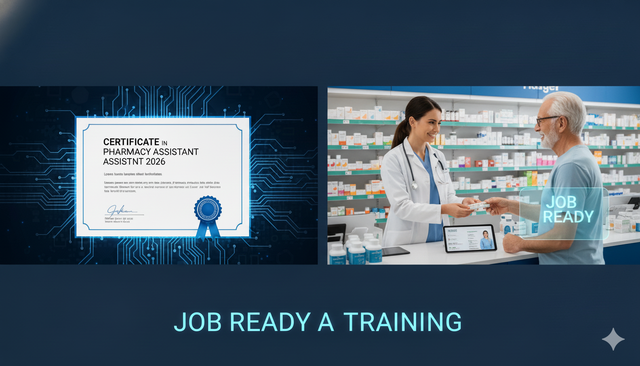
Certificate in Pharmacy Assistant 2026 (CPA-2026)
Rapid entry into the essential healthcare field.
1. Course Overview & Key Highlights
The Certificate in Pharmacy Assistant 2026 (CPA-2026) is an intensive, 4-to-6-month vocational program designed for immediate job readiness in retail, hospital, and mail-order pharmacy settings. This hybrid program focuses heavily on technical skills, regulatory compliance (especially HIPAA), inventory management, and patient communication, ensuring graduates can effectively support licensed pharmacists and technicians from day one.
Key Program Highlights
Feature Detail Course Name Certificate in Pharmacy Assistant 2026 Course Level Certificate (Vocational/Professional Development) Duration 4 to 6 Months (Full-Time Equivalent) Eligibility Criteria High School Diploma or GED Equivalent; Basic English/Math Proficiency Entrance Exams None (Internal placement assessment may apply) Estimated Course Fees ₹8,000 to ₹50,000 Admission Process Application Review and Interview Key Subjects Pharmaceutical Calculations, HIPAA Compliance, Inventory Management, Drug Classification, Insurance Billing. Examination Type Modular Assessments, Practical Skills Check-offs, Comprehensive Final Exam. Average Starting Salary ₹12,000 to ₹50,000 2. Course Identity & Logistics
- Course Title & Code: Certificate in Pharmacy Assistant 2026 (CPA-2026)
- Credit Value/Contact Hours: 300 Total Hours (200 Lecture/Lab + 100 Optional Externship Preparation)
- Delivery Modality: Hybrid (Online lectures/self-paced learning integrated with mandatory on-site practical labs/simulations).
- Instructor/Department Info: Taught by licensed Pharmacy Technicians and Pharmacists; administered by the Vocational Healthcare Training Department.
3. Course Description & Rationale
The CPA-2026 program provides intensive, focused training on the non-clinical, administrative, and technical duties required to support a modern pharmacy team. Students master the critical workflows involved in processing prescriptions, managing inventory, and ensuring patient data security, acting as the essential backbone of efficient pharmacy operations.
Curriculum Context: The curriculum is structured around real-world scenarios, utilizing industry-standard simulation software to bridge the gap between classroom theory and practical workplace demands. A strong emphasis is placed on professional ethics and precision, crucial elements in a high-stakes healthcare environment.
Industry Relevance (2025 Trends): The healthcare sector, driven by an aging population and increasing complexity in medication management, requires highly efficient support staff. This certificate directly addresses the growing need for assistants who can expertly handle insurance adjudication, maintain strict regulatory compliance (HIPAA), and manage sophisticated inventory systems, freeing up licensed personnel for direct patient care.
Target Audience: This program is ideal for high school graduates, individuals seeking a rapid career change into healthcare, and those looking for foundational knowledge before pursuing a full Pharmacy Technician certification.
4. Prerequisites & Eligibility
Academic Prerequisites
- Successful completion of a High School Diploma or General Education Development (GED) equivalent.
- Basic proficiency demonstrated in written English and foundational Mathematics (algebra/arithmetic).
Skill Requirements
- Strong organizational skills and attention to detail.
- Ability to handle repetitive tasks accurately.
- Professional demeanor and effective communication skills.
Technical Requirements
- Reliable high-speed internet access for online lecture components.
- Access to a computer (PC or Mac) capable of running standard office software and the required pharmacy simulation software.
Health Requirements (For Practicum/Labs)
- Mandatory comprehensive background check and drug screening.
- Proof of required immunizations (e.g., Hepatitis B, Tetanus/Diphtheria/Pertussis (Tdap), Annual Flu Shot).
5. Learning Objectives
By the end of this course, students will be able to:
- Define: Key medical terminology, common pharmaceutical abbreviations, and the different legal classifications of controlled substances (DEA Schedules).
- Apply: The rules of HIPAA and relevant state/federal regulations to ensure absolute patient confidentiality in all communication and record-keeping processes.
- Analyze: Prescriptions for completeness, legality, and potential errors, and accurately perform pharmaceutical calculations including dosage conversions and quantity determination.
- Evaluate: Inventory levels, identify drugs nearing expiration, and implement efficient ordering and storage procedures to minimize waste and ensure stock availability.
- Process: Insurance claims, handle adjudication issues, manage third-party payer systems, and effectively process copayments and cash transactions using pharmacy software.
6. Course Materials
Required Textbooks
- Snyder, L. J. (2024). Pharmacy Practice for Assistants: Workflow and Compliance Essentials.
- Benson, A. M. (2025). Pharmaceutical Calculations Simplified.
- DEA & HHS. Regulatory Handbooks: HIPAA and DEA Schedule Guide 2026 Edition.
Reference Materials
- Online subscription access to a comprehensive drug reference database (e.g., Lexicomp or similar).
- Medical and Pharmacy Terminology Dictionary.
Software & Tools
- Access to the institutional Online Learning Management System (LMS).
- Mandatory license for simulated pharmacy management software (e.g., PharmaSim Pro).
- Personal Protective Equipment (PPE) for compounding lab sessions.
7. Detailed Syllabus & Module Breakdown
The program is divided into three intensive phases over 4-6 months, totaling approximately 14 instructional weeks plus review time.
Phase I: Foundations (Weeks 1-4)
- Objective: Establish core vocabulary, legal principles, and professional roles within the pharmacy setting.
- Topics Covered:
- Week 1: Introduction to the Pharmacy Environment, Roles, and Scope of Practice.
- Week 2: Basic Medical Terminology, Abbreviations, and Dosage Forms.
- Week 3: Pharmaceutical Calculations I: Ratios, Conversions, and Measurement Systems.
- Week 4: Professional Ethics, Legal Compliance, and Deep Dive into HIPAA Rules.
Phase II: Application & Core Concepts (Weeks 5-9)
- Objective: Practical application of technical skills, focusing on drug knowledge and prescription processing.
- Topics Covered:
- Week 5: Introduction to Pharmacology: Drug Classification and the Top 100 Drugs.
- Week 6: Prescription Processing Workflow and Data Entry (Simulation Lab Focus).
- Week 7: Inventory Management, Ordering Systems, and Storage Requirements (Cold Chain, Security).
- Week 8: Insurance Billing, Adjudication, and Third-Party Payers.
- Week 9: Midterm Examination (Cumulative Written and Practical Skills Check-off).
Phase III: Advanced & Integration (Weeks 10-14)
- Objective: Advanced complexity, synthesis of knowledge, and career readiness.
- Topics Covered:
- Week 10: Sterile and Non-Sterile Compounding Basics (Safety, Aseptic Technique, Calculations II).
- Week 11: Advanced Communication and Conflict Resolution with Patients and Healthcare Providers.
- Week 12: Quality Assurance, Medication Error Prevention Strategies, and Documentation.
- Week 13: Career Preparation, Resume Building, and State Registration Requirements Review.
- Week 14: Final Comprehensive Review and Practice Exam Preparation.
8. Assessment & Grading Scheme
Student performance is evaluated continuously through a combination of written exams, practical lab assessments, and compliance checks.
Assessment Distribution
| Assessment Component | Weight |
|---|---|
| Quizzes & Regular Assignments | 30% |
| Midterm Examinations (Phase 1 & 2) | 30% |
| Practical Skills Assessment (Lab Competency Check-offs) | 25% |
| Final Comprehensive Exam (Written & Practical) | 15% |
Grading Scale and Passing Criteria
- A: 93–100% (Exceptional Mastery)
- B: 85–92% (High Competency)
- C: 75–84% (Acceptable Competency)
- D: 70–74% (Insufficient)
- F: Below 70% (Failure)
Required Passing Grade: Students must maintain a minimum cumulative GPA of 75% (C+) to successfully complete the certificate program and be eligible for the optional externship preparation.
9. Course Policies
Academic Integrity
The institution maintains a zero-tolerance policy regarding academic misconduct, including plagiarism, unauthorized collaboration, and cheating on examinations. Violations will result in disciplinary action up to and including expulsion from the program.
Attendance Requirements
Attendance is mandatory for all scheduled on-site practical lab sessions. A minimum of 80% attendance is required for online lecture components. Excessive absences may result in failure to meet practical competency requirements.
Professional Conduct
Students must adhere to a strict professional dress code and behavioral standards during all lab sessions and interactions. There is absolute zero tolerance for any violation of patient confidentiality (HIPAA), which constitutes immediate dismissal.
Late Submissions Policy
Assignments submitted late will incur a penalty of 5% per day, up to a maximum of five days, after which a grade of zero may be assigned unless prior arrangements were made with the instructor due to documented hardship.
10. Career Scope & Certification
The CPA-2026 certificate prepares graduates for immediate entry-level roles supporting licensed pharmacy staff in various high-demand environments.
Skills Acquired
- Technical Skills: Pharmaceutical calculations, data entry, inventory control, automated dispensing system operation, insurance claim submission.
- Soft Skills: Patient communication, regulatory adherence, problem-solving in fast-paced retail environments, teamwork, and professional ethics.
Potential Job Roles and Outlook
| Job Role | Description | Avg. Starting Salary Range |
|---|---|---|
| Pharmacy Assistant/Aide | General support role: handling paperwork, managing cash register, stocking shelves, and customer service. | ₹1.8 Lakhs to ₹2.3 Lakhs per year |
| Pharmacy Clerk | Focuses primarily on front-end tasks, patient intake, and administrative duties in a retail setting. | ₹1.8 Lakhs to ₹2.8 Lakhs annually |
| Inventory Specialist (Pharmacy) | Specializes in managing pharmaceutical stock, ordering, tracking expiration dates, and handling returns. | ₹1.8 - ₹3 Lakhs annually, |
Certification and Further Studies
This certificate provides the essential foundational knowledge required for students who wish to pursue the next step: becoming a certified Pharmacy Technician (CPhT) through organizations like the Pharmacy Technician Certification Board (PTCB). Graduates will be well-prepared for state-specific registration requirements for non-technician support roles.
11. Frequently Asked Questions (FAQs)
What are the admission requirements for the CPA-2026 program?
Admission requires a high school diploma or GED equivalent. Prospective students must also pass a basic assessment in English and Mathematics and complete a background check and drug screening due to the sensitive nature of the healthcare profession.
What is the structure of the course, and how does the hybrid model work?
The course is structured in three phases over 4 to 6 months. The hybrid model means lectures and theoretical content (e.g., HIPAA training, calculations) are delivered online and are often self-paced, while high-stakes practical application (e.g., dispensing simulations, compounding basics) requires mandatory, scheduled attendance at an on-site lab facility.
Are textbooks and materials included in the estimated tuition cost?
Generally, the estimated tuition fee covers instruction and access to the LMS and simulation software. Required textbooks, personal protective equipment (PPE), and any associated fees for background checks/drug screenings are typically separate costs, which students should budget for.
Can this Certificate be used as credit toward a Pharmacy Technician Diploma?
While the Pharmacy Assistant certificate is designed for immediate job entry, many institutions offer credit transfer for specific modules (like terminology or calculations) if a student chooses to pursue a longer Pharmacy Technician Diploma or Associate’s degree later. Students should confirm transferability directly with the receiving institution.
Is job placement guaranteed upon completion of the CPA-2026?
While the program is highly focused on job readiness and includes career preparation modules, job placement is not guaranteed. However, graduates receive comprehensive support in resume writing, interview preparation, and access to employer networks to maximize their employment opportunities in the high-demand healthcare field.