
M.Sc. Radiology & Imaging Technology 2026 | Advanced CT/MRI
Master advanced CT, MRI, and Interventional Radiology techniques. This 2-year M.Sc. program focuses on radiation safety, PACS, research methodology, and clinical leadership.
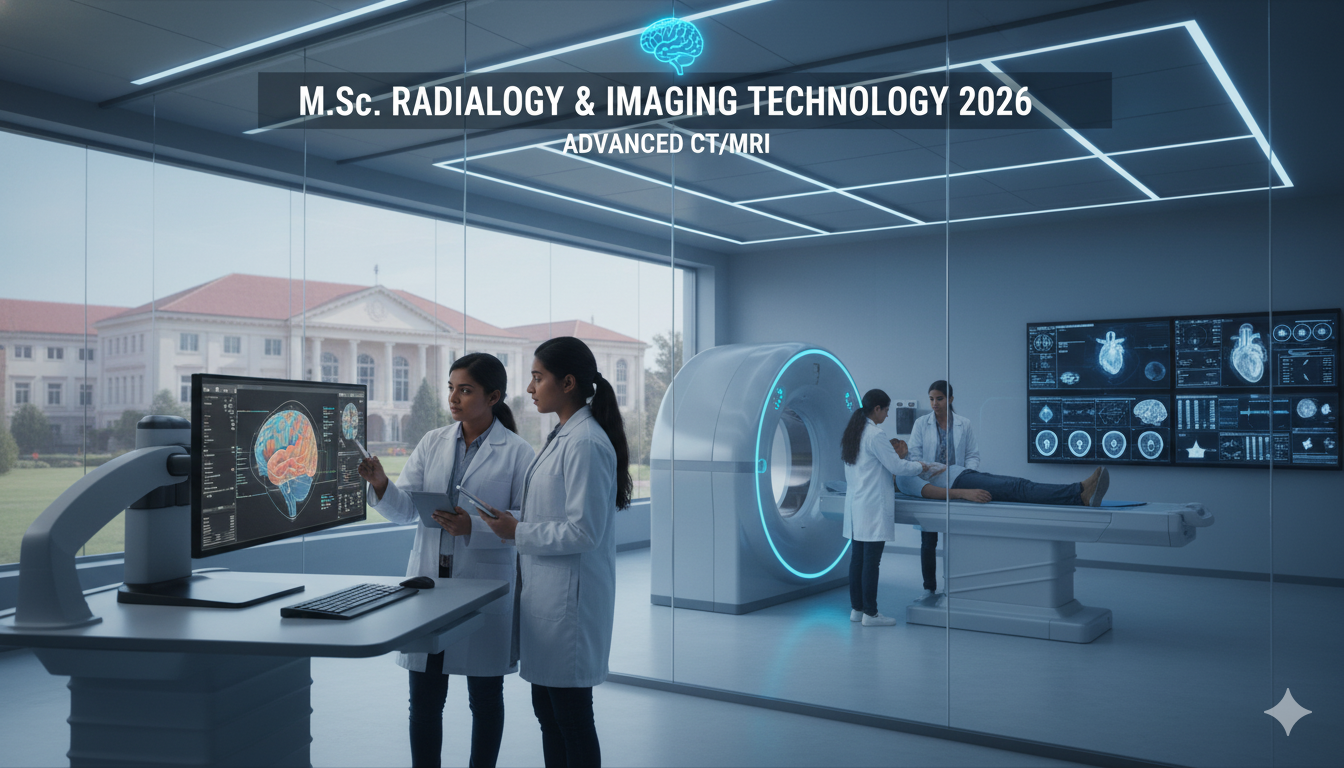
M.Sc. in Radiology & Imaging Technology (Batch 2026)
Advanced Postgraduate Specialization in Diagnostic and Interventional Imaging Science
The M.Sc. in Radiology & Imaging Technology is an intensive 2-year postgraduate program designed to transform skilled graduates into specialist imaging professionals. Focusing on the technical mastery of cutting-edge modalities—including 3T MRI, multi-slice CT, and PET-CT—this course prepares students for leadership roles in complex, high-volume healthcare environments, emphasizing radiation safety and advanced digital workflow management.
1. Course Overview & Key Highlights
This program offers a deep dive into the physics, technical operation, and clinical application required for advanced diagnostic and therapeutic imaging procedures, ensuring graduates meet the global demand for highly specialized technologists.
Category Detail Course Name Master of Science (M.Sc.) in Radiology & Imaging Technology Course Level Postgraduate Duration 2 Years (4 Semesters) Eligibility Criteria B.Sc. in Radiology/Medical Imaging Technology or related Paramedical/Life Science discipline (with Physics as core subject). Minimum 55% aggregate score. Entrance Exams Mandatory qualification in a national or institutional entrance test (e.g., MET, Institutional Screening Test). Estimated Course Fees ₹1,80,000 – ₹2,50,000 per annum (Varies by institution/location) Admission Process Entrance Exam Score followed by Personal Interview/Counseling. Key Subjects MRI Physics & Pulse Sequences, Advanced CT Protocols, Radiation Dosimetry & Safety, Interventional Radiology, PACS/RIS Management, Research Methodology. Examination Type Semester-wise Theory and Practical Examinations, Mandatory Dissertation Submission. Average Starting Salary ₹5,00,000 – ₹8,00,000 per annum (Specialist Technologist roles) 2. Course Identity & Logistics
- Degree Awarded: Master of Science in Radiology & Imaging Technology
- Course Code (Internal): RIMT-M2026
- Department: School of Allied Health Sciences / Department of Imaging Science
- Format: Full-time, comprising theoretical lectures, extensive mandatory clinical rotations (practicum), seminars, and dissertation research.
- Credit Value/ECTS: Typically 90–120 ECTS over two years.
- Commencement Year: 2026 Batch
- Intake Capacity: Limited (e.g., 15–20 seats) to ensure high faculty-to-student ratio and quality clinical mentorship.
3. Course Description & Rationale
This M.Sc. program is the next step for imaging professionals seeking technical mastery and scientific depth. It moves beyond fundamental operational skills to focus on optimizing complex digital imaging environments, managing advanced data sets, and contributing to clinical research.
Curriculum Context & Industry Relevance (2025 Trends)
The healthcare industry is rapidly adopting AI-driven diagnostic tools and requires technologists who understand image processing algorithms, not just equipment operation. The 2026 curriculum is structured around this trend, placing a strong emphasis on PACS/RIS administration, quality assurance (QA), and radiation safety in high-dose procedures like Interventional Radiology and PET-CT. This expertise is crucial for reducing diagnostic errors and improving patient outcomes in modern tertiary care hospitals.
Target Audience
This course is ideally suited for highly motivated B.Sc. graduates in Radiology or Medical Imaging Technology who aspire to take on leadership, supervisory, or clinical specialist roles, or those planning to transition into academic research or application specialist positions within the medical device industry.
4. Prerequisites & Eligibility
Academic Prerequisites
- Successful completion of a B.Sc. degree (3 or 4 years) in Radiology, Medical Imaging Technology, or a closely related Paramedical/Life Science field.
- Physics must have been a core subject studied at either the undergraduate or higher secondary level.
- Minimum aggregate score of 55% (or equivalent GPA) in the qualifying examination.
Skill Requirements
- Strong foundational knowledge of human anatomy and physiology.
- Aptitude for physics, mathematics, and complex technical problem-solving.
- Excellent communication skills for patient instruction and inter-departmental coordination.
Entrance & Interview Requirements
- Mandatory qualification in a specified institutional or national-level entrance examination.
- Successful performance in a personal interview/counseling session designed to assess clinical aptitude and research interest.
5. Learning Objectives
Upon successful completion of the M.Sc. in Radiology & Imaging Technology, students will be able to:
- Operate and Calibrate (Application): Independently manage, troubleshoot, and perform quality control checks on advanced imaging equipment, including 3T MRI, multi-slice CT, and Angiography units.
- Ensure Safety (Evaluation): Design and implement comprehensive radiation protection programs, adhering strictly to the ALARA principle and managing complex patient safety profiles during contrast media administration.
- Analyze and Optimize (Analysis): Critically evaluate complex imaging protocols and adjust technical parameters (e.g., CT pitch, MRI pulse sequences) to optimize image quality while minimizing acquisition time and patient dose.
- Conduct Research (Creation): Design, execute, and document a methodologically sound research project or clinical trial focused on advancements in imaging technology or clinical workflow efficiency.
- Manage Digital Workflow (Synthesis): Configure, maintain, and efficiently utilize Picture Archiving and Communication Systems (PACS) and Radiology Information Systems (RIS) for seamless digital clinical workflow management.
6. Course Materials
Required Core Textbooks
- Bushberg, J. T., et al. The Essential Physics of Medical Imaging. (For advanced physics and dosimetry).
- Westbrook, C., et al. MRI in Practice. (Focus on advanced pulse sequences and artifacts).
- Kanal, E., et al. MRI Safety. (For comprehensive patient safety protocols).
- Aebersold, H. J. Sectional Anatomy for Imaging Professionals. (Emphasis on advanced cross-sectional visualization).
Reference Materials & Digital Resources
- Access to institutional subscriptions for peer-reviewed journals (e.g., Radiography, Journal of Medical Imaging Technology).
- Case study databases and online anatomy atlases (e.g., Visible Human Project).
Software & Tools
- Training licenses for specialized image processing and analysis software (e.g., OsiriX, MATLAB basic functions for image filtering).
- Simulation software for radiation dose planning and virtual clinical environments.
- Hands-on access to hospital-grade PACS/RIS systems during clinical rotations.
7. Detailed Syllabus & Module Breakdown
Phase I: Foundations (Semester I)
Objective: Establish advanced foundational principles in physics, sectional anatomy, and digital infrastructure.
| Module Focus | Core Topics Covered |
|---|---|
| Advanced Anatomy & Physiology | Advanced Sectional Anatomy (Head, Neck, Thorax, Abdomen) relevant to cross-sectional imaging; Pathophysiology of common radiological diseases. |
| Radiation Physics & Dosimetry | Interaction of radiation with matter, advanced radiation protection protocols, calculation of effective dose, and regulatory compliance. |
| Digital Imaging Systems (PACS/RIS) | DICOM standards, image acquisition, storage, retrieval, network requirements, and basic system administration. |
| Basic Modalities Refresher & QA | Advanced quality assurance metrics for conventional radiography and fluoroscopy units; equipment calibration. |
Phase II: Application & Core Concepts (Semester II & III)
Objective: Practical mastery of advanced modalities, patient management, and research preparation.
| Module Focus | Core Topics Covered |
|---|---|
| Advanced CT Technology & Protocols | Multi-slice CT principles, dose modulation techniques, advanced applications (CT Angiography, Cardiac CT), and low-dose protocols. |
| MRI Physics & Pulse Sequences | Advanced spin physics, gradient systems, specialized pulse sequences (EPI, Diffusion, Perfusion), and artifact recognition/mitigation. |
| Ultrasound and Doppler Technology | Advanced physics of sound waves, specialized Doppler techniques, and quality control of ultrasound systems. |
| Patient Care & Contrast Media | Pharmacology of contrast agents (Iodinated, Gadolinium), management of adverse reactions, and advanced life support protocols. |
| Biostatistics & Research Methodology | Study design, data analysis, statistical software usage, and ethical requirements for human subjects research. |
Phase III: Advanced & Specialization (Semester IV)
Objective: Specialization, clinical leadership, and mandatory research synthesis.
| Module Focus | Core Topics Covered |
|---|---|
| Nuclear Medicine & Radiobiology | PET-CT and SPECT principles, radiopharmaceuticals handling, radiobiology of therapeutic procedures, and hot lab safety. |
| Interventional Radiology Procedures | Technical assistance for vascular and non-vascular procedures (e.g., angiography, embolization, stenting), C-Arm operation, and procedural safety. |
| Advanced Quality Assurance & Management | Equipment procurement, maintenance scheduling, regulatory compliance, and departmental leadership skills. |
| Thesis/Dissertation Project | Mandatory independent research project submission and final defense (Viva Voce). |
| Clinical Internship/Elective | Extended rotation in a chosen specialization (e.g., Cardiac Imaging, Neuro-Radiology). |
8. Assessment & Grading Scheme
Assessment is comprehensive, ensuring proficiency in theoretical knowledge, technical skills, and research aptitude.
Assessment Distribution
| Assessment Component | Weightage | Description |
|---|---|---|
| Internal Assessment (IA) | 40% | Mid-term exams, seminar presentations, clinical case studies, lab practicals, and professional conduct. |
| External Theory Examinations | 30% | End-of-semester written examinations covering core subject areas. |
| Clinical Practical / Viva Voce | 15% | Hands-on demonstration of technical skills and oral examination by external examiners. |
| Thesis/Dissertation Submission & Defense | 15% | Mandatory final research submission and defense (Viva Voce) in Semester IV. |
Grading Scale & Passing Criteria
A letter grading system (A+, A, B+, B, etc.) is utilized. Students must achieve a minimum of 50% in the external theory examinations and 60% in clinical practicals/dissertation components to be eligible for the degree award.
9. Course Policies
Academic Integrity
The university maintains a strict zero-tolerance policy regarding plagiarism, cheating, and academic misconduct. All dissertation work must pass institutional plagiarism checks (e.g., Turnitin) prior to submission.
Attendance Requirements
- Theory Classes: Minimum 75% attendance is required to be eligible to sit for the semester examination.
- Clinical Rotations/Practicals: Mandatory minimum 90% attendance is required due to the critical nature of hands-on patient care training.
Safety Compliance
Mandatory adherence to all institutional radiation safety protocols (ALARA principle) and infection control guidelines in all clinical and laboratory settings. Non-compliance may result in immediate suspension from clinical duties.
Late Submissions Policy
Penalties apply for late submission of assignments and dissertation drafts (e.g., 5% deduction per day). Extensions are granted only under documented exceptional circumstances.
10. Career Scope & Certification
Skills Acquired
Technical Skills: Advanced protocol optimization (CT/MRI), specialized dose management, complex equipment troubleshooting, PACS/RIS administration, and image analysis.Soft Skills: Leadership and team management, critical thinking in emergency settings, effective patient communication, and research writing.
Direct Employment Roles
| Job Role | Description | Average Starting Salary (INR) |
|---|---|---|
| Specialist CT/MRI Technologist | Performing and optimizing advanced cross-sectional imaging procedures in tertiary care centers. | ₹5,00,000 – ₹7,50,00,000 |
| Imaging Application Specialist | Training other technologists and providing technical support for medical device manufacturers (OEMs). | ₹6,00,000 – ₹9,00,000 |
| Lead Technologist / Department Supervisor | Managing departmental workflow, staff scheduling, quality assurance, and equipment maintenance. | ₹7,00,000 – ₹10,00,000+ |
| PACS Administrator | Managing the digital workflow, image archiving, and integration between RIS/PACS systems. | ₹5,50,000 – ₹8,50,000 |
Further Studies recommendations
Graduates are well-prepared for doctoral studies, leading to a Ph.D. in Medical Physics, Imaging Science, or Biomedical Engineering, paving the way for careers in academic research or high-level regulatory roles.
Professional Certification
The curriculum aligns with the required competencies for various national and international professional registrations (e.g., local regulatory body certification), providing structured guidance for post-graduation certification exams.
11. Frequently Asked Questions (FAQs)
1. What is the precise eligibility criteria for the M.Sc. Radiology 2026 batch?
You must hold a B.Sc. degree (3 or 4 years) in Radiology, Medical Imaging Technology, or a relevant Paramedical/Life Science field where Physics was a core subject. A minimum aggregate score of 55% in the qualifying examination is mandatory, along with successful completion of the required entrance examination.
2. Is the dissertation mandatory, and how much hands-on practice is included in the course?
Yes, the final Thesis/Dissertation project is a mandatory core requirement for the M.Sc. degree and is weighted heavily in the final assessment. The program includes extensive, mandatory clinical rotations (90% attendance required) in affiliated tertiary care hospitals, ensuring hands-on experience with high-end modalities like 3T MRI, multi-slice CT scanners, and dedicated angiography labs.
3. What is the typical faculty-to-student ratio for clinical mentorship?
We aim for a low faculty-to-student ratio (typically 1:10 or better) for core practical sessions and clinical mentorship. This ensures personalized attention and high-quality supervision, which is crucial for mastering complex imaging techniques and radiation safety protocols.
4. Are there any provisions for placement support after graduation?
The university maintains a dedicated Placement Cell with strong industry partnerships across major hospital chains, diagnostic centers, and medical device manufacturers. We provide comprehensive career counseling, interview preparation, and facilitate campus placements for our M.Sc. graduates.
5. How does this M.Sc. differ from a standard B.Sc. in Imaging Technology?
While the B.Sc. focuses on fundamental operation and general radiography, the M.Sc. program provides a deeper understanding of the physics, advanced image optimization, digital system management (PACS administration), and research methodology. It is designed specifically for specialization and leadership roles, offering significantly higher career trajectory and salary potential.