
Diploma in Sanitary Inspector Course 2026 | DSI Training
Enroll in the DSI 2026 Diploma in Sanitary Inspector course. Gain essential skills in food safety, waste management, public health law enforcement, and disease surveillance. 1-Year Program.
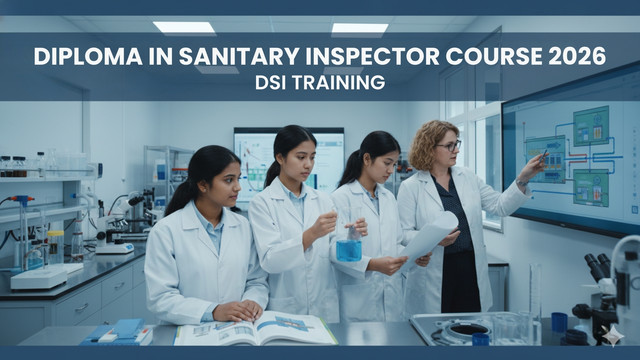
Diploma in Sanitary Inspector Course 2026 (DSI 2026)
A comprehensive vocational diploma program designed to train the next generation of public health and environmental sanitation professionals.
1. Course Overview & Key Highlights
The Diploma in Sanitary Inspector (DSI) Course 2026 is an intensive, one-year vocational program focused on equipping students with the scientific knowledge, legal understanding, and critical practical skills necessary to enforce public health standards. This course directly addresses the national demand for trained personnel capable of managing complex environmental challenges, ensuring food safety compliance (FSSAI), and implementing disease control protocols in municipal and rural settings.
Key Highlights Table
| Attribute | Detail |
|---|---|
| Course Name | Diploma in Sanitary Inspector Course 2026 |
| Course Level | Diploma (Vocational/Technical) |
| Duration | 1 Year (2 Semesters) |
| Eligibility Criteria | 10+2 (High School Pass, minimum 45% aggregate) |
| Entrance Exams | None (Admission typically Merit-based or Institutional Interview) |
| Course Fees (Est.) | ₹30,000 to ₹60,000 per annum (Varies by Institution) |
| Admission Process | Merit-based on 10+2 scores, followed by counseling/interview. |
| Key Subjects | Food Safety Inspection, Waste Management, Epidemiology, Public Health Law, Water Quality Testing, Vector Control. |
| Examination Type | Semester-wise (Theory, Practical, and Mandatory Internship Report) |
| Average Starting Salary (Est.) | ₹2,80,000 – ₹4,50,000 P.A. (Especially in Government/Railway sectors) |
2. Course Identity & Logistics
- Course Title & Code: Diploma in Sanitary Inspector Course (DSI 2026)
- Credit Value/ECTS: Approximately 40-50 institutional credits
- Delivery Mode: Full-time (Classroom, Laboratory, and Mandatory Field Work)
- Format: Lectures, intensive Laboratory sessions, Site Visits, and a 3-month supervised Field Internship.
- Language of Instruction: English and/or Regional Language
- Department Info: Typically administered by the Department of Community Health or Environmental Sciences.
3. Course Description & Rationale
The DSI 2026 program is an intensive curriculum designed to produce regulatory officers who act as the frontline defense against public health hazards. Students are trained to systematically assess sanitation standards across various environments—from restaurants and markets to residential areas and industrial sites. The program integrates scientific principles of microbiology and epidemiology with practical enforcement protocols.
Curriculum Context: The course is structured around current national mandates, including the goals of the Swachh Bharat Mission and strict enforcement of the Food Safety and Standards Act (FSSA). Graduates are prepared not just to inspect, but to educate communities and lead localized hygiene initiatives.
Industry Relevance (2025 trends): With increasing urbanization, climate change impacts, and the constant threat of communicable disease outbreaks, the role of the Sanitary Inspector is more critical than ever. The 2026 curriculum emphasizes advanced training in disaster management, integrated pest control, and sustainable waste disposal technologies, ensuring relevance in modern public health infrastructure.
Target Audience: Individuals who have completed 10+2, particularly those with a science background, who possess a strong interest in public service, environmental protection, and regulatory enforcement careers within government or large private organizations.
4. Prerequisites & Eligibility
Academic Prerequisites
- Successful completion of the 10+2 (Higher Secondary) examination or equivalent from a recognized Central or State Board.
- Minimum aggregate marks typically range from 45% to 50% in the qualifying examination.
- While Science stream is preferred, many institutions accept students from all streams if they demonstrate basic aptitude.
Skill Requirements
- Aptitude for Science: Basic understanding of Biology and Chemistry is beneficial.
- Public Service Interest: Commitment to community welfare and regulatory adherence.
- Communication Skills: Ability to clearly communicate technical findings to the public and regulatory bodies.
Technical Requirements
Students must be prepared for rigorous field work, including required use of Personal Protective Equipment (PPE) and basic proficiency in using digital reporting tools.
5. Learning Objectives
Upon successful completion of the course, students will be highly capable public health practitioners who can:
- Define: Key principles of environmental sanitation, foodborne disease epidemiology, and relevant Indian public health legislation (e.g., FSSAI, Municipal Acts).
- Apply: Standard operating procedures (SOPs) for water quality testing, food sampling, and integrated vector control strategies in diverse environments.
- Analyze: Complex sanitation issues, identify potential disease transmission pathways, and interpret epidemiological data to propose targeted interventions.
- Evaluate: The effectiveness and compliance of existing solid and liquid waste management systems against national standards (e.g., SWM Rules 2016).
- Create: Comprehensive, actionable inspection reports, design localized health education campaigns, and develop emergency sanitation protocols for disaster response scenarios.
6. Course Materials
Students will be provided access to a mix of foundational texts, specialized legislative handbooks, and digital resources required for regulatory work.
Required Textbooks (Examples)
- Core Textbooks: Park’s Textbook of Preventive and Social Medicine (latest edition).
- Environmental Health: Principles of Environmental Science and Engineering (Author Varies).
- Food Safety: FSSAI Manuals and Guidance Documents for Inspectors.
Reference Materials
- Compilations of relevant Indian legislation (e.g., Water Pollution Act, Air Pollution Act, Municipal Corporation Acts).
- World Health Organization (WHO) and Ministry of Health & Family Welfare (MoHFW) guidelines on hygiene and disease control.
- Practical manuals for laboratory analysis (e.g., bacteriological water testing protocols).
Software & Tools
Access to institutional Learning Management Systems (LMS) for case studies, basic statistical software (for epidemiological analysis), and mandatory field safety gear (PPE).
7. Detailed Syllabus & Module Breakdown (1 Year)
The course is delivered over two semesters, culminating in a mandatory field internship.
Phase I: Foundations (Semester 1 - Weeks 1-14)
Objective: Establish core vocabulary, scientific principles, and the legal context of public health administration.
- Week 1-3: Basic Anatomy, Physiology, and Microbiology (Focus on disease transmission pathways and human body systems).
- Week 4-6: Environmental Science Fundamentals (Air, soil, noise pollution, climate change impact on health).
- Week 7-9: Public Health Administration & Law (Structure of Indian health services, Municipal governance, basic health legislation).
- Week 10-12: Epidemiology and Biostatistics (Disease surveillance, data collection, calculating incidence and prevalence).
- Week 13-14: Initial Assessment and Review of Foundation Modules.
Phase II: Application & Core Concepts (Semester 2 - Weeks 15-28)
Objective: Practical application of theories in core areas of sanitation, food, and waste management.
- Week 15-18: Water Supply and Quality Management (Treatment methods, distribution networks, mandatory water quality testing procedures and standards).
- Week 19-22: Solid and Liquid Waste Management (SWM Rules, landfill management, composting, sewage treatment technologies, and legal compliance).
- Week 23-26: Food Safety and Hygiene Inspection (HACCP, FSSAI regulations, food adulteration testing, sanitary inspection simulation).
- Week 27-28: Housing, Occupational Health, and Midterm Evaluation (Ventilation, lighting standards, workplace safety protocols).
Phase III: Advanced & Field Work (Weeks 29-40+)
Objective: Advanced complexity, synthesis of knowledge, and mandatory professional practice.
- Week 29-30: Vector and Pest Control Management (Life cycles of key vectors, Integrated Pest Management (IPM) strategies).
- Week 31-32: Disaster Management and Emergency Sanitation (Role of SI during floods/outbreaks, temporary shelter sanitation).
- Week 33-36: Project Development and Final Review.
- Week 37 onwards (3 Months): Mandatory Field Internship & Project Work (Supervised placement in a Municipal Corporation, Health Department, or major institution like the Railways).
8. Assessment & Grading Scheme
Student performance is evaluated through a combination of theoretical knowledge, practical laboratory skills, and professional conduct during the field placement.
Assessment Distribution Table
| Component | Weightage | Description |
|---|---|---|
| Theory Examinations | 50% | Mid-term and End-of-Semester written exams covering all modules. |
| Practical Examinations | 30% | Lab skill tests (e.g., water analysis, food sampling), Field Inspection Simulations. |
| Internal Assessment | 20% | Assignments, quizzes, professional conduct, attendance, and viva-voce. |
| Total | 100% |
Grading Scale and Passing Criteria
A standardized grading scale (e.g., A, B, C, D, F) is used. Students must achieve a minimum of 40% (or equivalent institutional standard) in both the theory and practical components separately to pass the course and be eligible for the final diploma certification.
9. Course Policies
Academic Integrity
The institution maintains a strict zero-tolerance policy regarding academic dishonesty. Plagiarism, cheating in examinations, and fabrication of data in laboratory reports or the final internship project will result in disciplinary action, including potential course failure or dismissal.
Attendance Requirements
- Theory Classes: Minimum 75% attendance is mandatory.
- Practical/Field Sessions: Minimum 90% attendance is required due to the critical nature of hands-on training and regulatory compliance.
Late Submissions Policy
Assignments submitted after the deadline may incur a penalty (typically 10% reduction per day). Project reports require strict adherence to submission deadlines to ensure timely graduation.
Safety Protocols
Mandatory adherence to all laboratory and field safety guidelines is required. Students must wear designated PPE during practical sessions and field visits, particularly when handling biological samples or hazardous waste.
10. Career Scope & Certification
Certification Details
Successful completion of all modules, examinations, and the mandatory 3-month Field Internship results in the awarding of the official Diploma in Sanitary Inspector Course 2026, which is recognized across various government and private sectors.
Skills Acquired
- Technical Skills: Water testing, Food adulteration detection, epidemiological investigation, integrated pest management, and regulatory reporting.
- Soft Skills: Public communication, community education, legal interpretation, crisis management, and professional integrity.
Job Roles and Salary Potential
| Job Role | Description | Avg. Starting Salary Range (P.A.) |
|---|---|---|
| Sanitary Inspector (SI) | Enforces public health laws in Municipal Corporations, Panchayats, or Cantonment Boards. | ₹3,50,000 – ₹4,50,000 (Government Scale) |
| Health Inspector (Railways/Ports) | Oversees sanitation and hygiene standards in transport hubs, ensuring compliance with health regulations. | ₹3,00,000 – ₹4,00,000 (Central Govt. Scale) |
| Food Safety Supervisor | Monitors hygiene and safety protocols (HACCP) in food processing plants, hotels, or large catering operations. | ₹2,80,000 – ₹3,80,000 (Private Sector) |
| Public Health Assistant | Works with NGOs or health departments on community sanitation projects and disease surveillance. | ₹2,50,000 – ₹3,50,000 |
Further Studies
Graduates are eligible to pursue specialized post-diploma certification courses or enroll in higher education programs such as a Post Graduate Diploma in Public Health Management, Master of Public Health (MPH), or environmental science degrees, often receiving credit for their foundational knowledge.
11. Frequently Asked Questions (FAQs)
What are the primary eligibility criteria for the DSI 2026 course?
The primary criterion is successful completion of the 10+2 (Higher Secondary) examination from a recognized board, typically requiring a minimum of 45% aggregate marks. While a science background is advantageous, the course is often open to students from all streams.
Is the Diploma in Sanitary Inspector recognized for government job recruitment?
Yes. The curriculum is specifically designed and recognized by government bodies, including State and Central Health Departments, Railways, and Municipal Corporations, as meeting the essential qualification standards for entry-level Sanitary Inspector and Health Inspector posts.
Can I complete this course via distance learning or online mode?
No. Due to the mandatory and critical components involving laboratory work (water testing, sample analysis), practical field visits, and the 3-month supervised internship, the Diploma in Sanitary Inspector course requires full-time, in-person attendance.
What is the structure of the course fees and financial aid options?
Course fees vary widely by institution but generally range between ₹30,000 and ₹60,000 per annum. Students are encouraged to inquire about institutional scholarships or government-sponsored educational loan schemes available for vocational diploma programs.
What kind of practical training is included, and is the internship guaranteed?
The course mandates a 3-month supervised Field Internship (Phase III). This practical training is an integrated requirement, not optional. Placements typically occur in municipal health offices, public health laboratories, or large industrial units, providing essential real-world regulatory experience.