
Diploma in Emergency Medical Technology (EMT) 2026
Become a certified EMT with our intensive 2-year Diploma program. Focus on pre-hospital trauma, rapid assessment, and life-saving interventions. Enroll for the 2026 intake!
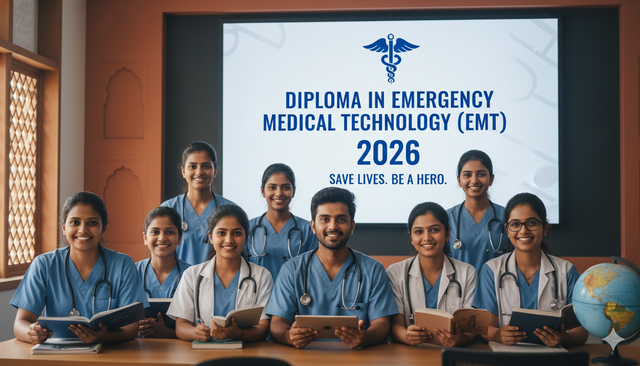
Diploma in Emergency Medical Technology (EMT) 2026
The Diploma in Emergency Medical Technology (EMT) is an intensive vocational program designed to prepare highly skilled first responders capable of delivering immediate, life-saving care in pre-hospital environments. This 2-year program emphasizes practical skills, critical decision-making under pressure, and adherence to international protocols, ensuring graduates are ready to enter the high-demand field of Emergency Medical Services (EMS).
1. Course Overview & Key Highlights
This comprehensive diploma focuses on mastering the techniques required for patient stabilization, trauma management, and rapid transport, underpinned by extensive practical simulation and mandatory clinical field experience.
Attribute Details Course Name Diploma in Emergency Medical Technology (EMT) 2026 Course Level Diploma (Vocational/Undergraduate Level) Duration 1.5 to 2 Years (Full-time) Eligibility Criteria 10+2 (Science stream preferred) Entrance Exams Institution-specific Entrance Examination and/or Interview Course Fees (Estimate) Admission Process Entrance-based, followed by Interview and Medical Screening Key Subjects Patient Assessment, Trauma Management, Cardiology & Resuscitation, Airway Management, Ambulance Operations Examination Type Semester-wise Theoretical Exams, Scenario-Based Practical Assessments (OSCEs), Clinical Competency Evaluations (CCTs) Average Starting Salary (Estimate) ₹2.4 to ₹3 Lakhs per year 2. Course Identity & Logistics
- Course Title: Diploma in Emergency Medical Technology
- Course Code: EMT-D-2026
- Total Credits: 70 Credits (Approximate ECTS equivalent)
- Instruction Mode: Hybrid (Lectures, High-Fidelity Simulation Labs, Mandatory Clinical Placements)
- Accreditation: Accredited by the National EMS Accreditation Council (NEMSAC) and recognized by local regulatory bodies.
- Intake: Annual Fall Intake
3. Course Description & Rationale
The EMT Diploma program is meticulously structured to transform dedicated students into competent, compassionate, and highly effective Emergency Medical Technicians. The curriculum is rigorous, focusing heavily on psychomotor skills development and critical thinking necessary to manage medical and trauma emergencies outside of the hospital environment. Students are trained to serve as the critical link between the patient's emergency site and definitive care.
Rationale: The global demand for certified pre-hospital providers is accelerating. This program directly addresses the critical shortage of trained EMTs, aiming to elevate the standard of emergency medical services (EMS) provision. By aligning the curriculum with international best practices (like NREMT guidelines), we ensure graduates are equipped to reduce response times, improve patient stabilization rates, and ultimately enhance community health outcomes.
Target Audience: Recent 10+2 graduates with a strong interest in healthcare, individuals seeking a fast-track entry into the medical field, and professionals looking for foundational certification in emergency response.
4. Prerequisites & Eligibility
Academic Prerequisites
- Successful completion of 10+2 (or equivalent qualification).
- Preference is given to applicants from the Science stream (Physics, Chemistry, Biology).
- Minimum aggregate score as determined by institutional policy.
Skill Requirements (Non-Academic)
- Strong communication and interpersonal skills.
- Physical ability to perform required EMS tasks (e.g., lifting up to 125 lbs with assistance, kneeling, bending).
- Emotional resilience and ability to function effectively under high stress.
- Basic computer literacy for documentation and data entry.
Technical Requirements
- Access to a reliable computer and internet connection for hybrid learning modules.
- Required uniform and safety gear for lab and clinical rotations.
5. Learning Objectives
Upon successful completion of the Diploma in Emergency Medical Technology, students will be able to:
- Analyze: Accurately and rapidly analyze patient conditions across complex trauma and medical emergencies using systematic assessment protocols (e.g., Primary and Secondary Surveys).
- Apply: Safely and effectively apply life-saving interventions, including advanced airway adjuncts, hemorrhage control techniques, and pharmacological interventions within the EMT scope of practice.
- Evaluate: Critically evaluate scene safety, resource availability, and the effectiveness of initiated treatments, adjusting protocols based on patient response and environmental factors.
- Communicate: Define and execute clear, concise, and professional communication strategies during patient handoffs (SBAR/MIST protocols) and inter-team operations.
- Operate: Safely operate and maintain emergency vehicles and all essential pre-hospital equipment, adhering strictly to institutional and regulatory safety guidelines.
6. Course Materials
Required Textbooks
- Core EMT Textbook: *AAOS Emergency Care and Transportation of the Sick and Injured* (Latest Edition).
- Anatomy & Physiology: Tortora & Derrickson, *Principles of Anatomy and Physiology*.
- Trauma Reference: *Prehospital Trauma Life Support (PHTLS) Manual*.
Reference Materials
- Local/State EMS Protocols and Standing Orders.
- Institutional LMS (Learning Management System) for lecture notes and assignments.
- Online database access for peer-reviewed case studies.
Software & Tools
- High-fidelity simulation software for virtual patient scenarios.
- Required personal equipment: Stethoscope, trauma shears, sphygmomanometer, and institutional uniform kit.
7. Detailed Syllabus & Module Breakdown
The program is structured across three integrated phases, combining classroom theory with extensive practical lab work and field experience.
Phase I: Foundations (Approx. Weeks 1–7)
- Objective: Establish core vocabulary, foundational sciences, legal responsibilities, and basic life support principles.
- Topics Covered:
- Week 1–2: Introduction to EMS Systems, Medical Terminology, Legal and Ethical Issues in Pre-hospital Care.
- Week 3–4: Human Anatomy & Physiology (Systems Review), Pathophysiology Basics.
- Week 5: Patient Assessment Principles (Scene Size-up, Primary Assessment).
- Week 6–7: Basic Life Support (BLS) Certification and Airway Management Fundamentals.
Phase II: Application & Core Concepts (Approx. Weeks 8–18)
- Objective: Practical application of assessment skills to manage common trauma and medical emergencies.
- Topics Covered:
- Week 8–10: Management of Shock, Hemorrhage Control, Soft Tissue and Musculoskeletal Injuries (Trauma Focus).
- Week 11–12: Cardiology, Electrocardiography Basics, and Advanced Cardiac Life Support (ACLS) Preparation.
- Week 13–14: Medical Emergencies (Respiratory, Diabetic, Neurological), Pharmacology Review.
- Week 15–16: Environmental Emergencies, Toxicology, and Behavioral Health Crises.
- Week 17–18: Obstetrics, Neonatal Care, and Pediatric Advanced Life Support (PALS) Preparation.
Phase III: Advanced & Integration (Approx. Weeks 19–End of Program)
- Objective: Integrating specialized knowledge, operational safety, and mandatory comprehensive field internship.
- Topics Covered:
- Week 19–20: Specialized Populations (Geriatrics, Developmental Disabilities) and Advanced Assessment Techniques.
- Week 21–22: Mass Casualty Incident (MCI) Triage, Incident Command System (ICS), and Disaster Management.
- Week 23–24: Ambulance Operations, Vehicle Safety, Documentation, and Quality Improvement (QI).
- Months 13–End: Comprehensive Field Internship and Clinical Rotations (Mandatory Hours).
8. Assessment & Grading Scheme
Student performance is evaluated continuously through theoretical knowledge testing, rigorous psychomotor skills check-offs, and clinical performance evaluations.
Assessment Distribution Table
| Assessment Component | Weight (%) | Description |
|---|---|---|
| Theoretical Assessment | 40% | Mid-term and End-term written examinations (MCQs, Short Answer). |
| Practical Assessment | 40% | Skills Check-offs, High-Fidelity Scenario Simulations (OSCEs). |
| Clinical/Field Assessment | 20% | Supervisor Evaluations, Professional Behavior, Mandatory Case Log. |
Grading Scale & Passing Criteria
A minimum overall score of 70% (C+) is mandatory to successfully complete the program and be eligible to sit for the National/State EMT Certification Examination.
- A: 90–100% (Exceptional Competence)
- B: 80–89% (High Competence)
- C: 70–79% (Satisfactory Competence)
- F: Below 70% (Failure to Meet Minimum Standards)
9. Course Policies
Academic Integrity
Students must adhere strictly to the institution’s policy on academic honesty. Plagiarism, cheating on examinations, or falsifying clinical documentation will result in immediate disciplinary action, including potential expulsion.
Attendance Requirements
Mandatory 90% attendance is required for all scheduled laboratory sessions and clinical placements. Failure to meet this threshold may result in the inability to proceed to the field internship phase.
Safety and Professionalism
Students must maintain strict adherence to Universal Precautions, EMS safety protocols, and the EMT Code of Conduct at all times, especially during clinical hours. Appropriate uniform and professional demeanor are non-negotiable requirements.
Accommodations for Students with Disabilities
Students requiring academic or physical accommodations must register with the Office of Student Services and provide appropriate documentation. Accommodations will be made where feasible without compromising the essential technical standards of the EMT profession.
10. Career Scope & Certification
Graduates of the Diploma in Emergency Medical Technology are prepared for high-impact roles in fast-paced emergency environments.
Certification Details
Upon graduation, students are eligible to sit for the relevant state or national EMT Certification Examination (e.g., National Registry of Emergency Medical Technicians - NREMT).
Skills Acquired
- Technical Skills: Advanced BLS, rapid patient triage (START/SALT), splinting and immobilization, medication administration (limited scope), emergency vehicle operation.
- Soft Skills: Crisis communication, leadership in emergency scenarios, teamwork, stress management, cultural sensitivity in care delivery.
Job Roles and Average Salary
| Job Role | Description | Avg. Starting Salary (USD Equivalent) |
|---|---|---|
| Ambulance EMT | Providing pre-hospital care and transport for public or private EMS providers. | ₹1.9 Lakhs to ₹3 Lakhs per year, with fresher EMTs often earning around ₹15,000-₹20,000 monthly, depending |
| Emergency Room Technician | Assisting nurses and physicians in hospital Emergency Departments with patient care and procedures. | ₹1.8 Lakhs to ₹3 Lakhs per year |
| Industrial Safety/Site Medic | Providing emergency response and occupational health services in high-risk industrial settings (e.g., construction, mining). | ₹1.9 Lakhs to ₹2.8 Lakhs per year+ |
| Fire Department (Entry-Level) | Serving as an EMT within a municipal fire and rescue service. | Varies greatly by location |
Further Studies
The EMT Diploma provides a strong foundation for advanced healthcare education, offering pathway articulation into:
- Associate of Applied Science (AAS) or Bachelor of Science (BSc) in Paramedicine.
- Nursing (RN) programs.
- Public Health or Disaster Management degrees.
11. Frequently Asked Questions (FAQs)
1. What is the difference between an EMT and a Paramedic?
This Diploma trains you as an EMT, which is the foundational level of pre-hospital care, focusing on basic and intermediate life support, assessment, and stabilization. Paramedic training requires further advanced study (typically AAS or BSc level) and involves a much broader scope of practice, including advanced pharmacology, invasive procedures, and complex cardiology management.
2. How competitive is the admission process for the EMT Diploma?
Admission is competitive. Due to the high requirement for practical lab time and quality clinical supervision, cohorts are typically limited to 30 students per intake. Successful applicants usually have strong academic records in science subjects and perform well in the entrance examination and interview portion.
3. Are clinical placements and field internships guaranteed?
Yes. Clinical placements in hospital Emergency Departments and mandatory field internships with licensed ambulance services are integral components of the curriculum. These placements are essential for graduation and are coordinated by the program office.
4. What specific physical requirements must I meet to enroll?
Students must be medically fit and capable of performing all required duties, including lifting, carrying, kneeling, and working extended hours in physically demanding environments. A medical fitness certificate and periodic physical ability testing are mandatory requirements for continued enrollment.
5. What is the expected time commitment outside of scheduled classes?
This is an intensive, full-time program. Students should expect to dedicate 15–20 hours per week outside of lectures and labs for study, simulation practice, and preparation for clinical rotations. The program demands high commitment due to the life-critical nature of the skills being taught.