
Diploma in CT Scan Technology 2026 | Course Details & Scope
Master CT imaging, radiation safety, and advanced protocols with the 2-year Diploma in CT Scan Technology (DCTST). High demand career in allied health.
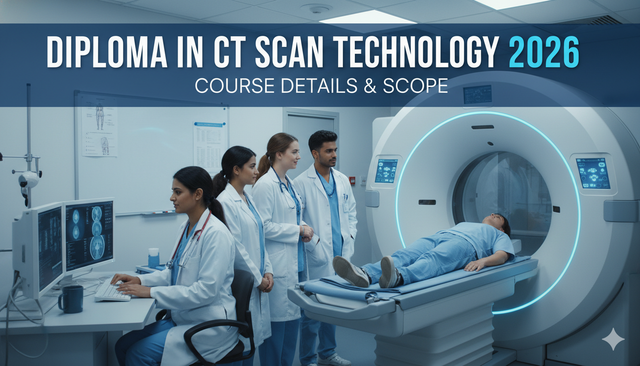
Diploma in CT Scan Technology (DCTST) 2026
The healthcare industry is experiencing rapid growth in diagnostic imaging, making specialized skills in Computed Tomography (CT) highly sought after. The Diploma in CT Scan Technology (DCTST) 2026 is a rigorous, two-year vocational program designed to train proficient CT technologists capable of operating cutting-edge imaging systems, ensuring optimal patient safety, and producing high-quality diagnostic images for clinical interpretation.
1. Course Overview & Key Highlights
This program offers specialized, hands-on training focusing exclusively on the physics, instrumentation, and clinical application of CT scanning. Graduates are prepared to meet the demands of modern radiology departments, equipped with advanced knowledge of radiation dose management, cross-sectional anatomy, and complex post-processing techniques.
Attribute Details Course Name Diploma in CT Scan Technology (DCTST) 2026 Course Level Diploma (Vocational/Paramedical) Duration 2 Years (Four Semesters) Eligibility Criteria 10+2 with Science (PCB/PCM) and a minimum 50% aggregate score. Entrance Exams None (Admission typically Merit-based or Institutional Interview) Course Fees (Estimate) ₹20,000 to ₹1,50,000 or more (Varies significantly by institution/region) Admission Process Merit-based selection followed by a mandatory counseling/interview session. Key Subjects Cross-Sectional Anatomy, CT Physics, Radiation Safety, Contrast Media, Advanced Protocols, Clinical Practicum. Examination Type Semester-wise theory and practical exams (OSPE/OSCE) complemented by clinical evaluations. Average Starting Salary ₹1.8 Lakhs to ₹3 Lakhs per year(Highly dependent on location and certification status) 2. Course Identity & Logistics
- Course Title: Diploma in CT Scan Technology (DCTST) 2026
- Course Code: DCTST-2026
- Credit Value/ECTS: Approximately 65 Total Credits
- Delivery Mode: Hybrid (Lectures, Simulation Labs, Mandatory Clinical Rotations)
- Department: School of Allied Health Sciences / Radiology Technology Division
- Clinical Rotation Requirement: Minimum 800 hours integrated into the curriculum.
3. Course Description & Rationale
The Diploma in CT Scan Technology 2026 is a comprehensive, skill-based curriculum designed to bridge the gap between theoretical knowledge and practical clinical execution. Students learn to master the technical intricacies of multi-slice and helical CT scanners, manage digital imaging systems (PACS/DICOM), and provide empathetic patient care under often high-stress diagnostic scenarios.
Curriculum Context & Industry Relevance
The rationale for this specialized diploma is driven by the rapid evolution of diagnostic technology. Modern CT scanners integrate Artificial Intelligence (AI) for dose optimization and feature advanced capabilities like perfusion imaging and Cardiac CT. This course ensures graduates are proficient in these 2025/2026 trends, making them immediately employable in specialized settings. The mandatory clinical rotation ensures practical competency in radiation protection and emergency procedure management.
Target Audience
This diploma is ideal for dedicated high school graduates from a Science background (Physics, Chemistry, Biology, or Mathematics) who are seeking a fast-track, specialized career in paramedical technology and have a strong commitment to patient safety and technical precision.
4. Prerequisites & Eligibility
Academic Prerequisites
- Successful completion of 10+2 (or equivalent) examination.
- Mandatory subjects: Physics, Chemistry, and either Biology or Mathematics.
- Minimum aggregate score of 50% in the qualifying examination.
Skill Requirements (Pre-Entry)
- Strong attention to detail and ability to follow precise protocols.
- Basic foundational knowledge of human anatomy and physiology.
- Proficiency in written and spoken English for technical communication.
Technical Requirements
- Access to a reliable internet connection for online modules (Radiation Safety, Ethics).
- Must possess a functioning laptop/tablet for accessing DICOM viewers and academic resources.
Health Requirement
All enrolled students must pass a basic occupational health screening, including up-to-date immunization verification, as mandated for clinical placement eligibility.
5. Learning Objectives
By the end of this course, successful students will be able to:
- Define: Key principles of radiation physics, biological effects of radiation, and the fundamental components of modern CT scanner hardware.
- Apply: Standard Operating Procedures (SOPs) to safely operate CT equipment, perform daily quality control (QC) checks, and administer contrast media under supervision.
- Analyze: Clinical requisitions to select appropriate scanning protocols, identify potential patient risks, and evaluate image quality for diagnostic acceptability.
- Evaluate: Radiation dose metrics (CTDIvol, DLP) and apply dose optimization techniques to maintain the lowest achievable dose (ALARA principle).
- Create: Advanced post-processing images, including Multiplanar Reconstructions (MPR), Maximum Intensity Projections (MIP), and complex 3D volume renderings for surgical planning or specialized diagnosis.
6. Course Materials
Required Textbooks
- Bontrager, K. L., & Lampignano, J. (2025). Textbook of Radiographic Positioning and Related Anatomy. (Focus on sectional anatomy correlation).
- Bushberg, J. T., et al. (2024). The Essential Physics of Medical Imaging. (For CT Physics and Safety).
- Mace, S. (2026). Clinical CT Procedures: Protocols and Contrast Administration.
Reference Materials
- Institutional Clinical Procedure Manuals (SOPs).
- Regulatory Guidelines (e.g., ICRP, local radiation control board publications).
- Online modules for HIPAA/GDPR compliance and professional ethics.
Software & Tools
- Picture Archiving and Communication System (PACS) Viewer access (Educational license).
- DICOM viewing and manipulation software.
- CT Simulation Lab Access (Virtual and physical equipment training).
- Personal Radiation Monitoring Devices (Dosimeters) for clinical use.
7. Detailed Syllabus & Module Breakdown (2 Years)
The curriculum is divided into three progressive phases, culminating in advanced clinical integration.
Phase I: Foundations (Semester 1)
Objective: Establish core science, patient care principles, and safety vocabulary.
| Weeks | Key Modules & Topics Covered |
|---|---|
| Weeks 1-4 | Human Anatomy & Physiology I: Focus on Organ Systems and Terminology. |
| Weeks 5-8 | Basic Radiographic Physics: Principles of X-ray generation, interaction with matter, and attenuation theory. |
| Weeks 9-12 | Patient Care & Ethics: Communication skills, vital signs monitoring, medical emergencies, professional conduct, and confidentiality (HIPAA). |
| Weeks 13-16 | Introduction to Radiation Safety: Dose units, regulatory bodies, and the ALARA principle. Initial written assessment. |
Phase II: Application & Core Concepts (Semesters 2 & 3)
Objective: Practical application of CT principles, instrumentation, and routine clinical protocols.
| Weeks | Key Modules & Topics Covered |
|---|---|
| Weeks 1-8 | CT Instrumentation & Quality Control: Gantry components, detectors, image acquisition techniques (helical vs. sequential), and daily QC procedures. |
| Weeks 9-16 | Cross-Sectional Anatomy: Detailed study of the Head, Neck, Spine, and Torso in axial, sagittal, and coronal planes. |
| Weeks 17-24 | Contrast Media Pharmacology: Types of contrast (iodinated, oral), administration methods, contraindications, and management of adverse reactions. |
| Weeks 25-32 | Routine Protocols: Standard CT Protocols for Head (Stroke), Chest (PE), and Abdomen/Pelvis. Digital Imaging (DICOM/PACS workflow). Midterm practical evaluation (OSCE). |
Phase III: Advanced & Clinical Integration (Semester 4)
Objective: Advanced complexity, specialized techniques, and full clinical competence.
| Weeks | Key Modules & Topics Covered |
|---|---|
| Weeks 1-4 | Advanced CT Techniques: Cardiac CT (Gating), CT Angiography (CTA), and Neuro-perfusion studies. |
| Weeks 5-8 | 3D Reconstruction and Post-Processing: Mastering MIP, MPR, Volume Rendering (VR), and bone removal techniques. |
| Weeks 9-12 | Pathology Correlation & Trauma Protocols: Recognizing common pathologies in CT images and executing rapid trauma protocols. |
| Weeks 13-16 | Clinical Internship & Final Review: Submission of comprehensive clinical logbook (800+ hours), final case study presentation, and preparation for certification exams. |
8. Assessment & Grading Scheme
Student performance is evaluated through a blend of theoretical knowledge, demonstrated practical skills, and documented clinical competency.
Assessment Distribution
| Assessment Component | Weightage |
|---|---|
| Theory Examinations (Mid-term & End-of-Semester Written) | 40% |
| Practical Examinations (OSPE/OSCE - Hands-on Skills) | 30% |
| Clinical Logbook & Supervised Evaluation | 20% |
| Final Project/Comprehensive Case Study | 10% |
| Total | 100% |
Grading Scale & Passing Criteria
- A (Excellent): 80% and above.
- B (Good): 70% - 79%.
- C (Satisfactory): 60% - 69%.
- D (Pass): 50% - 59%.
- F (Fail): Below 50%.
Passing Criteria: Students must achieve a minimum score of 50% in both the theory components and the practical/clinical components separately to pass the course and be eligible for certification.
9. Course Policies
Academic Integrity
The institution maintains a zero-tolerance policy regarding academic dishonesty, including plagiarism, unauthorized collaboration, and cheating on examinations. Violations will result in disciplinary action up to and including expulsion.
Attendance Requirements
A minimum of 75% attendance is mandatory for both didactic (theory) lectures and clinical rotation sessions. Failure to meet this requirement will render the student ineligible to sit for the final semester examinations or proceed to the next academic year.
Safety Compliance and Professional Conduct
Students must adhere strictly to all radiation safety protocols. Mandatory use of Personal Protective Equipment (PPE) and continuous wear of radiation monitoring badges (dosimeters) during all clinical hours are non-negotiable. Strict compliance with patient privacy laws (e.g., HIPAA) is required.
Late Submissions Policy
Assignments submitted after the deadline may incur a penalty of 5% per day, up to a maximum of five days, after which the assignment will receive a zero grade unless a documented medical or institutional exception is granted.
10. Career Scope & Certification
Graduates of the Diploma in CT Scan Technology are essential members of the diagnostic healthcare team, benefiting from high demand due to their specialized skillset.
Certification Details
Upon successful completion of the DCTST program, graduates are eligible to sit for national or international certification examinations (e.g., ARRT, CAMRT, or local regulatory boards). Obtaining certification significantly enhances career mobility and earning potential.
Skills Acquired
- Technical Skills: CT scanning execution, IV administration, contrast reaction management, DICOM/PACS system navigation, advanced 3D reconstruction.
- Soft Skills: Critical decision-making under pressure (especially in trauma), effective patient communication, teamwork, and ethical professionalism.
Job Roles and Salary Expectations
| Job Role | Description | Avg. Salary Range (Annual Estimate) |
|---|---|---|
| CT Technologist | Responsible for operating CT scanners, positioning patients, and ensuring image quality in a hospital or imaging center. | ₹1.8 Lakhs to ₹3.5 Lakhs per annum. |
| Radiography Technician Assistant | Entry-level role supporting general radiography and CT departments, focusing on patient throughput and safety checks. | ₹1.8 lakh and ₹3 lakh per annum. |
| Applications Specialist (Vendor) | Works for equipment manufacturers, training clinical staff on new CT technology and troubleshooting complex systems. | ₹3.2 Lakhs to ₹3.7 Lakhs per year. |
| PACS Administrator Assistant | Manages the storage, retrieval, and distribution of digital images (DICOM files) within the hospital network. | ₹3.2 Lakhs to ₹3.7 Lakhs per year. |
Further Studies Recommendations
Graduates can utilize this diploma as a strong foundation for continued academic growth, including: B.Sc. in Radiology Technology, Specialized Post-Diploma Certifications (e.g., Cardiac CT, Interventional Radiology), or management studies in Allied Health Administration.
11. Frequently Asked Questions (FAQs)
Q: What are the primary eligibility criteria for the Diploma in CT Scan Technology?
A: You must have successfully completed your 10+2 (or equivalent) examination with a Science background, specifically including Physics, Chemistry, and either Biology or Mathematics. A minimum aggregate score of 50% is typically required.
Q: How does this CT-specific diploma differ from a general Radiography course?
A: While general radiography covers X-ray and basic imaging, the DCTST is highly specialized. It dedicates significant time to advanced topics like cross-sectional anatomy, CT-specific physics (helical scanning, pitch), contrast administration, dose optimization, and 3D post-processing, making graduates experts in CT imaging specifically.
Q: Is the clinical internship component mandatory, and is it paid?
A: Yes, the clinical internship (minimum 800 hours) is a mandatory, non-negotiable requirement for graduation and certification eligibility, as hands-on experience is critical. Internships are primarily educational and typically unpaid, although some institutions may offer a minimal stipend.
Q: What is the course structure, and how is practical knowledge emphasized?
A: The 2-year course is divided into four semesters focusing on foundations, application, and advanced techniques. Practical knowledge is heavily emphasized through mandatory simulation lab hours, hands-on practical exams (OSCEs), and the extensive clinical logbook submission, which accounts for 50% of the overall assessment weight.
Q: What are the career prospects and typical starting salary for a certified CT Technologist?
A: Career prospects are excellent due to the high demand for specialized technicians. Graduates can work in hospitals, diagnostic centers, and research facilities. Starting salaries generally range from ₹2.5-₹4.5 LPA (INR) annually, varying significantly based on geographic location, facility type, and successful completion of professional certification exams.