
Diploma in Cardiac Care Technology 2026 | Cath Lab Expert
Launch your allied health career with the 2-year Diploma in Cardiac Care Technology 2026. Master Cath Lab, ECG, and critical care protocols with mandatory clinical rotations.
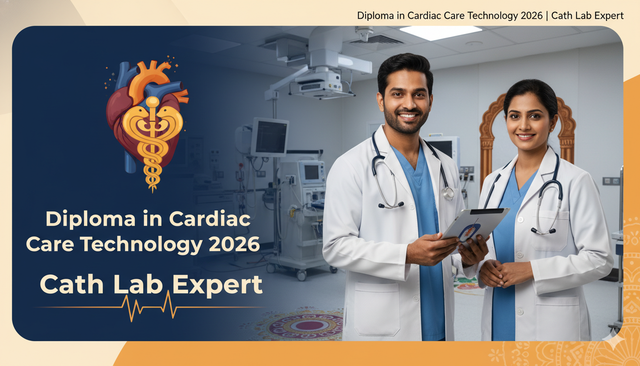
Diploma in Cardiac Care Technology 2026
1. Course Overview & Key Highlights
The Diploma in Cardiac Care Technology (DCC) 2026 is a rigorous two-year professional undergraduate program designed to train highly competent technical specialists capable of supporting cardiologists in advanced diagnostic and therapeutic procedures. Focusing heavily on Cath Lab operations, non-invasive diagnostics (ECG, Stress Testing), and critical care support, this program addresses the global demand for skilled cardiovascular technologists ready for immediate professional placement.
Key Highlights of the DCC 2026 Program
Feature Detail Course Name Diploma in Cardiac Care Technology 2026 Course Level Diploma (Professional Undergraduate Level) Typical Duration 2 Years (including 6 months mandatory Clinical Rotation) Eligibility Criteria 10+2 (Higher Secondary) with Physics, Chemistry, and Biology (PCB) or PCMB. Minimum 50% aggregate in core science subjects. Entrance Exams None (Admission typically Merit-based or Institutional Entrance Exam) Estimated Course Fees ₹15,000 to over ₹1 Lakh per year Admission Process Merit-based selection followed by institutional interview/counseling. Key Subjects Cardiac Pharmacology, Cath Lab Instrumentation, Advanced ECG Interpretation, Hemodynamics, Critical Care Cardiology, Pacemaker Technology. Examination Type Semester-wise Theoretical Exams and Practical Competency Assessments (OSCEs). Average Starting Salary ₹2.0 to ₹4.0 Lakhs annually 2. Course Identity & Logistics
- Official Course Title: Diploma in Cardiac Care Technology 2026
- Course Code: DCC26
- Credit Value/ECTS: Equivalent to 60 ECTS per academic year (120 Total Credits)
- Delivery Mode: Blended Learning (Lectures, Simulation Labs, Dedicated Practical Sessions, Mandatory Clinical Rotations)
- Instructor/Department: Taught by Certified Cardiologists, Allied Health Specialists, and Experienced Cardiac Technologists within the Allied Health Sciences Department.
3. Course Description & Rationale
The Diploma in Cardiac Care Technology 2026 is a comprehensive and skill-intensive program designed to transition students from foundational science knowledge to practical clinical expertise. The curriculum provides deep coverage of cardiac anatomy, cardiovascular physiology, specialized instrumentation, and the strict protocols required for invasive and non-invasive cardiac diagnostics and interventions.
Rationale: The global incidence of cardiovascular diseases necessitates a robust healthcare infrastructure. There is a critical and growing shortage of skilled technical professionals required to operate the sophisticated equipment—such as Cath Lab systems, IABP devices, and advanced hemodynamic monitors—used in modern cardiology. This diploma directly addresses this gap, producing job-ready technologists essential for tertiary care hospitals and specialized cardiac centers.
Curriculum Context & Target Audience
The course emphasizes high clinical rotation hours and simulation-based training, ensuring graduates possess not only theoretical knowledge but also the critical decision-making skills needed in high-pressure environments like the Cardiac Catheterization Lab and Cardiac Critical Care Unit (CCU). The target audience includes ambitious high school graduates (10+2 science stream) seeking an immediate, specialized entry into the high-growth allied healthcare sector.
4. Prerequisites & Eligibility
Academic Requirements
- Educational Level: Successful completion of 10+2 (Higher Secondary Education) or an equivalent qualification recognized by the relevant educational board.
- Required Subjects: Mandatory study of Physics, Chemistry, and Biology (PCB) or Physics, Chemistry, Mathematics, and Biology (PCMB).
- Minimum Aggregate Score: A minimum aggregate score of 50-55% in the core science subjects is typically required.
Health & Professional Requirements
- Health Requirements: Candidates must provide a mandatory medical fitness certificate and up-to-date immunization records (including Hepatitis B, Tetanus, etc.) prior to clinical placement.
- Language Proficiency: Demonstrated proficiency in the instruction language (e.g., English) is essential for patient communication and technical documentation.
5. Learning Objectives
By the end of this course, students will be able to:
- Define: Key terminology related to cardiac anatomy, electrophysiology, and advanced cardiac pharmacology, ensuring clear professional communication.
- Apply: Principles of radiation safety, sterile technique, and infection control standards meticulously within the Cath Lab and critical care settings.
- Analyze: Standard and complex 12-lead Electrocardiograms (ECGs) and interpret basic hemodynamic data accurately to assist in diagnosis.
- Evaluate: The operational status and troubleshoot advanced monitoring and life-support equipment, including Intra-Aortic Balloon Pumps (IABP) and ventilators.
- Create: Detailed patient records, procedure reports, and contribute effectively to the multidisciplinary team during complex cardiac interventions (e.g., Angiography, Pacemaker insertion).
6. Course Materials
Required Textbooks (Core Texts)
- Cardiac Technology: Principles and Practice by Smith & Johnson (2024 Edition)
- Cardiovascular Anatomy and Physiology for Allied Health Professionals by Dr. R. K. Sharma
- Introduction to Cardiac Pharmacology and Emergency Drugs by A. B. Chen
- The Cath Lab Manual: Instrumentation and Techniques by P. V. Rao
Reference Materials and Clinical Resources
- Access to institutional online simulation labs for ECG and Cath Lab scenarios.
- Interactive digital anatomy atlases focusing on coronary circulation and conduction systems.
- Standard Operating Procedures (SOPs) manuals for Cath Lab and Cardiac Critical Care Units (CCU/ICU).
Software & Tools
Students will utilize dedicated practical laboratories featuring modern equipment, including:
- 12-Lead ECG and Holter Monitoring Systems.
- Treadmill and Stress Test Units.
- High-fidelity Cath Lab Simulators for practicing sterile field setup and assistant roles.
- Hemodynamic Monitoring Software.
7. Detailed Syllabus & Module Breakdown
The 2-year program is structured into three progressive phases, culminating in mandatory clinical rotation.
Phase I: Foundations (Year 1, Semester 1)
Objective: Establish core vocabulary, foundational biomedical principles, and basic non-invasive diagnostic skills.
- Module 1: Human Anatomy & Physiology (Cardiovascular System Focus)
- Module 2: Medical Terminology, Ethics, and Patient Safety
- Module 3: Basic Physics of Medical Instrumentation and Electricity
- Module 4: Introduction to ECG Technology and Basic Rhythm Recognition
Phase II: Application & Core Concepts (Year 1, Semester 2 & Year 2, Semester 1)
Objective: Practical application of theories, mastering instrumentation, and understanding critical cardiac concepts.
- Module 5: Advanced ECG Interpretation and Arrhythmia Management
- Module 6: Cardiac Pharmacology and Emergency Drug Administration
- Module 7: Principles of Hemodynamics and Invasive Monitoring
- Module 8: Cath Lab Instrumentation, Sterile Techniques, and Radiation Safety
- Module 9: Assisting in Diagnostic Angiography and Interventional Procedures (Angioplasty/Stenting)
- Module 10: Echocardiography Basics and Non-Invasive Stress Testing
Phase III: Advanced Topics & Clinical Rotation (Year 2, Semester 2 & Internship)
Objective: Advanced complexity, synthesis of skills, and mandatory full-time clinical practice.
- Module 11: Critical Care Cardiology (ICU/CCU Protocols and Patient Management)
- Module 12: Advanced Electrophysiology and Pacemaker/ICD Technology
- Module 13: Mechanical Circulatory Support Devices (IABP, ECMO Principles)
- Module 14: Professional Development, Documentation, and Case Study Review
- Clinical Rotation: Mandatory 6-month full-time internship in an affiliated cardiac center (Cath Lab, CCU, and Non-Invasive Lab rotations).
8. Assessment & Grading Scheme
Assessment in the DCC 2026 program is competency-based, ensuring graduates are clinically ready upon completion.
Assessment Distribution
| Assessment Component | Weighting | Description |
|---|---|---|
| Theoretical Exams | 40% | Mid-term and End-of-Semester written examinations covering core knowledge. |
| Practical/Skills Examinations (OSCEs) | 30% | Objective Structured Clinical Examinations assessing hands-on competency in ECG setup, Cath Lab support, and equipment handling. |
| Clinical Evaluation | 20% | Supervisor ratings based on performance during the mandatory rotation, adherence to protocols, and professionalism. |
| Projects/Assignments | 10% | Case studies, research presentations, and simulation reports. |
Grading Scale and Passing Criteria
The program uses a standard letter grading system based on aggregate percentage:
- A (Excellent): 80% and above
- B (Good): 70% - 79%
- C (Satisfactory): 60% - 69%
- D (Pass): 50% - 59%
- F (Fail): Below 50%
Passing Criteria: Students must achieve a minimum aggregate score of 50% across all components and successfully pass the mandatory clinical evaluation to complete the course and receive the Diploma.
9. Course Policies
Academic Integrity
The institution maintains a zero-tolerance policy regarding academic misconduct. Any instance of plagiarism, cheating, or unauthorized collaboration in assignments or examinations will result in disciplinary action, potentially leading to immediate expulsion.
Attendance Requirements
- Theory and Practical Sessions: A minimum of 85% attendance is mandatory for all scheduled lectures, labs, and workshops.
- Clinical Rotations: Due to the critical nature of clinical training, a minimum of 95% attendance is strictly required for all mandatory clinical rotation hours.
Professional Conduct
Students are required to adhere strictly to medical ethics, maintain absolute patient confidentiality (HIPAA/GDPR compliance), and follow all hospital safety and infection control protocols while on clinical grounds. Professionalism, including punctuality and appropriate attire, is non-negotiable.
Safety & Infection Control
Mandatory annual training sessions on radiation safety (ALARA principles) and sterile field maintenance are compulsory. Failure to comply with safety checks will prohibit participation in practical and clinical sessions.
10. Career Scope & Certification
Graduates of the Diploma in Cardiac Care Technology 2026 are highly sought after by hospitals and specialized cardiac centers globally, ensuring excellent career growth prospects.
Certification Details
Upon successful completion of all academic requirements, practical assessments, and the mandatory clinical internship, students are awarded the official Diploma in Cardiac Care Technology 2026. Guidance will be provided regarding specific state or national professional registration requirements (e.g., certification exams, licensure).
Skills Acquired
- Technical Skills: Proficient ECG analysis, Cath Lab scrub and circulating assistance, operation of IABP, pacemaker interrogation assistance, hemodynamic monitoring.
- Soft Skills: Effective communication with critical patients and medical teams, crisis management, attention to detail, adherence to sterile protocols, and strong professional ethics.
Typical Job Roles and Career Pathways
| Job Role | Description | Estimated Annual Salary Range (USD) |
|---|---|---|
| Cardiac Technologist | Performs non-invasive tests (ECG, Holter, Stress Tests) and manages diagnostic equipment in clinics or hospitals. | ₹2.0 to ₹4.0 Lakhs per year (LPA) |
| Cath Lab Technician/Specialist | Assists cardiologists during invasive procedures (angiograms, angioplasties), manages inventory, and ensures equipment functionality. | ₹2 Lakhs to ₹3.9 Lakhs per year |
| Cardiovascular Invasive Specialist Assistant | Focuses specifically on assisting with complex interventional procedures in a dedicated surgical or Cath Lab environment. | ₹1.5 Lakhs to ₹2.5 Lakhs per year |
| Critical Care Technician (CCU/ICU) | Monitors critically ill cardiac patients, manages hemodynamic lines, and operates life-support devices under physician supervision. | ₹2.0 Lakhs to ₹4.0 Lakhs per year |
Further Studies Recommendations
Graduates have pathway options for lateral entry into advanced programs, including B.Sc. in Cardiovascular Technology, B.Sc. in Allied Health Sciences, or specialized Post-Graduate Diploma programs.
11. Frequently Asked Questions (FAQs)
Is the Diploma in Cardiac Care Technology 2026 recognized internationally?
The diploma adheres to international standards for cardiac care training, particularly regarding Cath Lab procedures and patient safety protocols. While specific licensure requirements vary by country, the strong clinical foundation and high level of practical training ensure that graduates are competitive candidates for certification and employment worldwide.
What is the typical admission process for the DCC 2026 course?
Admission is primarily merit-based, considering performance in the 10+2 science stream (PCB/PCMB). Shortlisted candidates typically undergo an institutional interview or counseling session to assess aptitude, communication skills, and commitment to the demanding clinical environment.
How are clinical placement sites selected, and is the internship paid?
Clinical placement sites are selected based on institutional affiliation with leading tertiary care hospitals and specialized cardiac centers, ensuring exposure to high-volume, complex cases. While the primary goal of the 6-month rotation is training, some institutions may offer a minimal stipend to cover basic expenses; however, the internship is primarily educational.
What is the required student-to-faculty ratio for practical labs and clinical rotations?
To ensure personalized instruction and maximum hands-on practice, the practical lab ratio is maintained at a maximum of 1:15. For critical clinical rotations (e.g., in the Cath Lab), the supervision ratio is significantly lower, typically 1:5, ensuring continuous oversight of patient care and procedural safety.
What are the mandatory health and safety requirements for enrollment?
All enrolled students must submit a comprehensive medical fitness certificate and proof of immunization (including mandatory doses for Hepatitis B and annual flu shots). Additionally, strict compliance with radiation safety protocols (dosimeter monitoring) and annual infection control training is compulsory throughout the program duration.