
Certificate in Home Health Aide (HHA) Training 2026
Launch your healthcare career with our 16-week hybrid HHA certification course. Includes 80 hours of clinical practice, state compliance, and exam prep. Enroll now.
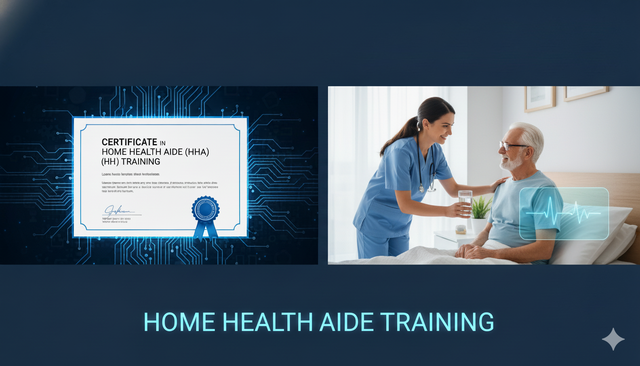
Certificate in Home Health Aide 2026 (HHA-C101)
1. Course Overview & Key Highlights
The Certificate in Home Health Aide 2026 is an intensive, 16-week vocational program designed to train compassionate and skilled caregivers ready to meet the demands of the modern home health industry. Combining 120 hours of essential classroom theory and lab practice with a mandatory 80-hour supervised clinical externship, this hybrid course ensures graduates are fully prepared for direct client care, regulatory compliance, and immediate employment in the fastest-growing sector of healthcare.
Key Highlights Table
Category Detail Course Name Certificate in Home Health Aide 2026 Course Level Certificate (Vocational/Professional) Duration 16 Weeks (Approx. 200 Total Hours) Eligibility Criteria High School Diploma/GED, Age 18+, Clear Background Check, Physical Ability/Health Screening. Entrance Exams None (Placement assessment may be required) Course Fees (Estimate) around ₹5,000 in government-affiliated programs to ₹60,000 for private academies Admission Process Application Review, Background Check, Health Screening Key Subjects Infection Control, ADL Assistance, Body Mechanics, Chronic Disease Management, HIPAA Compliance, Vital Signs Monitoring, Geriatric Care. Examination Type Skills Check-offs, Midterm, Final Comprehensive Exam, Clinical Practicum Evaluation. Average Starting Salary (Estimate) ₹10,000 to ₹15,000+ per month) 2. Course Identity & Logistics
- Course Title & Code: Certificate in Home Health Aide 2026 (HHA-C101)
- Credit Value/CEUs: 12 Continuing Education Units (CEUs)
- Delivery Mode: Hybrid (Online lectures/theory, mandatory in-person lab skills sessions, and supervised clinical practicum).
- Typical Duration: 16 Weeks
- Instructor Qualifications: All instructors are Registered Nurses (RNs) with a minimum of 3 years of verifiable experience in long-term or home health care settings.
3. Course Description & Rationale
This intensive vocational program is specifically designed to equip students with the essential knowledge and practical skills required to assist clients with activities of daily living (ADLs) in a comfortable, safe, and respectful home environment. The curriculum is deeply rooted in principles of safety, comprehensive infection control, strict adherence to client rights, and effective, therapeutic communication.
Curriculum Context & Industry Relevance (2025/2026)
The Home Health Aide role is experiencing explosive growth due to the demographic shift toward an aging population and the overwhelming preference among seniors to receive high-quality care at home rather than in institutional settings. This course directly addresses the critical national shortage of qualified, certified caregivers. By integrating state-specific regulatory compliance and mandatory 80-hour clinical hours, the Certificate in Home Health Aide 2026 ensures graduates are not only clinically competent but also legally prepared to deliver standardized, high-quality, and ethical care immediately upon certification.
Target Audience
This program is ideal for individuals seeking rapid entry into the healthcare field, those looking for a meaningful career change, or current caregivers needing formal certification to work in Medicare/Medicaid certified agencies. It provides an excellent foundation for future advanced studies, such as LPN or RN programs.
4. Prerequisites & Eligibility
Admission into the HHA-C101 program requires the successful fulfillment of the following criteria:
- Academic Prerequisites: High School Diploma or equivalent (GED).
- Health Requirements: Current CPR/BLS certification (must be maintained throughout the course), negative Tuberculosis (TB) test, and proof of required immunizations.
- Legal Requirements: Minimum age of 18. Successful completion of a state and federal criminal background check, including fingerprinting.
- Physical Requirements: Documented ability to safely lift a minimum of 50 pounds and stand for extended periods, necessary for safe patient transfer and mobility assistance training.
5. Learning Objectives
Upon successful completion of the Certificate in Home Health Aide 2026, students will be prepared to:
- Define: Key legal, ethical, and professional responsibilities of the Home Health Aide, including full compliance with HIPAA and client rights policies.
- Apply: Proper body mechanics, infection control techniques (including PPE use), and safe client transfer protocols (e.g., using gait belts) to prevent injury to themselves and the client.
- Analyze: Client care plans, accurately monitor and record vital signs, intake/output, and recognize critical changes in a client’s physical or mental status.
- Evaluate: Potential risks within the home environment (safety hazards) and implement appropriate crisis intervention strategies for common scenarios, such as falls or sudden illness.
- Execute: Personal care procedures (bathing, dressing, grooming, feeding) compassionately and proficiently, while maintaining the client's dignity and independence.
6. Course Materials
Students are required to obtain the following materials prior to the start of Phase I:
- Required Textbooks:
- Mosby's Textbook for Home Health Aides (Latest Edition), by Sheila A. Sorrentino & Leighann Remmert.
- Caring for the Older Adult: A Home Health Perspective, by Mary E. Jones.
- The Professional Caregiver Handbook: Documentation and Ethics, by the National HHA Association.
- Reference Materials: Student Workbook, Skills Competency Check-off Manual, and access to the institution’s Online Learning Management System (LMS).
- Software & Tools: Basic Medical Supplies Kit (stethoscope, blood pressure cuff, gloves, gait belt), and professional uniform (scrubs) required for all in-person sessions.
7. Detailed Syllabus & Module Breakdown (16 Weeks)
Phase I: Foundations of Caregiving (Weeks 1-5)
Objective: Establish core vocabulary, legal frameworks, professional boundaries, and foundational safety principles required for the HHA role.
- Week 1: Introduction to the HHA Role, Legal and Ethical Responsibilities, and HIPAA Compliance.
- Week 2: Basic Human Anatomy & Physiology, Patient Rights, and Therapeutic Communication.
- Week 3: Infection Control, Standard Precautions, and Proper Hand Hygiene Techniques (Key Skill Focus).
- Week 4: Safety in the Home Environment, Body Mechanics, and Injury Prevention.
- Week 5: Emergency Procedures, Disaster Preparedness, and Reporting Requirements.
Phase II: Application of Personal Care (Weeks 6-10)
Objective: Master the practical clinical skills necessary to assist clients with essential daily living activities and monitoring.
- Week 6: Measuring and Recording Vital Signs (Manual Blood Pressure and Temperature).
- Week 7: Assisting with Activities of Daily Living (ADLs): Bathing, Grooming, and Oral Care.
- Week 8: Nutrition, Feeding Dependent Clients, Special Diets, and Fluid Intake/Output Monitoring.
- Week 9: Mobility and Transfers: Use of Gait Belts, Pivot Transfers, and Assisting with Ambulation.
- Week 10: Skin Care, Pressure Ulcer Prevention, and Elimination Needs.
Phase III: Specialized Care and Clinical Integration (Weeks 11-16)
Objective: Address complex care needs, chronic disease management, and integrate theory into supervised practical experience.
- Week 11: Chronic Disease Management (Diabetes, COPD, Dementia) and Mental Health Awareness.
- Week 12: Home Management, Meal Preparation, and Medication Reminders and Safety.
- Week 13: Care of the Dying Patient (Hospice Care) and Communication with Families.
- Week 14: Documentation and Reporting, Certification Exam Preparation, and Final Skills Check-offs.
- Weeks 15-16: Mandatory 80-Hour Supervised Clinical Practicum/Externship (Pass/Fail) and Final Written Comprehensive Exam.
8. Assessment & Grading Scheme
Student performance is evaluated continuously throughout the 16 weeks, ensuring both theoretical knowledge and practical competency are achieved.
Grading Distribution Table
| Assessment Component | Weight | Notes |
|---|---|---|
| Written Exams (Midterm & Final Comprehensive) | 40% | Tests theoretical knowledge. |
| Skills Competency Check-offs (Lab) | 30% | Must achieve 100% proficiency on critical skills after remediation. |
| Quizzes and Homework | 15% | Module assessments and reading assignments. |
| Clinical Practicum Evaluation | 15% | Pass/Fail based on on-site Registered Nurse (RN) supervisor assessment. |
Passing Criteria
A minimum cumulative grade of 75% (C) in the didactic portion of the course is required to proceed to the clinical phase and sit for the state/national HHA certification examination.
9. Course Policies
- Academic Integrity: Zero-tolerance policy for plagiarism or cheating; violations may result in immediate dismissal from the program.
- Attendance Requirements: Mandatory 90% attendance for all scheduled lab and clinical hours. Missed time must be formally made up.
- Professionalism: Strict adherence to the professional dress code (scrubs), punctuality, and respectful interaction with clients and staff is required at all times.
- Confidentiality: Zero-tolerance policy for HIPAA violations during clinical rotations.
- Drug Testing: Successful completion of a pre-clinical drug screening and potential random testing throughout the program is mandatory.
10. Career Scope & Certification
Graduates are prepared for immediate employment in a high-demand field and are eligible to pursue formal certification required by Medicare/Medicaid certified agencies.
Certification Details
Graduates are eligible to take the state or national HHA certification examination. This certification validates competency and is essential for working in most professional healthcare settings.
Skills Acquired
- Technical Skills: Proficient vital signs collection, safe patient transfer, specialized geriatric care, medication reminders, and standardized documentation.
- Soft Skills: Compassionate communication, cultural sensitivity, crisis intervention, time management, and ethical decision-making.
Job Roles and Salary Potential
| Job Role | Description | Estimated Average Starting Salary (Annual) |
|---|---|---|
| Home Health Aide (HHA) | Provides direct personal care and assistance with ADLs for clients in their private residences. | ₹2.5 to ₹4.3 Lakhs per year |
| Personal Care Aide (PCA) | Focuses primarily on non-medical assistance, companionship, and household tasks. | ₹3.0 Lakhs to ₹4.3 Lakhs per year |
| Hospice Caregiver | Provides sensitive, supportive care for terminally ill patients and their families. | ₹2.1 Lakhs to ₹3.2 Lakhs per year. |
Further Studies Recommendations
The HHA certificate is an excellent first step toward achieving higher credentials, offering a direct pathway to further education in Licensed Practical Nursing (LPN) or Registered Nursing (RN) programs.
11. Frequently Asked Questions (FAQs)
Is job placement guaranteed upon completion of the HHA course?
No, job placement is not guaranteed. However, the institution offers robust career services support, including resume writing workshops, interview preparation, and regular networking events with local home health agencies and employers who actively recruit our graduates.
What is the difference between this HHA certificate and CNA certification?
The Certificate in Home Health Aide focuses specifically on providing care in the client's home environment. While this course meets many of the core curriculum requirements for Certified Nursing Assistant (CNA) certification, students may need to complete additional state-mandated classroom hours or a separate state test to achieve full CNA certification, depending on local regulations.
What are the financial requirements for enrollment?
The estimated course fee ranges from ₹1,000 to ₹25,000, which typically covers tuition, lab fees, and required materials like the skills kit. Financial aid, payment plans, and scholarship opportunities may be available; prospective students should contact the admissions office for detailed cost breakdowns.
How is the hybrid course structure managed?
The theoretical components (lectures, quizzes, exams) are delivered online via our Learning Management System (LMS), allowing for scheduling flexibility. However, all skills lab sessions (required for hands-on practice) and the 80-hour clinical practicum are mandatory and must be attended in person on site or at an approved clinical facility.
What happens if I fail a Skills Competency Check-off?
For critical skills such as vital signs and transfers, students must achieve 100% proficiency. If a student fails an initial check-off, remediation sessions are scheduled immediately. Students are typically given multiple attempts to pass the critical skills before being withdrawn from the program, emphasizing the importance of safety and mastery.