
M.Sc. Medical Laboratory Technology 2026 | Advanced Diagnostics
Master advanced clinical diagnostics, laboratory management, and molecular techniques with the M.Sc. MLT program. Become a certified clinical scientist and lab leader.
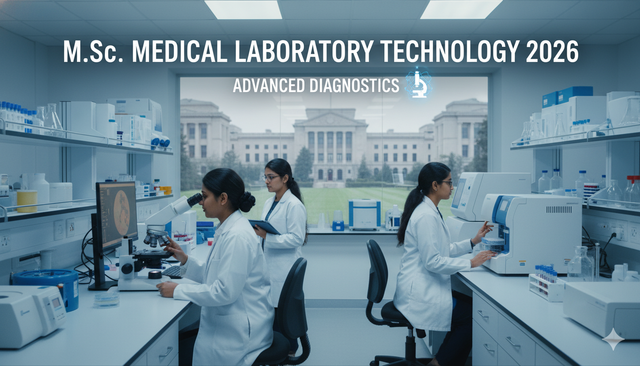
M.Sc. in Medical Laboratory Technology (MLT) 2026: Advanced Clinical Diagnostics
The M.Sc. in Medical Laboratory Technology is a specialized postgraduate program designed to cultivate expert clinical scientists capable of leading complex diagnostic laboratories and driving translational research. This two-year, full-time course integrates advanced molecular techniques, high-throughput automation, and rigorous quality management standards (NABL/CAP) to prepare you for the highest levels of professional practice in the dynamic field of clinical diagnostics.
1. Course Overview & Key Highlights
This Master of Science program transitions technologists into specialized clinical scientists, focusing on the sophisticated interpretation, management, and quality control required in modern, automated diagnostic environments.
| Metric | Detail |
|---|---|
| Course Name | M.Sc. in Medical Laboratory Technology |
| Course Level | Postgraduate (Master of Science) |
| Duration | 2 Years (4 Semesters) |
| Eligibility Criteria | B.Sc. in MLT or relevant Allied Health/Science disciplines (e.g., Biochemistry, Microbiology, Biotechnology) with min. 55% aggregate. |
| Entrance Exams | University/National Level Entrance Exam (e.g., NEET-PG equivalent for Allied Health) followed by a mandatory Personal Interview. |
| Course Fees (Estimate) | ₹80,000 to ₹2,00,000 per annum (Varies by institution) |
| Admission Process | Entrance-based, followed by merit screening and Interview. |
| Key Subjects | Molecular Diagnostics, Advanced Hematology, Laboratory Quality Management (NABL/CAP), Clinical Bioinformatics, Hospital Infection Control. |
| Examination Type | Semester-wise (Internal Assessment + External Theory/Practical Exams). Includes a major Dissertation/Thesis project in the final year. |
| Average Starting Salary | ₹4.5 LPA – ₹8.0 LPA (Depending on specialization and sector) |
2. Course Identity & Logistics
- Course Title: Master of Science in Medical Laboratory Technology
- Program Code: MLT-MSC-2026
- Credit Value/ECTS: 90-110 ECTS (European Credit Transfer System)
- Format: Full-Time, On-Campus, integrating Lectures, Specialized Laboratory Sessions, Clinical Rotations, and Research Workshops.
- Instructor/Department Info: Program overseen by Dr. [Name], Head of Allied Health Sciences, supported by specialized faculty in Pathology, Microbiology, and Clinical Chemistry.
- Intake Capacity: Limited to 30 students per cohort to ensure high-quality practical training and mentorship.
3. Course Description & Rationale
The M.Sc. in MLT is a rigorous postgraduate curriculum aimed at producing tomorrow's laboratory leaders. It moves beyond routine testing to focus on advanced diagnostic interpretation, validation of new assays, and the implementation of complex molecular and genetic testing protocols. Students gain deep expertise in translational research—bridging basic science discoveries into clinically viable diagnostic solutions.
Curriculum Context & Industry Relevance (2025 Trends)
In 2025, clinical laboratories are characterized by high-throughput automation, integration of Artificial Intelligence (AI) in image analysis, and the dominance of personalized medicine driven by genomics. This course is specifically structured to address these trends, providing extensive training in Laboratory Information Systems (LIS) management, automation troubleshooting, and stringent regulatory compliance (e.g., achieving and maintaining NABL/CAP accreditation). The mandatory research dissertation ensures students can contribute original findings to the biomedical community.
Target Audience
This program is ideal for dedicated B.Sc. MLT graduates, or graduates in closely related life sciences, who aspire to specialized roles such as Laboratory Managers, Clinical Scientists, Quality Assurance Officers, or those planning to pursue a Ph.D. in biomedical research.
4. Prerequisites & Eligibility
Academic Prerequisites
- A Bachelor's degree (B.Sc.) in Medical Laboratory Technology (MLT) is preferred.
- Alternatively, B.Sc. in Microbiology, Biochemistry, Biotechnology, or relevant Allied Health Sciences are considered, provided the applicant meets the minimum aggregate score (typically 55-60%).
- Applicants must have successfully cleared the designated University or National Level Entrance Examination.
Skill Requirements
- Strong foundational knowledge in human anatomy, physiology, and basic clinical pathology.
- Demonstrated aptitude for analytical problem-solving and critical thinking.
- High level of commitment to precision and detail required for laboratory work.
Technical Requirements
Students are expected to be proficient in basic computer operations. Familiarity with statistical software (like SPSS or R) and a basic understanding of LIS systems is highly advantageous.
Corequisites
Successful enrollment requires mandatory participation in clinical rotations and adherence to all institutional safety guidelines, including comprehensive BSL-2/BSL-3 training.
5. Learning Objectives
Upon successful completion of the M.Sc. in MLT, students will be able to:
- Define: Key principles of Quality Management Systems (QMS), regulatory standards (NABL/CAP), and advanced molecular diagnostic terminology.
- Apply: High-throughput automation tools and complex diagnostic methodologies across clinical biochemistry, hematology, and specialized microbiology.
- Analyze: Complex patient data, diagnostic results, and quality control metrics to troubleshoot and validate laboratory procedures effectively.
- Evaluate: Scientific literature critically, assess the clinical utility of new diagnostic assays, and ensure ethical compliance in laboratory practice.
- Create: Independent, evidence-based research designs (Dissertation) and develop comprehensive Standard Operating Procedures (SOPs) for specialized laboratory sections.
6. Course Materials
Required Textbooks (Core References)
- Henry’s Clinical Diagnosis and Management by Laboratory Methods (Latest Edition)
- Rodak’s Hematology: Clinical Principles and Applications (Latest Edition)
- Molecular Diagnostics: Fundamentals, Methods, and Clinical Applications (By L.A. Coleman/C. G. Tsongalis)
- Tietz Textbook of Clinical Chemistry and Molecular Diagnostics (Latest Edition)
Reference Materials
- Detailed laboratory manuals and SOP checklists for advanced techniques.
- Access to institutional databases (e.g., PubMed, ScienceDirect) for research purposes.
- Instructional videos and simulation tools for automated instrumentation (e.g., LIS integration tutorials).
Software & Tools
Licensed access to statistical analysis software (SPSS, R), specialized LIS training modules, and bioinformatics tools for genomic data analysis.
7. Detailed Syllabus & Module Breakdown
The curriculum is structured across three progressive phases, culminating in a comprehensive research thesis.
Phase I: Foundations (Semester 1)
Objective: Establish core systems mastery and advanced pathophysiology knowledge.
- Week 1-4: Advanced Clinical Biochemistry & Instrumentation: Focus on endocrinology, toxicology, mass spectrometry, and validation of automated chemistry analyzers.
- Week 5-8: Diagnostic Hematology & Coagulation: Detailed study of complex anemias, flow cytometry, molecular markers in leukemia, and advanced coagulation testing protocols.
- Week 9-12: Systemic Pathology & Histopathology Techniques: Correlation of laboratory findings with tissue pathology, advanced staining techniques, and immunohistochemistry principles.
- Week 13-16: Biostatistics & Research Methodology: Hypothesis testing, experimental design, and ethical considerations in biomedical research.
Phase II: Application & Core Concepts (Semester 2 & 3)
Objective: Practical application of specialized molecular and clinical techniques in a hospital setting.
- Semester 2: Molecular Diagnostics & Genomics: Focus on PCR variants (qPCR, ddPCR), next-generation sequencing (NGS) platforms, and clinical applications in infectious disease and oncology.
- Semester 2: Advanced Clinical Immunology & Serology: Autoimmune markers, transplantation immunology, and advanced infectious disease serology testing.
- Semester 3: Laboratory Automation & LIS Management: Principles of total laboratory automation (TLA), middleware management, data security, and troubleshooting interfaces.
- Semester 3: Hospital Infection Control & Epidemiology: Surveillance techniques, antibiotic stewardship, outbreak investigation, and BSL-3 safety procedures.
Phase III: Advanced Topics (Semester 4 - Capstone)
Objective: Leadership training, synthesis of knowledge, and execution of the final research project.
- Weeks 1-4: Laboratory Quality Management & Accreditation: Deep dive into NABL/CAP requirements, internal and external quality control, audit preparation, and corrective action procedures.
- Weeks 5-8: Bioethics and Leadership in Diagnostics: Professional communication, team management, conflict resolution, and ethical dilemmas in genetic testing.
- Weeks 9-16: Dissertation/Thesis Project: Dedicated time for data collection, analysis, writing, and formal defense of the comprehensive research thesis.
8. Assessment & Grading Scheme
Assessment is continuous and comprehensive, designed to test both theoretical mastery and practical competency in advanced laboratory settings.
Assessment Distribution
| Assessment Component | Weightage | Description |
|---|---|---|
| Internal Assessments (Quizzes/Assignments) | 15% | Continuous evaluation throughout the semester. |
| Midterm Examination | 15% | Comprehensive theory exam covering Phase I/II topics. |
| Practical Performance Exams (Viva) | 10% | Evaluation of technical skills and SOP adherence in specialized labs. |
| End-of-Semester Theory Exam | 35% | External assessment of theoretical knowledge. |
| Final Dissertation/Thesis Project | 25% | Research execution, written thesis, and formal defense (Viva Voce). |
| Total | 100% |
Passing Criteria
Students must achieve a minimum passing grade (typically 50% or C grade) in both the Internal and External components of each module separately. A minimum aggregate of 55% is required to clear the program. The Dissertation must be successfully defended.
9. Course Policies
- Academic Integrity: The institution maintains a strict zero-tolerance policy regarding plagiarism, cheating, and fabrication of research data. All work must adhere to established academic standards.
- Attendance Requirements: Mandatory minimum attendance of 75% for all theory classes and 90% for all practical sessions and clinical rotations is strictly enforced for eligibility to sit for the final examination.
- Late Submissions Policy: Assignments submitted past the deadline may incur a penalty (e.g., 10% deduction per day) unless a valid medical or extenuating circumstance is approved by the Program Coordinator.
- Safety: Adherence to BSL-2/BSL-3 biosafety protocols is mandatory. Non-compliance with safety regulations will result in immediate suspension from practical sessions.
10. Career Scope & Certification
Graduates of the M.Sc. in MLT are prepared for leadership roles in clinical diagnostics, research, and public health sectors.
Skills Acquired
- Technical Skills: Molecular assay development, flow cytometry operation, LIS management, advanced microbiology culture techniques, and high-throughput automation.
- Soft Skills: Leadership and team management, critical data interpretation, quality control auditing, technical communication, and ethical decision-making.
Job Roles and Average Salary
| Career Role | Description | Average Annual Salary (INR) |
|---|---|---|
| Laboratory Manager/Supervisor | Oversees daily operations, budgetary control, staff training, and compliance with regulatory standards (NABL/CAP) in a large diagnostic lab. | ₹7,00,000 – ₹12,00,000+ |
| Clinical Scientist (Specialized) | Focuses on complex test interpretation, assay validation, and implementation of new diagnostic technologies (e.g., genomics). | ₹6,00,000 – ₹10,00,000 |
| Quality Control (QC) Specialist | Responsible for developing and monitoring Quality Management Systems (QMS) and preparing the facility for accreditation audits. | ₹5,50,000 – ₹8,50,000 |
| Research Technologist | Works in Pharmaceutical, Biotechnology, or Academic R&D, developing novel diagnostic tools or supporting clinical trials. | ₹4,50,000 – ₹7,50,000 |
Certification Pathway
The degree provides the necessary academic foundation and clinical experience required to sit for specialized national or international professional certification exams, such as the Medical Laboratory Scientist (MLS) certification offered by organizations like ASCP (American Society for Clinical Pathology) or equivalent national bodies, enhancing global employability.
Further Studies
This M.Sc. program is the primary stepping stone for highly ambitious students wishing to pursue advanced academic careers, providing direct entry eligibility for Ph.D. programs in Clinical Pathology, Molecular Biology, Bioinformatics, or Biomedical Sciences.
11. FAQs (Frequently Asked Questions)
What are the primary eligibility criteria for M.Sc. MLT 2026?
Applicants must hold a B.Sc. degree in Medical Laboratory Technology or a closely related science field (Biochemistry, Microbiology) with a minimum aggregate score of 55-60%. Successful clearance of the mandatory entrance exam and personal interview is also required.
Is the M.Sc. MLT program focused more on research or clinical practice?
The program is balanced (translational). Semesters 1-3 focus heavily on advanced clinical diagnostics and laboratory management (practice), while Semester 4 culminates in a mandatory comprehensive research dissertation, ensuring graduates are competent in both research design and clinical application.
What is the typical class intake capacity for this program?
Due to the specialized nature and the requirement for extensive hands-on training and clinical rotations, the intake capacity is intentionally limited, typically to 30 students per cohort, ensuring individualized mentorship and access to advanced instrumentation.
Do students receive a stipend during clinical rotations or internships?
Stipend details vary significantly. While clinical rotations are mandatory, whether they are paid or unpaid depends entirely on the specific partnership agreement with the affiliated hospital or diagnostic chain. Students should clarify this during the admission interview process.
What career growth can I expect after completing the M.Sc. in MLT?
Graduates are positioned for leadership and specialized roles. You can progress from a specialized Clinical Scientist to a Laboratory Manager, Quality Assurance Officer, or even Academic Faculty. The degree significantly increases earning potential and opens doors to international certification and Ph.D. opportunities.