
M.Sc. Critical Care Technology 2026: Advanced Clinical Masters
Master advanced critical care systems, mechanical ventilation, and RRT. 2-year full-time PG program with mandatory clinical residency and ACLS certification focus.
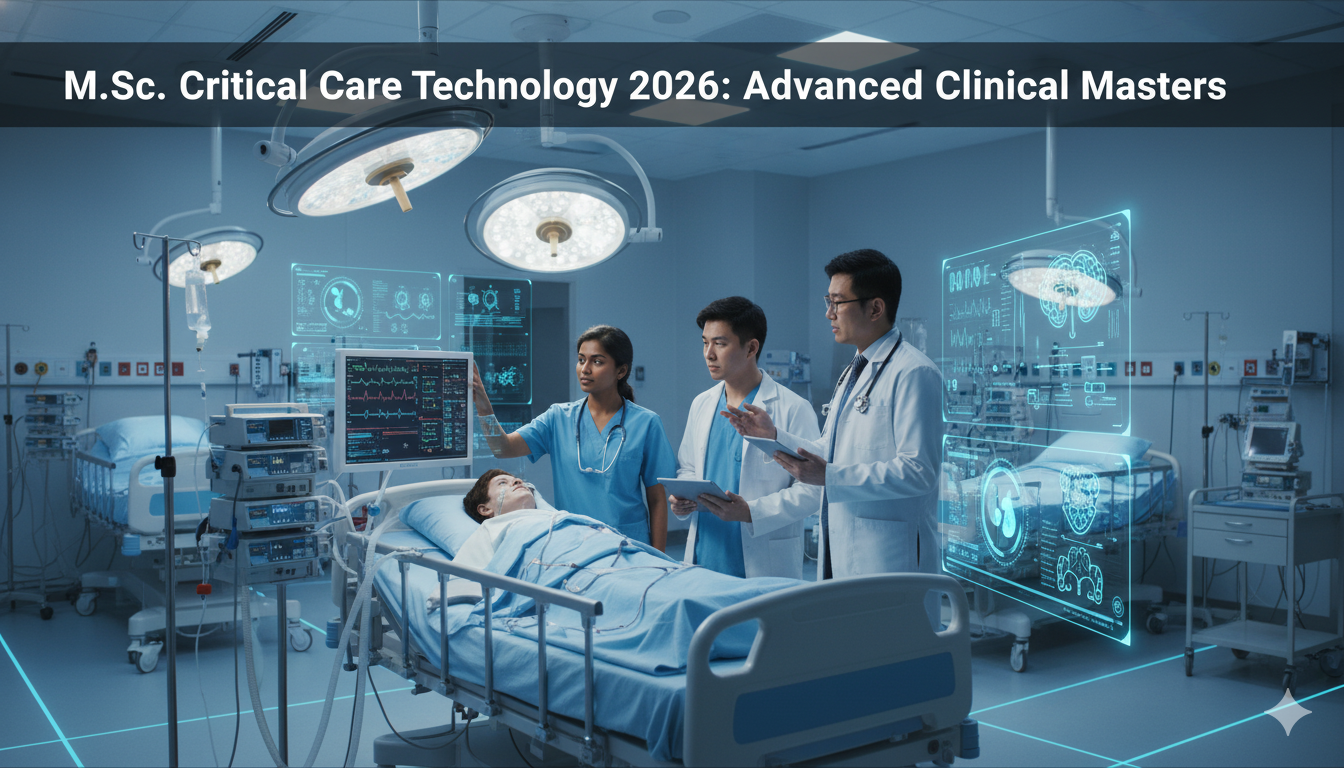
Master of Science (M.Sc.) in Critical Care Technology 2026
Expert Training for High-Acuity Clinical Settings
1. Course Overview & Key Highlights
The M.Sc. in Critical Care Technology is a comprehensive two-year postgraduate program designed to cultivate expert allied health professionals capable of managing, troubleshooting, and optimizing complex life support systems within high-acuity environments like Intensive Care Units (ICU), Cardiac Care Units (CCU), and Trauma Bays. This specialized degree emphasizes advanced technological mastery, evidence-based practice, interdisciplinary collaboration, and mandatory clinical residency to ensure graduates are immediately industry-ready.
Key Highlights Table
| Feature | Detail |
|---|---|
| Course Name | Master of Science in Critical Care Technology |
| Course Level | Postgraduate (M.Sc.) |
| Duration | 2 Years (4 Semesters) |
| Eligibility Criteria | B.Sc. in relevant Allied Health Science (e.g., Critical Care Tech, Anaesthesia Tech, Nursing) with minimum 55% aggregate. |
| Entrance Exams | Mandatory Institutional Entrance Examination (Followed by Personal Interview/Counseling) |
| Course Fees (Estimate) | ₹1,50,000 - ₹3,00,000 per annum (varies by institution) |
| Admission Process | Entrance-based, followed by Interview/Counseling. |
| Key Subjects | Advanced Mechanical Ventilation, Hemodynamic Monitoring, Renal Replacement Therapy (CRRT), Clinical Pharmacology, Research Methodology. |
| Examination Type | Semester-wise (Theory, Practical, Clinical Skills Assessment - OSCE/OSPE) |
| Average Starting Salary (Estimate) | ₹4 LPA - ₹8 LPA (Highly dependent on clinical setting and location) |
2. Course Identity & Logistics
- Official Title: Master of Science in Critical Care Technology (Code: CCT-M2026)
- Credit Structure: The program carries a total of 90-100 credits, distributed across theory, practical labs, clinical rotations, and the final research dissertation.
- Format: Full-Time, Residential. This course utilizes a blended format incorporating Lectures, High-Fidelity Simulation Labs, Clinical Rotations, and mandatory hands-on Workshops.
- Department Info: Offered by the Department of Allied Health Sciences in collaboration with the Institutional Critical Care Medicine Department.
3. Course Description & Rationale
This M.Sc. program is a rigorous postgraduate specialization focusing on the technological backbone of modern critical care. Graduates are trained not merely as operators, but as clinical experts who understand the underlying pathophysiology, allowing them to proactively manage complex life support modalities. The curriculum is meticulously designed to bridge the gap between technological complexity and critical patient management.
Curriculum Context & Rationale
The rationale for this degree stems from the global shift towards highly complex, technology-dependent critical care. Modern ICUs utilize technologies like ECMO, continuous renal replacement therapy (CRRT), and advanced hemodynamic monitors, requiring highly specialized professionals beyond traditional nursing or physician roles to ensure optimal operational efficiency and patient safety. This program addresses the critical need for allied health leaders proficient in these areas, directly contributing to improved patient outcomes and resource management.
Industry Relevance (2025 Trends)
The 2025 healthcare landscape demands technologists skilled in rapid diagnostics, data-driven decision-making, and specialized organ support technologies. The course integrates training on next-generation monitoring systems and AI-assisted diagnostics, ensuring graduates are prepared for the future of precision critical care medicine.
Target Audience
Recent graduates holding a Bachelor’s degree in Critical Care Technology, Anaesthesia Technology, Respiratory Therapy, or specialized B.Sc. Nursing who seek a leadership role and advanced technical expertise in high-acuity clinical environments.
4. Prerequisites & Eligibility
Academic Prerequisites
- Successful completion of a minimum 3-year Bachelor’s degree in a relevant Allied Health Science field.
- A minimum aggregate score of 55% or equivalent CGPA in the qualifying examination is mandatory.
- Preference is given to candidates with one year of documented clinical experience in an ICU or related high-acuity setting.
Skill Requirements (Preferred)
- Strong foundational knowledge of human physiology and basic life support (BLS).
- High mechanical aptitude and problem-solving skills under pressure.
- Excellent communication and interdisciplinary collaboration skills.
Selection Process
Admission is strictly competitive, requiring candidates to pass an institutional Entrance Examination focusing on applied sciences and critical care fundamentals, followed by a mandatory Personal Interview (PI) to assess clinical aptitude and communication skills.
5. Learning Objectives
Upon successful completion of the M.Sc. in Critical Care Technology, students will be able to:
- Mastery: Demonstrate operational and technical mastery of all major advanced life support systems, including complex mechanical ventilators, CRRT machines, and intra-aortic balloon pumps (IABP).
- Pathophysiology: Integrate complex pathophysiological knowledge (e.g., Sepsis, ARDS, Cardiogenic Shock) to anticipate technological needs and manage critical complications effectively.
- Analyze: Critically analyze hemodynamic data and diagnostic imaging to inform adjustments in life support settings and pharmacological interventions.
- Research: Formulate novel research questions, design and execute a comprehensive research study, and present findings relevant to improving critical care technology standards.
- Leadership: Apply ethical principles, quality management frameworks, and leadership skills necessary for coordinating critical care teams and managing high-stress clinical resources.
6. Course Materials
Required Textbooks
- Marino’s The ICU Book (Paul L. Marino) - Core reference for clinical management.
- Principles and Practice of Mechanical Ventilation (Tobin, et al.) - Specialized text.
- Critical Care Nephrology (Ronco, Bellomo, Kellum) - Focus on Renal Replacement Therapies.
- Standardized Institutional Critical Care Protocols and Guidelines (e.g., Surviving Sepsis Campaign, ATLS/ACLS manuals).
Simulation Resources
- Access to state-of-the-art High-Fidelity Simulation Labs featuring advanced patient manikins (e.g., SimMan 3G).
- Virtual Reality (VR) training modules for rare clinical scenarios (e.g., massive transfusion protocols).
Software & Tools
- Statistical analysis software (e.g., SPSS, R Studio) for biostatistics and dissertation work.
- Subscription access to leading international critical care journals (e.g., Critical Care Medicine, Lancet Respiratory Medicine).
7. Detailed Syllabus & Module Breakdown
The 2-year program is structured into three progressive phases, culminating in a mandatory clinical residency and research thesis.
Phase I: Foundations (Semester 1 - Weeks 1-14)
Objective: Establish core vocabulary, applied anatomy, and foundational technological principles for critical care.
- Weeks 1-3: Advanced Human Physiology & Applied Anatomy relevant to Critical Care (Focus on Cardiopulmonary, Renal, and CNS).
- Weeks 4-6: Critical Care Pharmacology and Pharmacokinetics (Sedation, Analgesia, Vasopressors, Inotropes).
- Weeks 7-9: Basic & Intermediate Ventilatory Management (Modes, Settings, Weaning Protocols).
- Weeks 10-12: Biostatistics and Research Design Fundamentals.
- Weeks 13-14: Initial Clinical Orientation and Institutional Protocol Review.
Phase II: Application & Core Concepts (Semesters 2 & 3 - Weeks 15-42)
Objective: Practical application of theories, specialized technology management, and clinical decision support.
- Weeks 15-18: Advanced Hemodynamic Monitoring & Support (PA Catheters, LiDCO, PiCCO, Arterial Lines, Shock Management).
- Weeks 19-22: Specialized ICU Rotations: Neuro Critical Care Technology and Monitoring (ICP, CPP management).
- Weeks 23-26: Specialized ICU Rotations: Cardio-Thoracic and Pediatric Critical Care Technology.
- Weeks 27-30: Renal Replacement Therapy (RRT) Management: Principles and operation of Intermittent Hemodialysis (IHD) and Continuous Renal Replacement Therapy (CRRT).
- Weeks 31-34: Infection Control, Sepsis Protocols, and Antibiotic Stewardship in the ICU.
- Weeks 35-38: Clinical Ethics, Medical Law, and Patient Safety Management.
- Weeks 39-42: Mid-Program Comprehensive Clinical Skills Assessment (OSCE).
Phase III: Advanced & Research (Semester 4 - Weeks 43-52)
Objective: Advanced complexity, synthesis of knowledge, leadership, and mandatory research/residency.
- Weeks 43-44: Research Methodology and Proposal Development (Mandatory Thesis Submission Milestone).
- Weeks 45-46: Advanced Technologies: Extracorporeal Membrane Oxygenation (ECMO) and Intra-Aortic Balloon Pump (IABP) principles and management.
- Weeks 47-48: ICU Administration, Quality Management, and Resource Allocation.
- Weeks 49-52: Mandatory Clinical Residency/Internship and Final Dissertation Viva Voce.
8. Assessment & Grading Scheme
Assessment is continuous and comprehensive, designed to test theoretical knowledge, practical skills, and research capability.
Assessment Distribution
| Assessment Method | Weightage | Description |
|---|---|---|
| Internal Assessment (Assignments, Case Studies, Presentations) | 40% | Continuous evaluation of classroom participation and written work. |
| End-Semester Theory Examinations | 30% | Comprehensive written exams covering core subjects. |
| Practical/Clinical Skills Assessment (OSCE/OSPE) | 20% | Objective Structured Clinical Examination/Practical Examination testing hands-on technical proficiency. |
| Dissertation/Research Viva Voce | 10% | Defense of the final research thesis before an external committee. |
Grading Scale and Passing Criteria
The institution utilizes a standardized letter grading system (e.g., A+, A, B+, B) corresponding to a Cumulative Grade Point Average (CGPA). Students must achieve a minimum of 50% separately in both the theory and practical/clinical components of each semester. Successful defense and submission of the final dissertation are mandatory for degree conferral.
9. Course Policies
- Academic Integrity: The program maintains a strict zero-tolerance policy regarding plagiarism, cheating, and all forms of academic misconduct. All submitted work is subject to plagiarism checks.
- Attendance Requirements: A minimum of 85% attendance is required for both theory lectures and mandatory clinical rotations to be eligible to sit for the end-semester examinations.
- Professionalism & Ethics: Students must strictly adhere to the institutional code of conduct, maintain patient confidentiality (HIPAA/equivalent standards), and uphold the highest standards of medical ethics throughout their clinical exposure.
- Late Submissions Policy: Penalties will be applied to late submission of assignments and project work, generally resulting in a grade reduction per day late, unless a formal extension is granted by the course coordinator.
10. Career Scope & Certification
Graduates of the M.Sc. in Critical Care Technology are highly sought after globally for their dual expertise in clinical medicine and advanced technology management, opening doors to leadership and specialized roles in tertiary healthcare.
Skills Acquired
- Technical Skills: Proficient management of ventilators, CRRT, IABP, ECMO circuits, and advanced physiological monitoring systems.
- Soft Skills: Crisis management, effective interdisciplinary communication, leadership, and clinical training/mentorship.
Job Roles and Average Salary
| Career Role | Description | Average Starting Salary (Annual) |
|---|---|---|
| Critical Care Specialist/Technologist (Level II/III) | Directly manages advanced life support systems and provides expert support in multi-specialty ICUs. | ₹6 LPA - ₹10 LPA |
| ICU Clinical Educator/Trainer | Responsible for training junior staff, nurses, and new technologists on complex equipment and protocols. | ₹7 LPA - ₹12 LPA |
| Research Associate/Clinical Application Specialist | Works for medical device companies (e.g., ventilator manufacturers) providing clinical support and product research. | ₹8 LPA - ₹15 LPA |
| ICU Manager/Administrator (Technical Operations) | Oversees the purchasing, maintenance, and deployment of critical care technology within a hospital network. | ₹9 LPA + |
Potential Certifications (Recommended)
Students are strongly encouraged to achieve and maintain professional certifications concurrent with their studies:
- Advanced Cardiac Life Support (ACLS) Provider: Mandatory training integrated into the curriculum.
- Specialty Certification in Mechanical Ventilation (e.g., offered by professional respiratory societies).
- Certification in Extracorporeal Life Support (ECLS) Organization (if institutionally available).
Further Studies
Graduates may pursue Ph.D. programs in Biomedical Technology, Clinical Research, or Healthcare Administration.
11. Frequently Asked Questions (FAQs)
1. What specific Bachelor’s degrees qualify me for the M.Sc. in Critical Care Technology?
You must hold a minimum 3-year B.Sc. in an allied health field directly related to critical care, such as Critical Care Technology, Anaesthesia Technology, Respiratory Therapy, or specialized B.Sc. Nursing. Degrees in general biology or chemistry are generally not sufficient without significant prior clinical experience.
2. Is the 6-month clinical residency mandatory, and where does it take place?
Yes, the final semester comprises a mandatory, full-time clinical residency integrated with the research dissertation phase. This rotation typically takes place within the institution's affiliated tertiary care hospitals, ensuring exposure across various specialties (Medical ICU, Surgical ICU, Neuro ICU, Cardiac ICU).
3. How competitive is the admission process for the 2026 intake?
Admission is highly competitive. Candidates must first clear the mandatory Entrance Examination, which assesses foundational scientific and clinical knowledge. Only top-scoring candidates proceed to the Personal Interview, where clinical aptitude, motivation, and ethical judgment are assessed.
4. Does the course curriculum provide training on advanced technologies like ECMO?
Yes. Phase III of the curriculum includes specialized modules dedicated to the principles, operation, monitoring, and troubleshooting of advanced life support modalities, including ECMO (Extracorporeal Membrane Oxygenation) and IABP (Intra-Aortic Balloon Pump).
5. What are the typical career progression paths after completing this M.Sc.?
Graduates typically start as Senior Critical Care Technologists or Clinical Application Specialists. With 5-7 years of experience, they can transition into leadership roles such such as Technical ICU Manager, Clinical Research Coordinator, or specialized Clinical Educators for medical device companies or large hospital systems.