
M.Sc. Anesthesia Technology 2026: Advanced Clinical Practice
Master advanced anesthesia technology, critical care management, and perioperative safety. Rigorous 2-year PG program with simulation and mandatory research thesis.
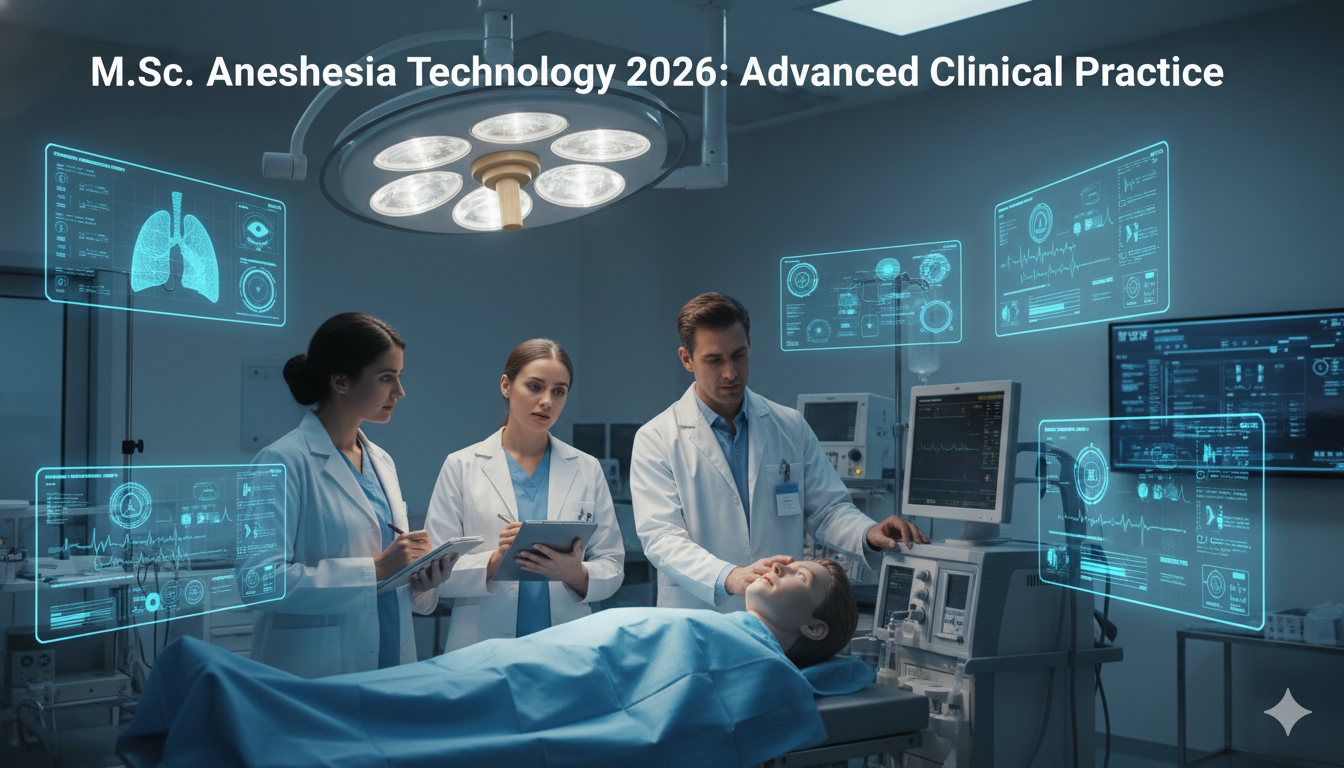
Master of Science in Anesthesia Technology (M.Sc. AT) 2026
Advanced Clinical Practice and Perioperative Leadership
1. Course Overview & Key Highlights
The M.Sc. in Anesthesia Technology (M.Sc. AT) is a rigorous two-year postgraduate program designed for highly motivated allied health professionals seeking mastery in complex anesthetic agent delivery systems, physiological monitoring, and critical care technology management. This program integrates advanced theoretical knowledge with extensive clinical rotations in super-specialty surgical environments, preparing graduates for leadership roles in the operating theatre and intensive care unit (ICU) by 2026.
Feature Detail Course Name Master of Science in Anesthesia Technology (M.Sc. AT) Course Level Postgraduate (M.Sc.) Duration 2 Academic Years (4 Semesters) Eligibility Criteria B.Sc. in Anesthesia Technology or Allied Health Sciences (Minimum 55% aggregate) Entrance Exams Institutional Clinical Aptitude Test (CAT) and Personal Interview Course Fees (Estimate) M.Sc. Anesthesia Technology Admission Process Entrance Examination, Clinical Experience Review, and Personal Interview Key Subjects Advanced Pharmacology, Critical Care Technology, Neuro/Cardiac Anesthesia, Research Methodology, Simulation Training. Examination Type Semester-wise Theory & Practical Examinations, Continuous Clinical Assessment, Final Thesis Defense. Average Starting Salary (Estimate) ₹2.5 Lakhs to ₹4 Lakhs per annum 2. Course Identity & Logistics
Official Title Master of Science in Anesthesia Technology (M.Sc. AT) Course Code AT-PG-2026 Credit Value/ECTS 120 ECTS (European Credit Transfer System equivalent) Delivery Format Full-Time, On-Campus (Didactic Lectures, High-Fidelity Simulation Labs, Clinical Rotations) Instructor/Department Department of Allied Health Sciences, Division of Anesthesia Technology 3. Course Description & Rationale
This postgraduate program provides deep specialization in the technical and pharmacological aspects of anesthesia delivery, moving beyond basic operational support to include complex troubleshooting, advanced patient monitoring analysis, and independent research. The curriculum emphasizes the critical link between technology and patient outcomes in high-acuity settings.
Curriculum Context
The M.Sc. AT curriculum is structured around the principles of advanced perioperative management. It mandates intensive training in regional anesthesia equipment, advanced mechanical ventilation, and sophisticated hemodynamic monitoring techniques (e.g., TEE, invasive pressure monitoring). A core component is the integration of human factors engineering into clinical safety protocols, ensuring graduates are proficient not only in operating equipment but also in designing safer clinical workflows.
Industry Relevance (2025 Trends)
The healthcare industry is rapidly adopting AI-driven monitoring, automated drug delivery systems (TCI), and complex neuro-monitoring techniques. This M.Sc. AT program is specifically tailored to address these 2025 trends by including mandatory modules on data analysis, digital integration, and advanced crisis resource management using virtual reality and high-fidelity simulation. This specialization meets the global demand for technologists capable of managing cutting-edge, interconnected medical technology with minimal supervision.
Target Audience
This course is ideal for Allied Health professionals who hold a B.Sc. in Anesthesia Technology or a related field, possess a minimum of six months of clinical experience, and aspire to take on managerial, instructional, or research-intensive roles within tertiary care hospitals or academic medical centers.
4. Prerequisites & Eligibility
Academic Prerequisites
- Completion of a recognized B.Sc. program (3 or 4 years) in Anesthesia Technology or a closely related Allied Health Science field.
- Minimum 55% aggregate marks in the qualifying undergraduate degree.
Skill Requirements
- Demonstrated foundational knowledge in basic physiological monitoring and anesthetic equipment operation.
- Strong analytical and problem-solving skills (assessed via the Clinical Aptitude Test).
- Excellent communication and teamwork abilities essential for the operating theatre environment.
Technical Requirements
- Proficiency in basic medical record software (EMR) and standard office productivity suites.
- Access to a reliable computer and high-speed internet for digital library access and simulation debriefing (institutional access provided).
Corequisites
Successful candidates must maintain certification in Basic Life Support (BLS) and obtain Advanced Cardiac Life Support (ACLS) certification within the first semester of the program.
5. Learning Objectives
Upon successful completion of the M.Sc. in Anesthesia Technology, students will be able to:
- Define: The detailed physiological and pharmacological mechanisms governing complex anesthetic agents and delivery systems (e.g., TIVA, low-flow anesthesia).
- Apply: Advanced clinical protocols and technology troubleshooting frameworks to manage equipment failure and patient crises in super-specialty surgical scenarios (e.g., cardiac bypass, neurosurgery).
- Analyze: Complex patient monitoring data (e.g., Bispectral Index, advanced hemodynamic waveforms) to predict and mitigate potential perioperative complications.
- Evaluate: Current literature and evidence-based practices in anesthesia technology to critically assess the effectiveness and safety of new equipment and clinical techniques.
- Create: Independent, methodologically sound clinical research projects or quality improvement initiatives aimed at enhancing safety and efficiency within the anesthesia department.
6. Course Materials
Required Textbooks
- Advanced Instrumentation for Anesthesia Technology (Specialized Technology Text)
- Principles of Critical Care Technology and Monitoring (Author/Editor TBD)
- Clinical Anesthesiology: Technology and Management (Focusing on advanced topics)
- Research Methodology and Biostatistics in Health Sciences (By relevant authors like Kothari or appropriate clinical research texts)
Reference Materials
- Access to Institutional Digital Library (e.g., ScienceDirect, PubMed, Cochrane Database).
- Departmental Standard Operating Procedures (SOPs) for specialized procedures (e.g., lung isolation, fiberoptic intubation).
- Current guidelines from professional bodies (e.g., ASA, AANA guidelines on equipment maintenance and safety).
Software & Tools
- Specialized Simulation Software Licenses (e.g., Virtual Reality Anesthesia Simulation Modules).
- Statistical Analysis Software (e.g., SPSS, R, or equivalent).
- Clinical Data Management Systems training.
7. Detailed Syllabus & Module Breakdown
The two-year curriculum is divided into three intensive phases, focusing on foundational knowledge, specialized application, and advanced leadership/research.
Phase I: Foundations and Core Sciences (Semester 1 Focus)
Objective: Establish advanced physiological, pharmacological, and technical vocabulary necessary for high-acuity practice.
| Week | Topics Covered |
|---|---|
| Week 1-2 | Advanced Human Physiology & Pathophysiology Review (Cardiovascular, Respiratory, Renal systems). |
| Week 3-4 | Applied Clinical Anatomy (Focus on Airway, Neuraxial, and Vascular Access Sites); Basic & Intermediate Anesthetic Pharmacology. |
| Week 5-6 | Instrumentation and Advanced Monitoring I: Invasive and Non-Invasive Hemodynamics, Pulse Oximetry, Capnography. |
Phase II: Application and Specialization (Semester 2 & 3 Focus)
Objective: Practical application of theories across specialized surgical domains and introduction to research principles.
| Week | Topics Covered |
|---|---|
| Week 7-8 | Anesthesia Technology for Super-Specialty Surgeries (Cardiac, Thoracic, and Vascular Anesthesia equipment management). |
| Week 9-10 | Advanced Ventilator Management and Respiratory Therapy Principles (Oscillation, APRV, Lung Protective Ventilation). |
| Week 11-12 | Critical Care Technology and ICU Patient Management (Monitoring in Sepsis, Trauma, and Organ Support). |
| Week 13-14 | Principles of Research Methodology, Biostatistics, and Literature Review for clinical research. |
Phase III: Advanced Practice and Research (Semester 4 Focus)
Objective: Mastery of crisis management, ethical leadership, and execution of independent research.
| Week | Topics Covered |
|---|---|
| Week 15-16 | Advanced Crisis Resource Management (CRM) and High-Fidelity Simulation-Based Training (Team dynamics, failed airway scenarios). |
| Week 17-18 | Ethics, Legal Issues (Malpractice, Documentation standards), and Quality Improvement (QI) in Anesthesia. |
| Week 19-20 | Leadership in Perioperative Safety, Technology Maintenance, and Departmental Management. |
| Week 21-24 | Thesis/Dissertation Project Submission, Defense Preparation, and Advanced Clinical Posting (Internship). |
8. Assessment & Grading Scheme
Distribution Table
| Assessment Type | Weightage | Description |
|---|---|---|
| Theory Examinations | 40% | Mid-term and End-of-semester written exams (MCQ, Short Answer, Case Studies). |
| Practical & Viva Voce | 30% | Clinical skills assessment, high-fidelity simulation performance, and equipment troubleshooting practical examinations. |
| Clinical Performance | 15% | Continuous assessment based on rotation logs, professionalism, patient safety adherence, and case presentations. |
| Thesis/Dissertation | 15% | Research project quality, oral defense (Viva Voce), and final submission of the written thesis. |
Grading Scale and Passing Criteria
The grading scale is typically A (Excellent) through F (Fail). To successfully complete the course, students must achieve a minimum passing grade of 50% in both the cumulative theory component and the cumulative practical/clinical components separately. A minimum grade of 'C' is required for the Thesis/Dissertation component.
9. Course Policies
Academic Integrity
The institution maintains a zero-tolerance policy regarding plagiarism, cheating, and academic misconduct. All research papers and assignments must adhere strictly to established citation standards (e.g., APA/Vancouver).
Attendance Requirements
Mandatory attendance of 80% is required for all didactic (lecture) sessions. Due to the critical nature of the training, a minimum of 90% attendance is strictly enforced for all clinical rotations and simulation labs.
Late Submissions Policy
Assignments submitted after the deadline may incur a penalty of 10% reduction per day, up to a maximum of five days, after which the assignment will receive a zero grade, unless a valid medical or extenuating circumstance is approved by the course coordinator.
Accommodations for Students with Disabilities
The institution is committed to providing reasonable accommodations for students with documented disabilities. Students requiring accommodations must register with the Student Support Services office at the beginning of the academic year.
10. Career Scope & Certification
Certification Details
Upon graduation, technologists are highly encouraged to pursue specialized professional certifications, such as the Certified Anesthesia Technologist (CAT) if applicable by the regional governing body, or specialized certifications in Critical Care Technology or Advanced Life Support (ACLS Instructor).
Skills Acquired
- Technical Skills: Advanced equipment maintenance, regional anesthesia assistance, complex ventilation management, pharmacological calculation, data analysis (SPSS).
- Soft Skills: Crisis Resource Management (CRM), clinical leadership, team communication, ethical decision-making, teaching/mentoring.
Job Roles and Salary Expectations
| Job Role | Description | Avg. Annual Salary (USD Equivalent) |
|---|---|---|
| Specialized Anesthesia Technologist (Cardiac/Neuro) | Provides high-level technical support for complex surgical cases in super-specialty units. | ₹3 Lakhs to ₹8 Lakhs per year |
| Clinical Instructor/Educator | Trains junior B.Sc. students and new staff on advanced equipment and safety protocols. | ₹30,000 - ₹50,000 per month |
| Anesthesia Department Manager | Oversees equipment inventory, maintenance schedules, quality assurance, and staffing logistics. | ₹3-6 LPA |
| Research Coordinator | Manages and executes clinical trials related to new anesthetic technology or patient safety. | ₹4.8 LPA to ₹5.3 LPA |
Further Studies Recommendations
Graduates of the M.Sc. AT program are well-positioned to pursue doctoral studies (Ph.D.) in related fields such as Biomedical Technology, Clinical Research, Healthcare Management, or Advanced Physiology.
11. Frequently Asked Questions (FAQs)
What are the primary eligibility requirements for the M.Sc. AT 2026 intake?
Candidates must hold a recognized B.Sc. degree in Anesthesia Technology or Allied Health Sciences with a minimum aggregate of 55%. Crucially, proof of a minimum of six months of clinical internship or professional experience post-B.Sc. is highly preferred.
How competitive is the admission process for this program?
Admission is highly competitive. It involves a multi-stage process: successful clearance of the institutional Clinical Aptitude Test (CAT), review of academic and clinical experience, and a final personal interview designed to assess clinical reasoning and ethical standards.
Is the research thesis component mandatory, and how is it supervised?
Yes, the thesis/dissertation project is mandatory and constitutes 15% of the final grade. Students are assigned clinical faculty mentors who provide supervision throughout the research design, execution, and final defense stages during Phase III (Semester 4).
What specialized clinical rotations are included in the course structure?
The program includes mandatory rotations in super-specialty areas, including Cardiac Anesthesia, Neuro Anesthesia, Pediatric Anesthesia, and dedicated postings in the Intensive Care Unit (ICU) focusing on advanced ventilator and monitoring technology.
What is the expected career progression after completing the M.Sc. AT?
Graduates move into specialized roles such as Cardiac Anesthesia Technologist, Departmental Manager, or Clinical Educator. The M.Sc. qualification provides a clear pathway for leadership roles, higher salaries, and entry into academic research or teaching positions.