
Master of Physiotherapy (MPT) 2026 | Advanced Clinical Specialist
Elevate your practice with the MPT 2026 program. Focus on advanced clinical reasoning, EBP, specialized tracks (Neuro, Sports), and mandatory research thesis.
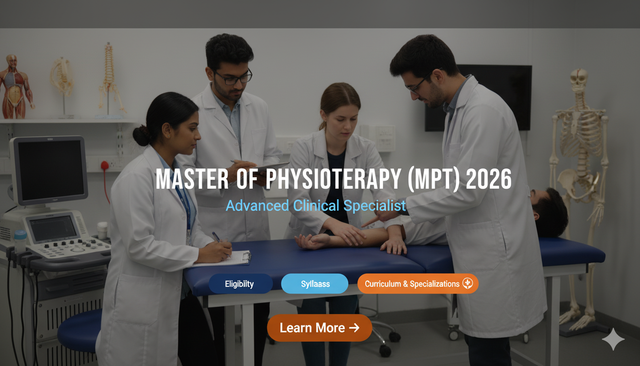
Master of Physiotherapy (MPT) 2026: Advanced Clinical Specialization Program
The Master of Physiotherapy (MPT) 2026 is an intensive, postgraduate degree designed for Bachelor of Physiotherapy (BPT) graduates seeking to specialize, deepen their clinical expertise, and contribute to evidence-based healthcare. This two-year, full-time program emphasizes advanced clinical reasoning, mandatory research, and practical mastery in specialized fields like Musculoskeletal, Neurosciences, or Cardiopulmonary rehabilitation, preparing graduates for leadership roles in complex clinical settings.
1. Course Overview & Key Highlights
Category Detail Course Name Master of Physiotherapy (MPT) 2026 Course Level Postgraduate (Master's Degree) Duration 2 Years (Full-Time) Eligibility Criteria Bachelor of Physiotherapy (BPT) degree or equivalent (Min. 50-60% aggregate GPA). Entrance Exams PGET (Physiotherapy Graduate Entrance Test) or Institutional Entrance Exam. Course Fees (Est.) from around ₹10,000 - ₹50,000 annually in government colleges to ₹50,000 - ₹2 Lakhs or more per year in private institutions Admission Process Entrance-based, followed by Interview/Counseling. Key Subjects Advanced Research Methodology, Diagnostic Imaging Interpretation, Neuroscience of Pain, Specialized Track Modules, Clinical Residency, Dissertation. Examination Type Semester-wise Theory/Practical Exams, OSCEs, and Final Dissertation Defense (Viva Voce). Average Starting Salary (Est.) ₹3.5 to ₹7 Lakhs Per Annum (LPA) 2. Course Identity & Logistics
- Course Title: Master of Physiotherapy (MPT) 2026
- Awarding Body: [University/Institution Name]
- Credit Value/ECTS: Typically 80-100 Credits (Varies by national system)
- Mode of Delivery: Blended (Lectures, Advanced Labs, Simulation Training, Clinical Rotations, Research Seminars)
- Specialization Tracks (Examples): Orthopedic & Sports Rehabilitation, Neurological Rehabilitation, Cardiopulmonary Physiotherapy, Community Health.
- Department: Department of Physiotherapy and Rehabilitation Sciences
3. Course Description & Rationale
Summary
The Master of Physiotherapy (MPT) 2026 program is curated to bridge the gap between foundational BPT knowledge and the requirements of highly specialized clinical practice and academic research. It moves beyond basic patient management to focus on complex differential diagnosis, advanced therapeutic interventions, and the critical appraisal of contemporary research. The program is inherently research-driven, culminating in a mandatory independent dissertation that requires students to contribute new knowledge to the field.
Curriculum Context and Rationale
The curriculum is structured around an intense commitment to Evidence-Based Practice (EBP), ensuring that every clinical decision is informed by the latest scientific literature. The rationale for the MPT 2026 program is simple: the global healthcare landscape requires specialized practitioners capable of managing increasingly complex, multi-morbid patient populations and leading clinical governance. Graduates are trained not just as clinicians, but as leaders, researchers, and educators.
Industry Relevance (2025 Trends)
The 2025 healthcare environment emphasizes interprofessional collaboration, digital health, and specialized care. This MPT program addresses these trends by including modules on telerehabilitation, robotics in movement analysis, and advanced diagnostic imaging interpretation. The focus on interprofessional training ensures graduates can seamlessly integrate into multi-disciplinary teams.
Target Audience
This course is ideal for motivated BPT graduates who possess a strong academic record, demonstrate excellent clinical aptitude during their internship, and are committed to pursuing specialized clinical roles, academic careers, or advanced research positions.
4. Prerequisites & Eligibility
Academic Prerequisites
- Successful completion of a Bachelor of Physiotherapy (BPT) degree or an equivalent qualification recognized by the awarding body.
- Minimum aggregate GPA/Percentage (e.g., 50-60%) in the BPT program.
- Successful completion of an institutional or national entrance examination (e.g., PGET).
Skill Requirements
- Strong foundation in human anatomy, physiology, and basic biomechanics.
- Excellent communication and interpersonal skills for patient interaction and interprofessional collaboration.
- Developing critical thinking and analytical abilities necessary for complex problem-solving.
Technical Requirements
- Access to a reliable personal computer and high-speed internet for LMS access and online journal research.
- Proficiency in basic data management and presentation software (e.g., MS Office Suite).
Licensure
Valid professional registration/licensure to practice physiotherapy in the candidate’s home jurisdiction, if required for clinical placements.
5. Learning Objectives
By the end of this course, successful students will be able to:
- Critically Appraise: Evaluate and apply advanced evidence-based clinical guidelines and contemporary research to complex patient scenarios.
- Formulate: Develop comprehensive differential diagnoses for complex neuromusculoskeletal, neurological, or cardiopulmonary disorders.
- Design and Execute: Plan, manage, and complete an independent, ethical research project (Dissertation) that contributes meaningfully to physiotherapy knowledge.
- Demonstrate Mastery: Execute advanced manual therapy techniques, specialized modalities, and technology-assisted rehabilitation strategies relevant to their chosen specialization track.
- Assume Leadership: Demonstrate ethical, professional, and managerial leadership skills in clinical, academic, or community health settings.
6. Course Materials
Required Textbooks (Examples)
- Advanced Clinical Reasoning in Physical Therapy by Mark Jones & Darcy Bullock (Focus on EBP and complex cases).
- Research Methods for Clinical Therapists by Carolyn Hicks (Essential for dissertation methodology).
- Specialized Track Text (e.g., Orthopedic): Orthopaedic Physical Assessment by David J. Magee.
- Specialized Track Text (e.g., Neuro): Motor Control: Translating Research into Clinical Practice by Ann Carr.
Reference Materials
- Access to institutional subscriptions for major physiotherapy and medical journals (e.g., JOSPT, Physical Therapy, The Lancet).
- Online databases (e.g., PubMed, Cochrane Library, PEDro).
Software & Tools
- Institutional Learning Management System (LMS) access (e.g., Moodle, Canvas).
- Specialized statistical analysis software (e.g., SPSS, R, or equivalent).
- Access to institutional simulation labs and specialized diagnostic tools (e.g., EMG, Gait Analysis Systems).
7. Detailed Syllabus & Module Breakdown (2-Year Program Structure)
The MPT 2026 curriculum is divided into three comprehensive phases, integrating foundational knowledge, specialized application, and advanced clinical synthesis over two years.
Phase I: Foundations (Year 1, Semester 1)
Objective: To establish advanced theoretical frameworks necessary for critical appraisal and specialized practice.
| Module Focus | Core Topics Covered |
|---|---|
| Advanced Biomechanics & Kinesiology | Complex motion analysis, tissue loading models, advanced joint kinematics. |
| Epidemiology & Research Methodology | Study design analysis (RCTs, systematic reviews), biostatistics, ethical considerations in human research. |
| Evidence-Based Practice (EBP) | Clinical decision-making algorithms, formulation of PICO questions, critical appraisal skills. |
| Diagnostic Imaging & Interpretation | Advanced interpretation of X-ray, MRI, CT scans, and ultrasound reports relevant to physiotherapy. |
Phase II: Application & Specialization (Year 1, Semester 2 & Year 2, Semester 1)
Objective: Practical application of theories through specialized modules, clinical rotations, and initial research proposal development.
| Module Focus | Core Topics Covered |
|---|---|
| Specialized Track Modules | In-depth study of chosen specialization (e.g., Advanced Manual Therapy, Pediatric Developmental Assessment, Cardiac Rehabilitation Protocols). |
| Clinical Reasoning Seminars | Complex case presentations, differential diagnosis practice, interprofessional collaboration exercises. |
| Integrated Clinical Rotations | Minimum three mandatory specialized rotations across diverse clinical settings (e.g., ICU, Sports Clinic, Neuro Unit). |
| Dissertation Proposal Development | Refinement of research question, comprehensive literature review, methodology planning, and ethics submission. |
Phase III: Advanced Practice & Synthesis (Year 2, Semester 2)
Objective: Culmination of clinical skills during residency and completion of the independent research thesis.
| Module Focus | Core Topics Covered |
|---|---|
| Clinical Residency/Advanced Placement | Long-term, intensive clinical practice under expert mentorship in the student's chosen specialty. |
| Professional Practice Management | Healthcare economics, clinical leadership, ethical dilemmas, and legal aspects of advanced practice. |
| Dissertation Execution & Submission | Data collection, analysis, thesis writing, editing, and preparation for the final Viva Voce defense. |
| Comprehensive Viva Voce Examination | Final synthesis examination covering theoretical knowledge and clinical application across all core modules. |
8. Assessment & Grading Scheme
Assessment is designed to evaluate both theoretical knowledge and specialized clinical competence, with a significant weight dedicated to research output.
Assessment Distribution
| Assessment Component | Weight (%) | Description |
|---|---|---|
| Summative Theory Exams | 40% | Mid-term and End-of-Semester written examinations covering advanced theoretical concepts. |
| Practical Assessment (OSCE/Viva) | 30% | Objective Structured Clinical Examinations (OSCEs), Practical Viva, and Clinical Logbook evaluation during rotations. |
| Research Component | 30% | Dissertation/Thesis submission, including the final Viva Voce defense. |
Grading Scale and Passing Criteria
The passing grade for all theoretical and practical components is typically 50-60% (C grade or equivalent). Clinical rotations are often graded on a Credit/No Credit basis, requiring 100% adherence to performance standards. Failure of the Dissertation defense requires mandatory revision and resubmission within a specified timeframe.
9. Course Policies
Academic Integrity
The institution maintains a strict zero-tolerance policy regarding academic misconduct, including plagiarism, cheating, and unauthorized collaboration. All research components, especially the Dissertation, are subject to mandatory plagiarism checks (e.g., using Turnitin), and violations are referred to the institutional research ethics board.
Attendance Requirements
Students must maintain a mandatory minimum of 80% attendance for all theoretical and seminar sessions. Attendance for mandatory clinical rotations and residency placements is 100%. Failure to meet these requirements may result in the student being debarred from the final examination or requiring remediation of clinical hours.
Late Submissions Policy
Assignments and research milestones submitted past the deadline without approved academic accommodation will incur grade penalties (e.g., 5% reduction per day). Dissertation deadlines are non-negotiable unless exceptional circumstances are formally approved by the Academic Committee.
Professional Conduct
Students must adhere strictly to the professional ethical standards and codes of conduct set forth by the institution and relevant regulatory physiotherapy bodies throughout all academic and clinical activities.
10. Career Scope & Certification
Certification Details
Upon successful completion of all academic, clinical, and research requirements, graduates are awarded the degree: Master of Physiotherapy (MPT).
Skills Acquired
- Technical Skills: Advanced manual therapy, specialized diagnostic interpretation (e.g., complex ECG/Spirometry analysis), gait analysis, statistical data management (SPSS/R).
- Soft Skills: Clinical leadership, mentorship, ethical decision-making, interprofessional communication, and complex project management (research).
Job Roles Table
| Job Role | Description | Avg. Salary Range (Annual Est.) |
|---|---|---|
| Clinical Specialist/Advanced Practitioner | Provides highly specialized, complex patient care within a specific clinical area (e.g., Spinal Cord Injury Unit, High-Performance Sports). | ₹4 to ₹9 lakh per annum (LPA) |
| Academic Lecturer/Clinical Instructor | Teaches BPT/MPT students, supervises clinical placements, and conducts independent research at a university. | ₹3 to ₹5 Lakhs per annum (LPA) |
| Clinical Manager/Director of Rehabilitation | Oversees operations, budget, and quality control for a department or facility. | ₹3 - ₹5 Lakhs per annum |
| Research Fellow/Scientist | Focuses primarily on grant-funded research projects, publishing, and contributing to EBP guidelines. | INR 3.5 to 4.5 Lakhs per annum (LPA) |
Further Studies
The MPT degree provides the highest academic foundation for pursuing further advanced studies, including a Ph.D. in Rehabilitation Sciences, Doctor of Physical Therapy (DPT), or Doctor of Science (ScD) programs globally.
11. Frequently Asked Questions (FAQs)
1. What are the key eligibility requirements for the MPT 2026 program?
The primary requirement is a recognized Bachelor of Physiotherapy (BPT) degree or equivalent, typically with a minimum aggregate score of 50-60%. Candidates must also successfully clear the required institutional or national entrance examination (e.g., PGET) and may benefit from having post-internship clinical experience.
2. Is the MPT course primarily clinical or research-focused?
The MPT 2026 program maintains a critical balance. It is designed to produce advanced clinical specialists whose practice is rigorously informed by evidence. Therefore, while 70% of the focus is on advanced clinical application and specialization, the mandatory 30% research component (Dissertation) ensures graduates are competent researchers and critical consumers of literature.
3. How much time should I allocate for studies outside of scheduled classes and rotations?
Due to the intensive nature of postgraduate study and the mandatory research component, students should expect to allocate a minimum of 15-20 hours per week for self-study, literature review, data analysis, and dissertation writing outside of their scheduled lectures and clinical duties.
4. Are clinical placements guaranteed, and can I choose my residency site?
Yes, clinical rotations and the final residency placement are mandatory components of the MPT degree and are guaranteed and organized by the institution in affiliated tertiary care centers and specialized clinics. While students’ specialization preferences are strongly considered, the final placement assignments are determined by the academic committee to ensure diverse exposure.
5. What is the difference between the MPT and the BPT degree in terms of career scope?
The MPT degree elevates the graduate from a general practitioner (BPT) to a specialized clinical expert, researcher, or academician. MPT holders are qualified for leadership roles, advanced specialty certifications, clinical management positions, and are eligible to pursue doctoral studies, commanding significantly higher salaries and greater professional autonomy.