
Master of Occupational Therapy (MOT) 2026 | ACOTE Accredited
Enroll in the MOT 2026 program. Prepare for NBCOT licensure with evidence-based training, integrated fieldwork, and specialized tracks in neurorehabilitation and pediatrics.
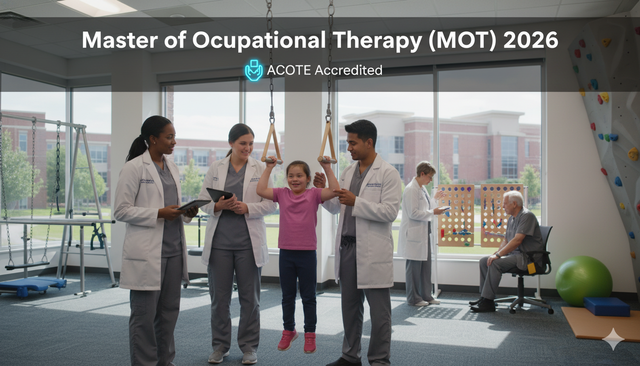
Master of Occupational Therapy (MOT) 2026
Prepare for national licensure and a rewarding career enabling participation across the lifespan. This comprehensive, evidence-based Master’s program combines rigorous academic training with extensive clinical fieldwork, meeting the highest standards set by the Accreditation Council for Occupational Therapy Education (ACOTE).
1. Course Overview & Key Highlights
The Master of Occupational Therapy (MOT) 2026 program is an intensive 2.5-year professional degree designed to mold competent, client-centered, and ethical entry-level occupational therapists. Focusing heavily on Evidence-Based Practice (EBP) and interprofessional collaboration, the curriculum integrates Level I and Level II Fieldwork early and often, ensuring graduates are fully prepared to obtain NBCOT certification and address the complex needs of modern healthcare systems.
Key Highlights Table
Parameter Details Course Name Master of Occupational Therapy (MOT) 2026 Course Level Postgraduate Professional Degree (Master's) Duration 2.5 years (5–6 full-time semesters) Eligibility Criteria Bachelor's Degree (GPA 3.0+), Specific Science Prerequisites Entrance Exams Graduate Record Examination (GRE) or equivalent professional test Estimated Total Course Fees ₹10,000 - ₹80,000/year Admission Process Holistic Review (GPA, GRE, Observation Hours, Interview) Key Subjects Kinesiology, Neuroscience, Psychosocial OT, EBP, Level II Fieldwork Examination Type Semester-wise, Technical Skill Competency Exams, Clinical Performance Assessments Average Starting Salary (OTR) ₹2.5 LPA to ₹4 LPA 2. Course Identity & Logistics
- Course Title & Code: Master of Occupational Therapy (MOT) 2026 (OT-MOT-26)
- Credit Value/ECTS: 75–90 semester credits
- Format: Hybrid Modality (Lectures, Intensive Hands-on Labs, Integrated and Full-time Clinical Rotations)
- Department: School of Health Sciences / Occupational Therapy Program
- Key Feature: Specialized tracks available (e.g., neurorehabilitation or pediatric mental health).
3. Course Description & Rationale
The MOT program provides a deep dive into the therapeutic use of everyday activities—or "occupations"—to promote health and participation. Students learn to address complex physical, cognitive, psychological, and environmental factors that limit an individual's ability to engage fully in life roles, regardless of age or disability status. The curriculum emphasizes client-centered care, cultural humility, and the critical thinking necessary for advanced clinical practice.
Curriculum Context & Industry Relevance
The 2026 curriculum is meticulously aligned with the latest ACOTE standards, focusing heavily on Evidence-Based Practice (EBP) and interprofessional competencies crucial for navigating modern, complex healthcare systems. The rationale for this program is clear: the demand for highly skilled OTs continues to rise, driven by aging populations, advances in chronic disease management, and the increasing recognition of OT’s role in mental health and community integration.
Target Audience
This program is designed for highly motivated individuals holding a Baccalaureate degree who are committed to a career in holistic healthcare, social justice, and professional advocacy. Applicants must meet rigorous academic prerequisites and possess documented clinical observation experience, demonstrating a readiness for the intensive clinical training required for national licensure.
4. Prerequisites & Eligibility
Academic Prerequisites
- Degree: Baccalaureate degree from a regionally accredited institution.
- GPA: Minimum cumulative GPA of 3.0 required (3.2 minimum in prerequisite science courses).
- Required Prerequisite Courses: Anatomy & Physiology I & II (with lab), Abnormal Psychology, Statistics, and Developmental Psychology.
Skill Requirements
- Clinical Experience: Minimum 40 documented volunteer or observation hours under a licensed Occupational Therapist Registered (OTR).
- Admissions Testing: Competitive score on the Graduate Record Examination (GRE) or equivalent professional admissions test.
- Professionalism: Demonstrated commitment to ethical behavior and professional communication.
Technical Requirements
Students must have access to a reliable computer, high-speed internet, and be prepared to utilize electronic medical record (EMR) simulation software and academic databases.
5. Learning Objectives
By the end of this course, students will be able to:
- Define: Articulate the core philosophical tenets, models, and ethical codes of occupational therapy practice (AOTA Code of Ethics).
- Apply: Utilize standardized and non-standardized assessments to evaluate client needs and design occupation-based intervention plans across physical, cognitive, and psychosocial domains.
- Analyze: Critically evaluate current research literature to integrate evidence-based practices into clinical reasoning and intervention selection.
- Evaluate: Assess the effectiveness of intervention plans, modify strategies based on client outcomes, and demonstrate management competency in documentation and billing.
- Advocate: Champion ethical practice, social justice, and the professional identity of occupational therapy within interprofessional healthcare teams and legislative contexts.
6. Course Materials
Required Textbooks
- Kielhofner, G. (Current Edition). Model of Human Occupation (MOHO).
- Peloquin, S. M. (Current Edition). The Development of Clinical Reasoning in Occupational Therapy.
- Radomski, M. V., & Trombly, C. A. (Current Edition). Occupational Therapy for Physical Dysfunction.
- AOTA. (Current Edition). Occupational Therapy Practice Framework (OTPF).
Reference Materials
Students are required to maintain active membership and access to the American Occupational Therapy Association (AOTA) Official Documents and current professional journals.
Software & Tools
- Electronic Medical Record (EMR) simulation software.
- Specialized assessment kits (e.g., standardized motor and cognitive tests).
- Required: Professional liability insurance for all fieldwork rotations.
7. Detailed Syllabus & Module Breakdown
The MOT 2026 curriculum is structured into three progressive phases, combining didactic learning, lab skills training, and integrated clinical experiences.
Phase I: Foundations (Semesters 1-2)
Objective: Establish core vocabulary, principles of human structure/function, and professional identity necessary for ethical practice.
- Human Anatomy and Kinesiology for OT: Detailed study of musculoskeletal mechanics and movement analysis.
- Theoretical Frameworks in Occupational Therapy: Deep dive into MOHO, PEOP, and other key models.
- Human Development Across the Lifespan: Examination of typical and atypical development from infancy through geriatrics.
- Introduction to Clinical Skills and Professional Ethics: Preparation for Level I Fieldwork, including foundational assessment techniques.
Phase II: Application (Semesters 3-4)
Objective: Practical application of theories, development of advanced clinical reasoning, and integration of research methods.
- Occupational Therapy in Physical Disability and Rehabilitation: Focus on interventions for orthopedic, neurological, and cardiovascular conditions.
- Occupational Therapy in Mental Health and Behavioral Adaptation: Models of practice for psychosocial disorders and community mental health.
- Neuroscience for Occupational Performance: Understanding neurological structures and their impact on motor, sensory, and cognitive function.
- Research Design and Evidence-Based Practice: Learning to critically appraise literature and conduct scholarly research.
- Integrated Level I Fieldwork Rotations: Short-term, supervised experiences across diverse settings.
Phase III: Advanced & Professional Integration (Semesters 5-6)
Objective: Specialized practice, management skills, and full professional integration leading to licensure eligibility.
- Advanced Practice: Pediatrics and School-Based OT: Specialized interventions for children and adolescents (e.g., sensory integration, IEP development).
- Health Policy, Management, and Advocacy: Understanding healthcare economics, reimbursement (billing/coding), and policy influence.
- MOT Capstone Project or Thesis: Independent scholarly work demonstrating mastery of EBP.
- NBCOT Review and Professional Transition Seminar: Intensive preparation for the national licensure exam.
- Level II Fieldwork Rotations: Two full-time, 12-week placements in contrasting practice settings.
8. Assessment & Grading Scheme
Student success is evaluated through a blend of academic rigor and clinical competency, ensuring readiness for autonomous practice.
Assessment Distribution
| Component | Weight (%) | Description |
|---|---|---|
| Assignments/Quizzes/Labs | 30% | Weekly readings, skill demonstrations (e.g., transfer techniques, splinting), and practical lab exams. |
| Midterm and Final Examinations | 30% | Comprehensive knowledge testing across foundational and application courses. |
| Research Proposal/Capstone Project | 10% | Scholarly work demonstrating EBP mastery. |
| Clinical Components (Fieldwork I & II) | 30% | Evaluations using the AOTA Fieldwork Performance Evaluation tool and professional behavior checklists. |
Grading Scale and Passing Criteria
The program maintains strict professional standards. A minimum grade of 'B' (80%) or higher is required in all clinical courses, professional seminars, and fieldwork components to progress in the program and graduate. Failure to meet this standard requires remediation or dismissal from the program.
9. Course Policies
- Academic Integrity: Zero-tolerance policy for plagiarism, cheating, or any academic dishonesty, resulting in immediate disciplinary action.
- Professional Conduct: Mandatory adherence to the AOTA Code of Ethics and institutional professionalism standards in all academic and clinical settings.
- Attendance Requirements: Strict attendance is enforced, particularly for hands-on labs and all clinical placements. Missed fieldwork hours must be formally documented and made up per ACOTE standards.
- Health and Safety: Requirement for current immunizations, annual background checks, and drug screening prior to all Level I and Level II fieldwork rotations.
10. Career Scope & Certification
Certification Details
Upon successful completion of the MOT 2026 program, graduates are eligible to sit for the National Board for Certification in Occupational Therapy (NBCOT) examination. Passing this exam grants the credential OTR (Occupational Therapist Registered), which is necessary for state licensure in the United States.
Skills Acquired
- Technical Skills: Advanced clinical reasoning, functional assessment, splint fabrication, adaptive equipment prescription, and EMR documentation.
- Soft Skills: Interprofessional communication, client advocacy, therapeutic use of self, time management, and ethical decision-making.
Job Roles and Settings for Occupational Therapists (OTRs)
| Job Role | Description | Typical Settings |
|---|---|---|
| Acute Care OT | Assessing patients immediately post-injury/illness to determine discharge needs and functional capacity. | Hospitals, Trauma Centers |
| Pediatric OT | Working with children to improve fine/gross motor skills, sensory processing, and participation in school and play. | School Systems, Early Intervention, Pediatric Clinics |
| Rehabilitation OT Specialist | Providing intensive, goal-directed therapy for clients recovering from stroke, spinal cord injury, or major trauma. | Inpatient Rehabilitation Facilities (IRFs), Outpatient Clinics |
| Geriatric OT | Focusing on maintaining independence, safety, and quality of life for older adults. | Skilled Nursing Facilities (SNFs), Home Health, Assisted Living |
11. Frequently Asked Questions (FAQs)
Is the Master of Occupational Therapy (MOT) 2026 program fully accredited?
Yes, the program is designed to meet, or is currently seeking/fully accredited by, the standards established by the Accreditation Council for Occupational Therapy Education (ACOTE). Successful completion qualifies graduates for the NBCOT exam.
What are the key eligibility requirements for admission?
Applicants must hold a Baccalaureate degree with a minimum cumulative GPA of 3.0, complete specific science prerequisites (A&P, Psychology, Statistics) with a 3.2 GPA, submit competitive GRE scores, and document a minimum of 40 hours of observation under a licensed OTR.
How are Level II Fieldwork placements determined?
Level II placements are mandatory full-time clinical rotations (two 12-week placements). They are coordinated by the Fieldwork Coordinator, who balances student preferences, site availability, and the necessity of providing diverse learning experiences required by ACOTE standards.
What is the typical cost of attendance and are there extra fees?
Tuition and standard university fees are detailed on the program's official website. Additional, non-tuition costs are required for MOT students, including professional liability insurance, background checks, drug screenings, lab fees, and the eventual NBCOT registration fee.
What career prospects are available after obtaining the OTR credential?
Occupational Therapists enjoy strong job growth and high demand across numerous settings, including hospitals, schools, outpatient clinics, rehabilitation centers, and home health services. The OTR credential allows for clinical practice focused on restoring function and promoting participation for individuals of all ages.