
Diploma in Medical Imaging Technology (DMIT) 2026
Launch your career in diagnostic healthcare with the 2-Year DMIT program. Get expert training in X-ray, CT, Ultrasound, and radiation safety. Apply now for 2026.
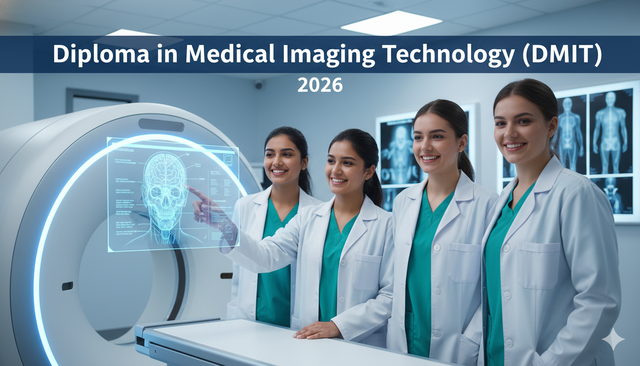
Diploma in Medical Imaging Technology (DMIT) 2026
Course Code: MIT-D-2026 | Level: Diploma (Allied Health Sciences)
1. Course Overview & Key Highlights
The Diploma in Medical Imaging Technology (DMIT) is a rigorous 2-year vocational program designed to train highly competent diagnostic imaging professionals. Focusing on practical skills, radiation safety, and patient care, this course provides comprehensive exposure to essential modalities like X-ray, Computed Tomography (CT), and Ultrasound. Graduates are prepared to meet the acute global demand for skilled technologists in modern digital healthcare settings.
Key Highlights of DMIT 2026
Parameter Details Course Name Diploma in Medical Imaging Technology (DMIT) Course Level Diploma (Vocational/Undergraduate-aligned professional program) Duration 2 Years (4 Semesters) Eligibility Criteria 10+2 (Science Stream mandatory: Physics, Chemistry, Biology/Mathematics) Entrance Exams Mandatory institutional entrance examination or interview process Course Fees (Estimate) ₹ 80,000 – ₹ 1,50,000 per annum (Varies by institution/location) Admission Process Entrance Exam Score followed by Counseling/Interview Key Subjects Radiographic Physics, Sectional Anatomy, CT Techniques, Radiation Safety, Clinical Practicum Examination Type Semester-wise Theory and Practical Examinations Average Starting Salary ₹ 2,50,000 – ₹ 4,50,000 per annum (Dependent on sector and experience) 2. Course Identity & Logistics
- Course Title: Diploma in Medical Imaging Technology (DMIT) 2026
- Course Code: MIT-D-2026
- Awarding Body: [Institution Name] / [Affiliating University/Board]
- Credit Hours: 90 Total Credits (Approx.)
- Mode of Delivery: Full-time, On-Campus (with mandatory clinical rotations)
- Format: Blended Learning (Lectures, High-fidelity Simulation Labs, Clinical Internship, Workshops)
3. Course Description & Rationale
The DMIT program offers a comprehensive and scientifically grounded education focusing on the practical application of diagnostic imaging technology. Students are trained to master the operation of sophisticated equipment, including conventional X-ray machines, CT scanners, and ultrasound units. The curriculum emphasizes the critical balance between producing high-quality diagnostic images and ensuring uncompromising patient and operator safety, particularly concerning ionizing radiation.
Rationale: The global healthcare industry is experiencing exponential growth, leading to a critical shortage of skilled allied health professionals. This diploma is specifically designed to bridge this gap by producing entry-level imaging technologists whose skills are standardized and aligned with international guidelines (e.g., ARRT/HCPC). The 2026 curriculum integrates modern digital workflow management, including PACS and digital radiography (CR/DR), making graduates immediately relevant to contemporary hospital environments.
Target Audience: This course is ideal for motivated 10+2 Science stream students who possess an interest in physics, human anatomy, technology, and patient care, and who seek a fast-track professional career in the high-demand field of diagnostic medicine.
4. Prerequisites & Eligibility
Enrollment in the DMIT 2026 program requires strict adherence to the following criteria:
- Academic Entry: Successful completion of 10+2 (Higher Secondary Education) or equivalent. Mandatory subjects include Physics and Biology.
- Minimum Score: Typically 50% aggregate score in the qualifying examination.
- Aptitude Test: Mandatory entrance examination focusing on basic science knowledge, general aptitude, and spatial reasoning. An interview may follow.
- Health Requirements: Submission of a mandatory medical fitness certificate and up-to-date immunization records (Hepatitis B, MMR, etc.), required due to extensive clinical exposure.
- Language Proficiency: Demonstrated proficiency in the language of instruction (usually English), verified through examination scores or an interview.
5. Learning Objectives
Upon successful completion of the Diploma in Medical Imaging Technology, students will be able to:
- Technical Proficiency: Operate, calibrate, and perform routine maintenance and troubleshooting on core imaging equipment, including fixed and mobile X-ray units, CT scanners, and Ultrasound devices.
- Safety & Ethics: Apply strict radiation protection principles (ALARA—As Low As Reasonably Achievable) and ensure mandatory compliance with institutional and national ethical guidelines and patient confidentiality standards.
- Patient Care: Demonstrate mastery in patient management, including positioning, preparation for contrast studies, monitoring vital signs, and executing emergency response procedures during imaging sessions.
- Image Quality: Analyze, evaluate, and optimize diagnostic image quality using digital processing techniques (windowing, leveling) and manipulate technical factors (kVp, mAs) effectively.
- Communication: Effectively communicate complex technical information to radiologists and physicians, and provide clear, empathetic instructions to diverse patient populations.
6. Course Materials
Core Resources
- Required Textbooks:
- Bushong, Stewart C. Radiologic Science for Technologists: Physics, Biology, and Protection.
- Snopek, Albert M. Fundamentals of Sectional Anatomy: An Imaging Approach.
- Clark, K.C. Clark's Positioning in Radiography. (Standard Positioning Reference)
- Digital Access: Access to institutional Learning Management System (LMS) for recorded lectures, high-resolution case studies, and interactive video tutorials.
- Laboratory Access: Dedicated access to simulation labs equipped with dummy phantoms, QA tools, and functional imaging equipment (e.g., 16-slice CT, DR/CR systems).
- Clinical Logbook: Mandatory, institution-provided logbook for tracking clinical rotation hours (minimum 600 hours) and documenting procedures performed under supervision.
7. Detailed Syllabus & Module Breakdown (2 Years / 4 Semesters)
Phase I: Foundations (Semesters 1 & 2)
Objective: Establish core anatomical, physical, and patient care principles necessary for safe practice.
- Module 1: Human Anatomy and Physiology (Focus on sectional anatomy for imaging).
- Module 2: Radiographic Physics and Instrumentation Basics (X-ray production, circuits, image formation).
- Module 3: Patient Care, Hospital Ethics, and Medical Terminology.
- Module 4: Basic Radiography and Image Processing (Upper/Lower Extremities, Chest, Spine).
- Module 5: Introduction to Digital Imaging (CR/DR Technology, PACS Architecture, and Digital Workflow).
Phase II: Application & Core Concepts (Semester 3 & Early Semester 4)
Objective: Practical application of theories across specialized modalities and advanced procedures.
- Module 6: Advanced Radiographic Positioning and Special Procedures (Skull, Facial Bones, Fluoroscopy basics).
- Module 7: Computed Tomography (CT) Principles and Techniques (Instrumentation, helical scanning, contrast protocols).
- Module 8: Ultrasound Physics and Basic Abdominal Scanning.
- Module 9: Contrast Media Pharmacology, Reactions, and Emergency Procedures (CPR certification included).
- Module 10: Quality Assurance (QA), Equipment Maintenance, and Dose Optimization.
Phase III: Advanced & Clinical Integration (Late Semester 4)
Objective: Advanced complexity, synthesis, introduction to advanced modalities, and mandatory clinical consolidation.
- Module 11: Introduction to Magnetic Resonance Imaging (MRI) Physics and Safety.
- Module 12: Interventional Radiology Support and Specialized Fluoroscopic Procedures.
- Module 13: Clinical Practicum / Internship (Minimum 600 mandatory supervised hours in a hospital setting).
- Module 14: Research Methodology, Data Analysis, and Capstone Project Submission.
8. Assessment & Grading Scheme
Assessment is continuous and cumulative, designed to test both theoretical knowledge and crucial hands-on technical proficiency.
Assessment Distribution
| Assessment Component | Weightage |
|---|---|
| Theory Examinations (Mid-term and End-of-Semester written exams) | 40% |
| Practical Examinations (Hands-on performance tests and Viva Voce) | 30% |
| Internal Assessment (Assignments, Quizzes, Case Studies, Attendance) | 20% |
| Clinical Performance (Supervisor evaluation during internship) | 10% |
Passing Criteria
Students must achieve a minimum cumulative score of 50% overall. Crucially, a minimum of 50% is required in both the theory component and the practical/clinical component separately to pass the semester and progress to the next phase.
9. Course Policies
- Academic Integrity: The institution maintains a zero-tolerance policy regarding plagiarism, cheating, and academic dishonesty. Violations may result in immediate dismissal from the program.
- Attendance Requirements: A minimum of 75% attendance in both theory classes and practical/clinical sessions is mandatory for eligibility to sit for final examinations.
- Professional Conduct: Strict adherence to institutional dress codes, professional behavior, and absolute compliance with patient confidentiality laws (e.g., HIPAA/GDPR standards) is required at all times, especially during clinical rotations.
- Radiation Safety: Mandatory and continuous compliance with all institutional and national radiation protection protocols (ALARA) is non-negotiable.
10. Career Scope & Certification
The DMIT diploma provides immediate entry into the dynamic and essential field of diagnostic healthcare, offering stable and rewarding career paths globally.
Skills Acquired
- Technical Skills: Radiographic positioning, CT scanning protocols, image quality optimization, PACS management, dose calculation, and IV contrast administration.
- Soft Skills: Critical thinking, emergency management, empathetic patient communication, teamwork, and adherence to sterile techniques.
Job Roles and Opportunities
| Job Role | Description | Average Starting Salary (Annual Estimate) |
|---|---|---|
| Radiography Technologist | Performing routine and specialized X-ray procedures in hospitals and clinics. | ₹ 3,00,000 - ₹ 4,50,000 |
| CT Scan Technician | Operating CT scanners, managing contrast injections, and ensuring image quality. | ₹ 3,50,000 - ₹ 5,00,000 |
| Ultrasound Assistant/Trainee | Assisting sonographers with patient preparation, documentation, and basic scanning procedures. | ₹ 2,50,000 - ₹ 3,80,000 |
| PACS Administrator Assistant | Managing digital image archives, troubleshooting digital workflow, and supporting IT infrastructure. | ₹ 3,20,000 - ₹ 4,80,000 |
Further Education and Certification
Certification: Graduates are eligible to sit for national or state-level licensure and certification examinations required to practice legally in various jurisdictions.
Further Studies: DMIT graduates often qualify for lateral entry (direct admission into the second or third year) into a B.Sc. in Medical Imaging Technology or related Allied Health Degree programs, providing a clear pathway for academic advancement.
11. Frequently Asked Questions (FAQs)
1. What is the mandatory eligibility criteria for DMIT 2026 admission?
To be eligible, candidates must have successfully completed 10+2 (Higher Secondary Education) from the Science stream, with Physics and Biology as mandatory subjects. A minimum aggregate score of 50% is generally required, alongside clearance of the institutional entrance examination.
2. How much clinical training is involved in the DMIT program?
Clinical training is central to the DMIT curriculum. Students are required to complete a minimum of 600 mandatory supervised clinical rotation hours, primarily during the final semester, across various departments like General Radiography, CT, and specialized units.
3. What specific imaging equipment will I train on?
You will receive hands-on training using modern diagnostic equipment, including both fixed and mobile Digital Radiography (DR) systems, Computed Radiography (CR) units, multi-slice CT scanners (e.g., 16-slice units), and high-frequency Ultrasound machines, alongside dedicated simulation phantoms.
4. Are placement services provided after graduation?
While placements are typically not guaranteed, the institution provides dedicated placement assistance. This includes career counseling, interview preparation workshops, and facilitating recruitment drives with major regional hospitals, diagnostic centers, and mobile imaging units. Historical placement rates are generally high due to the industry demand.
5. What is the difference between DMIT and B.Sc. in Imaging Technology?
DMIT is a 2-year diploma offering vocational, entry-level training focused heavily on practical skills for immediate employment. The B.Sc. program is a longer (3-4 year) degree focusing more deeply on theoretical physics, research methodology, and advanced modalities like MRI and Nuclear Medicine, often preparing students for leadership or academic roles. DMIT serves as a fast and direct entry point.