
B.Sc. in Radiography 2026 | 4-Year Allied Health Degree
Master advanced diagnostic imaging (CT, MRI, X-ray) with our 4-year B.Sc. Radiography program. Learn radiation safety, patient care, and clinical techniques for a high-demand career.
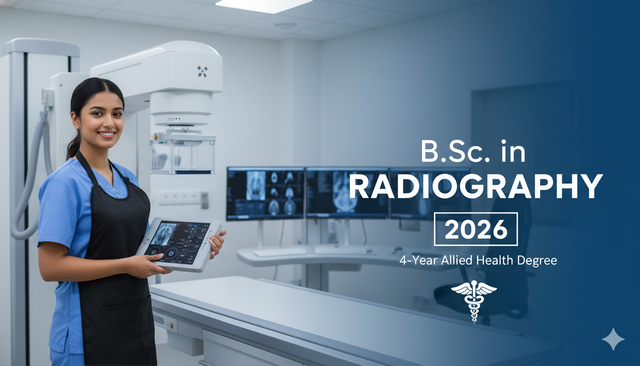
B.Sc. in Radiography 2026: Comprehensive Course Information
The Bachelor of Science (B.Sc.) in Radiography is a rigorous, four-year undergraduate professional degree designed to equip students with the essential knowledge and technical expertise required to excel as Diagnostic Radiographers and Medical Imaging Technologists. This program focuses on combining medical physics, advanced digital technology, and critical patient care skills, ensuring graduates are prepared for licensure and immediate employment in modern healthcare settings.
1. Course Overview & Key Highlights
The B.Sc. Radiography program provides intensive training in operating complex imaging modalities, including Computed Tomography (CT), Magnetic Resonance Imaging (MRI), and conventional X-ray systems. It emphasizes the strict implementation of radiation protection protocols (ALARA) and ethical patient management, preparing students for the dynamic challenges of the diagnostic healthcare sector.
Category Detail Course Name B.Sc. in Radiography Course Level Undergraduate Degree (Professional Allied Health Science) Duration 4 Years (8 Semesters) including mandatory internship Eligibility Criteria 10+2/High School Diploma with mandatory Physics, Chemistry, and Biology/Mathematics (PCB/PCM) Entrance Exams Successful performance in national or institutional entrance examination (e.g., NEET, institutional test) Course Fees (Estimate) ₹20,000 to ₹80,000 Admission Process Entrance-based, followed by counseling/interview Key Subjects Radiographic Physics, Human Anatomy, CT & MRI Technology, Radiation Safety, Patient Positioning Examination Type Semester-wise Theory and Practical Examinations (OSCEs) Average Starting Salary (Estimate) ₹2.5 to ₹4 Lakhs per annum (LPA) 2. Course Identity & Logistics
- Course Title: Bachelor of Science in Radiography
- Course Code: RADG-UG-2026
- Awarding Body: [Name of University/Institution]
- Credit Value/ECTS: 210 ECTS (European Credit Transfer and Accumulation System) equivalent
- Mode of Delivery: Full-time, On-campus
- Format: Lecture, Laboratory Simulation, Clinical Rotations, and Mandatory Internship
- Intake Cycle: Fall Semester (September 2026)
- Department: Department of Allied Health Sciences/Radiological Sciences
3. Course Description & Rationale
Summary
The B.Sc. in Radiography is a comprehensive program that focuses on the acquisition and processing of high-quality diagnostic images. Students develop a deep understanding of human pathology and cross-sectional anatomy alongside the technical skills required to operate cutting-edge imaging equipment. The curriculum is structured to transition students from foundational science principles in Year 1 to complex clinical applications and specialized modalities (CT, MRI, Interventional) in Years 3 and 4.
Curriculum Context
This program is anchored in evidence-based practice and rigorous safety standards. It integrates theoretical lectures with extensive hands-on training in dedicated simulation labs and mandatory clinical rotations. A strong emphasis is placed on radiobiology and radiation protection to ensure the highest level of safety for both the patient and the professional.
Industry Relevance (2025 Trends)
In 2025, diagnostic imaging is increasingly digital and relies heavily on multi-modality skills. The rationale for this course is driven by the global shortage of qualified technologists skilled in digital imaging (PACS/RIS), advanced cross-sectional modalities (CT/MRI), and interventional procedures. Graduates are prepared to meet the demands of technologically advanced healthcare systems worldwide.
Target Audience
High school graduates who possess a strong foundation in Physics and Biology, demonstrate meticulous attention to detail, and are committed to patient care and ethical professional conduct. Ideal candidates are those interested in a healthcare career that blends technology, physics, and direct patient interaction.
4. Prerequisites & Eligibility
Academic Prerequisites
- Successful completion of 10+2 (or equivalent secondary education) from a recognized board.
- Mandatory Subjects: Physics, Chemistry, and Biology (PCB) or Physics, Chemistry, and Mathematics (PCM).
- Minimum Aggregate Score: Typically 50% to 60% in the mandatory science subjects, depending on institutional requirements.
Skill Requirements
- Strong analytical and problem-solving abilities (for image critique and artifact identification).
- Excellent communication and interpersonal skills (essential for patient preparation and empathy).
- High degree of manual dexterity and physical fitness (required for patient handling and positioning).
Technical Requirements
- Basic computer literacy for handling Digital Imaging (PACS) and Learning Management Systems (LMS).
- Proof of physical fitness and required immunizations necessary for clinical placement.
Corequisites
Students must maintain continuous enrollment in clinical rotation modules alongside theoretical classes starting from Year 2. Successful radiation safety compliance is a mandatory corequisite for progression.
5. Learning Objectives
By the end of this course, successful students will be able to:
- Define: Key principles of radiation physics, radiobiology, and cross-sectional human anatomy relevant to diagnostic imaging.
- Apply: Strict radiation protection protocols (ALARA principle) to minimize radiation dose to patients, staff, and the public.
- Analyze: Technical quality of diagnostic images across various modalities (X-ray, CT, MRI, Ultrasound) and identify common artifacts and errors.
- Evaluate: Patient conditions, select appropriate imaging protocols, and manage patient care effectively before, during, and after procedures.
- Create: Standardized diagnostic images by accurately positioning patients and safely operating fixed, portable, and specialized imaging equipment.
6. Course Materials
Required Textbooks
- Bushong, S. C. (Author). Radiologic Science for Technologists: Physics, Biology, and Protection.
- Bontrager, K. L. (Author). Textbook of Radiographic Positioning and Related Anatomy.
- Fauber, T. L. (Author). Radiographic Imaging and Exposure.
- Clark's. Positioning in Radiography.
Reference Materials
- Access to institutional Learning Management System (LMS) for lecture notes and video resources.
- Online access to Digital Image Archives (PACS) for case study analysis and image critique.
- Journals: Radiologic Technology, Journal of Medical Imaging and Radiation Sciences.
Software & Tools
- Digital Simulation Software for virtual positioning and dose calculation.
- Dosimetry equipment (TLD badges, survey meters) used in lab environments.
- Access to institutional PACS/RIS systems for digital workflow management.
7. Detailed Syllabus & Module Breakdown (Sample)
The 4-year curriculum is divided into three distinct phases, transitioning from fundamental science to specialized clinical practice.
Phase I: Foundations (Year 1 Curriculum Sample)
- Objective: Establish core vocabulary, human sciences, and basic principles of radiation.
- Topics Covered:
- Week 1: Introduction to Radiography, Professional Ethics, and Medical Terminology.
- Week 2: Human Anatomy and Physiology I (Skeletal and Muscular Systems).
- Week 3: Basic Radiation Physics and Electromagnetism.
- Week 4: Fundamentals of Radiation Safety and Protection (ALARA).
Phase II: Application & Core Concepts (Year 2 Curriculum Sample)
- Objective: Practical application of theories, mastering general radiographic techniques, and introduction to clinical settings.
- Topics Covered:
- Week 5: Radiographic Positioning Techniques I (Chest, Abdomen, Extremities).
- Week 6: Principles of Digital Imaging (CR/DR) and Image Processing.
- Week 7: Contrast Media Administration and Pharmacology relevant to Imaging.
- Week 8: Midterm Evaluation & Image Critique Session (General Radiography).
- Week 9: Introductory Clinical Rotations and Trauma Radiography Protocols.
Phase III: Advanced & Specialization (Year 3/4 Curriculum Sample)
- Objective: Advanced complexity, mastery of specialized modalities, research synthesis, and mandatory internship.
- Topics Covered:
- Week 10: Computed Tomography (CT) Physics, Instrumentation, and Protocols.
- Week 11: Magnetic Resonance Imaging (MRI) Physics, Safety, and Cross-Sectional Anatomy.
- Week 12: Healthcare Ethics, Law, and Patient Confidentiality (HIPAA/GDPR).
- Week 13: Research Methodology, Biostatistics, and Capstone Project Development.
- Week 14: Intensive Clinical Rotation Review and Final Professional Assessment (Preparation for Licensure).
8. Assessment & Grading Scheme
Student performance is evaluated through a comprehensive system that balances theoretical knowledge, practical competency, and professional clinical behavior.
Assessment Distribution
| Assessment Component | Weight (%) | Description |
|---|---|---|
| Theory Assessment (Midterm/End-of-Semester Exams) | 50% | Written examinations covering physics, anatomy, and pathology. |
| Practical Assessment (OSCEs/Lab Practicals) | 30% | Hands-on evaluation of positioning, equipment operation, and image critique. |
| Clinical Assessment & Professionalism | 20% | Clinical instructor evaluations, logbook completion, and adherence to professional conduct. |
Grading Scale
- A: Excellent (90-100%)
- B: Good (80-89%)
- C: Satisfactory (70-79%)
- D: Marginal Pass (60-69%)
- F: Fail (Below 60%)
Passing Criteria
Students must achieve a minimum cumulative grade of 'C' (70%) in all core theoretical and practical modules. A mandatory minimum score of 75% is required for progression in all clinical rotation modules due to patient safety requirements.
9. Course Policies
Academic Integrity
The institution enforces a strict zero-tolerance policy regarding academic dishonesty, including plagiarism, cheating on examinations, and the falsification or fabrication of clinical logbook data or patient records. Violations may result in immediate dismissal from the program.
Attendance Requirements
- Theory Classes: Minimum 80% attendance is required to be eligible to sit for end-of-semester examinations.
- Clinical Rotations: 100% attendance is mandatory for all scheduled clinical hours. Missed clinical time must be made up immediately, as dictated by regulatory body requirements.
Late Submissions Policy
Assignments submitted after the deadline will incur a penalty (e.g., 10% deduction per day). Clinical logbooks must be updated and signed off weekly; failure to maintain the logbook current may jeopardize clinical progression.
Radiation Monitoring
All students engaged in clinical rotations involving ionizing radiation are required to wear personal dosimetry monitors (e.g., TLD badges) at all times. Monitoring results are reviewed monthly, and any breach of dose limits will result in immediate investigation and temporary removal from the clinical setting.
10. Career Scope & Certification
A B.Sc. in Radiography opens doors to a highly specialized, in-demand career path in modern medicine, with excellent opportunities for specialization and advancement.
Certification Details
Upon graduation, students receive the B.Sc. degree and are eligible to sit for national or regional licensure and registration examinations (e.g., ARRT in the US, HCPC in the UK, or equivalent local regulatory board certification). Certification is mandatory for practice.
Skills Acquired
- Technical Skills: Advanced knowledge of image acquisition physics, CT/MRI protocol optimization, fluoroscopy operation, and digital image archiving (PACS).
- Soft Skills: Patient communication, empathetic care, teamwork within multidisciplinary medical teams, ethical decision-making, and stress management.
Job Roles Table
| Career Role | Description | Average Starting Salary (Annual, USD equivalent) |
|---|---|---|
| Diagnostic Radiographer | Performs general X-ray and fluoroscopy procedures in hospital or clinic settings. | ₹15,000-₹30,000/month |
| CT Technologist | Specializes in operating Computed Tomography scanners and processing cross-sectional images. | ₹2.5 to ₹4 Lakhs per year |
| MRI Technologist | Operates Magnetic Resonance Imaging equipment, focusing on high-detail soft tissue imaging. | ₹2.5 to ₹4 Lakhs per year |
| Clinical Applications Specialist | Works for equipment manufacturers, training hospital staff on new imaging technology. | ₹15,000 to ₹6,00,000 |
Further Studies Recommendations
Graduates are well-prepared for M.Sc. programs in specialized areas such as Medical Physics, Advanced Medical Imaging, Ultrasound Technology, or Healthcare Administration.
11. Frequently Asked Questions (FAQs)
1. What are the key eligibility criteria for the B.Sc. Radiography 2026 intake?
Eligibility requires successful completion of the 10+2 system (or equivalent) with Physics, Chemistry, and Biology/Mathematics as mandatory core subjects. Candidates must also meet the minimum aggregate score (typically 50-60%) and successfully pass the institutional or national entrance examination.
2. Is the B.Sc. in Radiography a purely technical role, or does it involve significant patient interaction?
Radiography is fundamentally a patient-facing profession. While technical proficiency in physics and equipment operation is crucial, a majority of the technologist's time involves preparing, communicating with, and caring for patients, especially during stressful or traumatic procedures. Strong empathetic communication skills are a core component of the curriculum.
3. How is the 4-year course structured, and when do clinical rotations begin?
The course is structured over 4 years (8 semesters). Year 1 focuses on foundational sciences (Anatomy, Physics). Introductory clinical rotations begin in Year 2, focusing on general X-ray departments. Years 3 and 4 involve intensive, mandatory rotations across specialized units, including CT, MRI, and Interventional Radiology, culminating in a final mandatory internship.
4. What is the estimated cost of the program, and are scholarships available?
The estimated tuition typically ranges from ₹10,000 to ₹6 Lakhs USD equivalent per year, not including living expenses. [Name of University/Institution] offers various financial aid options, including merit-based scholarships for high academic achievers and need-based assistance. Specific details are available through the Admissions Office.
5. What are the primary career prospects and opportunities for specialization after graduation?
Graduates can work as Diagnostic Radiographers in hospitals, diagnostic centers, and mobile imaging units. The program prepares you for specialization in high-demand areas such as Computed Tomography (CT), Magnetic Resonance Imaging (MRI), or Interventional Radiology, leading to higher salaries and managerial roles like PACS Administrator or Chief Technologist.