
B.Sc. Physician Assistant Degree (PA) | 2026 Program
Launch your healthcare career with the rigorous 4-year B.Sc. Physician Assistant program. Integrated didactic and clinical training for PANCE certification eligibility.
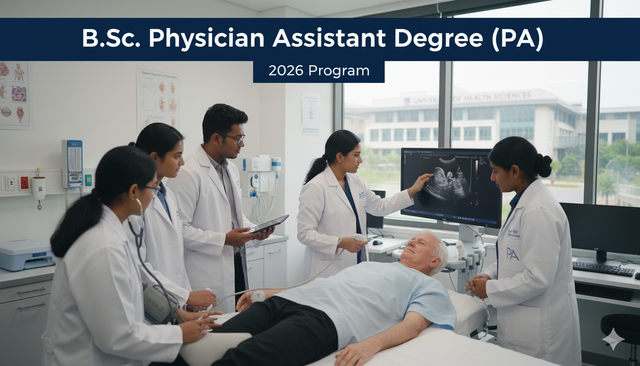
B.Sc. in Physician Assistant (PA) Program — 2026 Intake
1. Course Overview & Key Highlights
The Bachelor of Science in Physician Assistant (B.Sc. PA) is a demanding 4-year undergraduate professional degree designed to produce highly competent, versatile mid-level healthcare providers. Focusing on primary care, preventative medicine, and collaborative practice, the program integrates foundational medical knowledge (didactic instruction) with extensive hands-on clinical experience (rotations). Graduates are prepared to diagnose, treat, and manage complex patient conditions under the supervision of a licensed physician, directly addressing the critical global demand for accessible and quality healthcare professionals.
Key Highlights Table
Attribute Detail Course Name B.Sc. in Physician Assistant (PA) Course Level Undergraduate (Bachelor of Science) Duration 4 Academic Years (8 Semesters) Eligibility Criteria High School Diploma (B average in Biology, Chemistry, Math/Physics) + Documented Healthcare Experience Hours. Entrance Exams Successful Personal Interview (Required) Course Fees (Estimate) ₹50,000 to ₹2 Lakhs annually Admission Process Application Review, Essay Submission, Interview, and Merit-based selection. Key Subjects Human Anatomy, Pharmacology, Pathophysiology, Clinical Medicine, General Surgery, Emergency Medicine. Examination Type Semester-wise Written Exams, Objective Structured Clinical Examinations (OSCEs), and Clinical Preceptor Evaluations. Average Starting Salary (US Context) ₹3 Lakhs to ₹4.2 Lakhs per annum (LPA) 2. Course Identity & Logistics
- Course Title: Bachelor of Science in Physician Assistant
- Course Code: PA 400
- Credit Value/ECTS: Approximately 120-130 US Credits (30 ECTS per year)
- Format: Hybrid (Integrated Lecture, Lab, Simulation Workshop, and Full-Time Clinical Rotation)
- Instructor/Department Info: Delivered by the Department of Health Sciences, Faculty of Medicine. Taught by licensed PAs, MDs, and Ph.D. faculty specialists.
3. Course Description & Rationale
The B.Sc. PA program offers a rigorous, professional curriculum structured to transform high school graduates into proficient medical practitioners. The program is uniquely segmented into 40% foundational classroom learning and 60% intensive clinical practice, ensuring graduates possess both the deep theoretical understanding and the practical dexterity required for immediate entry into the workforce. Emphasis is placed on interprofessional education, fostering collaboration skills essential for modern team-based healthcare delivery.
Curriculum Context & Industry Relevance
The curriculum is benchmarked against national standards for PA education and is continually updated to reflect the latest evidence-based medicine (EBM) guidelines. In the 2025 healthcare landscape, Physician Assistants are recognized as vital components for mitigating physician shortages and improving patient access, particularly in primary care and underserved communities. This program directly trains students in high-demand skills like preventative medicine and surgical assisting, positioning graduates for rapid professional growth.
Target Audience
This course is specifically designed for ambitious High School Graduates or motivated Transfer Students who demonstrate exceptional academic aptitude in the sciences, possess strong communication and empathy skills, and have a proven commitment to patient care through prior healthcare experience (shadowing, volunteering, or employment).
4. Prerequisites & Eligibility
Academic Prerequisites
- High School Diploma or equivalent (e.g., IB Diploma, A-Levels).
- Minimum B grade average or higher in core sciences: Biology, Chemistry, and Mathematics/Physics.
- Official transcripts required.
Non-Academic & Skill Requirements
- Healthcare Experience: Completion of a minimum number of documented healthcare contact hours (e.g., 500+ hours recommended) demonstrating familiarity with the clinical environment.
- Professional Screening: Successful completion of a personal interview and submission of a compelling personal essay detailing motivations for the PA profession.
- Required Certifications (Pre-Phase III): Current Basic Life Support (BLS) and Advanced Cardiac Life Support (ACLS) certification.
Technical Requirements
- Personal device (laptop/tablet) capable of secure assessment taking and accessing Electronic Health Record (EHR) simulation platforms.
- Reliable internet access for database subscriptions and remote learning modules.
5. Learning Objectives
By the end of this course, successful students will be able to:
- Define: Comprehensive knowledge of human anatomy, physiology, pathophysiology, and pharmacology underlying common medical conditions.
- Apply: Evidence-based treatment protocols and diagnostic reasoning to formulate holistic patient management plans across diverse settings.
- Analyze: Complex clinical data, diagnostic imaging (e.g., X-rays, CT scans), and laboratory results to determine differential diagnoses.
- Evaluate: The ethical and legal implications of clinical decision-making, demonstrating cultural humility and commitment to lifelong professional learning.
- Create: Detailed, accurate clinical documentation (SOAP notes, discharge summaries) and execute essential clinical procedures safely and effectively (e.g., suturing, splinting, IV insertion).
6. Course Materials
Required Textbooks (Core Clinical Year)
- Bates' Guide to Physical Examination and History Taking (e.g., Bickley, L. S.)
- Current Medical Diagnosis & Treatment (e.g., Papadakis, M. A., et al.)
- Goodman & Gilman's The Pharmacological Basis of Therapeutics (Core Reference)
- Surgical Technology for the Surgical Assistant (Relevant surgical assisting texts)
Technology, Software & Tools
- Subscription access to clinical decision support databases (e.g., UpToDate, DynaMed).
- Access to dedicated Anatomy Lab and high-fidelity Simulation Center.
- Electronic Health Record (EHR) simulation platform access.
Equipment
- Professional diagnostic set (Ophthalmoscope/Otoscope).
- Stethoscope and Sphygmomanometer.
- Professional lab coat and scrubs for clinical environments.
7. Detailed Syllabus & Module Breakdown (4-Year Program Overview)
The program is structured across three progressive phases, culminating in intensive clinical practice.
Phase I: Foundations (Years 1 & 2 - Didactic Focus)
Objective: Establish core vocabulary and principles in biomedical sciences and introduce basic clinical skills.
| Module Focus (Conceptual Weeks 1-4) | Core Subjects Covered |
|---|---|
| Week 1: Anatomical Context | Human Anatomy and Physiology (with Lab), Medical Terminology. |
| Week 2: Molecular Basis of Health | Medical Biochemistry, Medical Genetics, Introduction to Pharmacology. |
| Week 3: Professional & Ethical Basis | Medical Ethics and Jurisprudence, Health Policy and Systems, Introduction to Healthcare Law. |
| Week 4: Initial Clinical Assessment | Introduction to Clinical Medicine, History Taking, and Physical Diagnosis I. |
Phase II: Application & Core Concepts (Years 2 & 3 - Advanced Didactic/Pre-Clinical)
Objective: Practical application of theories, focusing on disease processes, differential diagnosis, and advanced skills acquisition.
| Module Focus (Conceptual Weeks 5-9) | Core Subjects Covered |
|---|---|
| Week 5: Disease Mechanisms | Pathophysiology and Differential Diagnosis, Advanced Pharmacology and Therapeutics. |
| Week 6 & 7: System-Based Medicine | Clinical Medicine I & II (Cardiology, Pulmonology, GI, Renal, Dermatology, Orthopedics). |
| Week 8: Diagnostic Interpretation | Diagnostic Imaging and Interpretation, Evidence-Based Medicine (Midterm Evaluation focus). |
| Week 9: Surgical & Advanced Skills | Principles of Surgery, Advanced Clinical Skills Lab (Suturing, IVs, Injections). |
Phase III: Advanced (Years 3 & 4 - Clinical Rotations)
Objective: Full immersion in the clinical environment, practicing medicine under supervision and preparing for the Capstone.
| Module Focus (Conceptual Weeks 10-14) | Core Rotations (Mandatory) |
|---|---|
| Week 10: Foundational Practice | Primary Care/Family Medicine, Internal Medicine. |
| Week 11: Acute & Operative Care | General Surgery, Emergency Medicine. |
| Week 12: Specialty Populations | Pediatrics, Women's Health (OB/GYN), Behavioral and Mental Health. |
| Week 13: Tailored Practice | Elective Rotations (e.g., Orthopedics, Cardiology, Infectious Disease). |
| Week 14: Final Synthesis | Comprehensive Summative Exam and Clinical Portfolio Defense (Capstone Requirement). |
8. Assessment & Grading Scheme
The program utilizes a robust assessment structure combining written knowledge tests and performance-based clinical evaluations. A minimum passing grade of 75% is required for all core clinical subjects.
Assessment Distribution Table (Overall Program Weighting)
| Assessment Component | Weight (Didactic Phase I & II) | Weight (Clinical Phase III) |
|---|---|---|
| Written Exams (Midterm/Final/End-of-Rotation) | 40% | 20% |
| Objective Structured Clinical Examinations (OSCEs) | 25% | N/A |
| Preceptor Evaluations (Clinical Performance) | N/A | 60% |
| Quizzes/Assignments/Case Logs | 20% | 20% |
| Participation/Professionalism | 15% | N/A |
Grading Scale and Passing Criteria
- A: 93 – 100% (Exceptional Achievement)
- B: 85 – 92% (High Achievement)
- C: 75 – 84% (Satisfactory/Minimum Passing Grade for Core Subjects)
- D: 70 – 74% (Conditional Pass for Electives only)
- F: Below 70% (Failure)
Passing Criteria: Students must achieve a minimum of 75% in all core clinical and didactic courses. Failure to maintain professional standards, regardless of academic grades, may lead to immediate dismissal.
9. Course Policies
- Academic Integrity: The institution enforces a zero-tolerance policy against plagiarism, cheating, misrepresentation of clinical data, or any form of academic dishonesty.
- Attendance Requirements: Mandatory attendance is required for all clinical skills labs, simulation sessions, and 100% of scheduled clinical rotations. Strict monitoring of didactic lecture attendance is enforced.
- Late Submissions Policy: Late assignments will incur significant grade penalties unless prior accommodation is formally granted due to documented emergencies.
- Professionalism & Confidentiality: Students must adhere strictly to institutional codes of conduct, maintain HIPAA/patient confidentiality standards at all times, and present a professional demeanor in all clinical and academic settings.
- Health and Safety: Students must provide proof of current immunizations, clear a mandatory background check, and maintain current BLS/ACLS certifications before entering Phase III.
10. Career Scope & Certification
Certification Details
Successful completion of the B.Sc. in Physician Assistant program makes graduates eligible to sit for the national certification examination—typically the Physician Assistant National Certifying Examination (PANCE) in the US context. Passing the PANCE is mandatory for subsequent state or national licensure required to practice medicine.
Skills Acquired
- Technical Skills: Advanced physical diagnosis, surgical first assist, minor procedure execution (suturing, splinting), diagnostic interpretation, and complex medication management.
- Soft Skills: Interprofessional communication, ethical decision-making, cultural humility, patient advocacy, and team-based leadership.
Job Roles & Salary Expectations (Post-PANCE Certification)
| Job Role | Description | Average Starting Salary (USD) |
|---|---|---|
| Primary Care PA | Managing chronic and acute conditions in family medicine or internal medicine clinics; strong focus on preventative care. | ₹2 Lakhs to ₹4 Lakhs per annum |
| Surgical PA | Assisting surgeons in the operating room, performing pre-operative workups, and managing post-operative inpatient care. | ₹3 Lakhs to ₹4.5 Lakhs per annum (LPA) |
| Emergency Medicine PA | Providing urgent care in emergency departments, managing trauma, critical care stabilization, and rapid diagnosis. | ₹2.0 to ₹4.0 Lakhs per annum (LPA) |
Further Studies Recommendations
While the B.Sc. degree qualifies graduates for immediate practice, many PAs pursue post-graduate residency programs (typically 12-18 months) to specialize formally in areas such as cardiology, trauma surgery, or oncology.
11. Frequently Asked Questions (FAQs)
1. Is the B.Sc. degree sufficient for professional licensure?
Yes. The B.Sc. degree grants eligibility to sit for the required national certification examination (PANCE). Successful passing of this exam is the prerequisite for applying for state or national licensure, which authorizes you to practice as a Physician Assistant.
2. What are the most important eligibility factors for admission?
Admission is highly competitive. While strong academic performance in core sciences (Biology, Chemistry) is essential, equal weight is given to documented, hands-on healthcare experience hours (shadowing or patient care roles) and the quality of your personal essay and interview performance, which assess maturity and commitment.
3. How is the 4-year course structured? Is it mostly classroom work?
No. The program is intentionally balanced: the first two years focus on intensive didactic (classroom and lab) instruction to build foundational knowledge. The final two years shift heavily into clinical practice, featuring over 2,000 required hours of mandatory, supervised clinical rotations (Phase III), ensuring hands-on readiness.
4. How much are the estimated course fees, and are there funding options?
B.Sc. Physician Assistant (PA) course fees in India vary significantly, from ~₹30,000 to ₹1.5 Lakhs/year in government colleges to ₹2 Lakhs to ₹5 Lakhs/year (or total) in private ones, with total costs ranging from ₹1 Lakh to ₹6 Lakhs, depending on the institution. Funding options like scholarships (merit/need-based) and educational loans are available, with institutions often providing aid or directing students to resources, say The Apollo University and The Career Galaxy.
5. What is the career outlook for Physician Assistants starting in 2026?
The career outlook is exceptionally strong. The Bureau of Labor Statistics projects significant growth for the PA profession (much faster than average) due to the need for accessible primary care providers, an aging population, and the PA's versatile role in medical teams across specialty and general practice settings.