
B.Sc. in Perfusion Technology 2026: Course Details & Career Path
Launch your career as a Certified Clinical Perfusionist (CCP). Explore the 4-year B.Sc. Perfusion Technology program, eligibility, specialized curriculum, and high-demand job scope for the 2026 intake.
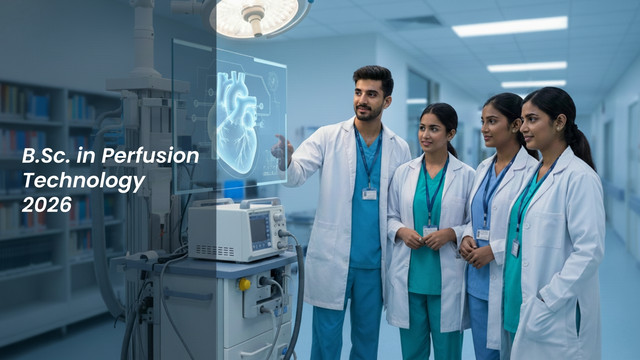
Bachelor of Science in Perfusion Technology (B.Sc. Perfusion Tech)
Academic Year: 2026 Intake
1. Course Overview & Key Highlights
The Bachelor of Science in Perfusion Technology is a specialized, four-year undergraduate program designed to train highly skilled Allied Health Professionals known as Clinical Perfusionists. This critical role involves managing extracorporeal circulation (ECC) systems, primarily the heart-lung machine, during open-heart surgeries and other procedures requiring temporary life support. The 2026 curriculum emphasizes intensive clinical simulation, advanced physiological monitoring, and ethical decision-making in high-stakes environments, providing a direct pathway toward professional certification.
Key Course Highlights Attribute Detail Course Name Bachelor of Science in Perfusion Technology Course Level Undergraduate (B.Sc.) Duration 4 Years (3 Academic Years + 1 Year Mandatory Clinical Internship) Eligibility Criteria 10+2 (High School) with mandatory PCB/PCMB stream. Minimum 50% aggregate score. Entrance Exams May require NEET-UG or Institutional Entrance Tests (Varies by University) Course Fees (Estimate) ₹4,800 per year in government colleges like JIPMER to over ₹1.5 Lakhs annually or even ₹8 Lakhs total for private universities Admission Process Entrance Exam Score followed by Counseling/Interview (Entrance-based) Key Subjects Cardiovascular Physiology, Perfusion Pharmacology, Extracorporeal Circulation (ECC), Hemodynamic Monitoring, ECMO, Pediatric Perfusion. Examination Type Semester-wise Theory Exams, Practical OSCEs, and Continuous Clinical Performance Evaluation (CPE) Average Starting Salary (Estimate) ₹3 Lakhs to ₹6 Lakhs per year 2. Course Identity & Logistics
- Course Title: Bachelor of Science in Perfusion Technology
- Course Code: BPT 2026
- Credit Value/ECTS: Approximately 180-200 total credits (including mandated clinical hours)
- Format: Full-time, On-Campus didactic lectures combined with extensive Hospital/Clinical rotations.
- Delivery Mode: Didactic, Simulation Lab Training, Clinical Rotation, Case Studies.
- Instructor/Department Info: Offered by the Department of Allied Health Sciences, often in collaboration with the Department of Cardiothoracic and Vascular Surgery (CTVS).
3. Course Description & Rationale
This B.Sc. program delivers comprehensive theoretical knowledge and rigorous practical proficiency necessary for the management of complex physiological conditions during surgery. Students are trained to operate, maintain, and monitor sophisticated extracorporeal circulation equipment, ensuring optimal blood flow, oxygenation, and temperature control for patients whose heart and lungs have been temporarily stopped or bypassed.
Curriculum Context & Industry Relevance
The curriculum is benchmarked against international standards for Clinical Perfusionists (CCP), integrating principles from advanced biomedical engineering, specialized pharmacology, and critical care medicine. The 2025/2026 intake focuses heavily on emerging technologies like Ventricular Assist Devices (VADs) and Extracorporeal Membrane Oxygenation (ECMO) management, reflecting current trends in complex cardiac and respiratory failure treatment.
Rationale & Target Audience
The primary rationale for this program is to address the critical shortage of qualified perfusionists globally, ensuring patient safety in high-stakes surgical environments. The program is ideal for highly motivated science students (PCB background) who possess exceptional attention to detail, are comfortable working under pressure, and aspire to a specialized, hands-on role in critical healthcare settings.
4. Prerequisites & Eligibility
Academic Prerequisites
- Successful completion of the 10+2 system (High School) or equivalent.
- Mandatory science stream subjects: Physics, Chemistry, and Biology (PCB) or Physics, Chemistry, Mathematics, and Biology (PCMB).
- Minimum 50% aggregate score in the qualifying examination.
- Qualifying scores in mandated entrance examinations (if applicable).
Skill Requirements
- Critical Thinking and Rapid Decision Making: Essential for troubleshooting physiological and technical complications during CPB.
- Dexterity and Precision: Required for setting up and managing complex tubing circuits and equipment.
- High Concentration: Ability to maintain focus during long, complex surgical procedures.
Health Requirements & Corequisites
Due to the mandatory clinical nature of the work, students must submit a mandatory physical fitness certification, comprehensive medical history, and up-to-date immunization records prior to clinical rotations.
5. Learning Objectives
Upon successful completion of the B.Sc. in Perfusion Technology, students will be able to:
- Define and Explain: Key principles of hemodynamics, blood gas physiology, and the mechanism of action of specialized perfusion pharmacology agents.
- Operate and Manage: Independently set up, prime, and manage Cardiopulmonary Bypass (CPB) circuits, Intra-Aortic Balloon Pumps (IABP), and other life support systems (e.g., ECMO).
- Analyze and Interpret: Accurately monitor and interpret patient physiological data (including blood gases, electrolytes, and complex hemodynamic parameters) in real-time.
- Evaluate and Adjust: Critically evaluate patient needs during surgery and make immediate, precise adjustments to the ECC circuit flow rates, gas mixtures, and pharmacological infusions to maintain homeostasis.
- Troubleshoot and Adhere: Identify, rapidly troubleshoot, and resolve critical technical failures or physiological complications while strictly adhering to national/international safety standards and professional ethics.
6. Course Materials
Required Textbooks (Illustrative Examples)
- Gravlee, K. et al. (Current Edition). Cardiopulmonary Bypass: Principles and Practice.
- Hensley, F. A. et al. A Practical Guide to Cardiovascular Physiology.
- Reves, J. G., & Prough, D. S. Clinical Perfusion: Pharmacology and Physiology.
- The Manual of Clinical Perfusion (Latest Edition).
Reference Materials
Students will utilize specialized medical databases (e.g., PubMed, ScienceDirect), peer-reviewed journals focusing on cardiothoracic surgery and critical care, and institutional e-learning platforms for simulation modules.
Software & Tools
Access to high-fidelity simulation software for ECC management, dedicated perfusion equipment (Heart-Lung Machines, oxygenators, monitoring devices, VADs), and clinical rotation handbooks detailing case logging procedures.
7. Detailed Syllabus & Module Breakdown (4-Year Structure)
The program is structured across three phases of increasing complexity, culminating in a mandatory 1-year clinical internship.
Phase I: Foundations (Year 1)
Objective: Establish core vocabulary, anatomical knowledge, basic life support skills, and principles of medical instrumentation.
- Core Subjects: General Human Anatomy, General Physiology, Biochemistry, Medical Terminology.
- Instrumentation & Safety: Basic Physics, Biomedical Instrumentation, Infection Control, Lab Safety Protocols.
- Perfusion Introduction: Introduction to Extracorporeal Circulation (ECC) History and Basic Components.
- Skills Focus: Basic Life Support (BLS) Certification and Aseptic Techniques.
Phase II: Application & Core Concepts (Year 2)
Objective: Practical application of physiological theories to CPB components and hemodynamic monitoring.
- Advanced Physiology: Cardiovascular Physiology, Respiratory Physiology, Renal Physiology.
- Perfusion Pharmacology: Anesthesia agents, Hemostatic drugs, Anticoagulation (Heparin/Protamine management).
- Technical Focus: Detailed study of CPB components (pumps, oxygenators, reservoirs, heat exchangers).
- Clinical Simulation: Setting up, priming, and operating basic CPB circuits in a simulated environment; Hemodynamic Monitoring interpretation.
Phase III: Advanced & Clinical Integration (Year 3 & 4)
Objective: Mastery of complex perfusion techniques, research methodology, professional ethics, and comprehensive clinical rotation.
- Advanced Techniques (Year 3): Pediatric Perfusion, Thoracic and Vascular Perfusion, Management of ECMO (Extracorporeal Membrane Oxygenation), Ventricular Assist Devices (VADs), and Organ Preservation techniques.
- Professional Development: Research Methodology, Biostatistics, Professional Ethics, Medico-legal aspects of Perfusion.
- Clinical Focus (Year 4 - Internship): Mandatory, full-time supervised clinical rotations (minimum required case logs). Rotations across Adult Cardiac, Pediatric Cardiac, and Transplant units.
- Assessment Requirement: Submission of comprehensive Final Project/Dissertation and mandatory clinical case log review.
8. Assessment & Grading Scheme
Assessment utilizes a tripartite system ensuring competence in theoretical knowledge, practical skills, and clinical performance.
| Assessment Component | Weightage | Description |
|---|---|---|
| Theory Assessment | 40% | Mid-term and End-of-Semester written examinations covering core subjects. |
| Practical Assessment (OSCEs/Viva) | 30% | Objective Structured Clinical Examinations (OSCEs) and laboratory performance evaluations demonstrating technical skill. |
| Clinical Competency (CPE/Logbook) | 30% | Continuous Clinical Performance Evaluation (CPE) by supervisors, detailed case studies, and review of the mandatory Internship Logbook. |
| Total | 100% |
Grading Scale & Criteria
The standard letter grading scale (A, B, C, D, F) is used. Students must achieve a minimum passing grade (typically C or 50-60%) in both the theory and the practical/clinical components independently to progress to the next academic year and qualify for the degree.
9. Course Policies
Academic Integrity
The university maintains a strict zero-tolerance policy regarding plagiarism, cheating, or any form of academic dishonesty in written exams, assignments, or clinical log entries. Violations may result in immediate failure of the course or expulsion.
Attendance Requirements
Due to accreditation and the critical nature of clinical training, a strict minimum of 80% attendance is mandatory for both didactic lectures and clinical/simulation sessions. Failure to meet this requirement may disqualify the student from sitting for semester examinations.
Late Submissions Policy
Assignments and case studies submitted past the deadline will incur a daily penalty (e.g., 5% reduction per day) unless prior approved accommodation is granted by the course coordinator.
Accommodations for Students with Disabilities
Students requiring accommodations should register with the university's disability services office. While the program adheres to all accessibility guidelines, students must meet the mandatory physical fitness standards required for critical clinical work.
10. Career Scope & Certification
The B.Sc. in Perfusion Technology provides highly sought-after specialization, positioning graduates for immediate employment in advanced cardiac care settings globally.
Certification Details
Graduates are prepared to sit for national or international professional certification exams, such as the examination administered by the American Board of Cardiovascular Perfusion (ABCP) or equivalent local regulatory bodies, to become a Certified Clinical Perfusionist (CCP). Certification is often mandatory for practice.
Skills Acquired
Technical Skills: CPB management, blood gas analysis, ECMO and VAD operation, Hypothermia management, specialized pharmacological administration, sterile field maintenance.
Soft Skills: Crisis management, interprofessional communication (with surgeons and anesthesiologists), extreme attention to detail, stamina, and ethical decision-making.
| Job Role | Description | Avg. Annual Salary (Post-Certification) |
|---|---|---|
| Certified Clinical Perfusionist (CCP) | Operating the heart-lung machine during open-heart surgery and managing patient physiological parameters in the operating room. | ₹2.5-₹4 LPA |
| ECMO Specialist/Coordinator | Managing long-term life support systems (ECMO) in critical care units (ICUs) for respiratory or cardiac failure patients. | INR 3-4 LPA, |
| Perfusion Educator/Trainer | Training new students or hospital staff in the operation and maintenance of perfusion equipment and protocols. | ₹3 Lakhs up to ₹16 Lakhs per annum |
| Medical Device Specialist (R&D) | Working with biomedical companies in the research, development, and testing of new ECC equipment and consumables. | ₹3-4 Lakhs per annum (LPA) |
Further Studies Recommendations
Graduates often pursue Master of Science (M.Sc.) degrees in Perfusion Technology, specialized fellowships (e.g., Pediatric Perfusion or Mechanical Circulatory Support), or Ph.D. programs focusing on cardiovascular research and biomedical engineering.
11. Frequently Asked Questions (FAQs)
How do I apply for the B.Sc. Perfusion Technology 2026 intake?
The application process typically involves submitting an online application, providing 10+2 academic transcripts (PCB mandatory), and submitting scores from mandatory entrance exams such as NEET-UG or the university's specific entrance test. Shortlisted candidates proceed to a counseling or interview round.
What are the strict eligibility requirements for this program?
You must have successfully completed 10+2 schooling (or equivalent) with Physics, Chemistry, and Biology (PCB) as core subjects. A minimum aggregate score of 50% in the qualifying examination is required. Due to the clinical nature, mandatory health and physical fitness certifications are also non-negotiable prerequisites.
Is the B.Sc. Perfusion Technology program physically demanding?
Yes. Clinical Perfusionists must maintain high concentration for extended periods (often 4-8 hours) while standing during surgical procedures. The role requires physical stamina, mental resilience, and the ability to respond calmly and effectively during high-pressure crises in the operating room.
What is the estimated total cost of the 4-year program?
While tuition fees vary significantly between public and private institutions (, students must also budge ₹25,000 to over ₹6 Lakhs for mandatory costs including textbooks, simulation lab fees, medical insurance, accommodation, and professional certification exam preparation materials in their final year.
What is the job outlook for Certified Clinical Perfusionists (CCPs)?
The job outlook is excellent globally. Perfusion is a highly specialized field with constant demand in cardiac centers, transplant hospitals, and critical care units. As cardiac surgery procedures become more complex and the use of technologies like ECMO increases, qualified CCPs are consistently in high demand, leading to competitive salaries.