
B.Sc. Optometry & Vision Science 2026 | Course Details
Enroll in the 4-year B.Sc. Optometry program. Learn clinical refraction, ocular diagnostics, and primary eye care. Start your career as a licensed optometrist and vision specialist.
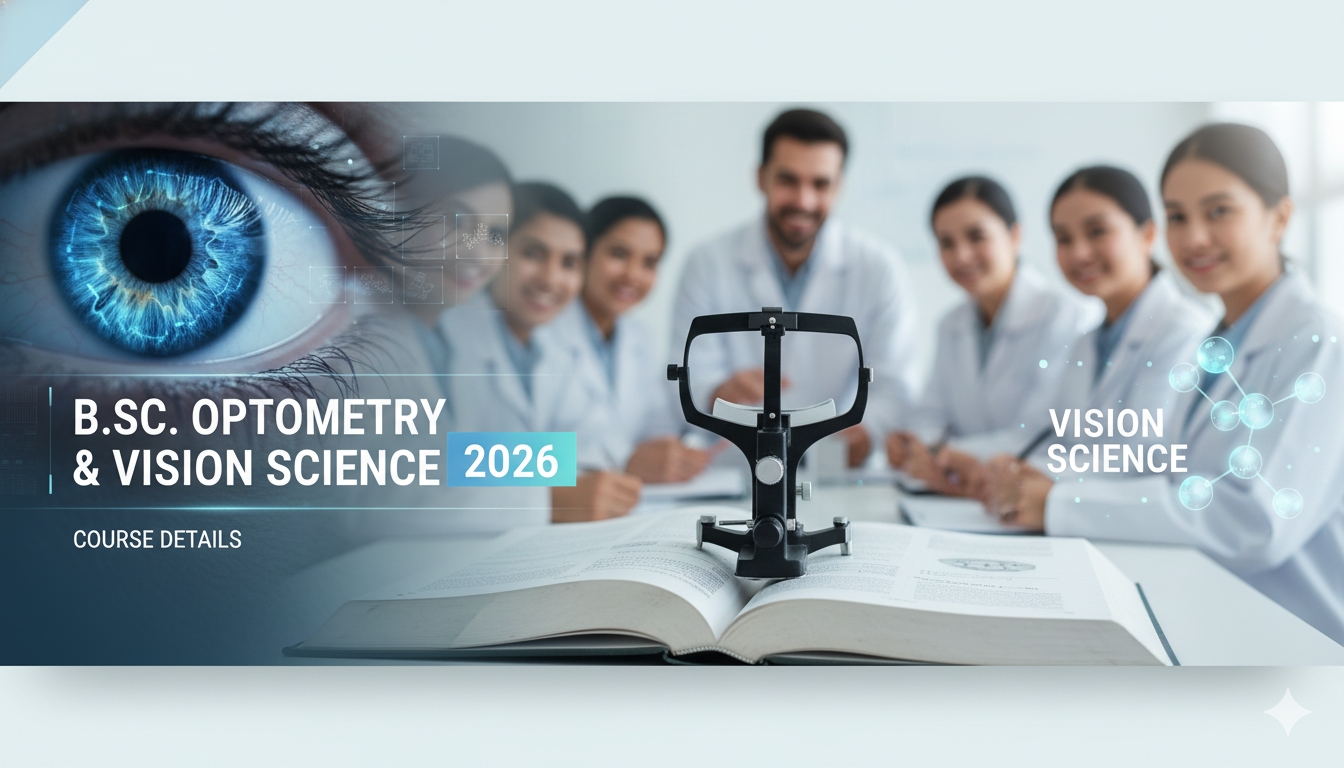
Bachelor of Science in Optometry & Vision Science (2026 Intake)
The B.Sc. in Optometry & Vision Science is a rigorous four-year undergraduate degree designed to train highly competent, primary eye care professionals. This program integrates foundational medical sciences, visual optics, and extensive clinical practice, ensuring graduates are prepared to diagnose, manage, and treat visual system disorders and refractive errors in diverse populations globally.
1. Course Overview & Key Highlights
This comprehensive program focuses on producing practice-ready Optometrists capable of independent clinical decision-making. Students benefit from mandatory clinical externships starting in Year 3, dedicated Ocular Instrumentation Labs, and opportunities to pursue specialized tracks like Low Vision or Sports Vision.
Key Program Information (2026 Intake) Feature Detail Official Course Title Bachelor of Science in Optometry & Vision Science Course Level Undergraduate Degree (B.Sc.) Duration 4 Years (8 Semesters, including mandatory clinical rotation) Eligibility Criteria 10+2 (High School) Science stream (Physics, Chemistry, Biology/Mathematics) Entrance Exams Mandatory score on institutional or national entrance examination (e.g., University Aptitude Test) Estimated Annual Course Fees ₹10,000-₹50,000 in government colleges to ₹50,000-₹2,00,000+ per year in private ones Admission Process Entrance-based, followed by counseling/interview process Key Subjects Ocular Anatomy, Clinical Refraction, Contact Lenses, Ocular Pathology, Binocular Vision, Public Health Optometry Examination Type Semester-wise (Theory, Practical, and OSCEs) Average Starting Salary (Entry-Level) ₹10,000 to ₹1 Lakh 2. Course Identity & Logistics
- Course Title: Bachelor of Science in Optometry & Vision Science
- Course Code: OPTVS401
- Credit Value/ECTS: Approximately 180 - 200 ECTS equivalent
- Delivery Mode: Full-time, On-Campus. This program requires high practical engagement and mandatory clinical attendance.
- Department: School of Health Sciences / Department of Optometry
- Typical Faculty Profile: Mix of Ph.D. holders in Vision Science, experienced practicing Optometrists, and Ophthalmologists.
3. Course Description & Rationale
Summary and Curriculum Context
The B.Sc. Optometry & Vision Science curriculum is structured to provide a deep understanding of the visual system, from foundational physiological optics to advanced therapeutic management. Students spend the initial years mastering scientific principles before transitioning into intensive clinical training using state-of-the-art diagnostic equipment, including fundus cameras, optical coherence tomography (OCT), and therapeutic laser simulation tools.
Industry Relevance (2025 Trends)
The program’s rationale is rooted in addressing the critical global shortage of qualified primary eye care providers. With increasing life expectancy and the rise of chronic systemic diseases (like diabetes and hypertension) that impact vision, the demand for optometrists skilled in early diagnosis and collaborative management is paramount. This course emphasizes advanced diagnostic imaging and interprofessional communication, aligning with 2025 healthcare delivery models.
Target Audience
This program is ideal for highly motivated high school graduates from the Science stream (PCB or PCM) who possess strong analytical skills, attention to detail, and a commitment to patient care and professional ethics.
4. Prerequisites & Eligibility
Academic Prerequisites
- Successful completion of 10+2 (High School) or equivalent.
- Mandatory subjects: Physics, Chemistry, and Biology (or Mathematics, depending on institutional focus).
- Minimum Score: A specific institutional cutoff, typically 60% aggregate in core science subjects.
- Mandatory participation and qualifying score in the institutional or national entrance examination.
Skill Requirements
- Attention to Detail: Crucial for accurate refraction and diagnostic interpretation.
- Interpersonal Communication: Essential for patient history taking and counseling.
- Manual Dexterity: Required for handling delicate clinical instrumentation and procedures (e.g., contact lens insertion, indirect ophthalmoscopy).
Technical Requirements
Students must have reliable access to a personal computer/laptop and stable internet for utilizing the Learning Management System (LMS) and accessing electronic health records (EHR) training modules.
Corequisites
Documentation confirming physical and visual fitness is required to ensure suitability for rigorous clinical practice and patient interaction.
5. Learning Objectives
Upon successful completion of the B.Sc. in Optometry & Vision Science, students will be able to:
- Define: Precisely articulate the anatomy, physiology, and pathology of the visual system, along with the principles of geometrical and physical optics.
- Apply: Execute comprehensive primary eye examinations, including accurate subjective and objective refraction techniques using specialized instrumentation (phoropters, retinoscopes, slit lamps).
- Analyze: Interpret complex diagnostic imaging results (e.g., OCT scans, visual fields) to differentiate between normal variation and pathological conditions like glaucoma, cataracts, and diabetic retinopathy.
- Evaluate: Critically assess patient data and evidence-based literature to formulate effective, individualized treatment and management plans, including therapeutic lens prescription and co-management strategies.
- Create: Develop original research projects in vision science, demonstrating mastery of research methodology, statistical analysis, and ethical reporting, contributing to the advancement of the field.
6. Course Materials
Required Textbooks
- Core Text 1:Clinical Optics by Elkington, Frank & Varma (Foundational Optics)
- Core Text 2:The Optometric Profession by Grosvenor (Clinical Refraction and Practice Management)
- Core Text 3:Ocular Anatomy & Physiology by Remington (Detailed Ocular Structure)
- Core Text 4:Ocular Pharmacology by Bartlett & Jaanus (Therapeutic Agents)
Reference Materials
Access to major peer-reviewed journals (e.g., Optometry and Vision Science, Investigative Ophthalmology & Visual Science), mandatory digital and physical Clinical Logbook for documenting patient encounters, and standardized clinical guidelines.
Software & Tools
- Learning Management System (LMS) access for lecture materials and assignments.
- Clinical simulation software for practicing diagnostic procedures.
- Electronic Health Records (EHR) training modules.
- Access to institutional instrumentation labs housing slit lamps, tonometers, phoropters, and specialized low-vision aids.
7. Detailed Syllabus & Module Breakdown (Strategic Phases)
The 4-year curriculum is divided into three strategic phases, ensuring a progressive blend of theoretical knowledge and clinical skill development:
Phase I: Foundations (Year 1)
Objective: Establish core vocabulary, basic medical sciences, and fundamental optical principles necessary for clinical application.
- General Anatomy & Physiology / Systemic Disease
- Ocular Anatomy & Histology
- Geometrical Optics and Physical Optics
- Introduction to Clinical Optometry and Instrumentation
- Biochemistry and Microbiology
Phase II: Application & Core Concepts (Year 2 & 3)
Objective: Practical application of theories, mastering primary diagnostic techniques, and exposure to disease management.
- Advanced Clinical Refraction and Prescribing
- Contact Lenses: Theory and Practice
- Binocular Vision and Orthoptics
- Ocular Pathology & Therapeutic Pharmacology
- Low Vision Rehabilitation & Aids
- Public Health Optometry and Epidemiology
Phase III: Advanced & Specialization (Year 4 - Internship)
Objective: Independent clinical decision-making, specialized case management, research synthesis, and professional practice readiness.
- Advanced Diagnostics & Ocular Imaging (OCT, Angiography)
- Pediatric and Geriatric Eye Care
- Optometric Practice Management and Jurisprudence
- Clinical Externship/Internship (6-9 months mandatory rotation)
- Research Methodology, Project, and Thesis Defense
8. Assessment & Grading Scheme
Student performance is evaluated through a blended approach that assesses theoretical comprehension, clinical skill proficiency, and research capability.
| Component | Weightage | Description |
|---|---|---|
| Theory Component | 50% | Mid-term exams, End-of-Semester written exams, Assignments, and Quizzes. |
| Practical/Clinical Component | 40% | Objective Structured Clinical Examinations (OSCEs), Lab reports, Clinical Logbook evaluation, Patient interaction scores. |
| Research/Project | 10% | Final Year Thesis/Dissertation and defense presentation. |
Grading Scale and Passing Criteria
A standard institutional grading scale (e.g., A, B, C, D, F) will be used. A minimum of 50% is required in both the theory component and the practical/clinical component separately for core clinical subjects to ensure minimum competency standards are met for licensure eligibility.
9. Course Policies
Academic Integrity
The Department enforces a strict zero-tolerance policy regarding academic dishonesty, including plagiarism, cheating, and unauthorized collaboration. All work must adhere to institutional guidelines and ethical standards.
Attendance Requirements
- Lectures and Labs: Mandatory 80% attendance required for eligibility to sit for semester examinations.
- Clinical Postings/Externships: 100% mandatory attendance is required due to the direct impact on patient care and skill mastery.
Late Submissions Policy
Assignments submitted after the deadline will incur a penalty (e.g., 5-10% deduction per day), unless a formal extension has been granted by the course coordinator due to documented extenuating circumstances.
Accommodations for Students with Disabilities
The institution is committed to providing reasonable accommodations for students with documented disabilities. Students must register with the Disability Services Office at the start of the semester to coordinate necessary support.
10. Career Scope & Certification
Certification/Licensure
Completion of the B.Sc. in Optometry & Vision Science fulfills the academic requirements necessary for the graduate to sit for the national or regional Optometry Board Licensure Examination, which is mandatory for legal practice as a primary care Optometrist.
Skills Acquired
- Technical Skills: Advanced refraction, contact lens fitting, therapeutic drug prescription, use of advanced diagnostic imaging (OCT, VF).
- Soft Skills: Patient counseling, interprofessional communication, ethical decision-making, practice management.
Job Roles and Career Trajectories
| Job Role | Description | Avg. Salary Range (Annual) |
|---|---|---|
| Primary Care Optometrist | Conducts comprehensive eye exams, prescribes corrective lenses, and manages common ocular diseases in private practice or retail settings. | ₹2.5 - ₹4 Lakhs per year |
| Specialty Practitioner (Low Vision/Pediatric) | Focuses on specialized areas such as vision therapy, low vision rehabilitation, or pediatric eye care. | ₹4 Lakhs and ₹12 Lakhs |
| Hospital-based Optometrist | Works collaboratively with Ophthalmologists in clinical settings, often focusing on advanced diagnostics and pre/post-operative care. | ₹2.5 - ₹4 Lakhs/year |
| Ophthalmic Industry Consultant | Works for lens manufacturers, equipment providers, or pharmaceutical companies in sales, training, or research roles. | ₹3.4 Lakhs to ₹6 Lakhs+ per annum. |
Further Studies
Graduates are highly eligible for advanced academic pursuits, including Master's (M.Optom) or Doctoral (Ph.D.) programs in Vision Science, Public Health, or specialized clinical Fellowships.
11. Frequently Asked Questions (FAQs)
1. What are the specific eligibility requirements for the 2026 intake?
You must have successfully completed your 10+2 (High School) education in the Science stream, including Physics, Chemistry, and Biology/Mathematics. A minimum aggregate score (typically 60%) in the core science subjects is required, along with a qualifying score on the mandatory institutional entrance examination.
2. Is the mandatory clinical internship in Year 4 paid?
The policy regarding stipends during the mandatory 6-9 month clinical rotation varies by institution and affiliated hospital/clinic. While many programs offer a modest stipend to cover basic expenses, candidates should verify the specific stipend structure during the admission process.
3. What is the typical student-to-faculty ratio in clinical settings?
We maintain a low student-to-faculty ratio, particularly during clinical postings (Phase II and III), often 4:1 or lower. This ensures intensive, individualized supervision and high-quality feedback necessary for mastering complex diagnostic and therapeutic procedures.
4. Are there opportunities for international exchange or clinical rotations?
Yes. The Department of Optometry maintains affiliations with several global Optometry institutions and research centers. High-performing students may have the opportunity to apply for short-term international electives or exchange programs during their third or fourth year.
5. What equipment am I required to purchase personally?
Students are typically required to purchase essential personal diagnostic instruments, such as a retinoscope, ophthalmoscope head, and trial frame/lens sets. Major, high-cost equipment (e.g., slit lamps, phoropters, fundus cameras) is provided by the institution within the dedicated Ocular Instrumentation Lab.