
B.Sc. in Nutrition & Dietetics 2026 | RD Pathway
Train as a future Registered Dietitian with our rigorous 3-year B.Sc. in Nutrition & Dietetics. Features clinical internships, food science labs, and evidence-based practice.
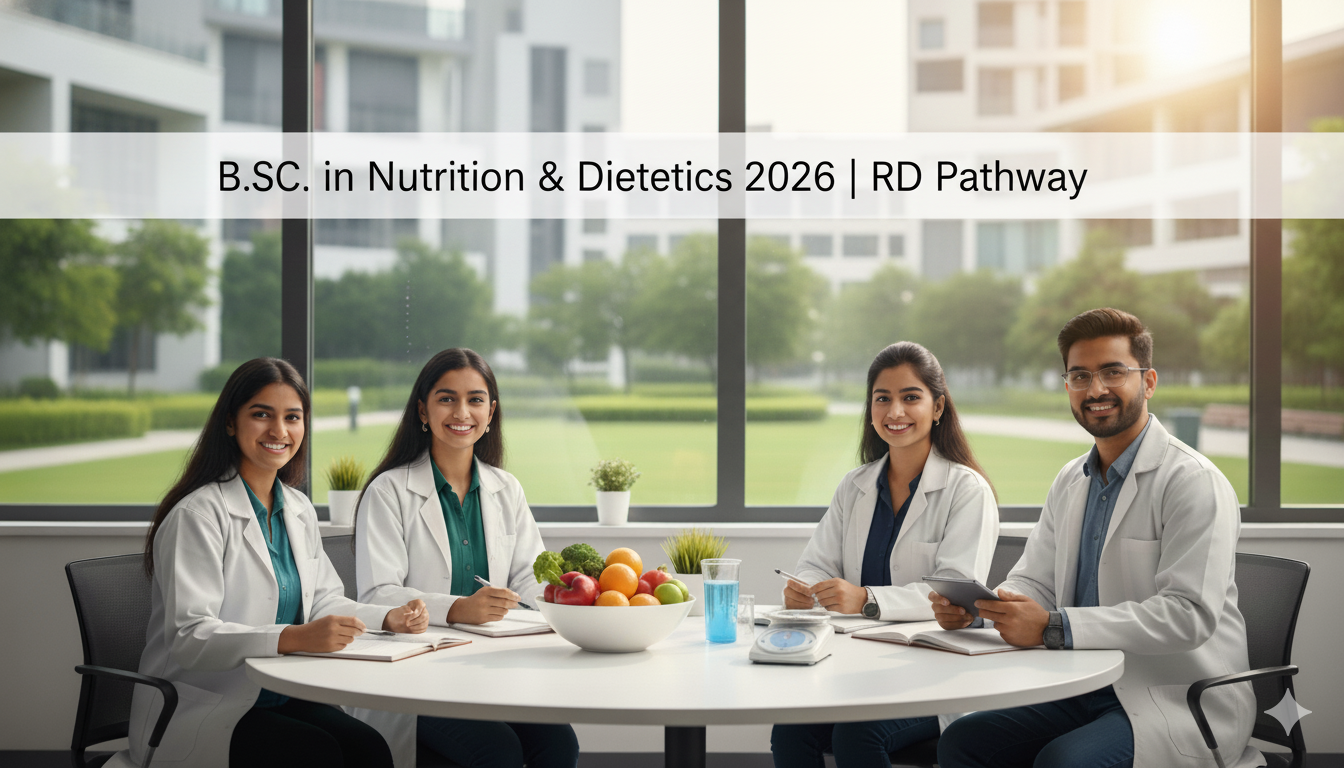
B.Sc. in Nutrition & Dietetics 2026: Clinical Science and Professional Practice
1. Course Overview & Key Highlights
The Bachelor of Science (B.Sc.) in Nutrition & Dietetics is a rigorous, three-year undergraduate program designed to produce highly skilled nutrition experts ready to meet the complex demands of modern healthcare and public health sectors. This science-focused degree integrates core principles of biochemistry, food technology, and clinical practice, culminating in a mandatory 6-month supervised clinical internship crucial for professional certification pathways (e.g., Registered Dietitian).
Key Highlights Table
Category Detail Course Name B.Sc. in Nutrition & Dietetics Course Level Undergraduate Degree (B.Sc.) Duration 3 Years (6 Semesters) Full-Time Eligibility Criteria 10+2 (High School) Science stream with Biology and Chemistry mandatory. Minimum 50% aggregate. Entrance Exams May require institutional entrance test or interview process (TBD). Course Fees (Estimate) INR 10,000 to INR 1.5 Lakhs per year in government colleges, while private colleges can charge INR 1 Lakh to over INR 5 Lakhs total for the 3-year program Admission Process Entrance-based and Merit-based review of academic records. Key Subjects Clinical Nutrition, Therapeutic Diet Planning, Food Microbiology, Nutritional Epidemiology, Biochemistry, Public Health Nutrition. Examination Type Semester-wise (Theory Exams, Practical Assessments, Internship Evaluation). Average Starting Salary ₹2.5 to ₹4.5 Lakhs per annum (LPA) 2. Course Identity & Logistics
- Course Title: Bachelor of Science in Nutrition & Dietetics
- Course Code: N&D-2026
- Credit Value/ECTS: 120 - 140 ECTS (or equivalent institutional credits)
- Format: Primarily On-Campus (Lectures, Seminars, Mandatory Lab Sessions, Clinical Practicum).
- Department/School: School of Health Sciences & Applied Sciences
- Start Date: Fall Semester 2026 (Specific Date TBD)
3. Course Description & Rationale
The B.Sc. in Nutrition & Dietetics is a scientifically grounded program focused on the intersection of human metabolism, food composition, and health outcomes. Students gain deep knowledge of how macro- and micronutrients function at the cellular level, how food systems impact public health, and how to apply this knowledge in clinical settings to manage chronic and acute diseases.
Curriculum Context & Industry Relevance
The curriculum is benchmarked against international standards required for professional licensure (RD/RN). In the context of 2025 and beyond, there is a crucial need for professionals who can address the dual burden of malnutrition—undernutrition alongside the rising epidemic of diet-related chronic diseases (diabetes, cardiovascular disease). This program emphasizes evidence-based practice and critical thinking to translate cutting-edge research into effective, personalized intervention strategies.
Target Audience
This course is ideal for high school graduates with a strong foundation in the Sciences (Biology and Chemistry) who are passionate about health, human physiology, and helping individuals and communities achieve optimal well-being through diet and lifestyle changes. It is the essential first step for those aiming for a career as a Registered Dietitian.
4. Prerequisites & Eligibility
Academic Prerequisites
- Successful completion of 10+2 (High School) or equivalent (A-Levels, IB Diploma).
- Mandatory subjects must include Biology (or Life Sciences) and Chemistry. Physics or Mathematics is highly recommended.
- Minimum aggregate score as specified by the institution (typically 50% or equivalent GPA).
- Demonstrated proficiency in the instruction language (IELTS/TOEFL may be required for international applicants).
Skill Requirements
- Strong analytical and problem-solving skills, particularly in scientific contexts.
- Excellent communication and interpersonal skills for future patient counseling.
- Basic computer literacy and data analysis capabilities.
Technical Requirements
Students must have access to a reliable personal computer capable of running specialized dietary analysis software and accessing digital library resources.
5. Learning Objectives
Upon successful completion of the B.Sc. in Nutrition & Dietetics, students will be able to:
- Analyze: The biochemical and physiological basis of macro- and micronutrient metabolism and their impact on human health across the lifecycle.
- Design: And implement therapeutic diets and nutrition care plans for various clinical conditions (e.g., renal failure, GI disorders, critical care).
- Evaluate: The nutritional status of individuals and diverse populations using standardized anthropometric, biochemical, clinical, and dietary assessment tools.
- Develop: Evidence-based public health nutrition interventions, policies, and educational materials aimed at improving community health outcomes.
- Adhere: To professional ethics, legal standards, and cultural sensitivity required for ethical practice in clinical and community settings.
6. Course Materials
Required Textbooks
- Mahan, L. K., & Raymond, J. L. (Year TBD). Krause’s Food & The Nutrition Care Process.
- Gropper, S. S., & Smith, J. L. (Year TBD). Advanced Nutrition and Human Metabolism.
- Sizer, F. S., & Whitney, E. (Year TBD). Nutrition Concepts and Controversies.
Reference Materials
- Access to peer-reviewed journals and databases (e.g., PubMed, Cochrane Library, Journal of the Academy of Nutrition and Dietetics).
- Institutional Library access to standard reference manuals (e.g., Dietary Reference Intakes, Food Composition Databases).
Software & Tools
- Specialized dietary analysis software (e.g., NutriSurvey, FoodWorks, or institutional equivalent).
- Statistical analysis packages (e.g., SPSS, R) for research methodology modules.
- Access to fully equipped Food Science labs, Biochemistry labs, and simulated clinical assessment facilities (e.g., MNT rooms).
7. Detailed Syllabus & Module Breakdown (3-Year Structure)
The program is structured across three phases, building complexity from foundational sciences to specialized clinical application and professional practice.
Phase I: Foundations (Year 1)
Objective: Establish core vocabulary, basic scientific principles, and understanding of human physiology fundamental to nutrition science.
- Core Modules: Human Anatomy & Physiology, General Chemistry (Organic/Inorganic), Introduction to Nutrition Principles, Food Microbiology, Academic Skills & Research Literacy.
- Key Concepts: Cellular metabolism, nutrient classification, digestive system function, fundamental food safety and preservation.
Phase II: Application & Core Concepts (Year 2)
Objective: Practical application of theories; developing core dietetic and assessment skills across the lifecycle.
- Core Modules: Clinical Nutrition I (Assessment & Basics), Lifecycle Nutrition (Pediatric, Geriatric), Advanced Food Science & Quality Control, Nutritional Epidemiology, Food Service Management.
- Key Concepts: Energy balance, fluid and electrolyte management, basic nutritional assessment techniques, menu planning, epidemiological study design.
Phase III: Advanced Topics & Professional Practice (Year 3)
Objective: Advanced complexity, specialization, research synthesis, and mandatory clinical placement.
- Core Modules: Therapeutic Dietetics (Clinical Nutrition II - Advanced Disease States), Public Health Nutrition, Research Methodology & Dissertation, Elective Specialization (e.g., Sports Nutrition, Renal Dietetics).
- Professional Requirement: Mandatory 6-month Supervised Clinical Internship/Practicum.
- Key Concepts: Critical care nutrition, policy development, advanced counseling techniques, ethical practice, professional leadership.
8. Assessment & Grading Scheme
Student performance is evaluated using a mixed assessment strategy designed to test both theoretical knowledge and practical clinical skills.
Assessment Distribution Table
| Assessment Component | Weightage | Description |
|---|---|---|
| Theory Examinations | 40% | Mid-term and End-of-Semester written examinations covering core concepts. |
| Practical & Lab Work | 30% | Hands-on skills assessment, practical exams (OSCEs), food preparation labs, and detailed lab reports. |
| Assignments & Projects | 15% | Case studies, policy analyses, oral presentations, and literature reviews. |
| Clinical Internship/Dissertation | 15% | Evaluated based on supervisor feedback, final comprehensive report, and research findings. |
Grading Scale and Passing Criteria
The standard institutional grading scale (A, B, C, D, F) applies. A minimum required grade of 'C' (or 60-69%) is mandatory for all core professional modules and the clinical internship to ensure professional competence before graduation.
9. Course Policies
Academic Integrity
The School of Health Sciences maintains a strict zero-tolerance policy regarding plagiarism, cheating, and academic misconduct. All work submitted must be original and adhere to the institutional code of conduct. Violations will result in disciplinary action up to and including expulsion.
Attendance Requirements
Attendance is mandatory. Students must maintain a minimum of 75% attendance in all lectures and seminars, and 90% in all lab, practical, and clinical sessions due to the hands-on nature of the degree and professional requirements.
Late Submissions Policy
Assignments submitted after the published deadline will incur a penalty (e.g., 5% deduction per day) unless a formal extension has been granted prior to the due date. Internship reports must be submitted punctually.
Accommodations for Students with Disabilities
Students requiring academic accommodations must register with the Disability Services Office. The department will work closely with the office to provide reasonable accommodations while maintaining the essential learning outcomes and technical standards of the program.
10. Career Scope & Certification
A B.Sc. in Nutrition & Dietetics provides a robust foundation for diverse and rewarding careers in healthcare, public policy, and the food industry.
Certification Pathway
Graduation from this program fulfills the academic requirements needed to pursue post-graduate supervised practice and/or sit for professional examinations required to achieve status as a Registered Dietitian (RD) or equivalent professional certification in most jurisdictions. Further steps (such as a Master's degree or specified hours of clinical practice) may be required depending on national standards.
Skills Acquired
- Technical Skills: Medical Nutrition Therapy (MNT), Dietary Assessment Software Proficiency, Food Safety Auditing, Biostatistical Analysis, Recipe Modification.
- Soft Skills: Patient Counseling, Interprofessional Communication, Ethical Decision-Making, Community Program Management, Critical Appraisal of Scientific Literature.
Job Roles and Potential Settings
| Job Role | Description | Average Starting Salary (USD Estimate) |
|---|---|---|
| Clinical Dietitian/Nutritionist | Providing MNT in hospitals, long-term care facilities, or private clinics. | ₹2.5 to ₹4.5 Lakhs Per Annum (LPA) |
| Public Health Nutritionist | Designing and implementing large-scale community interventions and health policies for government agencies or NGOs. | ₹2.8 Lakhs to ₹4 Lakhs per annum (LPA) |
| Food Product Development Scientist | Working in the food industry to create healthier products, ensure quality control, and manage regulatory compliance. | ₹3 Lakhs to ₹6 Lakhs per annum |
| Wellness Consultant / Health Coach | Providing personalized nutrition advice in corporate wellness programs or fitness centers. | ₹2.5 to ₹5 Lakhs Per Annum (LPA) |
Further Studies Recommendations
This degree serves as an excellent foundation for advanced study, including M.Sc. or Ph.D. programs in Clinical Nutrition, Public Health, Food Technology, or Exercise Physiology.
11. Frequently Asked Questions (FAQs)
1. What subjects are mandatory for eligibility?
You must have successfully completed the 10+2 level (High School) in the Science stream, with Biology (or Life Sciences) and Chemistry being mandatory subjects. Strong performance in these areas is crucial for success in the degree.
2. Is the B.Sc. in Nutrition & Dietetics sufficient to become a Registered Dietitian (RD)?
The B.Sc. provides the necessary academic foundation and meets the educational prerequisites. However, becoming a fully licensed Registered Dietitian typically requires completing a post-graduate supervised clinical internship (which is integrated partially into our program) and passing a national certification examination, depending on your local jurisdiction.
3. What is the ratio of theoretical study to practical experience?
The program is highly practical. Approximately 40% of the curriculum involves mandatory hands-on experience, including laboratory sessions (food science, biochemistry), simulated clinical practice, and the required 6-month supervised clinical internship in the final year.
4. What is the estimated total cost of the program, including materials?
The total cost for a B.Sc. in Nutrition & Dietetics in India varies widely, from around ₹30,000 to over ₹4 Lakhs for the entire program, depending on whether it's a government (lower cost, e.g., ₹4k-₹1.32L) or private college (higher cost, e.g., ₹50k-₹2.5L+ per year), with costs including tuition and potential materials, though major material costs aren't typically detailed separately. Expect fees from roughly ₹10,000 to ₹1.5 Lakhs per year
5. Can I specialize during the 3-year B.Sc. program?
Yes. While the core curriculum is broad, Year 3 offers elective modules (e.g., Advanced Sports Nutrition, Pediatric Nutrition) and the final dissertation/research project allows you to focus intensively on a specific area of interest, providing early specialization experience.