
B.Sc. in Nuclear Medicine Technology 2026 | Course Details
Launch your career in molecular imaging. The B.Sc. in Nuclear Medicine Technology (NMT) trains experts in radiopharmaceuticals, PET-CT, SPECT, and critical radiation safety.
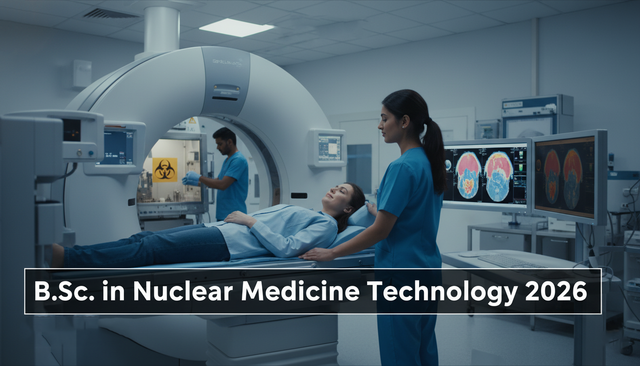
B.Sc. in Nuclear Medicine Technology (NMT) 2026
A Specialized Undergraduate Degree in Molecular Imaging and Radiotherapy
1. Course Overview & Key Highlights
The Bachelor of Science (B.Sc.) in Nuclear Medicine Technology is a highly specialized undergraduate program designed to bridge the gap between applied physics, radiochemistry, and clinical patient care. This 4-year degree (including a mandatory clinical internship) focuses on training competent Nuclear Medicine Technologists who utilize radioactive materials (radiopharmaceuticals) for advanced diagnostic imaging (like PET-CT and SPECT) and targeted therapeutic interventions, driving global advancements in oncology, cardiology, and neurology.
Key Highlights Table
Attribute Details Course Name B.Sc. in Nuclear Medicine Technology Course Level Undergraduate (UG) Degree Program Duration 4 Years (3 Academic Years + 1 Year Clinical Internship) Eligibility Criteria 10+2 (High School) with Physics, Chemistry, and Biology/Mathematics (PCB/PCM). Min. 50% aggregate in core science subjects. Entrance Exams May require NEET qualification or institutional/centralized university entrance tests. Estimated Annual Fees INR 30,000 to INR 2 Lakhs annually Admission Process Entrance Exam Score followed by Counseling/Interview (Entrance-based) Key Subjects Radiation Physics, Radiopharmacy, PET/CT Instrumentation, Dosimetry, Nuclear Cardiology, Radiation Safety. Examination Type Semester-wise Theory Exams, Practical Vivas, and Continuous Clinical Performance Evaluation (CCPE). Average Starting Salary ₹2 Lakhs to ₹5 Lakhs per annum 2. Course Identity & Logistics
This program ensures students are prepared for immediate professional practice upon graduation and certification.
- Degree Awarded: Bachelor of Science (B.Sc.) in Nuclear Medicine Technology
- Program Code: NMT-UG-2026
- Credit Value/ECTS: Approximately 180 - 200 ECTS (or equivalent institutional credits)
- Format: Hybrid (Lectures, Seminars, Mandatory Lab Sessions, Extensive Clinical Rotations)
- Department: Allied Health Sciences / Medical Technology
- Intake Cycle: Annual (Fall Semester 2026)
3. Course Description & Rationale
The B.Sc. NMT curriculum is comprehensive, focusing on the safe and accurate preparation, administration, and monitoring of radiopharmaceuticals, combined with the sophisticated operation and quality control of cutting-edge nuclear imaging equipment (Gamma Cameras, SPECT, and PET-CT). Students gain deep expertise in radiation detection, patient management, and image processing.
Curriculum Context & Industry Relevance
Nuclear Medicine is at the forefront of personalized medicine, especially in oncology (cancer staging and therapy monitoring) and cardiology. The 2025 industry trend shows a massive increase in demand for targeted radionuclide therapies (e.g., Lu-177 treatments) which requires highly specialized technologists proficient in both diagnostic and therapeutic procedures. This course is specifically structured to meet these immediate global workforce needs, ensuring graduates are not just operators, but integral members of the healthcare team.
Target Audience
This program is ideal for highly motivated high school graduates with a strong foundation in science (especially Physics and Chemistry) who possess excellent attention to detail, a commitment to patient safety, and an interest in high-technology medical diagnostics.
4. Prerequisites & Eligibility
Academic Prerequisites
- Successful completion of 10+2 (High School) or equivalent qualification.
- Mandatory subjects studied at the 10+2 level: Physics, Chemistry, and Biology or Mathematics (PCB or PCM stream).
- Minimum Aggregate Score: Typically 50-60% in the core science subjects.
- Entrance Exam Qualification: As mandated by the admitting institution (e.g., NEET or institutional test).
Skill Requirements
- Attention to Detail: Essential for handling precise doses of radioactive materials.
- Problem-Solving: Ability to troubleshoot complex instrumentation issues.
- Communication Skills: Crucial for explaining procedures to anxious patients and collaborating with physicians.
Health and Technical Requirements
- Mandatory physical fitness certificate and updated immunization records (due to clinical exposure).
- Proficiency in the language of instruction (e.g., English).
- Basic computer literacy for image processing and database management (PACS).
5. Learning Objectives
Upon successful completion of the B.Sc. in Nuclear Medicine Technology, students will be able to:
- Define: The fundamental principles of radioactive decay, interaction of radiation with matter, and the pharmacological action of major radiopharmaceuticals.
- Apply: Strict radiation safety protocols, including dose calculation (dosimetry), shielding techniques, and waste management, ensuring ALARA (As Low As Reasonably Achievable) compliance.
- Analyze: Complex nuclear medicine images (planar, SPECT, and PET) to identify potential artifacts, assess image quality, and prepare data for physician interpretation.
- Evaluate: The operational status and quality control data of Gamma Cameras and PET-CT systems, performing necessary calibrations and troubleshooting.
- Create: Standard Operating Procedures (SOPs) for the preparation and quality assurance of common diagnostic and therapeutic radiopharmaceuticals in a controlled hot lab environment.
6. Course Materials
Required Textbooks (Core Texts)
- Cherry, Sorenson, and Phelps. Physics in Nuclear Medicine. (Standard text for instrumentation and physics).
- Saha, Gopal B. Fundamentals of Nuclear Pharmacy. (Essential for Radiopharmacy and QC).
- Early, Paul J., and D. Bruce Sodee. Principles and Practice of Nuclear Medicine. (Clinical applications reference).
Reference Materials
- International Atomic Energy Agency (IAEA) documents on Radiation Protection and Safety.
- Specialized journals (e.g., Journal of Nuclear Medicine Technology).
- Clinical Rotation Manuals and Institutional Radiation Safety Policy Handbooks.
Software & Tools
- Simulation Software (e.g., Monte Carlo simulations for dosimetry).
- Picture Archiving and Communication System (PACS) access for image review.
- Institutional Learning Management System (LMS) access.
- Personal Protective Equipment (PPE): Mandatory personal dosimeters (OSL or TLD badges), lead aprons, and shielding equipment.
7. Detailed Syllabus & Module Breakdown (Year 1 Core Concepts)
The 4-year curriculum is structured into foundational sciences, core nuclear medicine application, advanced clinical specialties, and a full-year mandatory internship (Year 4).
Phase I: Foundations of Radiation and Matter (Weeks 1-7)
Objective: Establish core vocabulary, physical principles, and basic radiation safety requirements.
| Week | Topics Covered |
|---|---|
| 1 | Introduction to Nuclear Medicine: History, Scope, and Medical Terminology. |
| 2 | Atomic Structure and Radioactive Decay: Modes of decay (Alpha, Beta, Gamma), Half-life calculation. |
| 3 | Fundamental Radiation Physics: Interaction of charged and uncharged particles with matter (Photoelectric Effect, Compton Scatter). |
| 4 | Radiation Detection & Measurement: Principles of Geiger-Muller counters and scintillation detectors. |
| 5 | Basic Health Physics & Dosimetry: Units of radiation measurement (Becquerel, Gray, Sievert), Dose limits, ALARA principle. |
| 6 | Introduction to Radiopharmacy: Generator systems (Mo-99/Tc-99m), Preparation techniques, Sterility tests. |
| 7 | Midterm Assessment I (Theory & Practical Lab Safety Viva). |
Phase II: Instrumentation and Clinical Application (Weeks 8-14)
Objective: Practical application of theories, detailed study of major imaging modalities, and clinical procedure context.
| Week | Topics Covered |
|---|---|
| 8 | Gamma Camera Instrumentation I: Components (Collimators, Crystals, PMTs), Quality Control procedures. |
| 9 | SPECT and SPECT/CT Principles: Acquisition methods, Reconstruction algorithms, Filter application. |
| 10 | PET and PET/CT Imaging: Annihilation process, Coincidence detection, Time-of-Flight (TOF) technology. |
| 11 | Nuclear Cardiology Procedures: Stress testing protocols, Myocardial Perfusion Imaging (MPI) acquisition and processing. |
| 12 | Nuclear Oncology: Use of FDG and specialized tracers; Staging and monitoring protocols. |
| 13 | Radionuclide Therapy (RNT) Fundamentals: Dosage administration, Patient isolation, Safety protocols for I-131 and Lu-177 treatments. |
| 14 | Final Review and Comprehensive Examination. |
8. Assessment & Grading Scheme
Assessment is continuous, combining theoretical knowledge with demonstrated clinical competency and practical skills.
Assessment Distribution Table
| Assessment Component | Weight | Description |
|---|---|---|
| Assignments/Quizzes (Formative) | 15% | Weekly quizzes, homework, and radiation safety reports. |
| Midterm Examinations (Theory & Practical) | 30% | Comprehensive written exams and practical simulation vivas. |
| Clinical Competency Evaluation (CCPE) | 35% | Continuous assessment during clinical rotations, logbook maintenance, and procedure execution proficiency. |
| Final Comprehensive Examination | 20% | End-of-year theory paper covering all modules. |
| Total | 100% |
Grading Scale and Passing Criteria
- A (90-100%): Exceptional performance, mastery of clinical skills.
- B (80-89%): Strong performance, proficient in all key areas.
- C (70-79%): Satisfactory performance, meeting minimum competency standards.
- D (60-69%): Marginal pass.
- F (Below 60%): Failure.
Passing Criteria: Students must achieve a minimum of 50% in both the theoretical (combined assignments/exams) and practical/clinical components separately to pass the year and proceed to the next phase.
9. Course Policies
Academic Integrity
All work submitted must be original. The program maintains a strict zero-tolerance policy against plagiarism, cheating, or any form of academic dishonesty. Violations may result in immediate failure of the course or expulsion from the program.
Attendance Requirements
- Theory/Lectures: Mandatory minimum 80% attendance.
- Clinical Rotations/Labs: Mandatory 100% attendance due to the critical nature of hands-on training and radiation safety requirements. Missed clinical time must be remediated.
Late Submissions Policy
Assignments submitted after the deadline will incur a penalty (e.g., 10% deduction per day). Clinical logbooks must be signed off and submitted promptly; delays may affect CCPE scores.
Professional Conduct and Radiation Monitoring
Students must adhere strictly to clinical dress codes, patient confidentiality laws (e.g., HIPAA/GDPR), and ethical guidelines. Mandatory use and regular monitoring of personal dosimeters are enforced. Failure to comply with radiation safety protocols will result in immediate temporary suspension from clinical areas.
10. Career Scope & Certification
Skills Acquired
Graduates possess a unique blend of technical expertise and critical soft skills:
- Technical Skills: Radiopharmaceutical compounding, SPECT/PET image acquisition, Quality Assurance (QA/QC), Venipuncture, Radiation Shielding design.
- Soft Skills: Critical thinking, Patient empathy and communication, Interprofessional collaboration, Ethical decision-making.
Job Roles and Salary Expectations
| Job Role | Role Description | Average Starting Salary (USD/Year) |
|---|---|---|
| Nuclear Medicine Technologist | Perform diagnostic imaging procedures using radiopharmaceuticals and operate gamma cameras/SPECT systems. | ₹3.5 to ₹7 Lakhs per annum (INR 30,000 - 60,000 per month) |
| PET/CT Technologist | Specialized role focusing on oncology imaging using advanced Positron Emission Tomography equipment. | ₹3.5 to ₹5 Lakhs Per Annum (LPA) |
| Radiopharmacist Assistant/Lab Technician | Preparation, quality control, and dispensing of radioactive tracers in a hot lab setting. | ₹3 Lakhs to ₹6 Lakhs per annum |
| Clinical Application Specialist (Vendor Side) | Training hospital staff on new nuclear imaging equipment (OEM/Manufacturer role). | INR 3.5 to 5 Lakhs per annum (LPA) |
Professional Certification and Further Studies
Certification: Graduates must successfully pass a national or regional certifying examination (e.g., NMTCB in the US, ARRT, or specific local regulatory board exams) to obtain the license required for legal practice.
Further Education: Graduates are eligible for advanced studies, including M.Sc. in Nuclear Medicine Technology, Medical Physics, Advanced Imaging Sciences, or Public Health Administration.
11. Frequently Asked Questions (FAQs)
Is the B.Sc. NMT degree globally recognized?
Yes. The foundational science, instrumentation standards, and radiation safety protocols taught in the B.Sc. NMT program are based on international standards (IAEA, ICRP), making the degree internationally recognized. However, you must pass the local certifying examination in the country where you wish to practice.
What is the primary eligibility requirement for admission in 2026?
The primary requirement is successful completion of the 10+2 level (High School) with Physics, Chemistry, and Biology/Mathematics as core subjects. A competitive score on a centralized entrance examination (if applicable to the institution) is also mandatory for selection.
What is the difference between Radiology Technology and Nuclear Medicine Technology?
Radiology (X-ray, CT, MRI) uses external energy sources to create anatomical images. Nuclear Medicine uses internal, administered radioactive sources (radiopharmaceuticals) to create functional and molecular images, showing how organs work, not just what they look like. NMT is highly specialized in handling these internal sources and ensuring radiation safety.
Is this a dangerous job given the exposure to radiation?
No. Nuclear Medicine Technologists are highly trained in radiation protection. Occupational exposure is monitored continuously using personal dosimeters, and strict safety guidelines (ALARA) ensure that the radiation dose received by the technologist is minimal and well within legal limits, making it a safe profession.
Does the 1-year clinical internship count as paid work?
This varies by institution and country. Many institutions offer a mandatory clinical stipend during the internship year to cover basic living expenses, recognizing the professional nature of the work performed during this crucial training period.