
B.Sc. Medical Record Science 2026 | Course Details & Scope
Master Health Information Management (HIM), Medical Coding (ICD-11/CPT), and EHR systems with the B.Sc. MRS degree. High demand career path for data compliance experts.
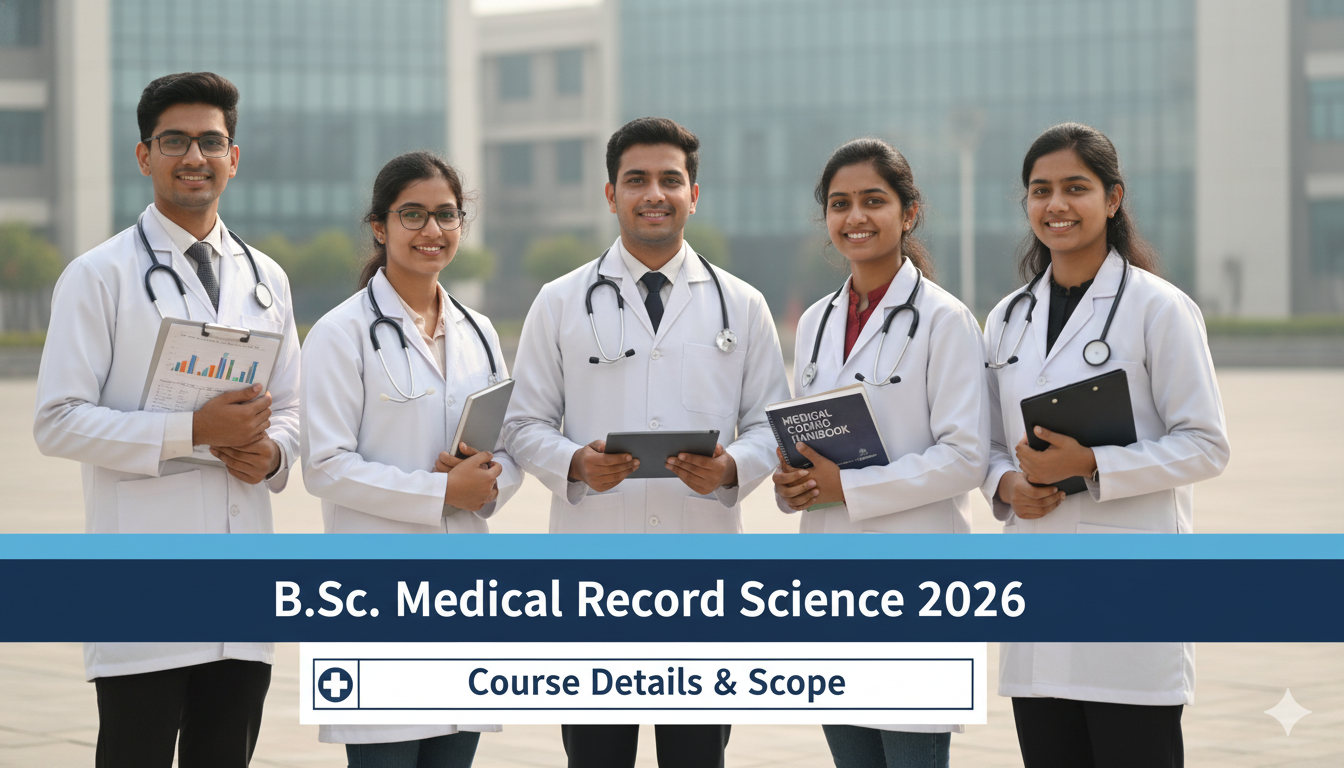
B.Sc. in Medical Record Science (MRS) 2026 Program Details
The Bachelor of Science in Medical Record Science (B.Sc. MRS) is a specialized undergraduate degree designed to meet the critical demand for healthcare data management professionals. This program provides a unique blend of medical knowledge, advanced health informatics, legal compliance training (HIPAA/GDPR), and essential medical coding skills (ICD-11/CPT). Graduates are equipped to manage, analyze, and protect patient data, ensuring efficient healthcare delivery and organizational compliance in the digital age.
1. Course Overview & Key Highlights
The B.Sc. MRS is a future-proof professional degree focusing on the intersection of clinical practice, information technology, and robust regulatory standards. It emphasizes practical training in Electronic Health Records (EHR) and Revenue Cycle Management (RCM), making graduates immediately employable in high-growth healthcare sectors.
Attribute Detail Course Name Bachelor of Science in Medical Record Science (B.Sc. MRS) Course Level Undergraduate Degree Duration 3 Years (6 Semesters) Eligibility Criteria 10+2 (Higher Secondary) with Science Stream (PCB/PCM) or relevant Health/Vocational Stream, minimum 50% aggregate. Entrance Exams May require University-level aptitude tests or specific institutional entrance examinations. Course Fees (Est.) from around ₹10,000 to ₹50,000 per year for government/some private colleges, and up to ₹1.5 Lakh total for some private institutions, with the average range often falling between ₹2 Lakhs to ₹4 Lakhs for the entire course Admission Process Merit-based on 10+2 scores, often followed by an Entrance Exam and/or Interview. Key Subjects Medical Coding (ICD-11/CPT), Electronic Health Records (EHR), Biostatistics, Healthcare Law & Ethics, Revenue Cycle Management. Examination Type Semester-wise (Theory and Practical components) Average Starting Salary (Est.) ₹2.5 to ₹4 Lakhs per annum (LPA) 2. Course Identity & Logistics
This program is structured to provide rigorous academic training alongside extensive practical lab work using industry-standard simulation tools.
- Course Title & Code: Bachelor of Science in Medical Record Science (B.Sc. MRS) - MRS-UG-2026
- Credit Value/ECTS: 120 - 150 ECTS (European Credit Transfer and Accumulation System)
- Format: Full-Time, On-Campus with Hybrid (EHR Lab) components.
- Instructor/Department Info: Taught by the Department of Health Information Management in collaboration with the Faculty of Medicine and Computer Science.
- Awarding Body: University/Affiliated College
3. Course Description & Rationale
The B.Sc. in Medical Record Science is a professional degree designed to equip students with the administrative, technical, and regulatory knowledge necessary to manage patient health data securely and efficiently within complex healthcare systems. This role is crucial for maintaining the quality, accessibility, and privacy of health records.
Curriculum Context & Industry Relevance
The global healthcare industry is undergoing a massive digital transformation, driven by the mandatory adoption of Electronic Health Records (EHR) and stringent data privacy laws (like HIPAA in the US or GDPR in Europe). This shift has created a critical gap in the workforce for professionals who can bridge the clinical world with IT and compliance. B.Sc. MRS graduates are the solution, ensuring data integrity for billing, regulatory audits, research, and public health reporting.
Target Audience
This program is ideal for students who possess a strong interest in science, data management, organization, and healthcare compliance, but who prefer an administrative or technical role rather than direct patient care.
4. Prerequisites & Eligibility
Academic Prerequisites
- Successful completion of 10+2 or equivalent higher secondary examination.
- Mandatory subjects in the qualifying examination must include English and Science (Physics, Chemistry, and Biology or Mathematics) or related healthcare vocational subjects.
- Minimum Score: Institutional minimum percentage (typically 50% - 60% aggregate).
Skill Requirements
- Analytical Aptitude: Ability to handle large datasets and detailed documentation.
- Attention to Detail: Crucial for accurate medical coding and compliance adherence.
- Communication Skills: Essential for liaising between clinical staff, IT teams, and administrative offices.
Technical Requirements
Students must have reliable access to a computer and internet connection for accessing simulated EHR software and digital course materials.
5. Learning Objectives
Upon successful completion of the B.Sc. MRS course, students will be able to:
- Define: Key medical terminology, healthcare regulatory frameworks (e.g., HIPAA, HITECH), and the core principles of Health Information Management (HIM).
- Apply: International classification systems (ICD-11, CPT, HCPCS) accurately for disease diagnosis coding, procedure coding, and subsequent healthcare billing.
- Analyze: Health data using biostatistical tools to identify trends, measure quality metrics, and support resource planning and epidemiological studies.
- Evaluate: The security, integrity, and efficiency of electronic and paper-based medical record systems, recommending improvements for workflow optimization.
- Create: Comprehensive compliance reports, risk management protocols, and disaster recovery plans for healthcare data security and management.
6. Course Materials
Required Textbooks (Core Reference)
- ICD-11 (International Classification of Diseases, 11th Revision) Official Reference Guide.
- CPT (Current Procedural Terminology) Professional Edition Manual (Latest Year).
- LaTour, K. & Maki, P. (2024). Health Information Management: Concepts, Principles, and Practice.
- Fries, L. (2025). Healthcare Law and Compliance in the Digital Age.
- Wayne, R. (2023). Biostatistics for the Health Sciences.
Reference Materials
- Extensive library of anonymized clinical documentation and discharge summaries for coding practice.
- Current national and international health data privacy legislation (HIPAA, GDPR, etc.).
- Journal articles focusing on quality improvement and health informatics.
Software & Tools
- Licensed access to simulated Electronic Health Record (EHR) systems (e.g., Epic or Cerner simulations).
- Statistical analysis software (e.g., SPSS, R, or specialized healthcare data tools).
- Database Management Systems (DBMS) access for practical IT fundamentals.
7. Detailed Syllabus & Module Breakdown (3 Years)
The 3-year curriculum is divided into three professional phases, culminating in a mandatory clinical internship.
Phase I: Foundations (Semesters 1 & 2)
Objective: Establish core vocabulary, medical knowledge, and foundational IT and legal principles.
- Medical & Scientific Basis: Anatomy, Physiology, Medical Terminology, Basic Pathology.
- Introduction to HIM: History, principles of Medical Records, and organization of health data.
- IT Fundamentals: Basic Computer Applications, Data Storage, Introduction to DBMS and Networking.
- Legal & Ethical Basis: Confidentiality principles, Introduction to Healthcare Law, and professional ethics.
Phase II: Application & Core Concepts (Semesters 3 & 4)
Objective: Practical application of technical theories, focusing heavily on coding and data analysis.
- Core Coding Systems: Detailed training in ICD-11 (Diagnosis Coding) and CPT (Procedure Coding) standards.
- EHR Management: Architecture, implementation, maintenance, and user training for EHR/EMR systems.
- Biostatistics & Epidemiology: Principles of data collection, statistical analysis, interpretation, and public health reporting.
- Healthcare Finance: Introduction to Healthcare Reimbursement, Billing cycles, and Revenue Cycle Management (RCM).
Phase III: Advanced & Professional Practice (Semesters 5 & 6)
Objective: Advanced complexity, synthesis of knowledge, management skills, and mandatory professional practice.
- Advanced Data Security & Compliance: Health Data Security, Risk Management, Disaster Recovery Planning, and advanced regulatory adherence.
- Quality Improvement & Auditing: Utilization Review, Clinical Auditing methodologies, and measuring Quality Metrics in Healthcare.
- Hospital Administration: Management principles, Resource Planning, and Health Informatics Project Management.
- Professional Internship (Semester 6): Mandatory 6-month supervised clinical rotation in a hospital's Medical Records Department or HIM office.
8. Assessment & Grading Scheme
Student performance is evaluated through a balanced scheme incorporating theoretical knowledge, practical application, and professional conduct during the internship.
Assessment Distribution
| Assessment Component | Weightage |
|---|---|
| Theoretical Examinations (Mid-term and End-term) | 40% |
| Practical & Lab Work (Coding exercises, EHR simulations) | 30% |
| Internal Assessment (Quizzes, Assignments, Seminars) | 15% |
| Internship/Thesis Project (Final Year) | 15% |
Grading Scale & Passing Criteria
The standard letter grading scale is used (A, B, C, D, F). Students must achieve a minimum passing grade (e.g., 50% or C grade equivalent) in both the theory and practical components of each subject independently to pass the semester.
9. Course Policies
Academic Integrity
A strict zero-tolerance policy is maintained for plagiarism, cheating on examinations, and unauthorized sharing or misuse of simulated EHR data. Violations will result in disciplinary action, up to and including expulsion.
Attendance Requirements
A minimum of 75% attendance is mandatory in both theory lectures and practical/lab classes. Failure to meet this requirement will result in students being ineligible to sit for end-term examinations.
Late Submissions Policy
Assignments submitted after the deadline will incur a penalty (e.g., 10% deduction per day late) unless a documented medical or institutional exemption is provided.
Accommodations for Students with Disabilities
Students requiring academic accommodations should register with the university's Student Services office at the start of the semester to ensure appropriate support is provided for lectures, labs, and examinations.
10. Career Scope & Certification
Graduates of the B.Sc. in Medical Record Science are highly sought after in the growing healthcare data economy, often commanding competitive starting salaries due to their specialized compliance and coding expertise.
Professional Certification
The curriculum is specifically designed to prepare students for globally recognized professional certifications, significantly boosting employability:
- Certified Professional Coder (CPC): Offered by the American Academy of Professional Coders (AAPC).
- Registered Health Information Technician (RHIT): Offered by the American Health Information Management Association (AHIMA).
Skills Acquired
Technical Skills:
- ICD-11, CPT, and HCPCS Coding Mastery
- EHR System Implementation and Maintenance
- Biostatistical Data Analysis
- Data Security and Risk Management
Soft Skills:
- Regulatory Compliance Interpretation
- Critical Thinking and Problem Solving
- Healthcare Workflow Optimization
- Professional Confidentiality
Job Roles and Salary Expectations
| Job Role | Description | Avg. Annual Salary (Entry Level/Mid-Level) |
|---|---|---|
| Medical Coder/Biller | Translating clinical documentation into standardized codes for reimbursement and statistics. | ₹2.4 Lakhs to ₹4 Lakhs per year |
| Health Information Manager (HIM) | Overseeing the entire medical records department, ensuring quality and compliance. | ₹2.5 to ₹4 Lakhs per annum (LPA) |
| Clinical Documentation Specialist (CDS) | Liaising with physicians to ensure documentation accurately reflects patient severity and complexity. | ₹4.1 Lakhs to ₹5.6 Lakhs per year |
| Data Quality Analyst | Auditing records for accuracy, completeness, and adherence to regulatory standards. | ] ₹3.5 Lakhs to ₹4.7 Lakhs per year |
Further Studies
Graduates may pursue advanced education, including M.Sc. in Health Informatics, Master of Health Administration (MHA), or specialized postgraduate diplomas in cyber security or data science.
11. Frequently Asked Questions (FAQs)
Q: Is the B.Sc. in Medical Record Science primarily an IT degree or a Medical degree?
A: It is a vital and unique blend of both. While it requires foundational medical knowledge (anatomy, terminology) to understand clinical documentation, the core function involves applying this knowledge through advanced IT systems, management principles, and strict legal compliance frameworks. It is a highly specialized administrative and technical health science degree.
Q: What are the primary eligibility criteria for admission in 2026?
A: You must have successfully completed your 10+2 (Higher Secondary) examination, typically requiring a Science stream background (Physics, Chemistry, and Biology/Maths). Institutions will also enforce a minimum aggregate score, often around 50% to 60%.
Q: How is the course structured, and is the internship mandatory?
A: The course is structured over three years (six semesters). The curriculum progresses from foundational medical science and IT to core application (coding, EHR) and finally to advanced management and professional practice. Yes, a supervised 6-month clinical/hospital internship in the final year (Semester 6) is a mandatory component for graduation.
Q: Do I need to be proficient in advanced mathematics for this degree?
A: While advanced calculus is not required, proficiency in basic algebra, statistics, and logical reasoning is essential. The curriculum includes mandatory Biostatistics and data analysis modules, which are crucial for quality improvement and public health reporting.
Q: What is the job market outlook for B.Sc. MRS graduates?
A: The job market outlook is excellent and sustained globally. The mandated shift to digital records (EHR/EMR) and the continuous increase in complex regulatory requirements (data privacy, billing audits) ensure a high, persistent demand for skilled Health Information Management professionals across all healthcare sectors.