
B.Sc. in Medical Genetics 2026 | Course Details & Careers
Explore the B.Sc. in Medical Genetics 2026 program. Gain expertise in genomics, bioinformatics, diagnostics, and personalized medicine. Duration: 3-4 years.
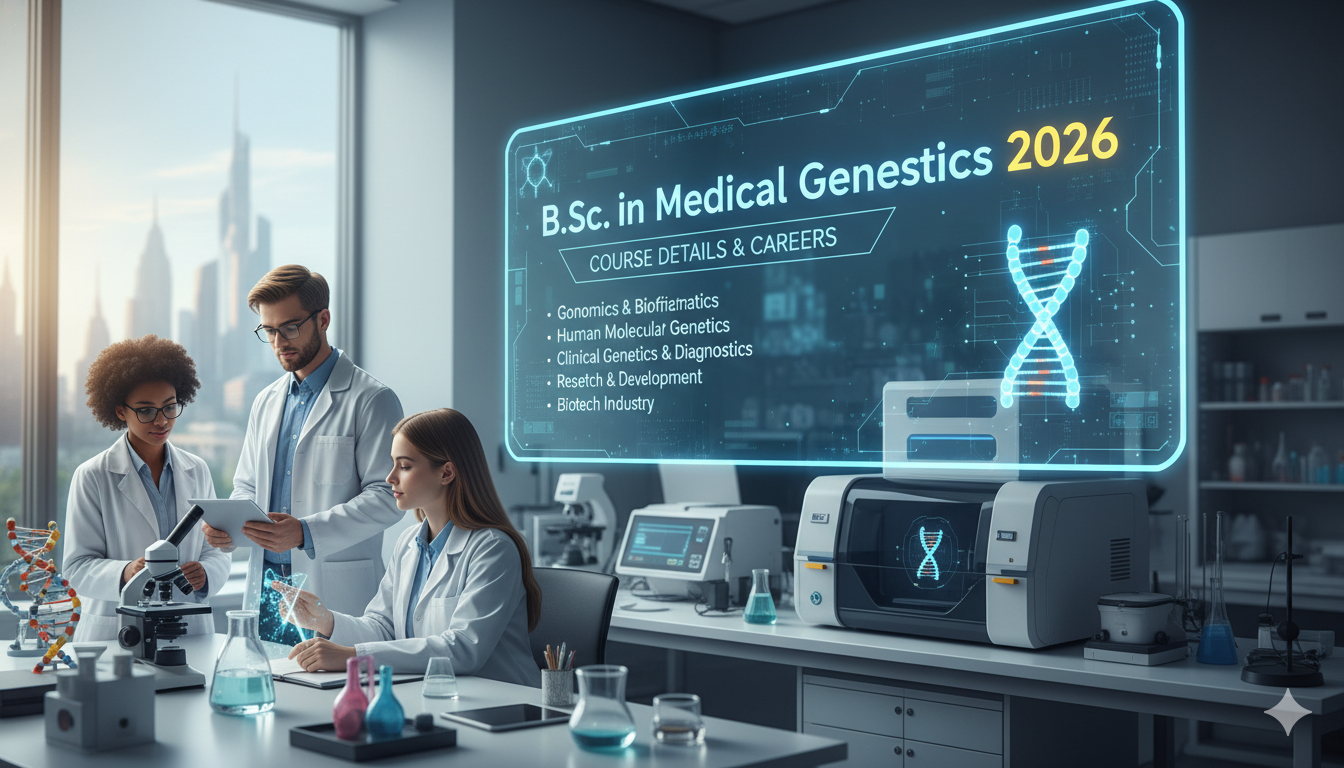
Bachelor of Science (B.Sc.) in Medical Genetics 2026
Course Code Prefix: MEDGEN
1. Course Overview & Key Highlights
The B.Sc. in Medical Genetics is a rigorous undergraduate degree designed to train the next generation of genomic specialists. This interdisciplinary program integrates foundational molecular biology with cutting-edge genomic technologies, emphasizing clinical application, bioinformatics, and the ethical implications of genetic science. Students gain extensive practical experience essential for careers in research, clinical diagnostics, and the burgeoning field of personalized medicine.
Attribute Detail Course Name Bachelor of Science in Medical Genetics Course Level Undergraduate Degree (B.Sc.) Duration 3 to 4 Academic Years (Full-time) Eligibility Criteria 10+2 (High School) with mandatory Biology, Chemistry, and Physics/Mathematics (Min. 65% aggregate in science subjects). Entrance Exams May require institutional or national science aptitude tests. Course Fees (Est.) from roughly ₹30,000 to over ₹5 Lakhs Admission Process Merit-based selection followed by institutional entrance examination or interview. Key Subjects Molecular Genetics, Bioinformatics, Next-Generation Sequencing (NGS), Cancer Genetics, Pharmacogenetics, Biostatistics, Clinical Diagnostics. Examination Type Semester-wise (Theory, Practical Examinations, and Capstone Project Defense) Average Starting Salary (Est.) INR 3 to 5 Lakhs per annum 2. Course Identity & Logistics
- Official Course Title: Bachelor of Science in Medical Genetics
- Course Code Prefix: MEDGEN
- Total Credits/ECTS: Typically 120-140 ECTS/Semester Credits
- Delivery Mode: In-person/Hybrid (High requirement for mandatory laboratory attendance)
- Target Intake: Academic Year 2026
- Department/Faculty: Faculty of Biological Sciences or School of Medicine/Genomic Sciences
3. Course Description & Rationale
The Bachelor of Science in Medical Genetics is a comprehensive program offering a deep dive into human genetic variation, the molecular basis of inheritance, and the role of genes in health and disease. Students learn to navigate the complexity of the human genome, utilizing advanced tools for data analysis and interpretation, which is crucial for modern personalized health strategies.
Curriculum Context & Rationale
The curriculum is structured to address the global shortage of professionals skilled in translational genomics. It moves beyond traditional biology to heavily incorporate computational skills (Python/R) and high-throughput technologies (NGS, CRISPR-Cas9). This course is rationally designed to bridge the gap between pure laboratory science and clinical diagnostics, preparing graduates to operate effectively in either research or clinical settings.
Industry Relevance (2025 Trends)
In 2025, the medical and pharmaceutical sectors are heavily invested in precision medicine and targeted therapies, relying on robust genomic data. Graduates of this program are immediately relevant to fields requiring expertise in genetic diagnostics, drug target identification, and large-scale data interpretation. Key highlights include mandatory modules on the ethical, legal, and social implications (ELSI) of genetics, ensuring graduates are prepared for the sensitive nature of the field.
Target Audience
This program is ideal for highly motivated high school graduates who possess a strong aptitude for science, particularly Biology and Chemistry, and demonstrate proficiency or interest in mathematics, statistics, and computational problem-solving.
4. Prerequisites & Eligibility
Academic Prerequisites
- High School Diploma (10+2): Successful completion with mandatory core sciences: Biology, Chemistry, and either Physics or Mathematics.
- Minimum GPA/Percentage: Typically requires a minimum aggregate of 65% or higher in science subjects.
Skill Requirements
- Recommended Background: Basic proficiency in high school level statistics, algebra, and fundamental computer science concepts.
- Aptitude: Strong analytical and critical thinking skills, high attention to detail (essential for lab work).
Technical Requirements
Students must have reliable access to a personal computer capable of running statistical and bioinformatics software (e.g., R Studio, Python environments, large dataset handling). Access to licensed institutional software will be provided.
Corequisites
Students must maintain satisfactory progress in foundational Biostatistics and Programming modules throughout Phase I to proceed to advanced Bioinformatics modules in Phase II.
5. Learning Objectives
By the end of this course, students will be able to:
- Define: Explain the fundamental mechanisms of inheritance, gene expression regulation, and mutation etiology in common and rare human diseases.
- Apply: Execute complex molecular biology techniques, including specialized PCR methods, Gel Electrophoresis, and Next-Generation Sequencing (NGS) preparation protocols.
- Analyze: Utilize bioinformatics tools and statistical software (R, Python) to analyze, interpret, and visualize large genomic and transcriptomic datasets.
- Evaluate: Critically evaluate genetic data derived from patients and research studies to contribute effectively to differential diagnosis and genetic risk assessment.
- Create: Design and execute independent research projects or clinical case studies, culminating in a professional capstone thesis or internship report that synthesizes technical, analytical, and ethical considerations.
6. Course Materials
Required Textbooks (Examples)
- Strachan & Read. Human Molecular Genetics.
- Nussbaum, McInnes, Willard. Thompson & Thompson Genetics in Medicine.
- Alberts et al. Molecular Biology of the Cell.
- Bourne, P.E. Structural Bioinformatics.
Reference Materials
- Subscription access to primary scientific journals (e.g., Nature Genetics, AJHG).
- Access to major biological databases (e.g., NCBI, OMIM, Ensembl, ClinVar).
Software & Tools
- Bioinformatics Suites (e.g., CLC Genomics Workbench, Galaxy, BLAST).
- Statistical Programming Environments (R/R Studio, Python IDEs).
- Data Visualization Tools (e.g., GraphPad Prism, specific R libraries).
- Dedicated access to specialized laboratory equipment (qPCR, NGS sequencers, cell culture facilities).
7. Detailed Syllabus & Module Breakdown
The curriculum is structured across three progressive phases, culminating in advanced clinical and research integration.
Phase I: Foundations (Year 1 Focus)
Objective: Establish core vocabulary, fundamental biological principles, and introductory computational skills.
- Week 1: Cell Biology and Medical Biochemistry Fundamentals.
- Week 2: Mendelian Genetics and Principles of Inheritance.
- Week 3: Introduction to Chromosomal Structure and Cytogenetics.
- Week 4: Biostatistics I and Introduction to Programming (R/Python Basics).
Phase II: Application & Core Concepts (Year 2 Focus)
Objective: Practical application of molecular theories and introduction to core genomic technologies and data analysis.
- Week 5: Gene Expression, Regulation, and Epigenetics.
- Week 6: Human and Population Genetics (Hardy-Weinberg, Pedigree Analysis).
- Week 7: Principles of PCR and Sanger Sequencing Methodologies.
- Week 8: Next-Generation Sequencing (NGS) Technologies and Library Preparation.
- Week 9: Bioinformatics I: Sequence Alignment, Genome Annotation, and Data Visualization.
Phase III: Advanced & Clinical Integration (Year 3/4 Focus)
Objective: Advanced complexity, clinical synthesis, and professional readiness through specialized topics and capstone work.
- Week 10: Specialized Medical Genetics: Cancer Genetics, Pharmacogenetics, and Gene Therapy.
- Week 11: Clinical Diagnostics: Prenatal, Preimplantation Genetic Diagnosis (PGD), and Non-Invasive Testing.
- Week 12: Ethical, Legal, and Social Implications (ELSI) of Genetics and Privacy Law.
- Week 13: Genetic Counseling Principles and Communication Skills Workshop.
- Week 14: Capstone Project Development, Final Thesis Submission, and Internship Presentation.
8. Assessment & Grading Scheme
Assessment is continuous and multi-faceted, emphasizing both theoretical understanding and critical practical skills. A mandatory pass mark (e.g., 60% or C grade) is required for all laboratory and capstone modules.
Distribution Table
| Assessment Type | Weight (%) | Description |
|---|---|---|
| Formative Assessment | 30% | Quizzes, Homework, Mid-term Exams, Lab Notebook Maintenance. |
| Practical Assessment | 40% | Laboratory Reports, Practical Examinations (OSCE/OSPE), Skills demonstration, Data Analysis Tasks. |
| Summative Assessment | 30% | Final Comprehensive Examinations and Capstone Thesis/Project Defense. |
| Total | 100% |
Grading Scale & Passing Criteria
- A (90-100%): Exceptional performance, mastery of concepts and application.
- B (80-89%): Strong performance, proficient in core knowledge and skills.
- C (70-79%): Satisfactory performance, meets minimum degree requirements.
- D (60-69%): Minimal acceptable performance, requires improvement in application.
- F (Below 60%): Failure, requires retake of the module.
Passing Criteria: Students must achieve a minimum grade of 60% (D) in all core modules and successfully complete the mandatory Capstone requirement.
9. Course Policies
Academic Integrity
The institution maintains a zero-tolerance policy regarding academic misconduct. This includes, but is not limited to, plagiarism, unauthorized collaboration, cheating on examinations, and the fabrication or manipulation of laboratory data.
Attendance Requirements
A minimum attendance of 75-80% is required for all lectures and seminars. Due to the nature of the training, 100% attendance is strictly mandatory for all scheduled laboratory and practical sessions.
Late Submissions Policy
Assignments and lab reports submitted after the stated deadline will incur a penalty, typically 5% deduction of the total grade per day late, up to a maximum of five days. Submissions beyond this period will generally receive a grade of zero.
Accommodations for Students with Disabilities
The institution is committed to providing reasonable and appropriate accommodations for students with documented disabilities. Students requiring accommodations must register with the dedicated Accessibility Services office at the beginning of the academic year.
10. Career Scope & Certification
Graduates of the B.Sc. in Medical Genetics are uniquely positioned to enter the rapidly expanding biotechnology, pharmaceutical, and healthcare sectors, equipped with both wet-lab and computational skills.
Certification Details
While this B.Sc. does not automatically confer certification as a licensed Genetic Counselor (which requires a specialized Master's degree), graduates are prepared to sit for entry-level professional certifications specific to Clinical Laboratory Technologist roles, depending on regional requirements (e.g., ASCP certification preparedness).
Skills Acquired
- Technical Skills: NGS data processing, qPCR, DNA/RNA extraction, Cell Culture, CRISPR methodology, Cytogenetic analysis.
- Soft Skills: Complex data interpretation, scientific communication, ethical reasoning, critical problem-solving, and collaboration in multidisciplinary teams.
Immediate Job Roles (B.Sc. Level)
| Job Role | Description | Average Salary (Est. Annual USD) |
|---|---|---|
| Research Technician/Assistant | Conducting experiments, managing protocols, and assisting PhD researchers in academic or industry biomedical labs. | INR 2.5 to 4.5 Lakhs per annum |
| Genetic Data Analyst/Bioinformatics Technician | Processing, cleaning, and performing basic statistical analysis on large genomic datasets using Python/R. | ₹4 to ₹6 Lakhs per annum (LPA) |
| Clinical Laboratory Technologist | Performing standardized genetic testing and molecular diagnostic procedures in certified clinical labs. | ₹4 to ₹6 Lakhs per annum (LPA) for freshers |
| Genetic Counselor Assistant | Managing patient records, preparing charts, and performing administrative tasks under the supervision of a certified Genetic Counselor. | INR 2 lakhs to INR 4 lakhs per year |
Further Studies Recommendations
This degree serves as an excellent foundation for advanced study:
- M.Sc. in Genetic Counseling (Required for full certification).
- M.Sc. or Ph.D. in Human Genetics, Genomics, or Bioinformatics.
- Entry pathway to professional medical programs (MD/DO) or specialized biomedical engineering degrees.
11. Frequently Asked Questions (FAQs)
Is the B.Sc. in Medical Genetics a highly mathematical course?
Answer: Yes. While rooted in biology, the course requires significant quantitative skills. Approximately 30-40% of the curriculum involves Biostatistics, Population Genetics, and mandatory computational analysis using programming languages (R/Python) to handle complex genomic data. Students must be comfortable with mathematical concepts.
What are the mandatory eligibility criteria for admission in 2026?
Answer: Applicants must have successfully completed 10+2 (or equivalent) with core subjects including Biology, Chemistry, and either Physics or Mathematics. A minimum aggregate score, typically 65% or higher in the science stream, is usually required for consideration.
Does this degree qualify me to practice as a certified Genetic Counselor?
Answer: No. The B.Sc. provides the foundational knowledge necessary for the field, but certification as a professional Genetic Counselor requires the completion of a specialized, accredited Master’s degree program, followed by a licensing examination.
What is the expected laboratory time commitment for this course?
Answer: Due to the intensive practical nature of genomic science, students should anticipate a high commitment. In the later years (Phase II and III), structured and independent laboratory work can consume between 15 to 20 hours per week, in addition to lecture time.
What is the typical career progression after obtaining the B.Sc. degree?
Answer: Most graduates immediately enter research labs as technicians or move into bioinformatics roles in biotech firms. For long-term career growth and higher salaries (e.g., Principal Investigator or certified professional), most graduates pursue further education, such as a specialized M.Sc. or Ph.D.