
B.Sc. in Emergency Medical Technology (EMT) 2026
Earn your B.Sc. in Emergency Medical Technology (EMT). Comprehensive 3-4 year degree focusing on ACLS, trauma, critical care transport, and disaster management. Prepare for licensure.
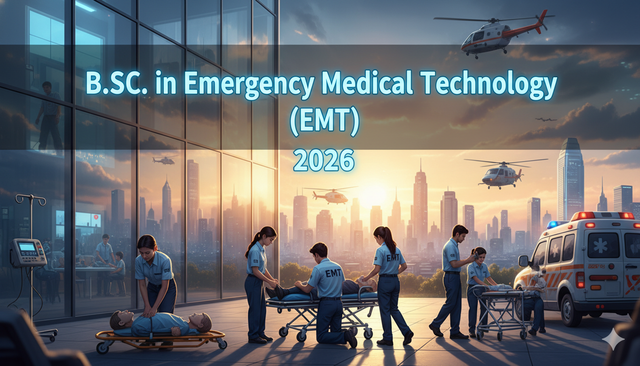
B.Sc. in Emergency Medical Technology (EMT) 2026
The Bachelor of Science in Emergency Medical Technology (B.Sc. EMT) is a rigorous 3-4 year undergraduate degree designed to transform science graduates into highly competent, licensed paramedics. This program focuses on advanced pre-hospital patient care, critical decision-making, trauma management, and disaster response, utilizing high-fidelity simulation and extensive clinical rotations to ensure graduates are prepared to lead in any emergency setting.
1. Course Overview & Key Highlights
The B.Sc. in Emergency Medical Technology is the foundational academic pathway for careers in advanced pre-hospital critical care. The curriculum integrates core medical sciences (Anatomy, Physiology, Pharmacology) with advanced clinical protocols (ACLS, PALS, Trauma), emphasizing evidence-based practice and the integration of modern concepts like telemedicine and Mobile Integrated Healthcare (MIH).
Attribute Detail Course Name B.Sc. in Emergency Medical Technology (EMT) Course Level Undergraduate Degree (Bachelor of Science) Duration 3 to 4 Years (Including mandatory 6-12 month Clinical Internship) Eligibility Criteria 10+2/HSC (Science Stream mandatory: PCB/PCM) with 50-60% aggregate. Entrance Exams May require national or institutional entrance exams (e.g., NEET, SAT, institutional test). Course Fees (Estimate) ₹50,000 to ₹2 Lakhs. Admission Process Entrance-based and/or Merit-based selection followed by interviews/counseling. Key Subjects Advanced Cardiac Life Support (ACLS), Pathophysiology, Trauma Care (ITLS), Pharmacology, Disaster Management, Critical Care Transport. Examination Type Semester-wise (Theoretical exams, OSCEs, Skills Check-offs). Average Starting Salary ₹2.4 - ₹4 LPA, 2. Course Identity & Logistics
The program is structured to provide deep theoretical knowledge complemented by extensive hands-on clinical exposure, ensuring readiness for high-stakes emergency environments.
- Course Title: B.Sc. in Emergency Medical Technology (EMT)
- Course Code: EMT-BS-2026
- Credit Value/ECTS: Typically 180 - 240 ECTS credits (or equivalent institutional credits).
- Format: Full-time, On-campus Didactic Lectures, High-Fidelity Simulation Labs, and significant Off-site Clinical Placements/Internships.
- Instructor/Department Info: Taught by certified Paramedics, Emergency Physicians, and specialized allied healthcare professionals within the School of Allied Health Sciences or Emergency Medicine Department.
3. Course Description & Rationale
Summary
The B.Sc. in Emergency Medical Technology is a specialized scientific and clinical program dedicated to cultivating highly skilled pre-hospital care providers. The curriculum focuses intensely on independent clinical decision-making, critical thinking, and the application of evidence-based medicine under pressure. Graduates are trained not just as technicians, but as clinical leaders capable of managing complex medical and traumatic emergencies from the moment of incidence until definitive hospital care is established.
Curriculum Context
The program moves beyond Basic Life Support (BLS) to master Advanced Cardiac Life Support (ACLS), Pediatric Advanced Life Support (PALS), and advanced trauma protocols (ITLS). The integration of pathophysiology and pharmacology allows students to understand the 'why' behind interventions, promoting adaptability rather than rote memorization of protocols.
Industry Relevance (2025 Trends)
In 2025, the demand for degree-holding paramedics capable of integrating technology is paramount. This course addresses this need by incorporating training in telemedicine protocols, Mobile Integrated Healthcare (MIH) models, and advanced critical care transport logistics, preparing students for roles in modern, community-focused EMS systems.
Target Audience
This course is ideal for highly motivated 10+2 science students who demonstrate excellent academic aptitude, strong physical fitness, resilience under stress, and a profound commitment to serving the public in emergent situations.
4. Prerequisites & Eligibility
Academic Prerequisites
- Required Qualification: Successful completion of 10+2/Higher Secondary Certificate (HSC) or equivalent.
- Mandatory Subjects: Physics, Chemistry, and Biology (PCB) are mandatory, though some institutions may accept Physics, Chemistry, and Math (PCM) depending on program focus.
- Minimum Score: A minimum aggregate of 50-60% in core science subjects is typically required.
Skill Requirements
- Excellent problem-solving and critical thinking abilities.
- High level of physical and mental resilience.
- Strong interpersonal and communication skills for interacting with distressed patients and diverse teams.
Technical Requirements
- Access to institutional Learning Management System (LMS).
- Basic proficiency in electronic documentation and mobile clinical platforms.
Corequisites
Students must maintain a satisfactory academic standing and pass mandatory practical skills assessments (Skills Check-offs) before being allowed to progress to subsequent clinical placement phases.
5. Learning Objectives
By the end of this course, students will be able to:
- Define: The fundamental legal, ethical, and scope-of-practice boundaries governing pre-hospital emergency care providers globally.
- Apply: Advanced Life Support (ACLS, PALS) protocols and International Trauma Life Support (ITLS) frameworks to manage complex patient presentations effectively.
- Analyze: Pathophysiological changes associated with critical illness and trauma to inform rapid, independent clinical decision-making in time-sensitive emergencies.
- Evaluate: Resource allocation, safety hazards, and triage requirements during mass casualty incidents (MCIs) and disaster response scenarios, demonstrating operational leadership.
- Create: Comprehensive patient care reports (PCRs) and research proposals utilizing evidence-based methodology to advance pre-hospital practice and quality improvement initiatives.
6. Course Materials
Required Textbooks
- Doyle, E. (2024). Advanced Paramedic Practice: Principles and Protocols.
- Tortora, G. J., & Derrickson, B. (Latest Edition). Principles of Anatomy & Physiology.
- American Heart Association (AHA) Guidelines. ACLS and PALS Provider Manuals.
- Mancini, M. (2023). Emergency Pharmacology for the Paramedic.
Reference Materials
- Institutional medical libraries and access to peer-reviewed medical databases (e.g., PubMed).
- Current clinical practice guidelines from recognized bodies (e.g., ITLS, NAEMT).
- Comprehensive digital atlas of human anatomy and physiology.
Software & Tools
- Learning Management System (LMS) access (e.g., Moodle, Canvas).
- High-fidelity patient simulation center software.
- Mobile clinical documentation platforms (e.g., ePCR systems).
- Personal Diagnostic Kit (Stethoscope, Sphygmomanometer, Penlight).
7. Detailed Syllabus & Module Breakdown (Illustrative Semester Structure)
This syllabus represents the conceptual flow and core topics covered across the multi-year program, structured for a typical semester progression.
Phase I: Foundations (Year 1 Focus)
Objective: Establish core anatomical, physiological, and clinical vocabulary and principles necessary for basic patient assessment.
- Module 1: Core Sciences: Human Anatomy & Physiology, Pathophysiology Fundamentals, Medical Terminology.
- Module 2: Introduction to EMT: History of EMS, Basic Life Support (BLS) certification, Ethical and Legal aspects of pre-hospital care.
- Module 3: Patient Assessment: Primary and Secondary Surveys, Vital Signs interpretation, Basic patient handling and movement techniques.
- Module 4: Supportive Subjects: Introduction to Pharmacology, Basic Communication Skills and Documentation.
Phase II: Application & Core Concepts (Year 2 Focus)
Objective: Practical application of advanced theoretical knowledge in simulated and controlled clinical environments.
- Module 5: Advanced Medical Management: Cardiac emergencies (ACLS), Respiratory failure, Neurological assessments.
- Module 6: Trauma Care: Mechanism of Injury (MOI) analysis, International Trauma Life Support (ITLS) principles, Shock management.
- Module 7: Pharmacology II: Advanced drug administration routes (IV, IO), Fluid resuscitation, Dosage calculations.
- Module 8: Midterm Evaluation: Comprehensive theoretical and Objective Structured Clinical Examination (OSCE).
- Module 9: Clinical Rotations I: Non-emergency transport exposure, Initial hospital Emergency Department (ED) observation.
Phase III: Advanced Topics & Specialization (Year 3-4 Focus)
Objective: Mastery of complex patient populations, operational leadership, and preparation for mandatory clinical internship and licensure.
- Module 10: Special Populations: Pediatric Advanced Life Support (PALS), Geriatric care, Obstetric and Neonatal emergencies.
- Module 11: Critical Care & Operational Leadership: Critical Care Transport (CCT) concepts, Flight Paramedicine basics, Advanced Airway Management.
- Module 12: Disaster Management: Triage systems (START/JumpSTART), Mass Casualty Incident (MCI) response, Incident Command System (ICS).
- Module 13: Research & Professional Development: Research Methodology, Evidence-Based Practice seminar, Capstone Project/Thesis preparation.
- Module 14: Internship/Practicum: Mandatory supervised clinical internship (Ambulance Service, ED, ICU rotations) leading to licensure eligibility.
8. Assessment & Grading Scheme
Assessment is rigorous, combining theoretical knowledge testing with essential practical competence checks to ensure clinical readiness.
Distribution Table
| Assessment Component | Weightage | Description |
|---|---|---|
| Theoretical Evaluation | 40% | Mid-term and End-term examinations (MCQs, Short Answers, Case Studies). |
| Practical Evaluation (OSCEs/Skills) | 40% | Objective Structured Clinical Examinations, High-fidelity Simulation Scenarios, and Skills Check-offs. |
| Clinical Performance | 20% | Supervisor evaluations during clinical rotations, quality of Patient Care Reports (PCRs), and professional conduct. |
| Total | 100% |
Grading Scale
Standard institutional grading scale (A, B, C, D, F or equivalent GPA) applies. However, a minimum passing grade for all core clinical and practical modules is typically higher (e.g., 70-80%) to ensure safety and competence.
Passing Criteria
Students must achieve the minimum passing grade in both the theoretical and practical components of each module to progress. Failure in critical skills modules requires mandatory remediation and re-testing before clinical placement.
9. Course Policies
Academic Integrity
The program maintains a zero-tolerance policy regarding academic dishonesty, including plagiarism, cheating on examinations, and the falsification of patient records or clinical documentation. Violations will result in disciplinary action up to and including expulsion.
Attendance Requirements
Due to the practical and clinical nature of the B.Sc. EMT, mandatory attendance is enforced. Students must maintain a minimum attendance rate of 80-90% for all labs, skills sessions, and clinical rotations to be eligible for assessment.
Late Submissions Policy
Assignments submitted past the deadline may incur penalties (e.g., a 10% deduction per day). Clinical documentation (PCRs) must be completed and submitted within 24 hours of the shift ending, as mandated by legal and institutional standards.
Accommodations for Students with Disabilities
The institution is committed to providing reasonable accommodations for students with documented disabilities, ensuring they can meet the academic and technical standards of the program without compromising patient safety.
10. Career Scope & Certification
Graduates of the B.Sc. EMT program are prepared for high-demand careers globally, specializing in life-saving pre-hospital interventions.
Certification Details
Upon successful completion of the academic and clinical requirements, graduates will be eligible to sit for relevant national or state Paramedic/EMT licensure examinations (e.g., National Registry of Emergency Medical Technicians (NREMT) in the US, or the equivalent national registry in their practicing country).
Skills Acquired
- Technical Skills: Advanced airway management (intubation), IV/IO access, defibrillation, mechanical ventilation operation, advanced drug administration, and interpretation of 12-lead EKGs.
- Soft Skills: Crisis communication, leadership, teamwork, stress management, critical thinking, and patient advocacy.
Job Roles Table
| Primary Job Role | Description | Further Studies Recommendation |
|---|---|---|
| Licensed Paramedic | Providing advanced life support and critical interventions in ambulance services (public or private). | Critical Care Transport (CCT) Certification |
| Critical Care Transport Paramedic | Specializing in inter-facility transfers of critically ill patients via ground or air (Flight Paramedicine). | Master’s in Public Health (MPH) |
| EMS Educator/Field Training Officer (FTO) | Training new EMTs/Paramedics and developing continuing education curriculum. | Master’s in Healthcare Administration |
| Disaster Response Specialist | Operational planning and execution of emergency medical services during Mass Casualty Incidents (MCIs) or natural disasters. | Tactical Paramedic Certification |
Further Studies Recommendations
The B.Sc. serves as an excellent foundation for pursuing advanced degrees, including a Master’s in Public Health, Healthcare Administration, or specialized post-graduate certificates in Community Paramedicine, Tactical Medicine, or CCT.
11. Frequently Asked Questions (FAQs)
1. What are the mandatory eligibility criteria for B.Sc. EMT admission?
You must have successfully completed your 10+2/HSC in the Science stream, with Physics, Chemistry, and Biology (or in some cases, Math) as mandatory core subjects. A minimum aggregate score, typically between 50% and 60%, is required. Physical fitness and a mandatory background check are also prerequisites.
2. How is the B.Sc. EMT course structured, and what is the balance between theory and practice?
The program typically runs for 3 to 4 years and emphasizes practical skill development. The structure approximates 40% didactic/theory instruction and 60% dedicated lab time, high-fidelity simulation, and mandatory clinical rotation exposure across hospital and ambulance settings.
3. Is the mandatory clinical internship paid, and how long does it last?
The clinical internship is a mandatory component, typically lasting 6 to 12 months, required for licensure eligibility. Generally, these are unpaid clinical rotations designed for learning, although some healthcare institutions may offer a small stipend to cover basic expenses.
4. What is the approximate cost of the program?
Course fees vary widely based on the institution type (public vs. private) and location. Prospective students should budget between ₹50,000 to ₹2,00,000 per year, plus costs for required uniforms, diagnostic kits, and certification fees (like ACLS/PALS).
5. What career opportunities exist beyond working on an ambulance?
Graduates are highly versatile. Beyond public or private ambulance services, B.Sc. EMT holders can work in hospital emergency departments, fire and rescue services, industrial safety and oil rigs, military or government agencies, and pursue roles in critical care transport, EMS education, or disaster management.