
B.Sc. Dialysis Technology 2026 | Course Details & Careers
Enroll in the 4-year B.Sc. Dialysis Technology program (3 academic + 1 internship). Master RRT, patient care, water systems, and advanced renal replacement therapies.
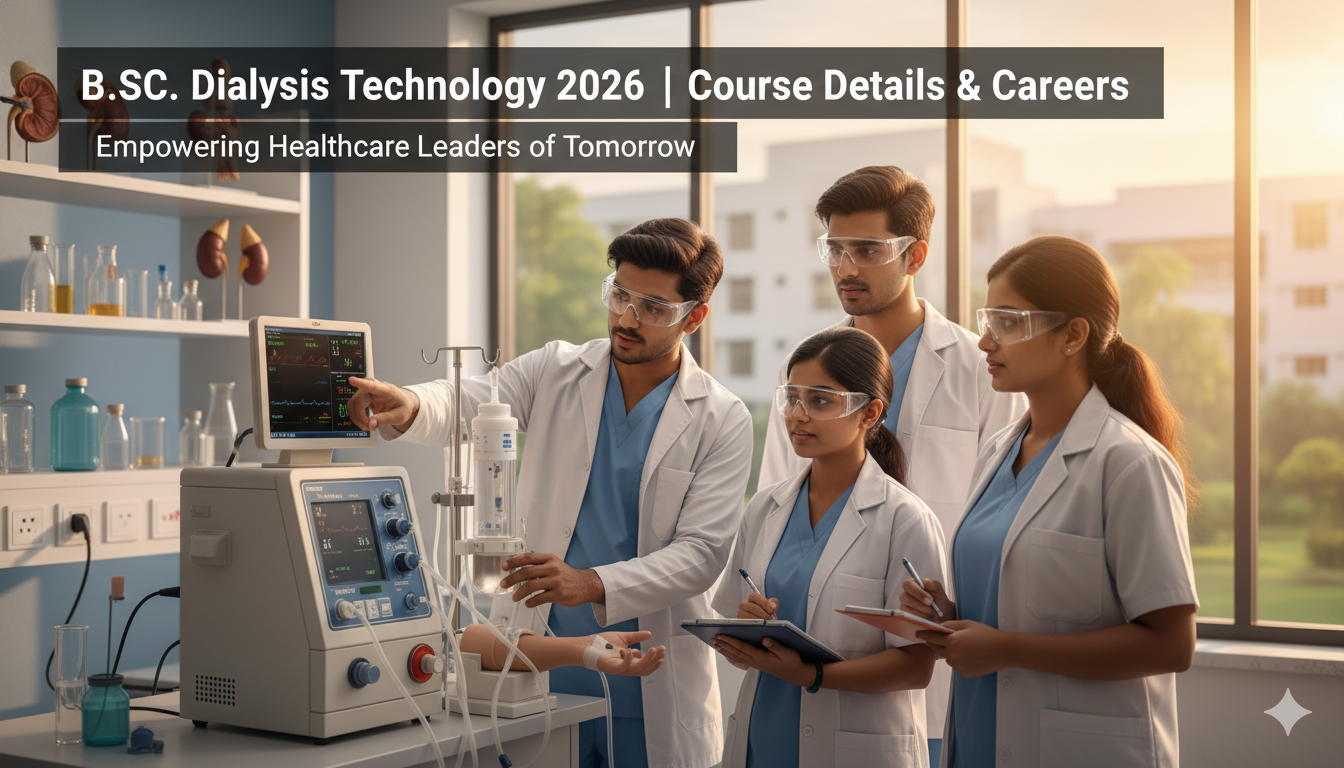
Bachelor of Science (B.Sc.) in Dialysis Technology 2026
Course Code: DT-BSc-2026 | Department: School of Allied Health Sciences
1. Course Overview & Key Highlights
The B.Sc. in Dialysis Technology is a specialized undergraduate paramedical program designed to equip students with the comprehensive theoretical knowledge and critical practical skills required to manage and execute renal replacement therapies (RRT). This 4-year program, integrating 3 years of rigorous academic study and a mandatory 1-year clinical internship, focuses on preparing competent professionals capable of operating complex dialysis equipment, ensuring patient safety, and collaborating effectively within a multidisciplinary nephrology team.
| Attribute | Details |
|---|---|
| Course Name | B.Sc. in Dialysis Technology |
| Course Level | Undergraduate (B.Sc.) |
| Duration | 4 Years (3 Academic Years + 1 Year Mandatory Clinical Internship) |
| Eligibility Criteria | Successful completion of 10+2 with Physics, Chemistry, and Biology (PCB) as mandatory subjects, and a minimum aggregate of 50%. |
| Entrance Exams | Institutional Entrance Examination or Merit-based admission (e.g., specific state/national paramedical entrance scores may be considered). |
| Estimated Annual Fees | ₹1,00,000 – ₹2,50,000 (Varies significantly by institution and location) |
| Admission Process | Entrance Exam Score/Merit List followed by Personal Interview/Counseling. |
| Key Subjects | Renal Physiology, Principles of Hemodialysis, Water Treatment Systems, Peritoneal Dialysis, Clinical Biochemistry, and Infection Control. |
| Examination Type | Semester-wise (Internal Assessment + End-of-Semester Theory Exams + Practical/Clinical OSCEs). |
| Average Starting Salary | ₹3,00,000 – ₹6,00,000 per annum (Dependent on sector and location). |
2. Course Identity & Logistics
- Course Title & Code: Bachelor of Science in Dialysis Technology (DT-BSc-2026)
- Department: School of Allied Health Sciences / Nephrology Technology Division
- Credit Value/ECTS: Approximately 180-200 Total Credits (including clinical internship).
- Format: Hybrid (Lectures, Seminars, Extensive Hands-on Laboratory Sessions, Mandatory Clinical Rotations).
- Intake Cycle: Annually (Typically Fall/Autumn Semester).
3. Course Description & Rationale
This comprehensive B.Sc. program is meticulously designed to create highly skilled Dialysis Technologists. Students gain deep knowledge in renal anatomy, pathophysiology, and the engineering principles underlying modern renal replacement therapies (RRT). The curriculum emphasizes safety, ethical practice, and technological proficiency in managing both acute and chronic renal failure patients.
Curriculum Context & Industry Relevance
The program is structured to meet global standards set by professional health councils. The mandatory 12-month clinical internship ensures 100% practical integration, allowing students to transition seamlessly from academic learning to clinical practice. Given the exponential rise in non-communicable diseases like diabetes and hypertension, the incidence of Chronic Kidney Disease (CKD) is skyrocketing globally, creating an urgent and sustained demand for certified Dialysis Technologists in 2025 and beyond.
Target Audience
This course is ideal for motivated 10+2 science graduates (PCB stream) who possess a strong interest in technology, patient care, life sciences, and seek a rewarding career in specialized healthcare settings where precision and attention to detail are paramount.
4. Prerequisites & Eligibility
Academic Prerequisites
- Mandatory Subjects: Physics, Chemistry, and Biology (PCB) in 10+2 or equivalent.
- Minimum Score: Aggregate percentage (e.g., 50%) in the qualifying examination.
- Foundational Knowledge: Strong grasp of basic cell biology, human physiology, and applied chemistry.
Skill Requirements (Non-Academic)
- Manual Dexterity: Essential for cannulation and equipment setup.
- Attention to Detail: Critical for monitoring treatment parameters and water quality.
- Communication Skills: Ability to communicate clearly and empathetically with distressed patients and complex medical teams.
- Ethical Grounding: Commitment to patient confidentiality and professional conduct.
Technical Requirements
Access to a stable internet connection for digital resources and potential online simulation modules.
5. Learning Objectives
By the end of this course, graduates will be able to:
- Define: The physiological principles of renal function, renal failure, and the mechanisms of solute transport (diffusion, convection, ultrafiltration) central to dialysis.
- Apply: Advanced technical skills to setup, operate, and manage complex hemodialysis machines, associated water treatment systems, and peritoneal dialysis cyclers safely and effectively.
- Analyze: Patient assessment data, including pre- and post-dialysis vital signs, blood chemistry reports, and treatment prescriptions, modifying procedures under supervision.
- Evaluate: Complications arising during dialysis (e.g., hypotension, air embolism, cramping) and implement immediate, appropriate emergency management protocols (including BLS).
- Create: Detailed clinical documentation, maintain accurate patient records and equipment logbooks, and contribute to research projects related to renal technology and patient outcomes.
6. Course Materials
Required Textbooks
- Daugirdas, J. T., Blake, P. G., & Ing, T. S. (Yearly Edition). Handbook of Dialysis.
- Papadakis, M. A., & McPhee, S. J. (Latest Edition). Current Medical Diagnosis & Treatment (for Renal Section).
- Eknoyan, G., & Lameire, N. (Latest Edition). Nephrology and Dialysis Technology: A Comprehensive Guide.
Reference Materials
- Institutional Standard Operating Procedure (SOP) manuals for all major dialysis equipment models.
- Access to specialized e-journals (e.g., Kidney International, Journal of Nephrology).
- Clinical Rotation Handbook and Logbook.
Software & Tools
- Virtual Simulation Lab Access (for practice cannulation and troubleshooting).
- Hospital Information System (HIS) training modules for documentation.
- Statistical software (e.g., SPSS or R) for research methodology module.
7. Detailed Syllabus & Module Breakdown (Illustrative 14-Week Structure)
The 3-year academic period is divided into six semesters, followed by a 1-year internship. The following structure illustrates core content delivery across foundational, application, and advanced stages.
Phase I: Foundations (Weeks 1-4) - Year 1 Focus
Objective: Establish core vocabulary and principles of human biology, safety, and hospital management essential for medical technologists.
| Week | Topics Covered |
|---|---|
| Week 1: | Human Anatomy & Physiology I: Introduction to Body Systems (Renal, Cardiovascular, Respiratory). |
| Week 2: | Medical Physics & Chemistry: Principles of Fluid Dynamics, Osmosis, and Acid-Base Balance. |
| Week 3: | Medical Microbiology & Infection Control: Sterilization, Disinfection, and Aseptic Techniques in Healthcare. |
| Week 4: | Introduction to Hospital Management, Medical Ethics, and Basic Life Support (BLS) Certification. |
Phase II: Application & Core Concepts (Weeks 5-9) - Year 2 Focus
Objective: Practical application of theories; mastering the principles and operation of standard hemodialysis technology.
| Week | Topics Covered |
|---|---|
| Week 5: | Principles of Hemodialysis I: Diffusion, Ultrafiltration, and Convection. Dialyzer Types and Specifications. |
| Week 6: | Dialysis Water Treatment Systems: Components (RO, Filters), Monitoring Standards (AAMI), and Maintenance. |
| Week 7: | Vascular Access Management: Anatomy of AV Fistula, Grafts, and Catheters. Cannulation techniques (Lab Practice). |
| Week 8: | Clinical Biochemistry & Renal Pharmacology: Common blood tests, electrolyte management, and drugs used in dialysis. |
| Week 9: | Hands-on Machine Preparation and Monitoring: Priming, alarm management, and documentation procedures. |
Phase III: Advanced Topics (Weeks 10-14) - Year 3 Focus
Objective: Advanced complexity, specialized modalities, synthesis of clinical practice, and research preparation.
| Week | Topics Covered |
|---|---|
| Week 10: | Advanced Dialysis Modalities I: Peritoneal Dialysis (CAPD, APD) – Principles, Catheter Insertion, and Complications. |
| Week 11: | Advanced Dialysis Modalities II: Continuous Renal Replacement Therapy (CRRT) and Pediatric Dialysis Considerations. |
| Week 12: | Renal Transplant Management: Pre-operative screening, post-operative care role, and immunosuppressive therapy overview. |
| Week 13: | Research Methodology & Biostatistics: Data collection, ethical review, and final research project proposal development. |
| Week 14: | Professional Development: Advanced Patient Assessment, Quality Assurance, and Final Capstone Project/Portfolio Submission. |
8. Assessment & Grading Scheme
Assessment is comprehensive, balancing theoretical knowledge, practical skills, and professional conduct, ensuring graduates are clinically ready.
Distribution Table
| Assessment Component | Weightage |
|---|---|
| Internal Assessment (Quizzes, Assignments, Professionalism/Attendance) | 30% |
| Practical/Clinical Assessment (Lab Proficiency, OSCEs, Clinical Logbook) | 40% |
| End-of-Semester Theory Exams (Comprehensive Written Exams) | 30% |
Grading Scale and Passing Criteria
A standard institutional letter grading scale (A, B, C, D, F) is utilized. Students must achieve a minimum passing grade (typically 50% or Grade C) in both the theory component and the practical/clinical component separately to pass the course module and proceed to the next semester. Failure in the clinical assessment requires mandatory re-rotation.
9. Course Policies
Academic Integrity
Strict adherence to academic honesty is mandatory. Plagiarism, cheating, or any form of academic misconduct will result in severe disciplinary action, including failure of the course and potential expulsion.
Attendance Requirements
- Theory Classes: Minimum 75% attendance required.
- Clinical Rotations/Labs: Minimum 90% attendance required due to the hands-on nature of the training.
- Failure to meet the minimum attendance criteria renders the student ineligible to sit for the final examinations.
Late Submissions Policy
Assignments submitted after the deadline will incur a penalty (e.g., 10% deduction per day), up to a maximum period, after which they will not be accepted unless extenuating circumstances are formally approved by the course coordinator.
Safety and Professional Conduct
All students must comply with institutional safety protocols, including mandatory annual certification in biohazard handling and fire safety. Strict adherence to patient confidentiality (HIPAA/GDPR standards) and hospital dress code is required during all clinical rotations.
10. Career Scope & Certification
Graduates of the B.Sc. in Dialysis Technology are highly sought after in the rapidly expanding global healthcare industry, specializing in life-saving renal care.
Skills Acquired
- Technical Skills: Hemodialysis equipment operation, water purification system management, vascular access cannulation, CRRT setup, and equipment maintenance/troubleshooting.
- Soft Skills: Critical thinking, emergency management, empathetic patient counseling, inter-professional communication, and documentation accuracy.
Job Roles and Salary Potential
| Job Role | Description | Avg. Starting Salary (INR/Year) |
|---|---|---|
| Certified Dialysis Technologist | Directly managing and performing dialysis procedures in hospital units or specialty clinics. | ₹3,50,000 – ₹6,00,000 |
| Renal Technologist/Specialist | Focus on advanced modalities (CRRT) and managing complex patient cases in tertiary care settings. | ₹4,00,000 – ₹7,50,000 |
| Technical Sales/Support Specialist | Working for medical device companies, training staff on new dialysis equipment and providing technical maintenance. | ₹5,00,000 – ₹9,00,000+ |
| Clinical Educator/Trainer | Training new staff or students within large hospital networks or academic institutions. | ₹4,50,000 – ₹7,00,000 |
Further Studies recommendations
Graduates are eligible to pursue higher education, including M.Sc. in Dialysis Technology, M.Sc. in Allied Health Sciences, or specialized postgraduate diplomas in clinical research or healthcare management.
Professional Certification
We strongly encourage graduates to pursue national or international professional board certifications (e.g., certification granted by the Nephrology Certification Board or equivalent state/national councils) to enhance career mobility and credibility.
11. Frequently Asked Questions (FAQs)
Q: What are the strict eligibility requirements for admission?
A: Candidates must have successfully completed 10+2 with Physics, Chemistry, and Biology (PCB) as mandatory subjects. A minimum aggregate score (usually 50% or higher) is required, and admission often relies on performance in a relevant entrance examination or merit ranking.
Q: Is the 1-year clinical internship mandatory, and is it paid?
A: Yes, the 1-year clinical internship (Year 4) is mandatory for degree completion and provides critical hands-on experience. Whether the internship is paid (stipend) varies significantly based on the affiliated hospital, institutional policy, and local government regulations.
Q: What is the main difference between a Dialysis Technician Diploma and a B.Sc. in Dialysis Technology?
A: The B.Sc. is a 4-year undergraduate degree that provides a much deeper foundation in renal physiology, pharmacology, research methodology, and advanced modalities (like CRRT and Pediatric Dialysis). It offers greater career progression opportunities, including management roles and eligibility for postgraduate studies, compared to a shorter diploma.
Q: Given the nature of the work, how much exposure to biohazards is there?
A: The role of a Dialysis Technologist involves frequent contact with patients' blood and bodily fluids. Therefore, students receive rigorous and mandatory training in biohazard handling, infection control, and needle stick prevention throughout the program to ensure maximum safety for both the technologist and the patient.
Q: Does the B.Sc. degree qualify me to work internationally?
A: Yes, the Bachelor of Science degree is internationally recognized. However, to practice in countries outside your home nation (e.g., US, Canada, UK, Australia), you must typically pass local licensing examinations and meet specific national professional board certification requirements.