
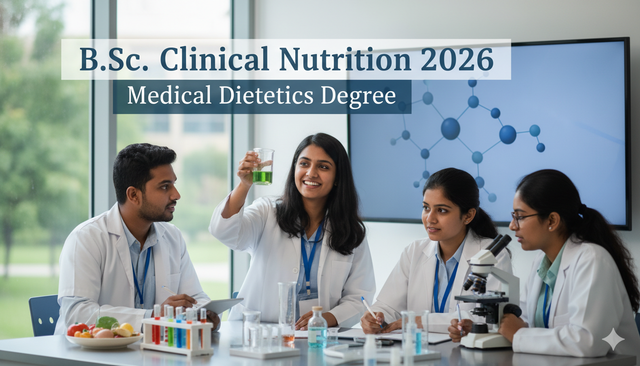
B.Sc. Clinical Nutrition 2026 | Medical Dietetics Degree
Earn your B.Sc. in Clinical Nutrition. Comprehensive 4-year program focusing on Evidence-Based Practice (EBP), 1000+ clinical hours, and preparation for the Registered Dietitian (RD) examination pathway.
Bachelor of Science in Clinical Nutrition (B.Sc. CN) 2026
Department of Health Sciences | School of Allied Health
1. Course Overview & Key Highlights
The B.Sc. in Clinical Nutrition is a rigorous, four-year undergraduate program designed to transform science students into competent, evidence-based nutrition professionals. This degree focuses heavily on Medical Nutrition Therapy (MNT), preparing specialists capable of diagnosing and managing acute and chronic diseases through dietary interventions. A standout feature is the integrated, mandatory 1000+ hour clinical internship, ensuring graduates possess the practical skills required for immediate entry into healthcare settings and eligibility for national professional credentialing exams like the Registered Dietitian (RD) or Certified Nutrition Specialist (CNS).
Key Program Highlights
Attribute Detail Course Name Bachelor of Science in Clinical Nutrition Course Level Undergraduate Degree (B.Sc.) Typical Duration 4 Academic Years (8 Semesters) Eligibility Criteria Successful completion of 10+2 Science stream (Biology, Chemistry mandatory). Minimum 60% aggregate score. Entrance Exams Institutional Aptitude Test (Varies by location) or None. Course Fees (Estimate) INR 50,000 to INR 2.5 Lakhs Admission Process Merit-based selection followed by mandatory interview/counseling. Key Subjects Nutritional Biochemistry, MNT, Pathophysiology, Clinical Assessment, Critical Care Nutrition. Examination Type Semester-wise (Theory, Practical Labs, Clinical Competency Checkpoints). Average Starting Salary ₹2.5 Lakhs to ₹4 Lakhs 2. Course Identity & Logistics
- Official Title: Bachelor of Science in Clinical Nutrition
- Credit Hours: 120 - 135 total credits
- Department: Department of Health Sciences / School of Allied Health
- Delivery Mode: Full-time, Hybrid (Lecture, Laboratory Sessions, and mandatory Clinical Rotations)
- Core Focus: Evidence-Based Practice (EBP) in therapeutic dietetics.
3. Course Description & Rationale
This comprehensive B.Sc. program provides foundational knowledge in basic sciences (chemistry, anatomy, physiology) and rapidly progresses into specialized areas of human metabolism, disease pathology, and the application of dietetics. The curriculum is structured to ensure that graduates are proficient in the Nutrition Care Process (NCP), capable of managing complex patient cases from initial assessment to ongoing monitoring.
The program’s rationale is driven by the urgent global epidemiological shift towards chronic, diet-related diseases (e.g., Type 2 Diabetes, cardiovascular disease). There is a critical, unmet demand for highly trained clinical dietitians who can operate effectively within interprofessional healthcare teams. The B.Sc. in Clinical Nutrition 2026 is specifically tailored to meet these modern standards, emphasizing not only scientific rigor but also ethical practice and interprofessional collaboration skills.
Curriculum Context: The curriculum integrates the latest guidelines from major dietetic bodies, ensuring the translation of scientific research into practical patient care protocols. It places a heavy emphasis on advanced courses like Medical Nutrition Therapy (MNT I & II) and dedicated research modules.
Target Audience: Highly motivated students who have excelled in high school science subjects (Biology and Chemistry) and are passionate about integrating science, medicine, and human wellness to improve patient outcomes.
4. Prerequisites & Eligibility
Academic Prerequisites
- Successful completion of 10+2 (High School) or equivalent.
- Mandatory subjects at the 10+2 level: Biology, Chemistry, and English proficiency.
- Minimum GPA/Score: Institutional cutoff, typically requiring a 3.0 GPA or equivalent 60-70% aggregate score.
Skill Requirements
- Strong analytical and problem-solving skills (essential for nutritional assessment).
- Excellent written and verbal communication (for patient education and charting).
- High level of empathy and professional maturity (required for clinical interactions).
Technical Requirements
- Access to reliable internet and a personal computer capable of running nutritional analysis software.
- Proficiency in standard office software (Word, Excel, PowerPoint).
Additional Requirement
All admitted students must pass a mandatory criminal background check and health screening clearance prior to commencing any clinical placements (typically Year 3).
5. Learning Objectives
Upon successful completion of the B.Sc. in Clinical Nutrition, students will be able to:
- Define: Key principles of human metabolism, nutritional biochemistry, and the pathophysiology of diet-related diseases (e.g., renal failure, diabetes).
- Apply: The Nutrition Care Process (NCP) framework and specialized nutritional analysis software to accurately assess patient status.
- Analyze: Complex patient clinical data (biochemical markers, clinical signs, medical history) to formulate appropriate nutritional diagnoses.
- Evaluate: Current nutrition research (systematic reviews, clinical trials) and critically apply Evidence-Based Practice (EBP) guidelines in developing Medical Nutrition Therapy (MNT) protocols.
- Create: Individualized, culturally sensitive MNT care plans and comprehensive patient/community education programs for sustainable dietary change.
6. Course Materials
Required Textbooks (Examples)
- Mahan, L. K., & Raymond, J. L. (2024). Krause's Food & The Nutrition Care Process.
- Gropper, S. S., & Smith, J. L. (2023). Advanced Nutrition and Human Metabolism.
- Escott-Stump, S. (2024). Nutrition and Diagnosis-Related Care.
Reference Materials
- Access to institutional electronic resources including PubMed, Cochrane Library, and dedicated dietetics databases.
- Professional guidelines and consensus statements from national and international dietetic associations.
Software & Tools
- Mandatory Nutritional analysis software (e.g., Food Processor, Diet Analysis Plus).
- Training modules for institutional Electronic Health Records (EHR) systems.
- Required clinical equipment: Lab coat, professional clinical attire, and basic anthropometric tools (e.g., skinfold calipers, measuring tape).
7. Detailed Syllabus & Module Breakdown (Core Theoretical Semester Example)
Note: This structure outlines a typical foundational semester (Year 1/2). The mandatory 1000+ hour clinical internship spans Years 3 and 4.
Phase I: Foundations (Weeks 1-4)
Objective: Establish core vocabulary, basic sciences, and principles of food systems necessary for clinical application.
- Week 1: Introduction to Clinical Nutrition and Professional Ethics.
- Week 2: Human Anatomy & Physiology I (Focus on Digestive System).
- Week 3: Organic & General Chemistry Review (Metabolic Pathways).
- Week 4: Food Science & Preparation: Nutrient retention and food safety.
Phase II: Application & Core Concepts (Weeks 5-9)
Objective: Transition from basic science to core dietetic principles and assessment techniques.
- Week 5: Nutritional Biochemistry I: Macronutrient Metabolism.
- Week 6: Advanced Nutritional Assessment Techniques (Anthropometrics, Diet History).
- Week 7: Lifecycle Nutrition I: Pregnancy and Infancy. Case Study Analysis.
- Week 8: Midterm Evaluation (Covers foundational sciences and assessment principles).
- Week 9: Principles of Pathophysiology I: Introduction to Chronic Disease (Diabetes).
Phase III: Advanced Topics (Weeks 10-14)
Objective: Introduction to specialized MNT and preparation for advanced clinical practice and research.
- Week 10: Medical Nutrition Therapy (MNT I): Cardiovascular Disease and Hypertension.
- Week 11: Community Nutrition & Public Health: Epidemiology of malnutrition.
- Week 12: Research Methodology & Biostatistics: Critical evaluation of literature.
- Week 13: Ethics and Professional Responsibility in Patient Confidentiality (HIPAA/GDPR).
- Week 14: Final Review and Comprehensive Project Development (Evidence-based review proposal).
8. Assessment & Grading Scheme
Distribution Table
| Assessment Component | Weightage | Description |
|---|---|---|
| Theory Examinations | 40% | Midterm and Comprehensive Final Exams (Knowledge Recall and Application). |
| Practical Assessments | 30% | Lab skills, Case Study presentations, Diet Formulation Projects, Nutritional Analysis Assignments. |
| Clinical Evaluation | 20% | Supervisor evaluation during mandatory clinical internship, competency checklists, and patient charting ability. |
| Research/Capstone Project | 10% | Evidence-based review or quality improvement project completed in the final year. |
| TOTAL | 100% |
Grading Scale and Passing Criteria
The program utilizes a standard A-F grading scale. A minimum grade of 70% (C+) is required in all core Medical Nutrition Therapy (MNT) and Clinical Rotation modules to proceed to the next academic year and graduate. Failure to meet the 70% threshold requires remediation or repetition of the module.
9. Course Policies
Academic Integrity
The Department enforces a zero-tolerance policy regarding academic misconduct. This includes strict adherence to policies concerning plagiarism, unauthorized collaboration, cheating during examinations, and fabrication of clinical data or research findings.
Attendance Requirements
Mandatory 80% attendance is required for all theoretical lectures and laboratory sessions. Due to the professional nature of the degree and patient safety concerns, 100% attendance is mandatory for all scheduled clinical placements and supervised practice hours.
Late Submissions Policy
Assignments submitted after the deadline will incur a penalty (e.g., 5% deduction per day) unless a documented medical or institutional excuse is provided. Clinical documentation must be submitted immediately upon completion of the rotation requirement.
Accommodations for Students with Disabilities
The institution is committed to providing reasonable accommodations for students with documented disabilities. Students requiring accommodations must register with the Student Accessibility Services office at the start of the semester to ensure timely support.
10. Career Scope & Certification
Certification Pathway
The B.Sc. in Clinical Nutrition is designed to fulfill the didactic coursework requirements mandated by professional credentialing bodies (e.g., ACEND in the US context, or equivalent national bodies). Graduates are eligible to apply for supervised practice programs (internships) which are the final step before sitting for the national credentialing exam to become a Registered Dietitian (RD) or equivalent professional credential.
Key Skills Acquired
Technical Skills:
- Medical Nutrition Therapy (MNT) proficiency.
- Biochemical data interpretation.
- Enteral and parenteral nutrition support.
- Advanced disease management protocols.
Soft Skills:
- Interprofessional Collaboration (working with doctors, nurses, pharmacists).
- Patient counseling and motivational interviewing.
- Ethical decision-making and patient confidentiality management.
Job Roles & Salary Expectations (Entry-Level)
| Job Role | Role Description | Avg. Starting Salary Range (USD) |
|---|---|---|
| Clinical Dietitian | Providing MNT to inpatients and outpatients in hospitals, focusing on acute care. | ₹50,000 to ₹2 Lakhs+ |
| Renal/Dialysis Dietitian | Specializing in managing nutritional needs for patients with kidney disease. | BSc fees around ₹50k-₹1.5L/year, MSc ₹1L-₹2L+/year |
| Public Health Nutritionist | Designing and implementing large-scale community interventions and education programs. | ₹50k-₹2L/year |
| Nutrition Consultant (Private Practice) | Offering individualized dietary advice and wellness coaching. | ₹50,000 to ₹2 Lakhs |
Further Studies Recommendations
Graduates often pursue Master’s degrees (M.Sc.) in advanced fields such as Public Health Nutrition, Sports Dietetics, or specialized areas like Oncology Nutrition, often required for high-level research or academic positions.
11. Frequently Asked Questions (FAQs)
What are the primary eligibility requirements for the B.Sc. in Clinical Nutrition?
Prospective students must have successfully completed their 10+2 (High School) education with a mandatory focus on Science subjects, particularly Biology and Chemistry. Institutions typically require a minimum aggregate score (e.g., 60-70%) for admission consideration.
Is this program available as a fully online or distance learning course?
No. Due to the core requirement for hands-on practical laboratory work, complex nutritional analysis training, and the mandatory 1000+ hours of supervised clinical rotations in healthcare facilities, this program operates strictly in a full-time, hybrid (in-person) delivery mode.
How is the course structured over the four years?
The program is divided into three main phases: Phase I (Foundations) focuses on basic sciences; Phase II (Application) covers core dietetics and assessment; and Phase III (Advanced) involves specialized Medical Nutrition Therapy (MNT) modules, research, and the extensive mandatory clinical internship experience during Years 3 and 4.
What is the estimated cost of the degree and are scholarships offered?
The course fees typically range from 20,000 to over INR 1,50,000 per academic year, depending on whether the institution is public or private. Yes, both merit-based scholarships (for high academic achievement) and need-based financial aid are available, specifically encouraging entry into allied health fields.
What professional certifications can I pursue after graduation?
This degree fulfills the didactic requirements necessary to apply for post-graduate supervised practice programs. Successful completion of the supervised practice makes you eligible to sit for the national professional exam to earn the Registered Dietitian (RD) or Certified Nutrition Specialist (CNS) credential, which is essential for clinical practice.