
B.Sc. Cardiovascular Technology 2026 | Course Details
Enroll in the 4-year B.Sc. CCT program (2026 cohort). Become a skilled Cath Lab and Echo technologist. Comprehensive syllabus, clinical training, and high career scope.
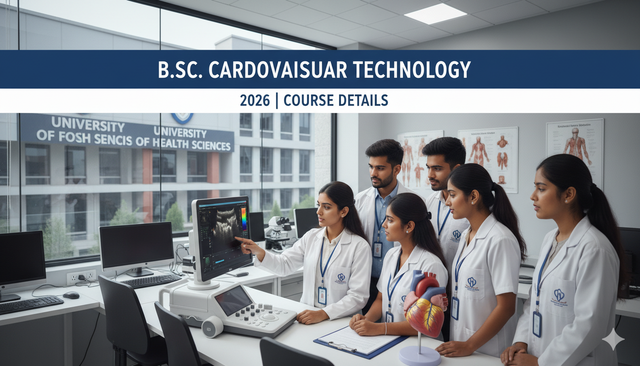
Bachelor of Science in Cardiovascular Technology (B.Sc. CCT) 2026-2030
The B.Sc. in Cardiovascular Technology (B.Sc. CCT) is a highly specialized, 4-year undergraduate program designed to train expert allied health professionals. This program focuses on equipping students with the crucial technical skills needed to operate, monitor, and maintain advanced diagnostic and life-support equipment used in modern cardiology, including Cath Labs, Echo Labs, and Critical Care Units. The curriculum integrates rigorous theoretical knowledge with mandatory year-long clinical training, ensuring graduates are procedure-ready for the evolving demands of cardiac healthcare.
1. Course Overview & Key Highlights
| Attribute | Details |
|---|---|
| Course Name | Bachelor of Science in Cardiovascular Technology (B.Sc. CCT) |
| Course Level | Undergraduate (UG) |
| Duration | 4 Years (3 Academic Years + 1 Mandatory Clinical Internship) |
| Eligibility Criteria | 10+2 Science Stream (PCB mandatory), minimum 50% aggregate score. |
| Entrance Exams | Institutional or National Level Entrance Examination followed by Interview. |
| Estimated Annual Course Fees | INR 1,50,000 – 3,00,000 (Varies by institution) |
| Admission Process | Entrance-based selection. |
| Key Subjects | Cardiac Physiology, ECG & Stress Testing, Cath Lab Technology, Echocardiography, Invasive Procedures, Cardiac Critical Care. |
| Examination Type | Semester-wise theory and practical (VIVA/OSCE) examinations. |
| Average Starting Salary | INR 3.5 LPA – 6.0 LPA (Highly dependent on clinical setting and location). |
2. Course Identity & Logistics
- Course Title: Bachelor of Science in Cardiovascular Technology (B.Sc. CCT)
- Academic Code: CCT-UG-2026
- Department: Allied Health Sciences / School of Medicine
- Total Credits/ECTS: Approximately 165 Credits
- Format: Hybrid (Lectures, Simulation Labs, Workshops, Mandatory Clinical Rotations)
- Medium of Instruction: English
3. Course Description & Rationale
Summary
The B.Sc. CCT program is a rigorous, skill-oriented degree focused on producing highly competent Cardiovascular Technologists. Students gain foundational knowledge in human anatomy and cardiac physiology before diving deep into the technical aspects of cardiology. The program places heavy emphasis on the operational mechanics of advanced equipment, from non-invasive tools like echocardiography systems to invasive tools used in cardiac catheterization and electrophysiology labs.
The final year is dedicated entirely to a mandatory, full-time clinical internship, ensuring graduates transition seamlessly from the academic environment to critical clinical roles, providing direct support to cardiologists during complex diagnostic and interventional procedures.
Industry Relevance (2025 Trends)
The demand for specialized Cardiovascular Technologists is surging globally due to the aging population, increasing prevalence of cardiovascular diseases, and rapid technological advancements in interventional cardiology (e.g., TAVR, complex CTO procedures). This course directly addresses the critical industry gap for skilled technical staff who can manage high-value equipment, maintain sterile environments, and ensure patient safety during life-saving cardiac interventions.
Target Audience
This program is ideal for highly motivated 10+2 Science (PCB) graduates who possess a strong aptitude for technology, precision, critical thinking, and who are committed to working in high-stress, patient-facing clinical environments.
4. Prerequisites & Eligibility
Academic Prerequisites
- Successful completion of the Higher Secondary Examination (10+2 or equivalent).
- Mandatory subjects: Physics, Chemistry, and Biology (PCB).
- Minimum aggregate score of 50-60% in the qualifying examination (varies by institution).
Selection Process
Candidates must qualify through a competitive Entrance Examination (institutional or state/national level) followed by a personal interview to assess communication skills and commitment to the profession.
Skill Requirements
- Manual Dexterity and Attention to Detail (crucial for Cath Lab procedures).
- Strong observational and critical thinking skills.
- Effective communication and teamwork abilities, especially in emergency situations.
5. Learning Objectives (CLOs)
Upon successful completion of the B.Sc. CCT program, students will be able to:
- Define: Key principles of cardiovascular physiology, pathophysiology, and the mechanisms of action for common cardiac drugs.
- Apply: Strict infection control protocols, sterile techniques, and radiation safety (ALARA principle) within the Cath Lab environment.
- Analyze: Interpret complex hemodynamic data, basic ECG rhythms, and standard echocardiography views to identify potential patient distress or procedural complications.
- Evaluate: The functionality and performance of advanced cardiovascular equipment (e.g., IABP, defibrillators, Cath Lab imaging systems) and troubleshoot minor technical issues independently.
- Create: Detailed clinical documentation, maintain procedural logbooks, and assist in developing standardized protocols for equipment management and patient care pathways.
6. Course Materials
Required Textbooks
- Core Physiology: Guyton and Hall Textbook of Medical Physiology (Twelfth Edition or later)
- Echocardiography: The Practice of Clinical Echocardiography (Catherine M. Otto)
- Invasive Cardiology: Cardiac Catheterization and Intervention (Morton J. Kern, et al.)
- Instrumentation: Handbook of Biomedical Instrumentation (R.S. Khandpur)
Reference Materials
- Access to institutional Learning Management System (LMS) for lecture notes and video modules.
- Subscription access to peer-reviewed cardiology journals (e.g., JACC, Circulation).
- Guidelines published by the American Heart Association (AHA) and relevant national cardiac societies.
Software & Tools
- Specialized software for hemodynamic monitoring and data acquisition (e.g., Mac-Lab or similar systems).
- High-fidelity Cath Lab and Echo simulation software/mannequins.
- Basic statistical software (e.g., SPSS, R) for research methodology modules.
7. Detailed Syllabus & Module Breakdown (4 Years)
The program is structured into three progressive phases, culminating in a mandatory year-long clinical residency.
Phase I: Foundations (Year 1)
Objective: Establish core vocabulary, principles of human science, and fundamental patient care skills.
- Module 1: Human Anatomy and Physiology (Focus on Cardiovascular, Respiratory, Renal Systems)
- Module 2: Medical Physics, Instrumentation Fundamentals, and Biomechanics
- Module 3: Basic Pharmacology, Microbiology, and Infection Control
- Module 4: Hospital Practice, Ethics, and Basic Life Support (BLS Certification)
Phase II: Application & Core Concepts (Year 2)
Objective: Practical application of theories; mastering non-invasive and introductory invasive techniques.
- Module 5: Electrocardiography (ECG) and Ambulatory Monitoring Technology
- Module 6: Non-Invasive Cardiovascular Techniques (Principles of Echocardiography, TEE, Vascular Doppler)
- Module 7: Invasive Cardiovascular Techniques (Introduction to Cath Lab Environment, Sterile Field Management, Basic Hemodynamics)
- Module 8: Advanced Cardiac Life Support (ACLS Certification) and Cardiovascular Critical Care
- Module 9: Biostatistics and Research Methodology
Phase III: Advanced & Clinical Integration (Year 3 & 4)
Objective: Advanced complexity, synthesis, interventional skills, and full-time clinical competency.
- Year 3 Modules:
- Advanced Cath Lab Technology (Complex Interventions, Device Implantation, Structural Heart Disease Support)
- Cardiac Pacing and Electrophysiology (EP) Technology
- Vascular Technology and Peripheral Interventions
- Cardio-Thoracic Surgical Assistance and Perfusion Principles (Introductory)
- Year 4: Clinical Internship / Residency
- Full-time rotation (12 months) across Cath Lab, Echo Lab, EP Lab, and Cardiac ICU.
- Mandatory procedural volume achievement and detailed logbook maintenance.
- Final Thesis/Project Submission based on clinical experience.
8. Assessment & Grading Scheme
Assessment is continuous and multi-faceted, emphasizing both theoretical understanding and verifiable practical skills.
Assessment Distribution Table (Per Semester)
| Assessment Component | Weightage | Description |
|---|---|---|
| Assignments / Quizzes / Attendance | 20% | Internal Assessment & Professionalism (Continuous Evaluation) |
| Midterm Examination | 20% | Written theory examination covering the first half of the syllabus. |
| Practical Assessment (OSCEs/Skill Tests) | 30% | Objective Structured Clinical Examinations, VIVA voce, and simulation lab proficiency tests. |
| End-of-Semester Theory Exam | 30% | Comprehensive written examination. |
| Total | 100% |
Grading Scale and Passing Criteria
A standard university grading scale (A, B, C, D, F) is used. Students must achieve a minimum passing grade (typically 50%) in both the theoretical and practical components of each subject independently to proceed to the next academic year.
9. Course Policies
- Academic Integrity: The department enforces a zero-tolerance policy regarding plagiarism, cheating, and unauthorized collaboration. Violations will result in disciplinary action up to and including expulsion.
- Attendance Requirements: Mandatory minimum attendance of 75% for theory classes and 90% for clinical rotations is required for eligibility to sit for final examinations.
- Professionalism and Ethics: Students must strictly adhere to patient confidentiality guidelines (e.g., HIPAA/GDPR standards) and maintain professional conduct, including appropriate dress code, in all clinical settings.
- Safety Compliance: Mandatory participation in radiation safety training (ALARA principle) and biohazard protocols is required before entering the Cath Lab environment.
10. Career Scope & Certification
Graduates of the B.Sc. CCT program are highly sought after due to their specialized skillset, opening doors to diverse roles across the healthcare and medical device sectors.
Primary Job Roles for B.Sc. CCT Graduates
| Job Role | Description | Estimated Average Starting Salary (INR) |
|---|---|---|
| Cath Lab Technologist (RCIS Equivalent) | Assisting cardiologists during interventional procedures (Angiography, Stenting, Device Implantation); managing imaging and hemodynamic recording systems. | 4.5 LPA – 7.0 LPA |
| Cardiac Sonographer (Echo Technologist) | Performing and analyzing non-invasive cardiac ultrasound (Echocardiography, TEE, Stress Echo). | 4.0 LPA – 6.5 LPA |
| EP Lab Technologist | Specializing in assisting during Electrophysiology studies and ablation procedures; managing complex pacing and monitoring equipment. | 5.0 LPA – 8.0 LPA |
| Cardiac Critical Care Technician | Monitoring patients in CCUs and ICUs; managing life support devices (IABP, ECMO, ventilators). | 3.5 LPA – 5.5 LPA |
| Medical Device Application Specialist | Providing technical support, training, and sales services for cardiology equipment manufacturers. | 6.0 LPA + Incentives |
Potential Certification
Upon graduation, students will be prepared to sit for international or national professional certification examinations, such as the Registered Cardiovascular Invasive Specialist (RCIS) or specialized certification for Cardiac Sonography (RCS) or Electrophysiology (RCEPS), significantly enhancing employability and salary potential.
Further Studies
Graduates are eligible to pursue postgraduate studies, including M.Sc. in Cardiovascular Technology, M.Sc. in Cardiac Perfusion Technology, or specialized management degrees in Healthcare Administration.
11. Frequently Asked Questions (FAQs)
1. What are the strict eligibility requirements for the B.Sc. CCT 2026 cohort?
Candidates must have successfully completed 10+2 (or equivalent) in the Science stream, with Physics, Chemistry, and Biology (PCB) being mandatory subjects. A minimum aggregate score of 50% is required, and selection is highly competitive, based on performance in the institutional entrance exam and subsequent interview.
2. Is the B.Sc. CCT degree focused more on theory or practical training?
While the first two years build a strong theoretical foundation, the program is intensely practical. The structure emphasizes a shift from 60% theory/simulation in the initial phase to over 80% mandatory clinical exposure during the final two years, including a full-time, year-long internship to ensure operational proficiency.
3. What is the expected career path and salary range for a fresh graduate?
Graduates typically start as Cardiovascular Technologists in Cath Labs, Echo Labs, or Cardiac ICUs. Due to the high specialization, starting salaries are competitive within the allied health sector, generally ranging from INR 3.5 LPA to 6.0 LPA, with significant growth potential upon gaining professional certification (e.g., RCIS) and experience.
4. Are clinical rotations and the mandatory internship paid?
The final year internship is a mandatory training component of the curriculum. While it is not considered a full employment salary, most institutions provide a competitive monthly stipend to cover living and training expenses during this period.
5. How does this course address radiation safety, given the Cath Lab environment?
Safety is paramount. The curriculum includes dedicated modules on Medical Physics and Radiation Safety. Students receive mandatory, recurrent training on protocols like the ALARA principle (As Low As Reasonably Achievable) and are trained in the proper use of protective equipment to minimize occupational radiation exposure.