
B.S. Medical Laboratory Science 2026 | Degree & Career Guide
Train as a certified MLS expert. Comprehensive 4-year program covering molecular diagnostics, automation, clinical chemistry, and 12-month hospital rotations.
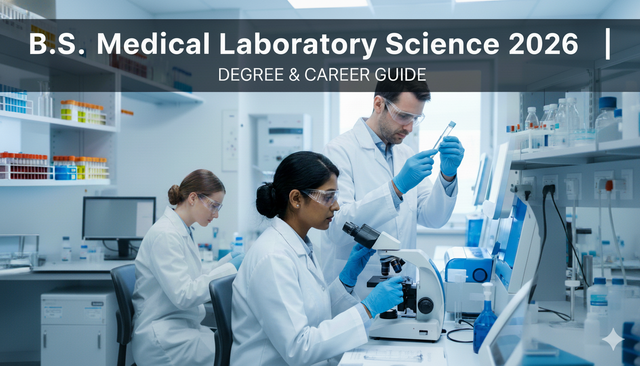
Bachelor of Science in Medical Laboratory Science (B.S. MLS) - 2026 Curriculum
The Bachelor of Science in Medical Laboratory Science (B.S. MLS) is a rigorous four-year professional degree designed to prepare students for certification as highly skilled clinical laboratory scientists. This 2026 curriculum emphasizes proficiency in complex diagnostic testing, laboratory automation, molecular diagnostics, and clinical decision support, culminating in a mandatory 12-month clinical rotation in accredited hospital settings.
1. Course Overview & Key Highlights
The B.S. MLS program is the essential pathway for individuals seeking to become the critical link between patients and diagnosis. Focusing on the five major disciplines—Chemistry, Hematology, Microbiology, Immunohematology, and Immunology—this program ensures graduates are proficient in both routine and advanced testing required for personalized medicine.
Key Highlights Table: B.S. Medical Laboratory Science
Attribute Details Course Name Bachelor of Science in Medical Laboratory Science (B.S. MLS) Course Level Undergraduate Degree Typical Duration 4 Years (8 Semesters, including 1 year of clinicals) Eligibility Criteria High School Diploma (or equivalent) with strong academic standing in Biology, Chemistry, and Mathematics. Entrance Exams None (Admission often merit-based on foundational GPA) Course Fees (Estimate) ₹10,000 to over ₹3 Lakhs per year Admission Process Merit-based entry into foundational years, competitive application for clinical/upper-division placement. Key Subjects Clinical Chemistry, Hematology & Hemostasis, Molecular Diagnostics, Immunohematology (Blood Banking), Clinical Microbiology Examination Type Semester-wise (Didactic) & Competency-based (Clinical Rotations) Average Starting Salary ₹2.5 Lakhs to ₹4 Lakhs per annum 2. Course Identity & Logistics
- Official Course Title: Bachelor of Science in Medical Laboratory Science (B.S. MLS)
- Department: Clinical Sciences / Allied Health
- Total Credit Hours: 120–130 Credit Hours
- Accreditation Standard: NAACLS (National Accrediting Agency for Clinical Laboratory Sciences) compliance.
- Format: Hybrid (Lecture/Online) and In-Person Mandatory Laboratory/Clinical Workshops.
- Faculty Oversight: Program Director (Certified MLS, PhD/MS) and specialized clinical affiliate instructors.
3. Course Description & Rationale
Summary
The B.S. MLS program is a comprehensive professional curriculum dedicated to training future laboratory professionals in the analysis, interpretation, quality control, and management of clinical testing. Students gain deep knowledge of human pathophysiology and the laboratory methods used to detect, diagnose, and monitor disease states, ensuring accurate patient results.
Curriculum Context
The curriculum is structured around rigorous scientific principles and adheres strictly to NAACLS standards, preparing graduates specifically for the ASCP Medical Laboratory Scientist certification exam. A significant portion of the final year is dedicated to mandatory, supervised clinical rotations, translating theoretical knowledge into hands-on, high-stakes clinical practice.
Industry Relevance (2026 Trends)
The 2026 curriculum is heavily weighted toward emerging technologies. Given the rise of personalized medicine, there is an increased focus on integrating Molecular Diagnostics (PCR, sequencing) and Bioinformatics into core training. Furthermore, students are trained in managing automated instrumentation and Laboratory Information Systems (LIS), skills critical for optimizing efficiency and throughput in modern hospital laboratories.
Target Audience
Prospective students who possess a strong aptitude for the sciences (Biology and Chemistry), meticulous attention to detail, and a commitment to patient safety and ethical practice. This degree also serves as excellent preparation for subsequent professional programs, including Medical School (MD/DO), Physician Assistant (PA), or graduate studies (MPH/MHA).
4. Prerequisites & Eligibility
Academic Prerequisites (for upper-division entry)
Students must successfully complete the following foundational science courses, typically with a minimum GPA of 3.0 or higher, before formally applying to the professional MLS program:
- General Chemistry I & II (with labs)
- Organic Chemistry I
- General Biology I & II (with labs)
- Human Anatomy & Physiology I & II
- College Mathematics (Calculus or Statistics preferred)
Skill Requirements
- Technical Literacy: Proficiency in scientific calculations, data analysis, and basic computer operation.
- Attention to Detail: Essential for accurate specimen handling and result reporting.
- Problem Solving: Ability to troubleshoot complex instrumentation and identify quality control failures.
Technical Requirements
Access to a reliable computer and internet connection for didactic portions, and required purchase of professional Personal Protective Equipment (PPE) for laboratory sessions.
Professional Requirements (Prior to Clinical Placement)
All students must pass a mandatory criminal background check and provide documentation of up-to-date immunization records (including Hepatitis B, MMR, Varicella, and annual flu shot).
5. Learning Objectives
By the end of this course, students will be able to:
- Define: Key pathophysiological mechanisms, clinical laboratory terminology, and regulatory standards (CLIA, HIPAA).
- Apply: Principles of quality assurance, statistical analysis, and preventative maintenance to ensure reliable test results in all core disciplines.
- Analyze: Complex patient data, including abnormal hematological smears, biochemical profiles, and microbial identification results, correlating findings with patient diagnoses.
- Evaluate: Systematically troubleshoot complex, automated instrumentation and Laboratory Information System (LIS) errors to maintain operational efficiency.
- Create: Standard Operating Procedures (SOPs) for new methodologies and develop comprehensive research capstone projects focused on laboratory improvement or advanced diagnostic techniques.
6. Course Materials
Required Textbooks
Students are required to obtain the latest editions of discipline-specific texts, including:
- Harmening, D. (Ed.). Modern Blood Banking & Transfusion Practices.
- McPherson, R. A., & Pincus, M. R. (Eds.). Henry's Clinical Diagnosis and Management by Laboratory Methods.
- Rodak, B. F., et al. Rodak's Hematology: Clinical Principles and Applications.
- Mahon, C. R., et al. Textbook of Diagnostic Microbiology.
Reference Materials
- Customized laboratory manuals and Standard Operating Procedures (SOPs) for each core discipline.
- Access to institutional online libraries for peer-reviewed journal articles (e.g., Clinical Chemistry, AJCP).
Software & Tools
- Laboratory Information System (LIS) simulation software for data management practice.
- Statistical analysis tools (e.g., R, SPSS, or specialized QC software).
- Access to molecular diagnostic databases (e.g., BLAST).
- Required Personal Protective Equipment (PPE) including lab coats, safety goggles, and specialized gloves.
7. Detailed Syllabus & Module Breakdown (4-Year Structure)
The B.S. MLS program is divided into three distinct phases, transitioning from foundational science to specialized application and culminating in mandatory clinical integration.
Phase I: Foundations (Year 1 & 2)
Objective: Establish core scientific vocabulary, principles of human physiology, and introductory laboratory safety and practice.
- Module 1: Core Sciences: General Chemistry, Organic Chemistry, Biochemistry.
- Module 2: Human Systems: Human Anatomy & Physiology, General Biology.
- Module 3: Introductory MLS: Introduction to the Clinical Laboratory, Medical Terminology, Clinical Calculations.
- Module 4: Essential Skills: Basic Phlebotomy and Specimen Processing Techniques, Laboratory Safety and Regulations (OSHA, CLIA).
Phase II: Application & Core Concepts (Year 3)
Objective: Master the theory, methodology, and quality control procedures for the five major clinical disciplines.
- Module 5: Clinical Chemistry: Instrumentation, routine analysis (glucose, electrolytes, enzymes), and Urinalysis.
- Module 6: Clinical Hematology & Hemostasis: Blood cell morphology, differential counts, coagulation studies, and automated hematology analyzers.
- Module 7: Clinical Microbiology: Detailed study of Bacteriology, Parasitology, Mycology, and susceptibility testing.
- Module 8: Immunohematology (Blood Banking): ABO/Rh typing, compatibility testing, antibody identification, and transfusion reactions.
- Module 9: Specialized Diagnostics: Clinical Immunology and Serology, Fundamentals of Molecular Diagnostics (DNA/RNA extraction, basic PCR).
Phase III: Advanced & Clinical Integration (Year 4)
Objective: Demonstrate clinical competency, leadership, and expertise in advanced topics and laboratory management.
- Module 10: Advanced Molecular Techniques: Real-time PCR, Sequencing technologies, and application in infectious disease and oncology.
- Module 11: Laboratory Management: Quality Management Systems (QMS), Operational Budgeting, Education, and Supervision principles.
- Module 12: Clinical Rotations: Mandatory 12-month rotation across all core laboratory sections in affiliated hospitals (Hospital Affiliates).
- Module 13: Capstone & Review: Comprehensive board review seminar (ASCP preparation) and final research project/case study presentation.
8. Assessment & Grading Scheme
The assessment strategy balances theoretical knowledge with demonstrable practical competency, especially during the clinical year.
Distribution Table: Assessment Weighting
| Assessment Component | Weight (%) | Phase |
|---|---|---|
| Didactic Exams (Midterm/Final) | 40% | Phase I & II |
| Quizzes, Assignments, Case Studies | 20% | Phase I & II |
| Laboratory Practical Exams (Bench Competency) | 10% | Phase I & II |
| Clinical Competency Checklists | 15% | Phase III |
| Clinical Supervisor Evaluations | 10% | Phase III |
| Capstone Research/Presentation | 5% | Phase III |
| Total | 100% |
Grading Scale
- A: 93–100% (Superior Performance)
- B: 85–92% (Above Average)
- C: 75–84% (Average Competency)
- D: 65–74% (Below Standard)
- F: Below 65% (Failure)
Passing Criteria
Students must achieve a mandatory minimum grade of C (75%) in all core MLS courses and clinical rotation modules to proceed in the program and graduate.
9. Course Policies
Academic Integrity
All work submitted must be the student’s own. Any instance of cheating, plagiarism, or unauthorized collaboration will result in disciplinary action, including potential failure of the course or dismissal from the program.
Attendance Requirements
Mandatory attendance is required for all laboratory sessions, skills workshops, and clinical rotations. Excessive unexcused absences (defined as more than two per semester for didactic courses or any unexcused absence from clinical rotations) may result in failure.
Safety and Biosafety
Strict adherence to Biosafety Level 2 (BSL-2) protocols is non-negotiable in all laboratory environments. Failure to comply with safety regulations, including improper handling of biohazardous materials or failure to wear required PPE, will result in immediate dismissal from the lab session and may lead to program dismissal.
Professionalism and Confidentiality
Students are expected to maintain the highest ethical standards, professional demeanor, and strict confidentiality (HIPAA compliance) during all clinical and academic interactions. Violations of patient privacy are grounds for immediate termination from the program.
10. Career Scope & Certification
Primary Certification Details
Upon graduation, students are eligible to sit for the national certification examination administered by the American Society for Clinical Pathology (ASCP). Successful completion grants the title of Medical Laboratory Scientist, MLS(ASCP).
Skills Acquired
Technical Skills:
- Automated Instrumentation Operation and Maintenance
- Advanced Microscopy and Cell Morphology Identification
- Molecular Technique Execution (PCR, Gel Electrophoresis)
- Complex Quality Control and Troubleshooting
- Phlebotomy and Specimen Integrity Assessment
Soft Skills:
- Critical Thinking and Clinical Correlation
- Interprofessional Communication (with physicians and nurses)
- Ethical Decision Making
- Time Management and Prioritization in High-Volume Settings
Job Roles Table
| Career Role | Description | Average Annual Salary (Estimate) |
|---|---|---|
| Generalist Medical Laboratory Scientist | Performs testing across multiple core departments (Heme, Chem, Micro) in hospital or reference labs. | ₹2.5 to ₹4 Lakhs per year |
| Molecular Technologist | Specializes in DNA/RNA testing for genetic disorders, infectious diseases, and oncology. | ₹2.5 to ₹4 Lakhs Per Annum (LPA) |
| Blood Bank Specialist (SBB) | Handles complex transfusion protocols, antibody identification, and component therapy management. | ₹2.8 Lakhs to ₹4 Lakhs annually |
| Laboratory Supervisor/Manager | Manages workflow, staff scheduling, regulatory compliance, and quality systems for a laboratory section. | ₹2.5 - ₹4 Lakhs per annum (LPA) |
Further Studies Recommendations
Graduates are well-positioned for advanced studies, including specialized certification (e.g., SBB, SM, SC), Master of Science in MLS (M.S. MLS), Master of Healthcare Administration (MHA), or applying to professional schools (Medical, Dental, or Physician Assistant).
11. Frequently Asked Questions (FAQs)
1. What are the key eligibility requirements for admission into the B.S. MLS program?
To enter the professional phase of the B.S. MLS program (typically Year 3), students must have successfully completed foundational science prerequisites, including General Chemistry, Organic Chemistry, and Anatomy & Physiology, generally maintaining a minimum GPA of 3.0 in these courses. A high school diploma with a science focus is required for initial university admission.
2. Is the B.S. MLS degree offered entirely online?
No. While some didactic (lecture) coursework may be offered through a flexible online or hybrid format, all critical laboratory skills training, bench competency assessments, and the mandatory 12-month clinical rotation require in-person, hands-on attendance at approved campus labs and hospital affiliates.
3. How competitive is the clinical placement process?
Clinical placement is highly competitive. Slots are limited and are assigned based on a combination of factors, including academic performance (GPA in core MLS courses), demonstrated professionalism, technical readiness, and successful background/health checks. Students must prepare rigorously for the clinical year.
4. What is the typical cost and financial aid outlook for this program?
Course fees vary widely, but estimates range fromStarting salaries are around ₹2.5 - ₹5 Lakhs per annum (LPA). Due to the high demand for MLS professionals, many institutions offer specific departmental scholarships or grants for students accepted into the professional phase. Federal and institutional aid options are generally available based on financial need.
5. What career prospects exist immediately after graduation and certification?
The job placement rate for certified Medical Laboratory Scientists is historically very high, often exceeding 95% employment within six months of certification. Graduates are needed in hospitals, reference laboratories, public health settings, and research facilities. The certification MLS(ASCP) is nationally recognized and provides excellent career mobility.