
Bachelor of Physiotherapy (BPT) 2026 | Admission & Career Scope
Enroll in the 4.5-year BPT 2026 program. Learn evidence-based musculoskeletal, neurological, and cardiopulmonary rehabilitation. Eligibility: 10+2 PCB.
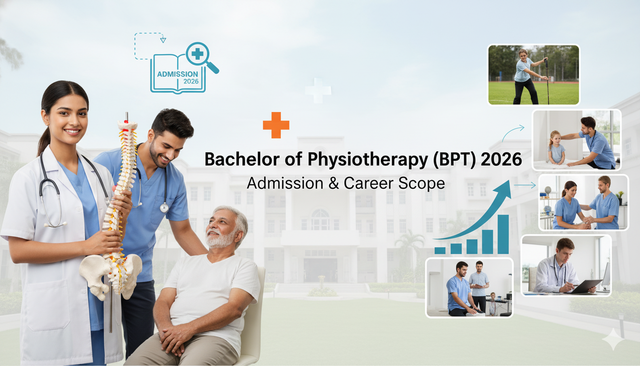
Bachelor of Physiotherapy (BPT) 2026 Cohort
Course Code: BPT-UG-2026
1. Course Overview & Key Highlights
The Bachelor of Physiotherapy (BPT) 2026 program is a comprehensive, professional undergraduate health science degree designed to prepare autonomous clinical decision-makers. Spanning 4 academic years plus a mandatory 6-month clinical internship (4.5 years total), the curriculum emphasizes Evidence-Based Practice (EBP) across core domains: musculoskeletal, neurological, and cardiopulmonary rehabilitation. Graduates are equipped with advanced skills to manage complex physical dysfunctions and meet the growing global demand for rehabilitation specialists.
| Attribute | Detail |
|---|---|
| Course Name | Bachelor of Physiotherapy (BPT) 2026 Cohort |
| Course Level | Undergraduate Degree Program |
| Duration | 4 Academic Years + 6 Months Internship (4.5 Years Total) |
| Eligibility Criteria | 10+2 (Higher Secondary) with Science Stream (PCB) |
| Entrance Exams | Mandatory qualification in a recognized national/institutional entrance test (e.g., NEET, CET, or equivalent) |
| Course Fees (Estimate) | INR 80,000 – 2,50,000 per annum (Varies by institution/affiliation) |
| Admission Process | Entrance-based, followed by counseling/interview |
| Key Subjects | Human Anatomy, Kinesiology & Biomechanics, Musculoskeletal PT, Neurological PT, Research Methodology, Electrotherapy. |
| Examination Type | Semester-wise Theory and Rigorous Practical Viva Voce (PVV) |
| Average Starting Salary | INR 3.5 LPA – 6.0 LPA (Highly dependent on sector and location) |
2. Course Identity & Logistics
- Course Title: Bachelor of Physiotherapy (BPT) 2026 Cohort
- Course Code: BPT-UG-2026
- Credit Value/ECTS: Standardized Credit System (Approx. 200 Total Credits)
- Format: Full-Time, On-Campus Lectures, Simulation Labs, Practical Workshops, and Extensive Clinical Rotations.
- Instructor/Department Info: Delivered by the Department of Physiotherapy, affiliated with [Suggested University/Regulatory Body Name].
3. Course Description & Rationale
Summary
The BPT 2026 curriculum is a professional health science program dedicated to optimizing physical function, movement potential, and overall quality of life. The program utilizes a blend of theoretical knowledge (anatomy, pathology) and clinical skills (manual therapy, therapeutic exercise, physical agents) to diagnose and manage physical impairments. A unique feature is the integration of Early Clinical Exposure (ECE) starting in Year 2, alongside high-fidelity Simulation Labs, ensuring students transition smoothly from classroom learning to clinical practice.
Curriculum Context & Industry Relevance
The curriculum is structured around Evidence-Based Practice (EBP), ensuring that interventions are informed by the latest scientific literature. Given the 2025 trends of an aging global population, increased incidence of chronic lifestyle diseases (diabetes, cardiovascular issues), and high demand for specialized sports rehabilitation, this program is critically relevant. Graduates are trained not just as therapists but as primary contact practitioners capable of independent assessment and comprehensive patient management.
Target Audience
High school graduates (10+2 Science stream) who possess a strong aptitude for biological sciences, empathy, excellent communication skills, and a dedication to hands-on patient care and physical interaction.
4. Prerequisites & Eligibility
Academic Prerequisites
- Academic Requirement: Successful completion of the 10+2 examination (Higher Secondary) or equivalent qualification.
- Compulsory Subjects: Physics, Chemistry, and Biology (PCB).
- Minimum Marks: Aggregate of 50% (or equivalent GPA) in the compulsory PCB subjects.
- Entrance Examination: Mandatory qualification in a recognized entrance examination (e.g., NEET or institutional CET).
Skill Requirements
Candidates should demonstrate strong critical thinking, effective verbal and written communication, physical stamina, and high ethical standards for clinical practice.
Technical Requirements
Access to personal computing devices and reliable internet for utilizing the institutional Learning Management System (LMS) and specialized rehabilitation databases.
Corequisites
Submission of a certified medical fitness certificate demonstrating physical capability necessary for the demands of clinical work (e.g., manual handling, long hours of standing).
5. Learning Objectives
Upon successful completion of the BPT program, students will be able to:
- Define: Master the core terminology, principles of human anatomy, physiology, kinesiology, and pathology relevant to physical therapy practice.
- Apply: Competently utilize core physiotherapy techniques, including therapeutic exercise, manual therapy, and electrotherapy, across diverse clinical populations.
- Analyze: Evaluate complex patient case scenarios, interpret diagnostic reports, and synthesize subjective and objective data to formulate accurate clinical hypotheses.
- Evaluate: Critically assess scientific literature (Research Literacy) to inform patient-centered, evidence-based assessment and intervention plans.
- Create: Design and execute comprehensive rehabilitation protocols, contribute to interprofessional healthcare plans, and conduct basic clinical research projects (Dissertation/Project).
6. Course Materials
Required Textbooks
Students will be provided with a detailed reading list, including:
- Palastanga & Field: Anatomy and Human Movement: Structure and Function
- Kendall: Muscles: Testing and Function with Posture and Pain
- Kisner & Colby: Therapeutic Exercise: Foundations and Techniques
- Goodman & Snyder: Differential Diagnosis for Physical Therapists
- O’Sullivan: Physical Rehabilitation
Reference Materials
- Access to institutional LMS and specialized medical/rehabilitation databases (e.g., Cochrane Library, PEDro).
- Peer-reviewed journals in Physiotherapy, Sports Medicine, and Rehabilitation.
- Detailed Clinical Handbook outlining competencies, policies, and placement guidelines.
Software & Tools
- Virtual Anatomy Tables (e.g., Anatomage)
- Gait analysis software and motion capture tools.
- High-fidelity patient simulation equipment for emergency and complex case management.
7. Detailed Syllabus & Module Breakdown (Representative Progression)
The 4-year BPT program is structured across three progressive phases, ensuring a smooth transition from foundational science to advanced clinical autonomy.
Phase I: Foundational Sciences (Year 1 Focus)
Objective: Establish core vocabulary and principles of human structure and movement.
- Week 1: Introduction to Physical Therapy and Professional Ethics
- Week 2: Gross and Surface Human Anatomy
- Week 3: General Physiology and Biochemistry
- Week 4: Kinesiology and Biomechanics I (Foundational Concepts)
Phase II: Application & Core Concepts (Years 2 & 3 Focus)
Objective: Practical application of theories, focusing on primary rehabilitation domains and Early Clinical Exposure (ECE).
- Week 5: Kinesiology and Biomechanics II (Applied Pathological Analysis)
- Week 6: Musculoskeletal Physiotherapy (Assessment and Management)
- Week 7: Neurological Physiotherapy (Assessment and Management)
- Week 8: Midterm Evaluation (Focus on Foundational Sciences Mastery)
- Week 9: Cardiopulmonary Physiotherapy and Electrotherapy
Phase III: Advanced Practice and Professional Transition (Year 4 + Internship Focus)
Objective: Advanced complexity, synthesis of knowledge, specialty practice, and professional preparation.
- Week 10: Pediatric, Geriatric, and Sports Physiotherapy
- Week 11: Community-Based Rehabilitation (CBR) and Ergonomics
- Week 12: Research Methodology, Biostatistics, and Dissertation Preparation
- Week 13: Advanced Clinical Rotations (Specialty Clinics)
- Week 14: Final Review and Preparation for Mandatory 6-Month Rotating Internship
8. Assessment & Grading Scheme
Student performance is evaluated through a rigorous system combining internal continuous assessment, external university examinations, and dedicated clinical performance metrics.
Distribution Table
| Assessment Component | Weightage | Description |
|---|---|---|
| Assignments/Quizzes & Lab Performance | 20% | Internal assessments, practical skill checks, and module quizzes. |
| Midterm/Internal Examinations | 20% | Mid-semester theory papers focusing on comprehensive knowledge. |
| External Theory Examination | 30% | End-of-semester written examinations. |
| Practical Viva Voce (PVV) & CPE | 30% | Rigorous practical exams and Continuous Clinical Performance Evaluation (CPE) during rotations. |
Grading Scale
A standardized letter grading scale (A, B, C, D, F) is used. Grades reflect mastery of both theoretical knowledge and practical clinical application.
Passing Criteria
Students must achieve a minimum of 50% in both the theory component (Internal + External) and the practical component (PVV + CPE) separately to pass a module and be eligible for the next academic year.
9. Course Policies
Academic Integrity
The university maintains a strict zero-tolerance policy regarding academic misconduct, including plagiarism, cheating on examinations, and unauthorized access or use of sensitive patient data during clinical rotations.
Attendance Requirements
Mandatory minimum attendance is 75% for all theory classes. Due to the clinical nature of the program, 90% attendance is strictly required for all practical labs, workshops, and clinical sessions to ensure competency development.
Late Submissions Policy
Assignments submitted after the deadline will incur penalties (e.g., 10% deduction per day). Clinical documentation (e.g., patient notes) must be completed in real-time as per institutional standards.
Accommodations for Students with Disabilities
Students requiring academic accommodations should register with the Student Services Office at the start of the semester. While academic adjustments are made, all students must meet the essential physical and technical standards required for safe and effective clinical practice.
10. Career Scope & Certification
Certification Details
Upon successful completion of the 4.5-year program (including the mandatory internship), graduates receive the Bachelor of Physiotherapy (BPT) degree. They are then eligible to apply for registration and licensure with relevant national/state regulatory councils and prepared to sit for international credentialing exams.
Skills Acquired
Technical Skills
- Musculoskeletal Assessment (e.g., joint mobilization, manipulation)
- Neurological Rehabilitation Techniques (e.g., NDT, PNF)
- Cardiopulmonary Rehabilitation and Chest Physiotherapy
- Therapeutic Exercise Prescription
- Electrotherapy Modality Application
Soft Skills
- Patient-Centered Communication and Empathy
- Interprofessional Collaboration and Teamwork
- Ethical Clinical Decision Making
- Time Management and Documentation Accuracy
Job Roles Table
| Role | Description | Avg. Salary (Initial) |
|---|---|---|
| Clinical Physiotherapist | Working in general hospitals, managing acute and chronic patient caseloads. | INR 3.5 – 5.0 LPA |
| Sports/Fitness Rehab Specialist | Focusing on injury prevention, performance enhancement, and recovery in sports clinics or teams. | INR 4.5 – 6.5 LPA |
| Geriatric Rehabilitation Specialist | Providing functional maintenance and mobility training in long-term care or home health settings. | INR 3.0 – 4.5 LPA |
| Community-Based Rehabilitation Officer | Delivering services and health education in rural or underserved community settings. | INR 3.5 – 5.5 LPA |
Further Studies Recommendations
Graduates are highly encouraged to pursue specialization through a Master of Physiotherapy (MPT) in areas such as Orthopedics, Neurology, Cardio-Respiratory Sciences, or Women's Health.
11. Frequently Asked Questions (FAQs)
What are the exact eligibility criteria for BPT 2026 admission?
The primary eligibility requires successful completion of the 10+2 (Higher Secondary) examination with Physics, Chemistry, and Biology (PCB) as compulsory subjects, maintaining an aggregate minimum score of 50% in the PCB grouping. Furthermore, qualification in a mandatory entrance examination is required.
Is the 6-month clinical internship paid, and is it compulsory?
Yes, the 6-month clinical internship is a mandatory component of the 4.5-year degree and essential for graduation and licensure. While the internship is unpaid in some institutions, many affiliated hospitals offer a basic stipend to cover essential expenses, depending on local regulatory policies.
How is the BPT course structure balanced between theory and practical work?
The BPT curriculum is heavily practical-focused. While the first year emphasizes foundational theory (Anatomy, Physiology), subsequent years integrate substantial practical labs, simulation training, and clinical rotations. The assessment scheme reflects this, with 60% of external grading dedicated to theory papers and rigorous practical viva voce exams (PVV) and continuous clinical evaluation (CPE).
What is the estimated total cost of the BPT program?
The total cost varies significantly based on whether the institution is government-aided or private. Generally, annual tuition fees range from INR 80,000 to INR 2,50,000. Prospective students should also budget for clinical uniforms, specialized textbooks, and examination fees.
What career prospects are available immediately after BPT graduation?
BPT graduates have excellent career prospects in diverse settings. Immediate roles include Clinical Physiotherapist in multispecialty hospitals, specialized centers (e.g., neurological or cardiac rehab), sports clinics, and private practice. The demand is consistently high due to the focus on non-pharmacological management of chronic conditions.