
BASLP 2026: Bachelor of Audiology & Speech-Language Pathology
Enroll in the 4-year BASLP program (2026 intake). Become a certified Audiologist or Speech-Language Pathologist. Learn diagnostics, therapy, and clinical intervention.
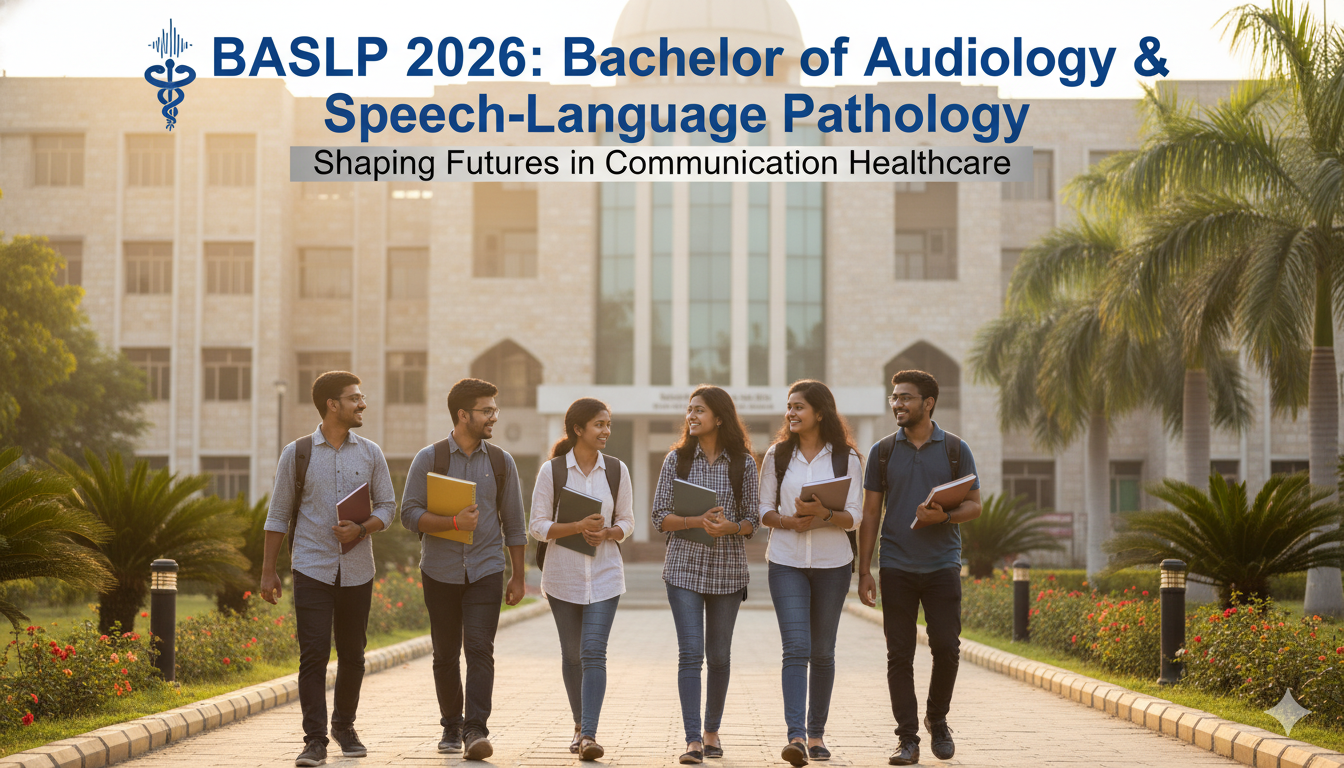
Bachelor of Audiology & Speech-Language Pathology (BASLP) 2026
The Bachelor of Audiology & Speech-Language Pathology (BASLP) is a comprehensive undergraduate professional degree designed to train specialized allied healthcare providers. This 4-year program integrates foundational sciences (Physics, Biology, Linguistics) with intensive clinical training, preparing graduates to assess, diagnose, and manage communication, hearing, balance, and swallowing disorders across all ages.
1. Course Overview & Key Highlights
The BASLP 2026 intake emphasizes clinical competency and dual specialization, ensuring graduates meet the rigorous standards required for professional licensure in both Audiology and Speech-Language Pathology (SLP).
| Attribute | Details |
|---|---|
| Official Course Name | Bachelor of Audiology & Speech-Language Pathology (BASLP) |
| Course Level | Undergraduate Professional Degree (Allied Health) |
| Duration | 4 Years (3 Academic Years + 1 Year Mandatory Clinical Internship) |
| Eligibility Criteria | 10+2 (High School) with mandatory Physics, Chemistry, and Biology (PCB) |
| Entrance Exams | Mandatory institutional or national entrance examinations (e.g., AIISH/CET) |
| Estimated Annual Fees | INR 1,00,000 – 3,50,000 (Varies significantly by institution) |
| Admission Process | Entrance-based, followed by counseling/interview |
| Key Subjects | Audiology Diagnostics, Speech Science, Neuro-Communication Disorders, Amplification Devices, Dysphagia, Research Methodology |
| Examination Type | Semester-wise theory and practical examinations (including OSCEs/OSPEs) |
| Average Starting Salary (India) | INR 3,50,000 – 6,00,000 per annum (Highly dependent on clinical setting) |
2. Course Identity & Logistics
- Official Title: Bachelor of Audiology & Speech-Language Pathology (BASLP)
- Course Code (Example): BASLP-2026
- Credit Structure: Typically 180–200 total credits (including 40+ clinical credits)
- Delivery Mode: Full-time, On-campus with mandatory clinical placements in affiliated hospitals/rehabilitation centers.
- Awarding Body: University/Affiliated Medical Faculty (Accredited by National Regulatory Body).
- Format: Integrated structure combining Lectures, Seminars, Laboratory Work, and supervised Clinical Rotations.
3. Course Description & Rationale
The BASLP program offers deep insights into the mechanisms of human communication and its disorders. Students are trained in the scientific principles necessary to understand the anatomical and physiological bases of speech, hearing, and balance, alongside the psychological and linguistic factors influencing communication.
Curriculum Context
This curriculum is highly interdisciplinary, drawing heavily from medical sciences (Neuroanatomy, Physiology), engineering sciences (Acoustics, Electronics for Hearing Aids), and behavioral sciences (Psychology, Linguistics). The rigorous clinical curriculum ensures students develop the practical skills necessary for immediate employment upon graduation.
Industry Relevance (2025 Trends)
The demand for certified Audiologists and SLPs is rapidly increasing due to global demographic shifts (aging populations), advancements in neonatal care (early identification of hearing loss), and greater public awareness of communicative disorders (e.g., autism spectrum disorders, post-stroke rehabilitation). This degree directly addresses the critical shortage of regulated professionals required to deliver evidence-based rehabilitation services.
Target Audience
High school graduates who possess a strong foundation in science (PCB), demonstrate empathy, excellent interpersonal skills, and a commitment to patient care and clinical problem-solving.
4. Prerequisites & Eligibility
Academic Prerequisites
- Successful completion of the 10+2 system (High School) or equivalent.
- Mandatory subjects: Physics, Chemistry, and Biology (PCB).
- Minimum aggregate score of 50% (or equivalent GPA) in the core science subjects.
- Successful qualification in the required entrance examination.
- Minimum age of 17 years by December 31st of the admission year.
Essential Skills (Recommended)
- Empathy and Patience: Essential for long-term therapeutic relationships with patients across the lifespan.
- Analytical Thinking: Required for accurate differential diagnosis and data interpretation (e.g., audiograms, speech analysis).
- Strong Communication Skills: Necessary for effective patient counseling and multidisciplinary team collaboration.
5. Learning Objectives
Upon successful completion of the BASLP program, students will be able to:
- Knowledge Base: Define and demonstrate a comprehensive understanding of the anatomy, physiology, and acoustics underpinning normal and disordered speech, hearing, and swallowing functions.
- Diagnostic Proficiency: Apply standardized, evidence-based diagnostic protocols to accurately identify, assess, and classify audiological and speech-language disorders in diverse populations.
- Therapeutic Intervention: Design, implement, and modify culturally sensitive and evidence-based rehabilitation and therapeutic programs for diverse communication needs.
- Professional Ethics: Evaluate clinical situations critically and adhere strictly to national professional ethical codes, regulatory standards, and patient confidentiality guidelines (e.g., HIPAA/GDPR principles).
- Research Acumen: Critically evaluate scientific literature, utilize specialized clinical software, and engage in basic clinical research methodologies to contribute to evidence-based practice.
6. Course Materials
Required Textbooks (Core Examples)
- Audiology:Introduction to Audiology by Martin & Clark.
- Speech Science:The Science of Speech by Borden & Harris.
- Neuroanatomy: Standard texts covering neuroanatomy relevant to communication and swallowing.
- Clinical Practice: National/Regulatory Body Guidelines for Clinical Practice.
Software & Tools
- Acoustic Analysis: Praat, MDVP (Multi-Dimensional Voice Program)
- Audiological Equipment: Clinical Audiometers, Impedance/Tympanometers, OAE/ABR systems.
- Digital Resources: Mandatory access and utilization of specialized academic databases (e.g., PubMed, ASHA Journals, RCI resources).
Mandatory Documentation
All students must maintain a detailed Clinical Logbook documenting minimum required clinical hours, case history management, diagnostic procedures performed, and therapeutic goals achieved, authenticated by supervising clinicians.
7. Detailed Syllabus & Module Breakdown
The BASLP curriculum is structured into three progressive phases, culminating in intensive clinical practice.
Phase I: Foundations (Year 1)
Objective: Establish core vocabulary, principles, and the biological and physical basis of communication.
- Module 1: Basic Sciences & Context
- Week 1: Introduction to BASLP, Scope, and Professional Ethics.
- Week 2: Anatomy & Physiology of the Head, Neck, and Ear.
- Week 3: Physics of Sound and Basic Acoustics.
- Week 4: Introduction to Linguistics and Phonetics.
Phase II: Application & Core Concepts (Year 2 & Early Year 3)
Objective: Practical application of theories, introduction to core diagnostic and intervention methodologies.
- Module 2: Speech-Language Pathology Diagnostics
- Week 5: Assessment and Management of Articulation and Phonological Disorders.
- Week 6: Diagnosis and Therapy for Fluency Disorders (Stuttering).
- Week 7: Voice Disorders: Assessment, Etiology, and Management.
- Week 8: Neuro-Communication Disorders (Introduction to Aphasia and Dysarthria).
- Module 3: Basic Audiology & Testing
- Week 9: Pure Tone Audiometry and Speech Audiometry.
- Week 10: Impedance Audiometry (Tympanometry and Acoustic Reflexes).
- Week 11: Introduction to Hearing Aid Technology and Selection.
Phase III: Advanced & Clinical Practice (Late Year 3 & Year 4 Internship)
Objective: Advanced complexity, specialized practice, synthesis, and professional readiness.
- Module 4: Specializations & Research
- Week 12: Pediatric Audiology: Screening and Early Intervention.
- Week 13: Advanced Hearing Aid Fitting and Cochlear Implants.
- Week 14: Swallowing Disorders (Dysphagia) Diagnosis and Management.
- Week 15: Research Methodology and Biostatistics.
- Year 4: Mandatory Clinical Internship/Rotations (12 Months)
- Rotation through ENT/Audiology Departments.
- Rotation through Pediatric and Adult SLP Clinics.
- Mandatory Case Study Submission and Clinical Skill Demonstration.
8. Assessment & Grading Scheme
Student performance is evaluated through a rigorous system combining theoretical knowledge, practical skills, and clinical competence.
Assessment Distribution Table
| Component | Weightage | Description |
|---|---|---|
| Theory Examinations | 50% | Mid-term and End-of-Semester written papers covering core subjects. |
| Practical/Clinical Examinations | 40% | Objective Structured Clinical Examinations (OSCEs), Practical skill demonstrations, and Case Study presentations. |
| Internal Assessment | 10% | Attendance, class participation, assignments, and professional conduct evaluation. |
Passing Criteria
Students must achieve a minimum passing grade (typically 50%) in both the theoretical and practical components of each subject independently. Failure in the clinical component requires mandatory re-posting and re-evaluation.
9. Course Policies
Academic Integrity
The institution maintains a zero-tolerance policy regarding academic dishonesty, including plagiarism, unauthorized collaboration, and cheating. All submissions must adhere to recognized citation standards.
Attendance Requirements
Mandatory minimum attendance of 75% is required for all theoretical classes and 80% for all scheduled clinical postings. Failure to meet these requirements may result in debarment from appearing in the semester examinations.
Clinical Standards and Confidentiality
Students must adhere to strict professional dress codes during clinical hours. Compliance with patient confidentiality laws (e.g., HIPAA standards or local equivalents) is non-negotiable. Breach of confidentiality will lead to immediate disciplinary action.
Internship Requirement
The degree will only be conferred upon the successful completion of the mandatory, supervised 12-month clinical internship, including the required minimum clinical hours and case logbook submissions.
10. Career Scope & Certification
The BASLP degree provides immediate pathways to critical healthcare roles and advanced academic pursuits.
Certification & Licensure
Graduates are eligible to apply for professional registration and licensure with national regulatory bodies (e.g., the Rehabilitation Council of India (RCI), or equivalent state/national licensing boards in other jurisdictions like ASHA in the US context) to practice legally as a certified clinician.
Skills Acquired
- Technical Skills: Proficient use of diagnostic audiological equipment, speech analysis software, and hearing aid fitting tools.
- Soft Skills: Patient counseling, multidisciplinary team collaboration, critical thinking, and advanced clinical report writing.
Job Roles and Employment Settings
| Job Role | Primary Description | Typical Employment Settings |
|---|---|---|
| Audiologist | Assessment and rehabilitation of hearing, balance, and tinnitus disorders, including hearing aid fitting and aural rehabilitation. | Hospitals (ENT Dept.), Private Audiology Clinics, Hearing Aid Manufacturers. |
| Speech-Language Pathologist (SLP) | Diagnosis and treatment of communication (speech, language, voice, fluency) and swallowing disorders (dysphagia). | Rehabilitation Centers, Pediatric Clinics, Schools, Geriatric Care Facilities. |
| Clinical Researcher | Conducting studies related to communication science, hearing technology, and therapeutic efficacy. | Universities, Specialized Research Institutes. |
| Consultant/Sales Specialist | Technical support and consultation for amplification devices and assistive listening technologies. | Medical Device and Hearing Aid Industry. |
Further Studies Recommendations
Graduates are fully eligible to pursue specialized Master’s programs, such as the Master of Audiology and Speech-Language Pathology (MASLP), MS in Audiology, or MS in Speech-Language Pathology, for advanced clinical specialization or academic careers.
11. Frequently Asked Questions (FAQs)
Is the BASLP considered a medical degree?
No, the BASLP is classified as an Allied Health Professional degree. While it involves extensive clinical training and requires collaboration with medical doctors (like ENT specialists and Neurologists), graduates are certified clinicians specializing in communicative and sensory rehabilitation, not medical practitioners.
What are the mandatory eligibility requirements for admission?
The primary mandatory requirement is successful completion of 10+2 (High School) with Physics, Chemistry, and Biology (PCB) as core subjects, along with achieving the minimum aggregate score (typically 50-60%) set by the admitting institution. Entrance exam qualification is also essential.
How is the 4-year course structured?
The program is divided into three academic years focusing on foundational theory and core diagnostics, followed by one full year (12 months) of mandatory, supervised clinical internship/rotations. The internship is crucial for degree conferral and professional registration.
Are clinical rotations or internships paid?
In most institutions, the mandatory 12-month clinical internship is classified as a training period and is either unpaid or involves the provision of a small, nominal stipend. Students should budget for living expenses during this period.
What are the long-term career prospects after BASLP?
The career prospects are excellent due to the high demand for certified professionals. Graduates can work in diverse settings—from tertiary care hospitals and private clinics to schools and NGOs. Upon obtaining licensure, career growth is robust, often leading to specialization and private practice ownership.