
CLAT 2026 Ultimate Guide: Dates, Eligibility, Pattern, and 18-Month Preparation Strategy
Are you currently in 11th or 12th grade with a dream of stepping into the hallowed halls of a National Law University (NLU)? If so, the Common Law Admission Test (CLAT) 2026 is your gateway. Since CLAT is a highly competitive, comprehension-based exam, simply knowing the dates isn’t enough—you need a detailed, long-term blueprint.
This comprehensive guide breaks down everything you need to know about CLAT 2026, from crucial tentative dates and eligibility rules to a strategic 18-month preparation plan designed to turn your NLU dream into reality.
Table of Contents
Understanding the CLAT 2026 Landscape
What is CLAT and Why Does It Matter?
The CLAT is a centralized national-level entrance examination for admission to undergraduate (UG) and postgraduate (PG) law programs in 24 participating National Law Universities (NLUs) across India. It is the single most important test for students seeking a prestigious, government-backed law degree.
Unlike traditional board exams, CLAT tests your comprehension, critical thinking, speed, and analytical abilities—not just rote memorization.
Who Conducts the Exam? (The Consortium of NLUs)
The CLAT examination is organized by the Consortium of National Law Universities. This body rotates the organization responsibilities annually among the NLUs, ensuring fairness and consistency in the examination process.
Tentative Timeline: Key CLAT 2026 Dates (Based on 2025 Trends)
CLAT is usually held on the first Sunday of December. While the official notification for 2026 will arrive in mid-2025, having a tentative schedule is crucial for planning.
| Event | Expected Month/Year | Key Action for Aspirants |
|---|---|---|
| Official Notification Release | July/August 2025 | Check detailed eligibility updates. |
| Registration Window Opens | August 2025 | Start gathering essential documents. |
| Application Deadline | November 2025 | Submit application early to avoid last-minute rush. |
| Admit Card Release | Late November 2025 | Verify exam center details. |
| CLAT 2026 Exam Date | First Sunday of December 2025 | D-Day! Apply all strategies learned. |
| Results Declaration & Rank List | Mid-December 2025 | Prepare for counselling based on rank. |
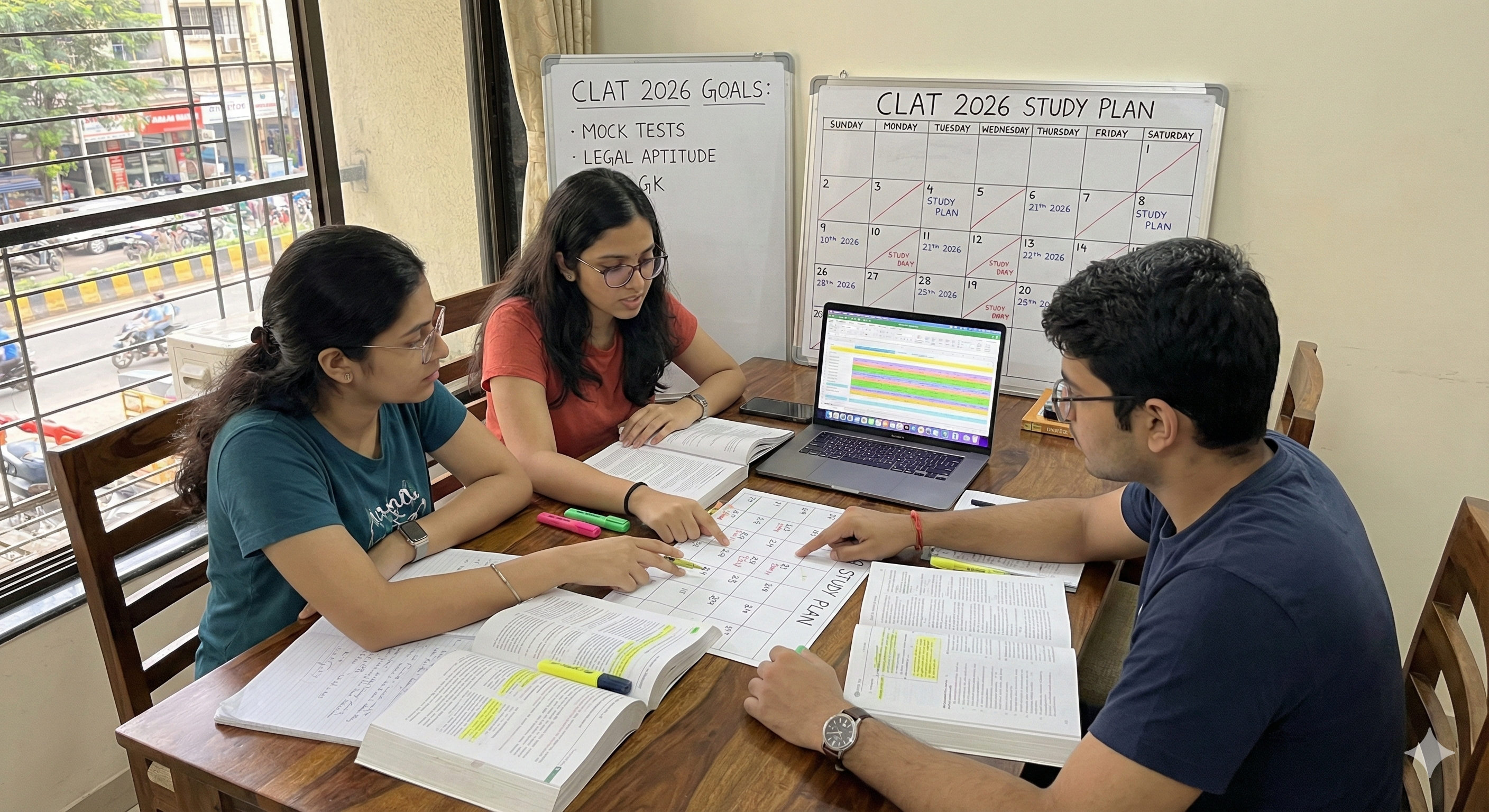
Eligibility Criteria and Application Process
Academic Requirements (Minimum Percentage & Board Requirements)
To be eligible for CLAT 2026 (UG), you must meet the following criteria:
Age Limit (Clarifying the current 'no age limit' rule)
This is great news for all aspirants! Following court rulings, the Consortium of NLUs has removed the upper age limit for the CLAT examination. As of now, there is no age restriction to appear for CLAT 2026.
Step-by-Step Guide to the CLAT 2026 Application Form
The application process is entirely online:
Essential Documents Required for Registration
Keep these handy to ensure a smooth registration process:
Decoding the CLAT 2026 Exam Pattern
The CLAT pattern focuses heavily on critical reasoning and reading speed. It is a 2-hour, offline, pencil-and-paper test.
Exam Format (Duration, Mode, Total Questions)
The Marking Scheme (Positive and Negative Marking)
Accuracy is vital due to negative marking:
Sectional Weightage and Recommended Time Allocation
Your strategy must be built around allocating time efficiently. Here is the estimated breakdown:
| Section Name | Questions (Approx.) | Total Marks | Recommended Time (in minutes) |
|---|---|---|---|
| English Language | 28–32 | 28–32 | 25 min |
| Current Affairs Including General Knowledge | 35–39 | 35–39 | 30 min |
| Legal Reasoning | 35–39 | 35–39 | 35 min |
| Logical Reasoning | 28–32 | 28–32 | 25 min |
| Quantitative Techniques | 13–17 | 13–17 | 5–10 min |
| Total | 150 Questions | 150 Marks | 120 Minutes (2 Hours) |
Comprehensive Syllabus Breakdown for CLAT 2026
English Language
This section is passage-based. You will be tested on your ability to read and understand main ideas, draw inferences, summarize text, and spot errors in grammar and vocabulary within the context of the passage.
Current Affairs Including General Knowledge
This is arguably the most crucial section for a long-term strategy. The passages will be derived from news, journalistic sources, or non-fiction works. The questions test contemporary events in India and the world, including historical events related to current affairs, art, culture, and international relations. Strategy: Start reading at least two national newspapers (e.g., The Hindu/The Indian Express) daily from day one.
Legal Reasoning
Expect passages based on facts, hypothetical situations, or moral/philosophical legal issues. You do not need prior legal knowledge. The key is to read the principle provided in the passage and apply it correctly to the given facts, identifying arguments and counter-arguments.
Logical Reasoning
This is divided into Critical Reasoning (analyzing arguments, identifying premises, spotting flaws) and Analytical Reasoning (puzzles, sequences, relations). Critical Reasoning is heavily weighted in CLAT and relies entirely on reading comprehension skills.
Quantitative Techniques (Data Interpretation Focus)
This section tests your ability to interpret numerical information presented in graphs, charts, or text passages. The math required is generally up to the 10th-grade level (ratios, proportions, averages, time & work). Focus on speed and accuracy in interpreting data sets.
Strategic 18-Month Preparation Plan for CLAT 2026 Aspirants
Eighteen months is the perfect runway to build confidence, speed, and accuracy. Divide your preparation into three structured phases:
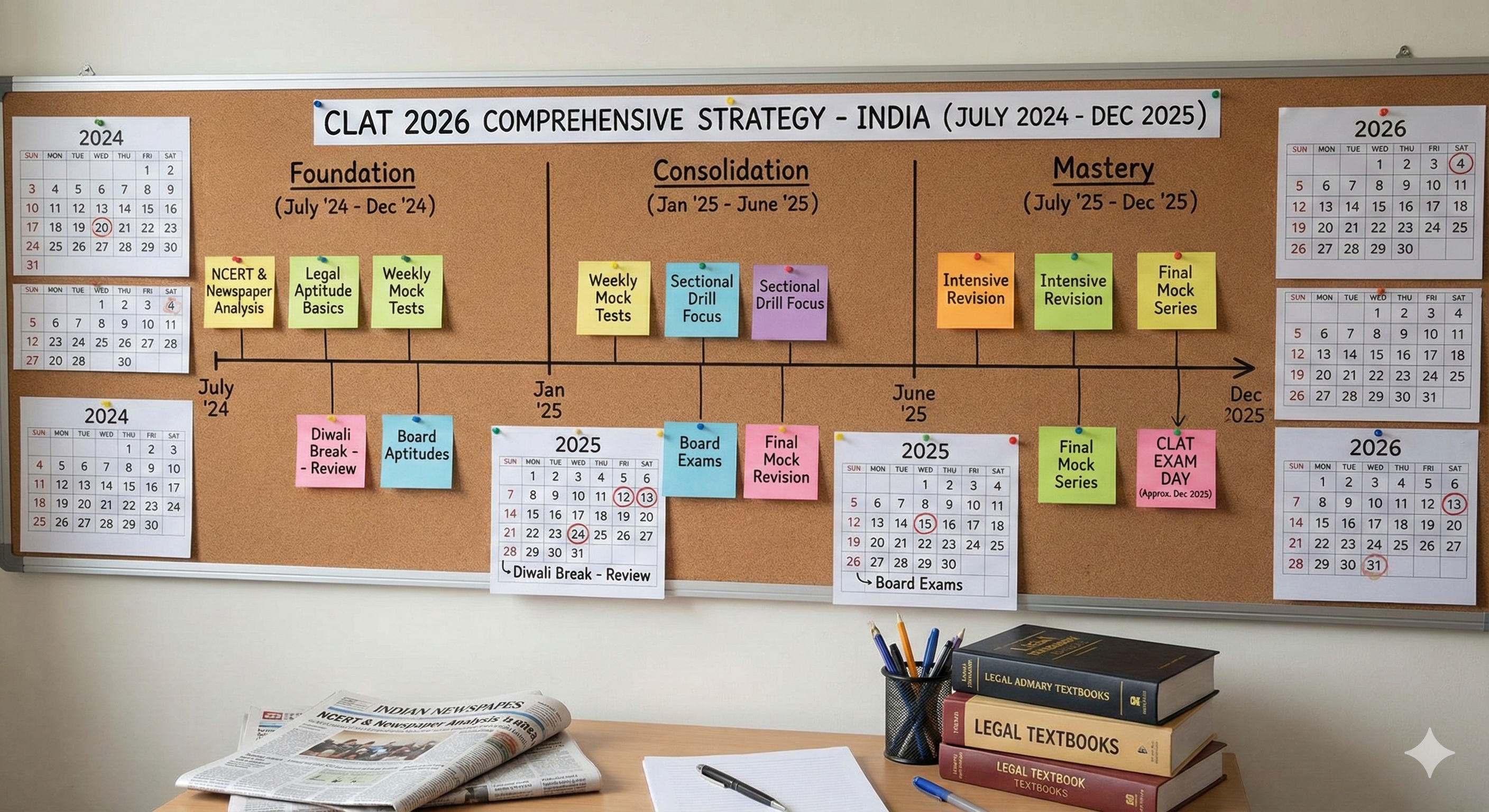
Phase 1: Foundation Building (Months 1-6)
This phase is about developing the habits necessary for success, especially reading and speed.
Phase 2: Core Concept Mastery (Months 7-12)
Deep dive into subject-specific skills and heavy practice.
Phase 3: Mock Tests and Analysis (Months 13-18)
This is the final stretch, where performance optimization takes center stage.
Recommended Study Resources
Post-Exam: Counselling and Top NLUs
Understanding the CLAT Counselling Process
Once results are declared, the Consortium manages a centralized counselling process. Seats are allocated based on your CLAT rank and the NLU preferences you listed in your application form. You will be required to pay a counselling fee and complete document verification.
Required Cut-Offs for Tier 1 NLUs (Historical Data Snapshot)
Your goal should be a rank within the top 1000 to secure a seat in a Tier 1 NLU.
| NLU Name | Estimated Seats (UG Program) | Expected CLAT Rank for Admission (General) |
|---|---|---|
| National Law School of India University (NLSIU), Bangalore | 180 | 1–120 |
| NALSAR University of Law, Hyderabad | 130 | 121–250 |
| The West Bengal National University of Juridical Sciences (WBNUJS), Kolkata | 132 | 251–450 |
| National Law Institute University (NLIU), Bhopal | 120 | 451–650 |
| Gujarat National Law University (GNLU), Gandhinagar | 172 | 651–1000 |
List of Participating National Law Universities (NLUs)
In total, 24 NLUs participate in CLAT. Additionally, several private colleges and universities also accept CLAT scores, significantly expanding your options.
Key Takeaways for CLAT 2026 Success
Frequently Asked Questions (FAQs)
Is 18 months enough time to prepare for CLAT?
Yes, 18 months is an excellent timeframe. It allows you to build a strong foundation, integrate preparation with your board exams, master mock test analysis, and ensure thorough coverage of 1.5 years of current affairs without excessive pressure.
How many attempts are allowed for CLAT?
There is currently no official limit on the number of attempts for CLAT. Any eligible candidate can attempt the examination.
What is the ideal score for a Top 5 NLU?
While the required score fluctuates based on the difficulty of the paper, an ideal raw score usually falls between 95 and 105 out of 150 to secure a rank within the top 500 (guaranteeing a seat in one of the top 5 NLUs).