
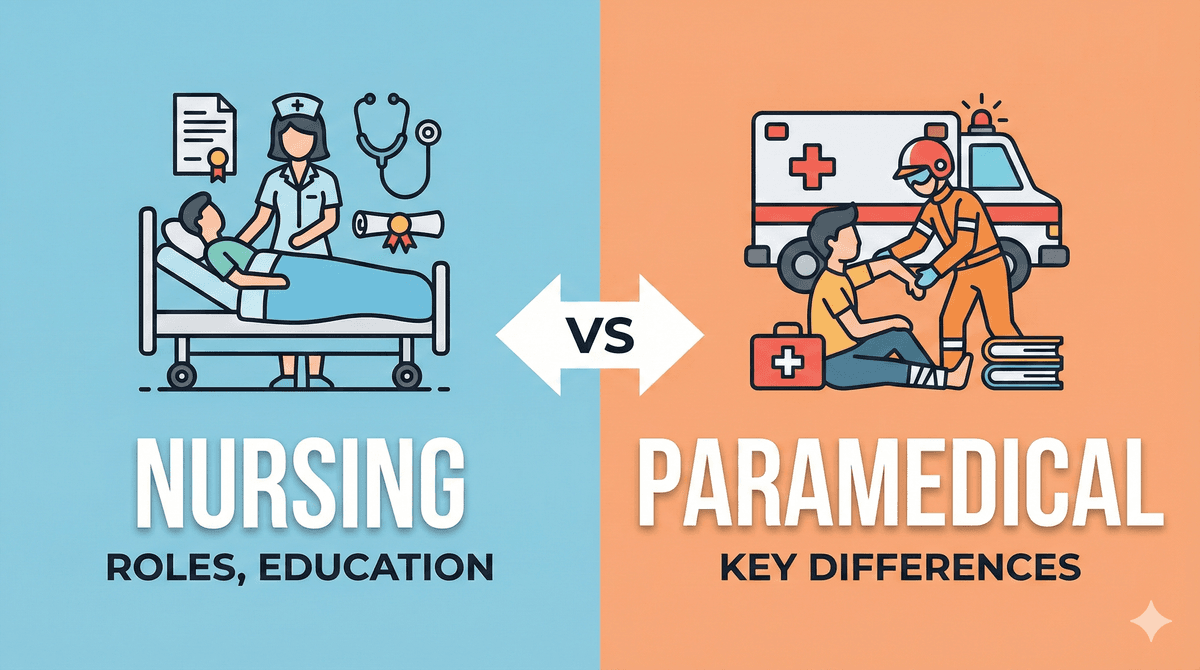
Nursing vs Paramedical: Roles, Education & Key Differences
Learn the difference between nursing and paramedical roles. Nurses provide holistic patient care, while paramedical staff are technical specialists focused on diagnostic or emergency services.
Fact-Check: Paramedical vs Nursing - Clarifying the Roles in Healthcare
The healthcare system relies on a vast team of professionals, and two common but distinct career paths are nursing and paramedical professions. While both are crucial for patient care, their training, day-to-day duties, and primary focus areas differ significantly. This fact-check breaks down the core distinctions between these vital roles.

What is the Difference Between Paramedical and Nursing Roles?
In the simplest terms, nurses are typically the primary caregivers focused on holistic patient care, while paramedical professionals are technical specialists who perform diagnostic, therapeutic, or emergency services.
The Role of a Nurse
A nurse’s role centers on continuous patient management and direct care. They administer medication, monitor vital signs, educate patients and families, and assist doctors in treatment plans. Nurses work predominantly within established healthcare facilities like hospitals, clinics, and long-term care homes. They ensure patients receive constant attention and emotional support throughout their recovery journey.
The Role of Paramedical Professionals
The term "paramedical" covers a broad range of specialized roles. These professionals are trained to provide specific technical or diagnostic services that support the work of doctors and nurses. Examples include:
These specialists are essential for diagnosis and focused treatment, essentially keeping the complex medical system running.

Education and Scope of Practice Comparison
The educational pathways and the legal scope of practice for each profession reflect their distinct responsibilities.
Nursing education typically involves two to four years to earn an Associate Degree in Nursing (ADN) or a Bachelor of Science in Nursing (BSN), leading to Registered Nurse (RN) licensure. The scope of practice for a nurse covers a wide range of services that a qualified professional is deemed competent and permitted to perform, focusing heavily on patient advocacy and ongoing care management.
Paramedical education can vary significantly by specialization. For a Paramedic, training can be approximately two years, combining Emergency Medical Technician (EMT) certification and Paramedic training. Other specialties, like Physiotherapy, require a dedicated bachelor's degree. Their scope is narrower, focusing on the technical or emergency procedure they are specialized in.

Comparative Data Table
Here is a concise comparison of key features:
| Feature | Nursing (Registered Nurse) | Paramedical Professionals (General) |
|---|---|---|
| Primary Focus | Holistic, continuous patient care and management. | Specific technical, diagnostic, or emergency services. |
| Typical Work Setting | Hospitals, clinics, long-term care facilities. | Hospitals (Labs, Radiology), Ambulances (Paramedics), Clinics, Field Response. |
| Education Timeline | 2 to 4 years (ADN/BSN). | Varies widely, from 2-year certifications (Paramedic) to 4-year degrees (Physiotherapy). |
| Example Roles | Staff Nurse, ICU Nurse, Midwife. | Paramedic/EMT, Lab Technologist, Radiographer, Dialysis Technician. |
| General Compensation | Often structured monthly salaries with growth potential (e.g., ₹25k–₹40k/month starting in some markets). | Varies highly by specialization; entry-level can be competitive (e.g., ₹2.5–4 LPA in some markets). |
Key Takeaways
Understanding the distinction is vital for anyone considering a healthcare career:
Both professions are equally valuable and indispensable to the functioning of modern medicine. The choice between them depends entirely on an individual’s interest in either continuous patient management (nursing) or technical specialization (paramedical).
Disclaimer: Salary figures and educational timelines can vary significantly based on country, region, institution, and specialization.
Comments
Leave a Comment
No comments yet. Be the first to comment!