
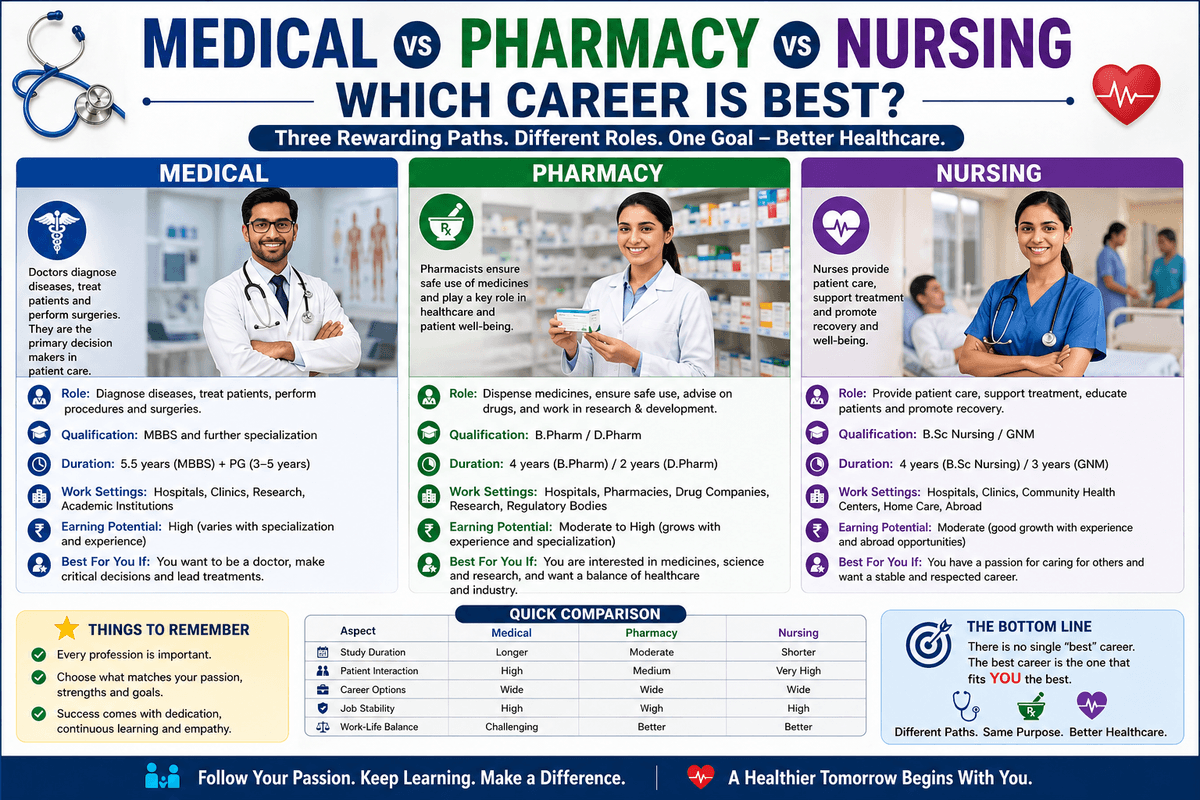
Medical vs Pharmacy vs Nursing
Medical (MBBS) offers the highest long‑term salary and prestige but needs NEET, a high score, long study time (5.5+ years), and can be very expensive in private colleges.
Medical vs Pharmacy vs Nursing: Which Career Is Best After 12th in 2026?
Medical vs Pharmacy vs Nursing: Which Career Is Best After 12th in 2026?
Confused between MBBS (Medical), Pharmacy (D.Pharm / B.Pharm), and Nursing (B.Sc Nursing / GNM / ANM) after 12th PCB? This 2026 comparison guide will help you choose the best career based on NEET eligibility, fees, duration, salary, difficulty, and future scope in India. It also includes practical backup options for students who do not want NEET or could not clear NEET.
Quick Answer (2026)
- Medical (MBBS) – Best for high long‑term salary and socio‑professional status, but needs NEET, high score, and 5.5+ years of study.
- Pharmacy (D.Pharm / B.Pharm) – Best for quick entry into the job market, business opportunities, and strong options without NEET.
- Nursing (B.Sc Nursing / GNM) – Best for job security, government‑sector roles, and strong abroad opportunities (UK, Canada, Gulf, etc.).
If you do not want NEET or could not clear NEET in 2026, Pharmacy and Nursing are the strongest healthcare‑aligned options.
What’s Inside This Guide?
- What is Medical vs Pharmacy vs Nursing?
- NEET requirement and eligibility (2026)
- Course duration & difficulty level
- Approximate fees (India 2026)
- Starting salary & career scope
- Which career suits YOU best?
- Frequently asked questions (FAQs)
What is Medical vs Pharmacy vs Nursing?
The three fields are all part of healthcare but focus on different roles:
- Medical (MBBS) – Focuses on disease diagnosis, treatment planning and surgery. After MBBS you can become a doctor, then specialise in fields like internal medicine, surgery, paediatrics, etc.
- Pharmacy (D.Pharm / B.Pharm) – Focuses on medicines, drug formulation, analysis and dispensing. You can work as a pharmacist, hospital / community pharmacy officer, or run your own medical store.
- Nursing (B.Sc Nursing / GNM / ANM) – Focuses on patient care, bedside monitoring, treatment assistance, and hospital support. Nurses are essential in hospitals, ICUs, community health centres and abroad.
Medical vs Pharmacy vs Nursing: Eligibility (2026)
| Course | Minimum Qualification | Typical Marks | Entrance Exam | Notes |
|---|---|---|---|---|
| Medical (MBBS) | 12th PCB (Physics, Chemistry, Biology) | 50% (UR), 40% (SC/ST/OBC) in PCB as per NEET norms | NEET required | Only NEET‑qualified students can apply for MBBS in India. |
| Pharmacy (D.Pharm / B.Pharm) | 12th PCB or PCM (Biology/Chemistry/Maths) | 45–50% in 10+2 (varies by state/university) | Usually no NEET (some states may take CET / state‑pharma entrance) | D.Pharm is 2 years, B.Pharm is 4 years; both are popular NEET alternatives. |
| Nursing (B.Sc Nursing / GNM) | 12th PCB (Biology essential) | 45–50% in PCB (rules vary by state and college) | Some institutes use NEET or state CET; many admit directly on marks / entrance | Nursing gives strong job security and global opportunities. |
NEET is compulsory only for MBBS (and other medical degrees like BDS, AYUSH‑MBBS). Pharmacy and Nursing admission can often be done without NEET, especially if you choose D.Pharm or B.Pharm or apply through state‑level / college‑level entrances.
Course Duration & Difficulty Level (India 2026)
| Course | Duration | Difficulty Level |
|---|---|---|
| MBBS | 5.5 years (including 1‑year internship) | Very high – intense syllabus, long‑term competition, and high pressure. |
| B.Pharm | 4 years (8 semesters) | Medium – mix of theory, practicals and projects; more technical than non‑science streams. |
| D.Pharm | 2 years (Part I + Part II + practical training) | Easy–Medium – practical‑oriented, shorter, and good for quick entry into the job market. |
| B.Sc Nursing | 4 years (including clinical training) | Medium – practical‑heavy, shift‑based, and emotionally demanding but manageable. |
| GNM (General Nursing & Midwifery) | 3.5 years | Medium – clinical‑focused; popular for those who want faster entry into nursing. |
MBBS is the longest and toughest option. Pharmacy (D.Pharm/B.Pharm) is more balanced and technical, while Nursing is practical and emotionally intense but very stable.
Fees Comparison (India 2026)
| Course | Government / Low‑Fee Range | Private / High‑Fee Range |
|---|---|---|
| MBBS | ₹50,000 – ₹1,50,000 per year (government colleges) | ₹5,00,000 – ₹20,00,000+ per year (private medical colleges) |
| Pharmacy (D.Pharm / B.Pharm) | ₹30,000 – ₹70,000 per year (government / aided colleges) | ₹60,000 – ₹1,50,000 per year (private pharmacy colleges) |
| Nursing (B.Sc Nursing / GNM) | ₹20,000 – ₹60,000 per year (government institutions) | ₹50,000 – ₹1,00,000 per year (private nursing colleges) |
Pharmacy (D.Pharm) and Nursing (GNM / B.Sc Nursing) are generally much cheaper than private MBBS. For budget‑conscious students in 2026, these are the best value‑for‑money healthcare‑aligned options.
Starting Salary & Career Scope (India 2026)
| Field | Typical Starting Salary (Freshers) | Long‑Term Growth |
|---|---|---|
| Medical (MBBS) | During internship: ₹10,000 – ₹30,000/month; after internship / PG: ₹40,000 – ₹1,00,000+ per month in many cities. | Very high – specialists and consultants can earn several lakhs per month in private practice or corporate hospitals. |
| Pharmacy (D.Pharm / B.Pharm) | ₹15,000 – ₹30,000 per month in clinics, hospitals, retail chains and pharma companies; higher in corporate or clinical‑research roles. | High – can grow into pharmacy‑manager, regulatory‑affairs, quality‑assurance, or start your own medical store / pharmacy‑chain. |
| Nursing (B.Sc Nursing / GNM) | ₹20,000 – ₹40,000 per month in private hospitals; government nursing posts can start around ₹45,000+ with allowances. | High – scope in ICU, OT, critical care, management, and strong international opportunities (UK, Canada, Gulf, Australia). |
Recent 2026 data shows that government nursing officers in central hospitals (AIIMS, ESIC, etc.) can earn ₹60,000–₹80,000+ per month with allowances, while pharmacists in government roles earn around ₹40,000–₹55,000+ with allowances. Abroad, nursing packages are often higher than pharmacy for entry‑level roles.
Career Opportunities After Each Course
After Medical (MBBS)
- MBBS Doctor in hospitals, clinics, or private practice
- Specialist (MD/MS/DNB) in surgery, internal medicine, paediatrics, etc.
- Government Medical Officer (CMO, PHC, district hospital roles)
- Roles in corporate‑health chains, insurance, and digital health startups
After Pharmacy (D.Pharm / B.Pharm)
- Community / hospital pharmacist
- Medical‑store owner or pharmacy‑chain manager
- Roles in pharmaceutical companies (production, quality control, quality assurance, regulatory affairs, clinical research, sales & marketing)
- Further studies: B.Pharm, M.Pharm, Pharm.D, or MBA in Pharmaceutical Management
After Nursing (B.Sc Nursing / GNM)
- Staff Nurse in hospitals, clinics, and NGOs
- ICU, OT, cardiology, and other speciality‑nursing roles
- Government‑hospital nursing officer and community‑health‑nurse roles
- Abroad nursing jobs (with registration in UK, Canada, Gulf, Australia, etc.)
- Post‑graduation: M.Sc Nursing, nursing management, or nursing education
Which Career Is Best for YOU? (2026)
Choose Medical (MBBS) if:
- You have a strong NEET score and real interest in being a doctor.
- You are ready for 5.5+ years of intense study and competition.
- You want high long‑term earning potential and social status.
Choose Pharmacy if:
- You want a quick career start (especially with D.Pharm – 2 years).
- You are interested in medicines, formulations, and drug‑business ideas (medical store, pharmacy startup).
- You did not crack NEET or do not want to take NEET.
- You enjoy a mix of science theory, practicals, and problem‑solving.
Choose Nursing if:
- You enjoy patient care, emotional support and hands‑on hospital work.
- You want job security and strong government‑sector opportunities.
- You are open to working in shifts and have a strong interest in critical care.
- You want to explore international jobs (UK, Canada, Gulf, etc.).
Final Verdict (India – 2026)
- Best for money & prestige: Medical (MBBS) – highest long‑term income and social status.
- Best for fast career + business options: Pharmacy (D.Pharm / B.Pharm) – quick entry into jobs or entrepreneurship.
- Best for job security & abroad scope: Nursing (B.Sc Nursing / GNM) – stable roles, strong government and global opportunities.
There is no single “best” career after 12th. The right choice depends on your NEET performance, budget, personality, and long‑term goals.
Frequently Asked Questions (FAQs)
What is better: Medical, Pharmacy or Nursing?
Medical (MBBS) is best for high long‑term salary and social status. Pharmacy (D.Pharm / B.Pharm) is best for quick entry into healthcare and business opportunities. Nursing (B.Sc Nursing / GNM) is ideal for job stability, government‑sector jobs, and strong abroad scope.
Can I do Pharmacy or Nursing without NEET?
Yes. Many states and colleges allow you to join D.Pharm, B.Pharm, GNM or B.Sc Nursing without NEET, using state‑level / college‑level entrance or merit‑based admission. NEET is only compulsory for MBBS and some medical‑related degrees.
<
Comments
Leave a Comment
No comments yet. Be the first to comment!