
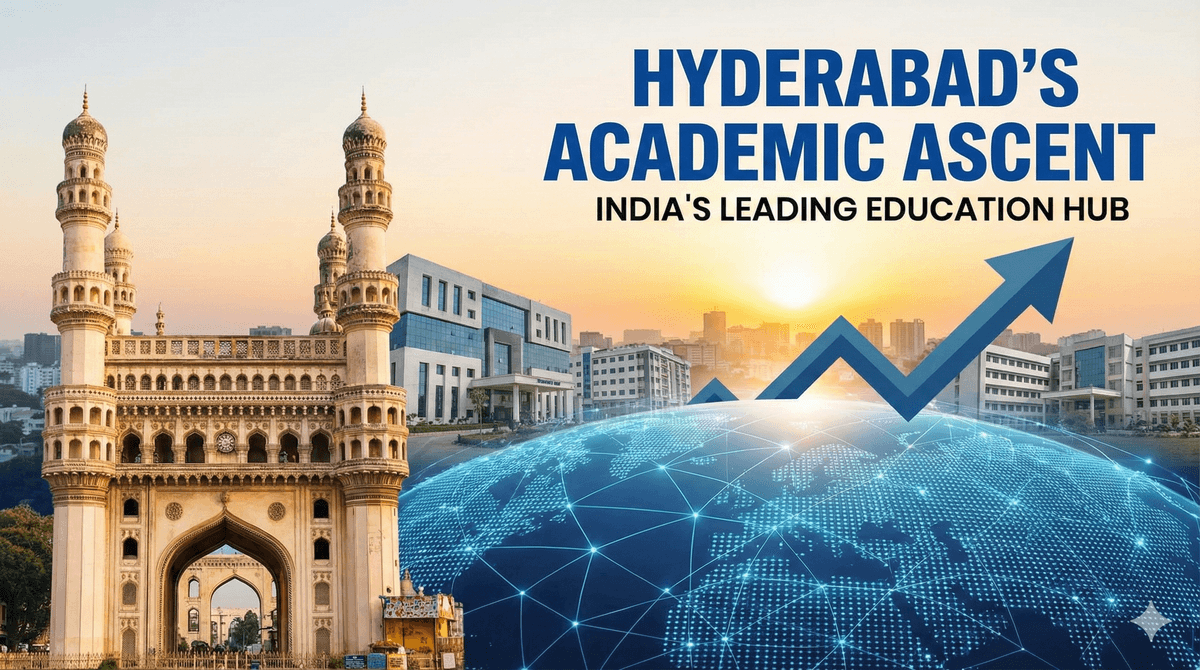
Hyderabad's Academic Ascent: India's Leading Education Hub
Learn how Hyderabad became a leading education hub post-2010. Proactive policy, institutions like IIT-H/ISB, and deep links to IT/Pharma clusters (Genome Valley) drive academic excellence.
Why Hyderabad Is Emerging as a Leading Education Hub in IndiaFact Check: Why Hyderabad Is Emerging as a Leading Education Hub in India

I. Introduction: Defining Hyderabad's Academic Ascent
A. The Thesis: Hyderabad's transformation from a regional hub to a national educational powerhouse.
For decades, India's premier academic and technological hubs were often synonymous with Bangalore, Mumbai, or Delhi. However, post-2010, Hyderabad has undergone a rapid, policy-driven transformation, cementing its status not just as an IT and Pharma capital, but as a leading destination for higher education in India. This ascent is characterized by the convergence of proactive governance, massive industrial demand, and institutional density.
B. Historical context vs. contemporary emergence (Focusing on the post-2010 boom).
While some key institutions were founded earlier, the real acceleration in institutional quality, research output, and student intake began with focused policy interventions and the establishment of new national institutes in the 21st century. The establishment of institutions like IIT Hyderabad (IITH) and the subsequent clustering of other national bodies have defined the city’s contemporary educational emergence.
II. Foundational Pillars: Policy and Governance Support
A. Proactive State Policy: The role of the Telangana government in land allocation, grants, and attracting premier institutions.
The state government of Telangana has actively pursued policies to bolster the higher education sector, treating it as a key economic driver. This includes significant budget allocations for new state-funded universities and R&D parks, coupled with grants designed to expand innovation centers like T-Hub and WE-Hub, which directly engage with academic research.
B. Ease of Establishment: Streamlined processes for private universities and research centers.
To meet the demand for high-quality, specialized education, the state has streamlined the processes for the entry and establishment of private universities. Amendments to legislation, such as the Telangana Private Universities Act (or similar policies), have created an environment conducive to rapid growth and private investment in the education sector.
C. Focus on Skill Development: Aligning education goals with national economic mandates.
Educational policy is increasingly being aligned with national economic mandates, particularly concerning emerging technologies. This focus ensures that the curricula are immediately relevant to the labor market, producing skilled graduates in fields like Artificial Intelligence, Data Science, and Bio-Pharma.
III. Institutional Density and Diversity
A. The 'Golden Triangle' of Excellence: Concentration of central and globally recognized institutes.
Hyderabad is unique in its concentration of high-quality national and global institutions. This density is often referred to as a 'Golden Triangle' due to the proximity and reputation of institutions like the Indian School of Business (ISB), the Indian Institute of Technology Hyderabad (IIT-H), the International Institute of Information Technology Hyderabad (IIIT-H), and the National Academy of Legal Studies and Research (NALSAR).
B. Sector-Specific Leadership:
- 1. Management and Tech: ISB and IIIT-H are globally recognized for their programs in business leadership, computer science, and innovation.
- 2. Law and Social Sciences: NALSAR University of Law consistently ranks among India’s top law schools.
- 3. Research and Medicine: The establishment of institutions like AIIMS Bibinagar further expands the scope, providing top-tier medical education and research opportunities within the metro area.
C. Rise of Private Sector Investment: Attracting top-tier private universities and research parks.
The welcoming policy environment has attracted significant investment from private players. New, world-class campuses from institutions like Mahindra University and Woxsen University have been established in the Hyderabad region since 2018, adding considerably to the overall capacity and specialization of the hub.

IV. The Synergy of Industry-Academia Linkages
The true power of Hyderabad's academic ecosystem lies in its seamless integration with the local economy, creating a powerful feedback loop for curriculum design, research, and placements.
- A. The IT Engine: Proximity to major global tech campuses (Google, Microsoft, Amazon, Facebook) in areas like Gachibowli creates unparalleled placement and research opportunities. Several universities now have mandatory, credit-based internship programs directly linked to these corporate giants.
- B. Pharma and Biotechnology Hub: Hyderabad's 'Genome Valley' is India's largest life sciences cluster, housing hundreds of major companies. This proximity drives specialized M.Sc. and M.Tech. programs in biotechnology and pharmacology through corporate partnerships and joint research projects with companies like Dr. Reddy's Labs.
- C. Defense and Aerospace Cluster: Collaborations with DRDO and other public sector defense units provide specialized engineering courses and R&D projects, particularly for institutions focused on advanced electronics and systems engineering.
- D. Mandatory Internships and Corporate Mentorship: The common practice of embedding real-world experience into curricula ensures that graduates are immediately employable, strengthening the city's appeal to students and employers alike.
Industry-Academia Collaboration Data
| Institution (Post-2000 Focus) | Primary Sector Linkage | Outcome |
|---|---|---|
| IIT Hyderabad (IITH) | R&D (Defense, Electronics) | High-impact research papers, Tech Incubators |
| IIIT-Hyderabad (IIIT-H) | Information Technology (AI/ML) | Startup creation, Global Tech Placements |
| Private Universities (e.g., Mahindra U.) | Multiple (Tech, Management) | Increased enrollment capacity, Curricular flexibility |
| Central/State Universities | Life Sciences (Genome Valley) | Specialized Bio-Tech/Pharma PG Courses |
V. Infrastructure, Quality of Life, and Ecosystem
A. World-Class Infrastructure: Modern campus facilities, improved urban connectivity (ORR, Metro Rail).
The growth of educational institutions has been mirrored by significant investment in urban infrastructure. The Outer Ring Road (ORR) and the expansion of the Metro Rail network provide rapid connectivity between residential areas, the IT corridor, and the academic campuses often located on the city's periphery.
B. Cost Competitiveness: Offering a high quality of life and lower cost of living relative to other leading metros.
Compared to established hubs like Mumbai and Bangalore, Hyderabad generally offers a better quality of life and lower cost of living, making it an attractive proposition for students from across India and abroad.
C. EdTech Adoption: Rapid incorporation of digital learning tools and establishment of regional EdTech headquarters.
Hyderabad is also a hub for EdTech companies, with regional offices for several major platforms. The state actively supports digital learning through initiatives like T-SAT, promoting the rapid incorporation of digital tools and content into the curricula of colleges and universities, thereby modernizing the teaching experience.

VI. Conclusion: Sustaining the Momentum
A. Summary of Drivers: Policy, Industry, and Infrastructure.
Hyderabad's success as an emerging education hub is not accidental but the result of a deliberate strategy based on three pillars: proactive state policy that facilitates institutional entry and growth; deep industry-academia linkages driven by the city's massive IT and Pharma clusters; and continuous infrastructure development that improves access and quality of life.
Key Takeaways
- Hyderabad's academic boom is a post-2010 phenomenon, driven by targeted policy and the establishment of premier national institutes (IIT-H, AIIMS).
- State policies have streamlined private university establishment, resulting in significant investment from new, high-quality institutions.
- The city offers unparalleled synergy, with universities structuring mandatory internships and research around the Gachibowli (IT) and Genome Valley (Pharma) clusters.
- Infrastructure (Metro, ORR) and cost competitiveness enhance the city's appeal to students nationally.
B. Future Outlook: Projections for Hyderabad’s continued dominance and challenges.
The future trajectory for Hyderabad looks strong, propelled by continued investment and the virtuous cycle of industry demand driving academic excellence. The primary challenges will involve managing rapid expansion, ensuring consistent quality control across all new institutions, and maintaining the low-cost competitiveness that currently sets it apart from competitor metros.
Comments
Leave a Comment
No comments yet. Be the first to comment!