
🔥 Admissions Open for 2026! Apply Now

Back to Blog
B Pharma Entrance Exam 2026: Ultimate Roadmap & Strategic Prep Guide

B Pharma Entrance Exam 2026: Ultimate Roadmap & Strategic Prep Guide

ByAdmin

Planning for B Pharma 2026? Get the complete guide to entrance exams (GPAT, MHT-CET, etc.), eligibility, 18-month preparation roadmap, and crucial dates. Start early!

The Ultimate 2026 Roadmap: Complete Guide to B Pharma Entrance Exams, Syllabus, and Strategic Preparation.

If you are currently in Class 11 or 12 and considering a high-growth career path outside of traditional MBBS/BDS, B. Pharma (Bachelor of Pharmacy) is an exceptional choice. But securing a seat in a top college requires early planning—especially for the 2026 entrance season.

This comprehensive guide is designed for proactive students and parents, providing a definitive 18-month roadmap, breaking down the essential entrance exams, overlapping syllabus areas, and the strategic preparation techniques you need to master. Don't wait until Class 12; your 2026 success starts today.


Why B. Pharma Now? Understanding the Career Landscape

Choosing your bachelor’s degree is a monumental decision. B. Pharma offers stability, exponential growth, and diverse roles that go far beyond working in a medical store.


Growth of the Indian Pharmaceutical Industry

India is often called the "Pharmacy of the World." The sector is booming, currently valued at over $42 billion and projected to grow rapidly over the next decade. This growth translates directly into a massive demand for qualified pharmacy graduates in R&D, manufacturing, and regulatory roles. Securing a B. Pharma degree is securing a future in a recession-proof, essential industry.


Diverse Career Prospects

A B. Pharma degree opens doors to multiple specialized fields:

  • Research & Development (R&D): Developing new drugs and formulations.
  • Production/Manufacturing: Overseeing large-scale drug creation and quality assurance.
  • Quality Control (QC) & Assurance (QA): Ensuring products meet international standards.
  • Marketing & Sales: Promoting pharmaceuticals to healthcare professionals.
  • Regulatory Affairs: Liaising with government bodies (like the FDA) to approve new medicines.

  • B. Pharma vs. Other Medical Courses: Making the Right Choice

    While MBBS focuses on clinical practice, B. Pharma focuses on the science of medicine—how drugs work, how they are made, and how they are regulated. It generally offers a shorter, less competitive path to lucrative industrial roles compared to the long residency periods required after MBBS.


    Student studying pharmaceutical chemistry in a modern lab setting

    Essential Entrance Exams for B. Pharma 2026

    Unlike engineering (which is dominated by JEE) or medicine (dominated by NEET), B. Pharma admission is decentralized. You must track multiple exams to maximize your college options.


    National Level Exams

    • GPAT (Graduate Pharmacy Aptitude Test): While GPAT is primarily for M. Pharma admissions, performing well in it helps students understand the national competitive standard and is a great goal for long-term preparation.
    • NEET (National Eligibility cum Entrance Test): Increasingly, many top universities and states (especially private institutions) use valid NEET scores for B. Pharma admission, especially if the student has chosen the PCB combination.

    • Key State-Level CETs

      These exams are crucial as they offer admission to the best state universities at subsidized rates. Focusing on the CET for your home state (and potentially neighboring states) is vital.

      • MHT-CET (Maharashtra): Highly competitive, mandatory for colleges in Maharashtra.
      • WBJEE (West Bengal): Used for many professional courses, including pharmacy, in West Bengal.
      • KCET (Karnataka): A gateway to many excellent private and government colleges in Karnataka.
      • TS EAMCET / AP EAMCET (Telangana / Andhra Pradesh): Essential for regional admissions.

      • University-Specific Examinations

        Don't overlook private or deemed universities, which often have separate, rigorous entrance tests:

        • MET (Manipal Entrance Test)
        • BITSAT (Birla Institute of Technology and Science Admission Test) (For some specialized B. Pharma courses)
        • SRM Joint Entrance Examination (SRMJEE)

        • Major B. Pharma Entrance Exams (2026 Projected Snapshot)

          Exam NameConducting BodyLevelExpected 2026 Application StartPrimary Subjects TestedNegative Marking
          MHT-CETState CET Cell, MaharashtraStateJan 2026Physics, Chemistry, Maths/Biology (PCMB)No
          NEET (Used by some)NTANationalDec 2025 – Jan 2026Physics, Chemistry, Biology (PCB)Yes
          GPATNTANational (M. Pharma focus)Nov 2025Pharmaceutical Sciences (B. Pharma syllabus focus)Yes
          KCETKEA, KarnatakaStateFeb 2026Physics, Chemistry, Biology/MathsNo

          Eligibility Criteria and Exam Structure Blueprint

          Understanding the rules of the game is the first step toward victory. Eligibility is fairly standard, but exam patterns vary wildly.


          Academic Requirements

          Generally, to be eligible for B. Pharma entrance exams, you must:

          • Have passed (or be appearing for) 10+2 (Intermediate) from a recognized board.
          • Mandatory Subjects: Physics, Chemistry, and either Mathematics or Biology (PCMB or PCB/PCM).
          • Minimum Percentage: Typically requires an aggregate of 45%-50% marks in the mandatory subjects, though top colleges often require higher scores.

          • Understanding the 2026 Syllabus Overlap

            The greatest advantage you have is the massive overlap between all major B. Pharma entrance syllabi. They are almost universally based on the NCERT Class 11 and Class 12 curricula (Physics, Chemistry, and either Biology or Mathematics).

            Strategic preparation means mastering the NCERT texts first, as they form the bedrock for 90% of the entrance questions.


            Decoding the Exam Pattern

            Key factors that determine your preparation strategy:
            • Mode: Many state CETs and University exams are now Computer Based Tests (CBT). Practicing online mocks is non-negotiable.
            • Negative Marking: Be extremely mindful of the negative marking policy (common in NEET and GPAT). This demands accuracy over mere attempts. If an exam has no negative marking (like MHT-CET), your strategy should shift to attempting every question.
            • Duration: Exams typically range from 2.5 to 3 hours, requiring intense focus and time management skills.

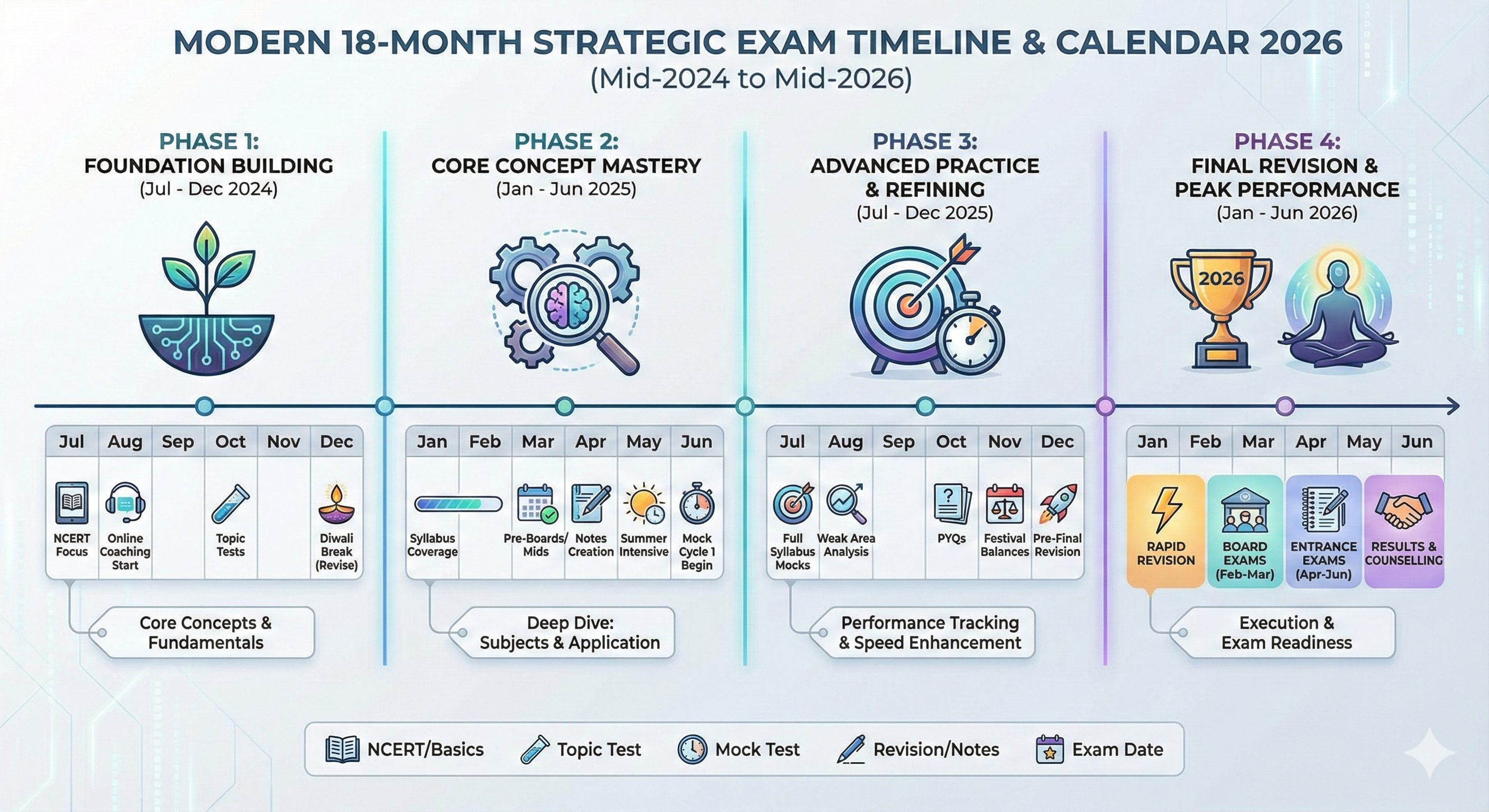
            • 18 month strategic timeline and calendar for exam preparation

              The Strategic 18-Month Preparation Plan (Starting Early for 2026)

              Since you are planning early, you can adopt a phased approach that balances board exams and competitive preparation perfectly.


              Phase I: The Foundation (Class 11 Review and Conceptual Clarity) (Approx. 6 Months)

              This phase is critical for students currently finishing Class 11 or entering Class 12. Focus on shoring up conceptual weaknesses from the Class 11 syllabus. Almost 40% of entrance questions come from this material, and rushing it later is disastrous.

              • Identify weak chapters in Physics (Mechanics) and Chemistry (Organic Basics, Equilibrium).
              • Solve objective questions immediately after finishing a topic to solidify understanding.

              • Phase II: The Core (Focusing on Class 12 Syllabus and Application) (Approx. 9 Months)

                As you cover Class 12 material for your board exams, simultaneously solve competitive-level questions for the same topic. Integration is the key.

                • Target the most high-weightage topics (e.g., Electrochemistry, P-Block Elements, Genetics/Biotechnology).
                • Start weekly subject tests to track retention and application speed.

                • Phase III: Mock Tests and Revision (Strategic practice, speed, and accuracy) (Approx. 3 Months)

                  The final months must be devoted almost entirely to practice.

                  • Take Full-Length Mock Tests specific to your target exams (e.g., MHT-CET format, NEET format).
                  • Analyze every mock test meticulously—identify why you lost marks (silly errors, lack of knowledge, time pressure).
                  • Create crisp revision notes focusing purely on formulas, reaction mechanisms, and exception cases.

                  • Time Management Techniques for Science Students

                    Balancing board exams and entrance prep is challenging, but manageable:

                    1. Allocate 70% of study time to common topics (NCERT).
                    2. Allocate 30% of study time to application-based problems and speed drills specific to the entrance exam format.
                    3. Use weekends strictly for mock tests and backlog clearing.

                    4. Must-Have Resources and Study Tools


                      Essential Textbooks and Reference Materials

                      • The Non-Negotiables: NCERT Textbooks (Class 11 & 12) for Physics, Chemistry, and Biology/Maths. Read them cover-to-cover.
                      • Chemistry: O.P. Tandon (Physical/Inorganic) or Himanshu Pandey (Organic) for advanced practice.
                      • Physics: H.C. Verma (Concepts of Physics) for problem-solving techniques.
                      • Practice Sets: Buy previous years' question papers (PYQs) specific to your target state CETs.

                      • Leveraging Online Platforms and Mock Test Series

                        Online resources offer personalized learning that coaching centers sometimes miss. Use platforms for:

                        • Targeted practice quizzes on weak chapters.
                        • Video lectures for complex topics (especially Organic Chemistry and Wave Physics).
                        • Simulated online mock tests to build speed for CBT format exams.

                        • Importance of Coaching vs. Self-Study

                          There is no one-size-fits-all answer, but here are the pros and cons:

                          MethodProsCons
                          CoachingStructured syllabus, timely coverage, competitive environment, doubt resolution.Time-consuming commute, often expensive, less flexibility.
                          Self-StudyMaximum flexibility, highly cost-effective, deep personalized learning.Requires immense discipline, difficulty in resolving complex doubts, slower pace sometimes.

                          Key Dates and What to Expect in 2026 (Projections)

                          While definitive dates are still far off, entrance exams generally follow a predictable cycle. Use these projections to schedule your preparation phases.


                          Tentative Application Windows for Major Exams

                          • National Exams (NEET/GPAT): Applications typically open between December 2025 and January 2026.
                          • State CETs (MHT-CET, KCET): Applications often open between January and February 2026.
                          • Exam Months: Most B. Pharma entrances (State CETs) are held between March and May 2026, often immediately following the 12th Board examinations.

                          • Checklist: Documents Required for Application and Counseling

                            Prepare these crucial documents well in advance to avoid last-minute stress:

                            • 10th and 12th Mark Sheets and Certificates (or passing proof).
                            • Passport-size photographs and Signature scans (digital format).
                            • Valid Photo ID proof (Aadhar Card, Passport).
                            • Caste/Category Certificate (if applicable, must be current and valid).
                            • Domicile Certificate (essential for state-level quotas).

                            • 🔑 Key Takeaways for B. Pharma 2026 Aspirants

                              • Start Early: Conceptual clarity from Class 11 is your biggest competitive advantage.
                              • Syllabus Strategy: Master NCERTs first. Use advanced books only for practice/application.
                              • Negative Marking: Know the rules of each exam. Accuracy matters more than attempts in high-stakes tests.
                              • Target Multiple Exams: Don't rely on just one CET. Keep options open by preparing for state and national formats simultaneously.

                              • Successful student celebrating pharmacy exam result

                                The journey to B. Pharma 2026 is long, but it is incredibly rewarding. By adopting this strategic, phase-wise roadmap starting now, you position yourself ahead of the competition and ensure a successful entry into India's booming pharmaceutical sector. Good luck with your preparation!

                                Comments

                                Leave a Comment

                                No comments yet. Be the first to comment!

                                CallWhatsApp